A unilateral NDA is a one-sided confidentiality agreement that binds only the receiving party, while a mutual NDA creates symmetrical obligations for both parties. The difference between these two NDA types is not just technical. It directly shapes negotiation speed, legal risk, and how much administrative burden your business takes on. Choosing the wrong structure for your situation can expose you to liability you never intended to accept. This guide breaks down when each type applies, how they compare in real negotiations, and how to make the right call for your business.
What is a unilateral NDA and when should you use it?
A unilateral NDA creates a one-sided legal burden on the receiving party. The disclosing party shares confidential information, and only the recipient is bound by confidentiality obligations. The disclosing party has no corresponding duty to protect anything from the other side.
This structure fits a specific set of scenarios cleanly:
- Employee onboarding: A company shares proprietary processes, client lists, or trade secrets with a new hire. The employee receives the information and signs a unilateral NDA.
- Contractor engagements: A startup hires a developer or designer and shares product specs. The contractor does not share proprietary information back, so only they need to be bound.
- Investor pitches: A founder shares financial projections or product roadmaps with a potential investor. The investor receives sensitive data but discloses nothing confidential in return.
- Vendor evaluations: A business shares internal data with a vendor to get a quote or proposal. The vendor is the only party receiving protected information.
The legal advantage of a unilateral NDA is clean risk allocation. You know exactly who carries the confidentiality burden, and there is no ambiguity about which party's data is protected. That clarity makes enforcement simpler if a breach occurs.
Two clauses matter most in a well-drafted unilateral NDA. First, the definition of "Confidential Information" must be broad enough to cover everything you intend to protect. Second, the "Permitted Use" clause must limit how the recipient can use your information. Failing to restrict permitted use can expose the disclosing party to information misuse, including unintentional license grants or reverse engineering of proprietary technology.

Pro Tip: Draft the "Permitted Use" clause to name the specific purpose for which the recipient may use your information. "Evaluating a potential business relationship" is far safer than leaving the purpose undefined.
The main risk with unilateral NDAs is negotiation pushback. Counterparties sometimes resist signing a one-sided agreement, viewing it as unfair. That friction is manageable when you can clearly explain why only one party is disclosing sensitive information.
What is a mutual NDA and when is it appropriate?
A mutual NDA agreement applies when both parties exchange confidential information, creating symmetrical obligations on each side. Neither party can disclose the other's information without authorization, and both carry the same legal duties.
Mutual NDAs fit these situations well:
- Partnerships and joint ventures: Two companies explore a collaboration and each shares proprietary technology, customer data, or financial information.
- M&A due diligence: Both the buyer and seller share sensitive financial and operational data during the evaluation process.
- Vendor evaluations with two-way data flow: A SaaS company shares integration specs while the vendor shares proprietary API documentation.
- Co-development agreements: Two startups build a product together and each contributes protected intellectual property.
The practical benefit of a mutual NDA is speed. Mutual agreements minimize pushback in complex commercial discussions because both parties feel equally protected. When neither side feels disadvantaged by the agreement structure, negotiations move faster and sign-off happens sooner.
Mutual NDAs also reduce misunderstandings about data sharing. When both parties know they are equally bound, there is less ambiguity about what each side can and cannot do with the information they receive. That clarity prevents disputes before they start.
The downside is administrative overhead. Each party now has obligations to protect the other's information, which means internal compliance processes, data handling procedures, and potential liability if either side mishandles what they receive.
Pro Tip: Include a clause specifying that each party's confidential information is identified separately, either by labeling or by category. This prevents disputes about which information falls under the agreement's protection.
Mutual NDAs work best when the information exchange is genuinely two-way. Using one when only one party actually discloses sensitive information creates unnecessary legal complexity without any corresponding benefit.
Comparing unilateral vs mutual NDAs: key differences and negotiation impact
The core difference between these two NDA types comes down to who carries the legal obligation. Every other difference flows from that single fact.
| Attribute | Unilateral NDA | Mutual NDA |
|---|---|---|
| Who is bound | Receiving party only | Both parties equally |
| Typical use cases | Employee onboarding, contractor agreements, investor pitches | Partnerships, M&A due diligence, joint ventures |
| Negotiation friction | Higher, due to one-sided obligations | Lower, due to perceived fairness |
| Speed to sign | Slower when counterparty pushes back | Faster in most commercial contexts |
| Administrative burden | Lower for the disclosing party | Higher for both parties |
| Risk of accidental liability | Minimal for the disclosing party | Present for both parties |
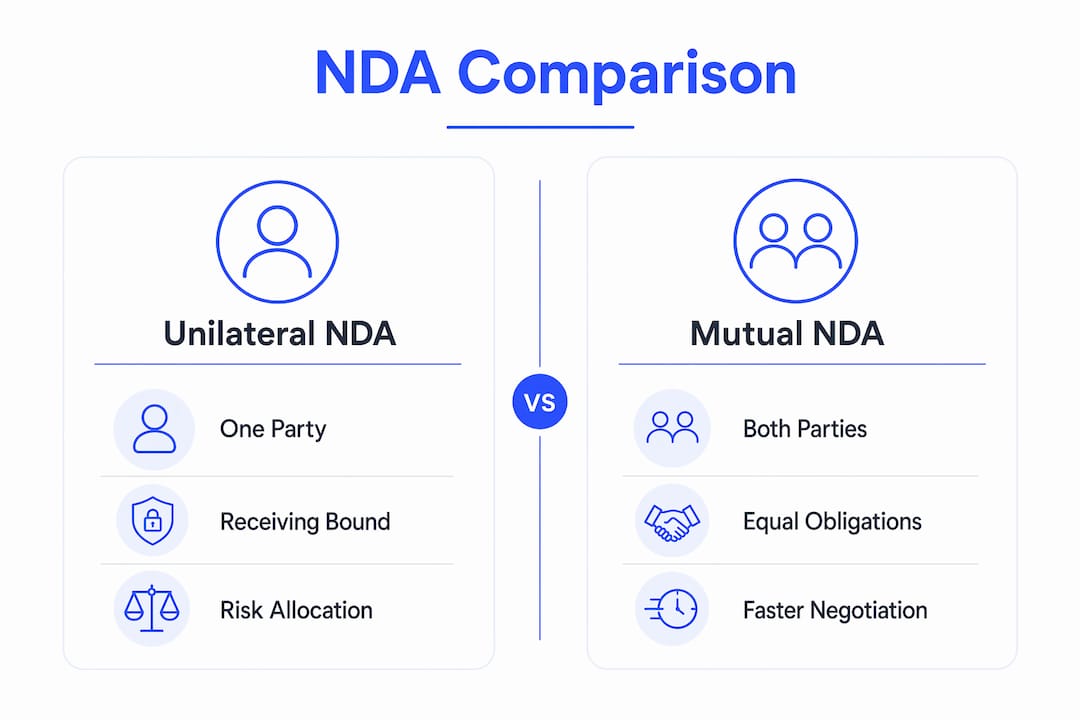
Mutual NDAs close faster in most commercial negotiations. The perceived fairness of equal obligations reduces the back-and-forth that often delays unilateral agreements. That speed advantage is real, but it comes with a cost.
Using mutual NDAs prematurely increases a company's legal risk profile unnecessarily. If you sign a mutual NDA but only you are sharing sensitive information, you have just accepted an obligation to protect the other party's data even though they have nothing confidential to share. That is a liability you created for yourself without any business reason.
A common misconception is that mutual NDAs are inherently fairer. Fairness in an NDA comes from matching the agreement structure to the actual information exchange. In imbalanced information scenarios, a mutual NDA can mask liability imbalances rather than resolve them. The party sharing nothing confidential gains protection they did not earn, while the disclosing party takes on obligations that serve no purpose.
Choosing the wrong NDA type also creates enforcement problems. If a breach occurs and the agreement structure does not match the actual information flow, courts may scrutinize the agreement's intent more closely. Clear alignment between the NDA type and the real-world situation strengthens enforceability.
Pro Tip: Before selecting an NDA type, map the actual flow of confidential information. Draw an arrow from the disclosing party to the receiving party. If the arrow points in one direction, use a unilateral NDA. If it points both ways, use a mutual NDA.
How to decide which NDA to use for your business negotiations
The decision between a one-way and a mutual NDA starts with one question: who is actually sharing confidential information? Answer that honestly, and the right structure becomes clear.
-
Map the information flow. Identify which party will disclose sensitive information during the engagement. If only one party discloses, a unilateral NDA is the correct instrument. If both parties will share proprietary data, a mutual NDA is appropriate.
-
Assess the stage of the relationship. Early-stage evaluations typically involve one party sharing information to assess fit. Start with unilateral NDAs for initial business evaluation stages and only switch to mutual NDAs when joint development or two-way exchange is established.
-
Consider what the other party actually discloses. Startups should resist mutual NDA demands from contractors who share no proprietary information and instead use unilateral NDAs combined with IP assignment agreements. Accepting a mutual NDA in that context creates obligations with no corresponding benefit.
-
Evaluate your risk tolerance. Startups that misuse mutual NDAs risk accidental liability and exposure when they agree to protect the other party's data without a genuine reciprocal information exchange. Understand what you are committing to before you sign.
-
Plan for relationship evolution. A staged approach starting with unilateral NDAs and upgrading to mutual NDAs as partnerships develop balances protection with efficiency. Build that upgrade path into your contract strategy from the start.
-
Tailor the clauses to your actual risk profile. A generic mutual NDA template may include obligations that do not match your situation. Work with legal counsel to customize the confidentiality definitions, permitted use limitations, and term length to reflect what you are actually sharing and why.
When a counterparty demands a mutual NDA and you believe a unilateral agreement is more appropriate, explain the information flow clearly. Most sophisticated counterparties will accept the right instrument when the reasoning is sound. If they insist on a mutual NDA despite a one-way information flow, that is a negotiation signal worth noting.
Key takeaways
The right NDA type is determined by the direction of confidential information flow, not by convention or negotiation convenience.
| Point | Details |
|---|---|
| Unilateral NDA meaning | Only the receiving party is bound; use this when one party discloses and the other does not. |
| Mutual NDA agreement | Both parties carry equal obligations; use this only when both sides share confidential information. |
| Negotiation speed | Mutual NDAs close faster due to perceived fairness, but that speed comes with added liability for both parties. |
| Startup risk | Accepting a mutual NDA without a genuine two-way information exchange creates accidental liability. |
| Staged approach | Start with a unilateral NDA for early evaluations and upgrade to a mutual NDA when the relationship becomes genuinely bilateral. |
What I've learned from watching teams pick the wrong NDA
After working through hundreds of contract negotiations, I have seen the same pattern repeat. A founder or business development lead defaults to a mutual NDA because it "feels fairer" or because they do not want to create friction with a potential partner. The mutual NDA gets signed quickly, everyone moves on, and nobody thinks about what was just agreed to.
The problem surfaces later. The startup is now contractually obligated to protect the contractor's "confidential information," even though the contractor shared nothing proprietary. If the contractor later claims a breach, the startup is exposed. That liability was entirely avoidable.
My recommendation is to match the instrument to the flow. It is a simple rule, and it works. If you are the only party sharing sensitive information, a unilateral NDA protects you cleanly without creating obligations you do not need. If the relationship evolves into a genuine two-way exchange, upgrade the agreement. You can find patterns from real contract negotiations that show how this staged approach plays out in practice.
The other mistake I see is treating NDA type as a negotiation concession. Agreeing to a mutual NDA to avoid pushback is not a compromise. It is accepting legal risk in exchange for a faster conversation. That trade is almost never worth it.
— Alex
How Formable supports your NDA workflow
Drafting the right NDA is only half the work. Getting it signed, tracked, and stored without friction is where most teams lose time.
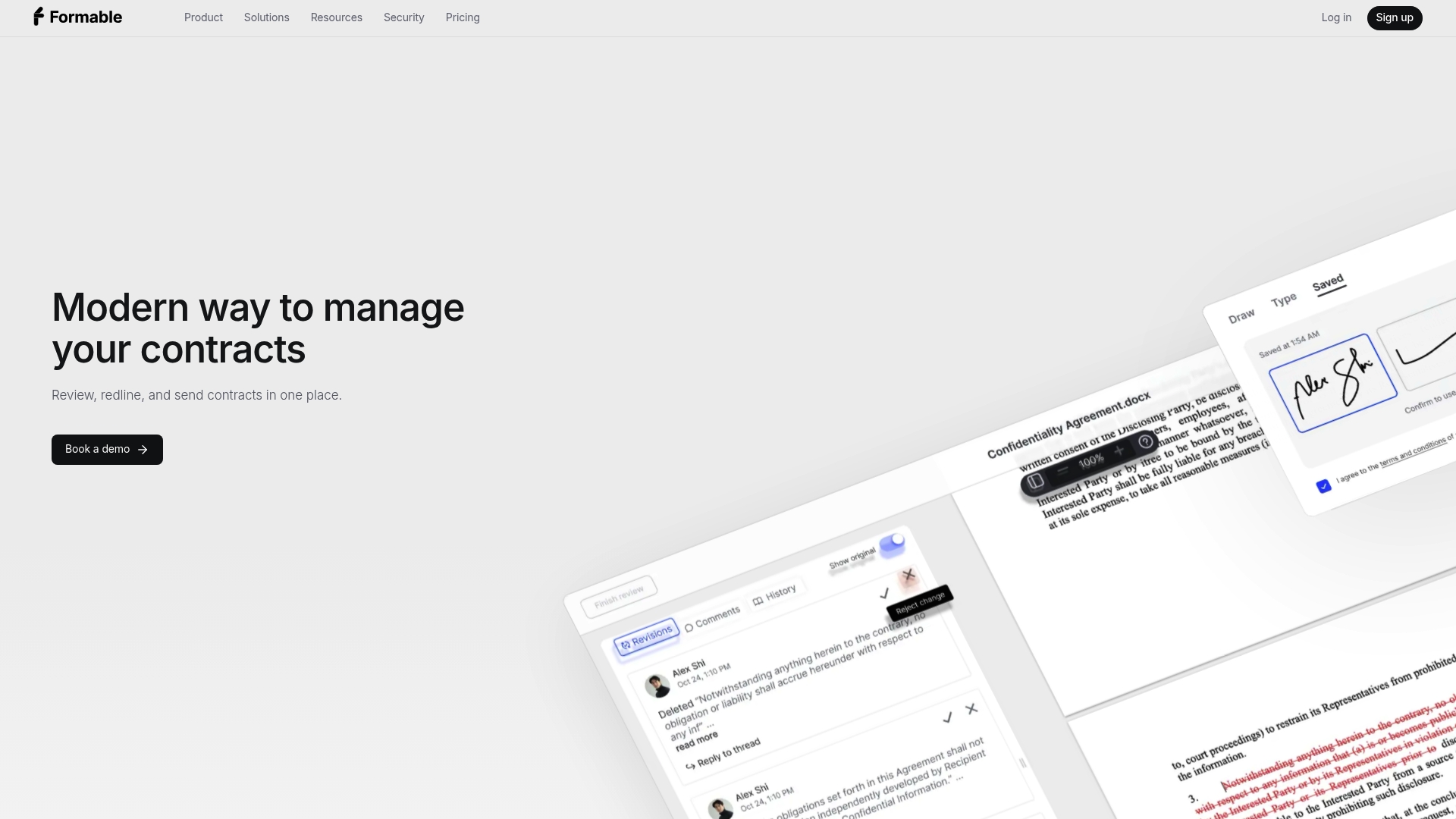
Formable is a contract management platform built for startups and GTM teams that need to move fast without cutting corners. It supports both unilateral and mutual NDA templates, with AI-assisted drafting, redlining, and negotiation tools built in. Every agreement gets a full audit trail, so you have a timestamped record of every change and signature. If you are evaluating your current signing workflow, the contract management options page shows how Formable compares across key features. Reach out and the team will walk through your specific NDA use case.
FAQ
What is the main difference between a unilateral and mutual NDA?
A unilateral NDA binds only the receiving party with confidentiality obligations, while a mutual NDA binds both parties equally. The right choice depends on which party is actually disclosing confidential information.
When should a startup use a unilateral NDA?
Startups should use a unilateral NDA when sharing sensitive information with contractors, employees, or investors who do not disclose proprietary information in return. Accepting a mutual NDA in that context creates unnecessary legal obligations.
Are mutual NDAs always faster to negotiate?
Mutual NDAs typically face less pushback because both parties feel equally protected, which speeds up sign-off. However, that speed advantage disappears if the agreement structure does not match the actual information flow and the counterparty raises questions about scope.
Can you switch from a unilateral NDA to a mutual NDA later?
Yes. A staged approach is common in practice. Parties often start with a unilateral NDA during early evaluations and replace it with a mutual NDA once the relationship involves genuine two-way information sharing.
What happens if you sign the wrong type of NDA?
Signing a mutual NDA when only one party discloses information creates accidental liability for the disclosing party. They become obligated to protect the other party's data even when no sensitive data was shared, which can expose them to breach claims they never anticipated.