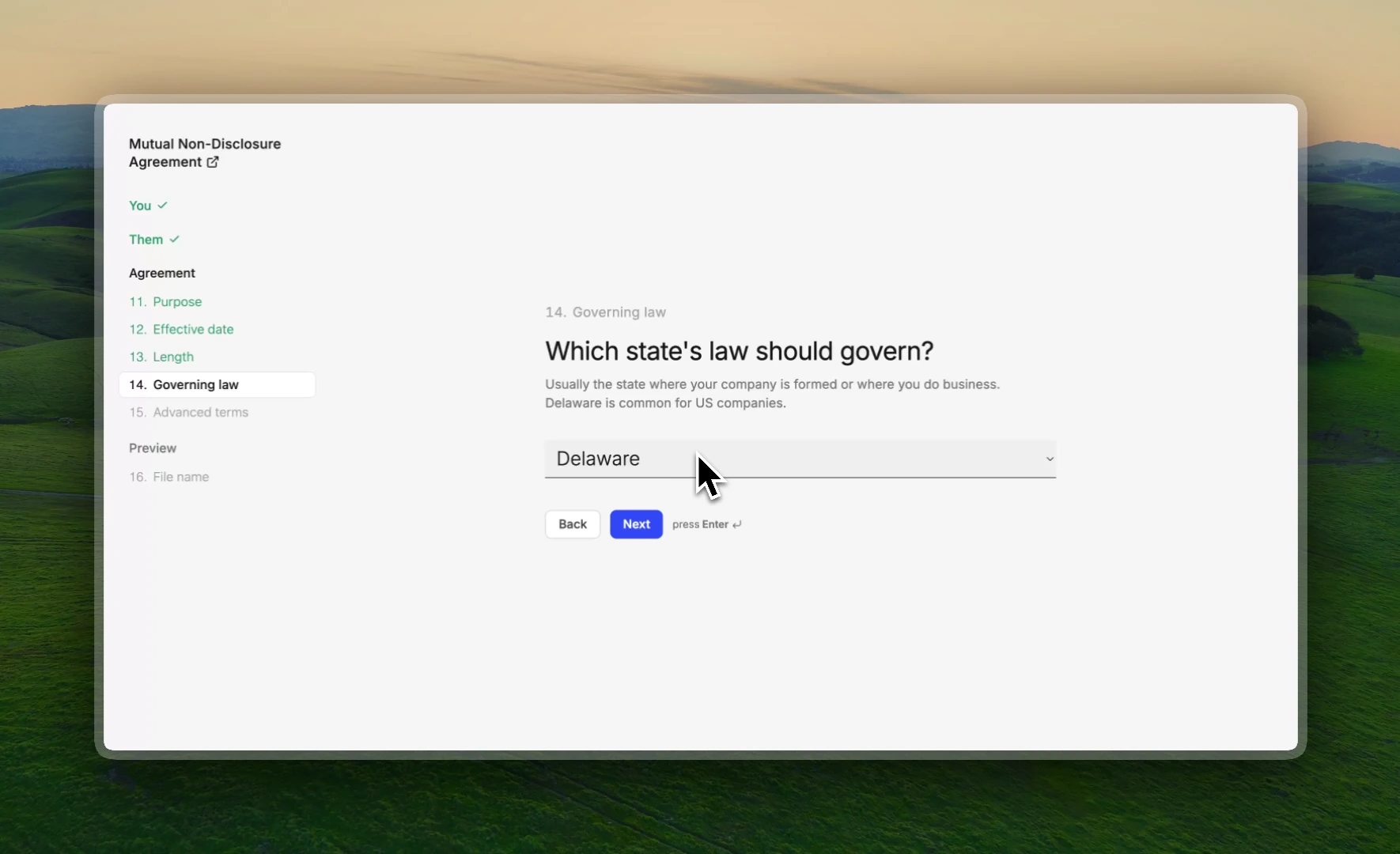
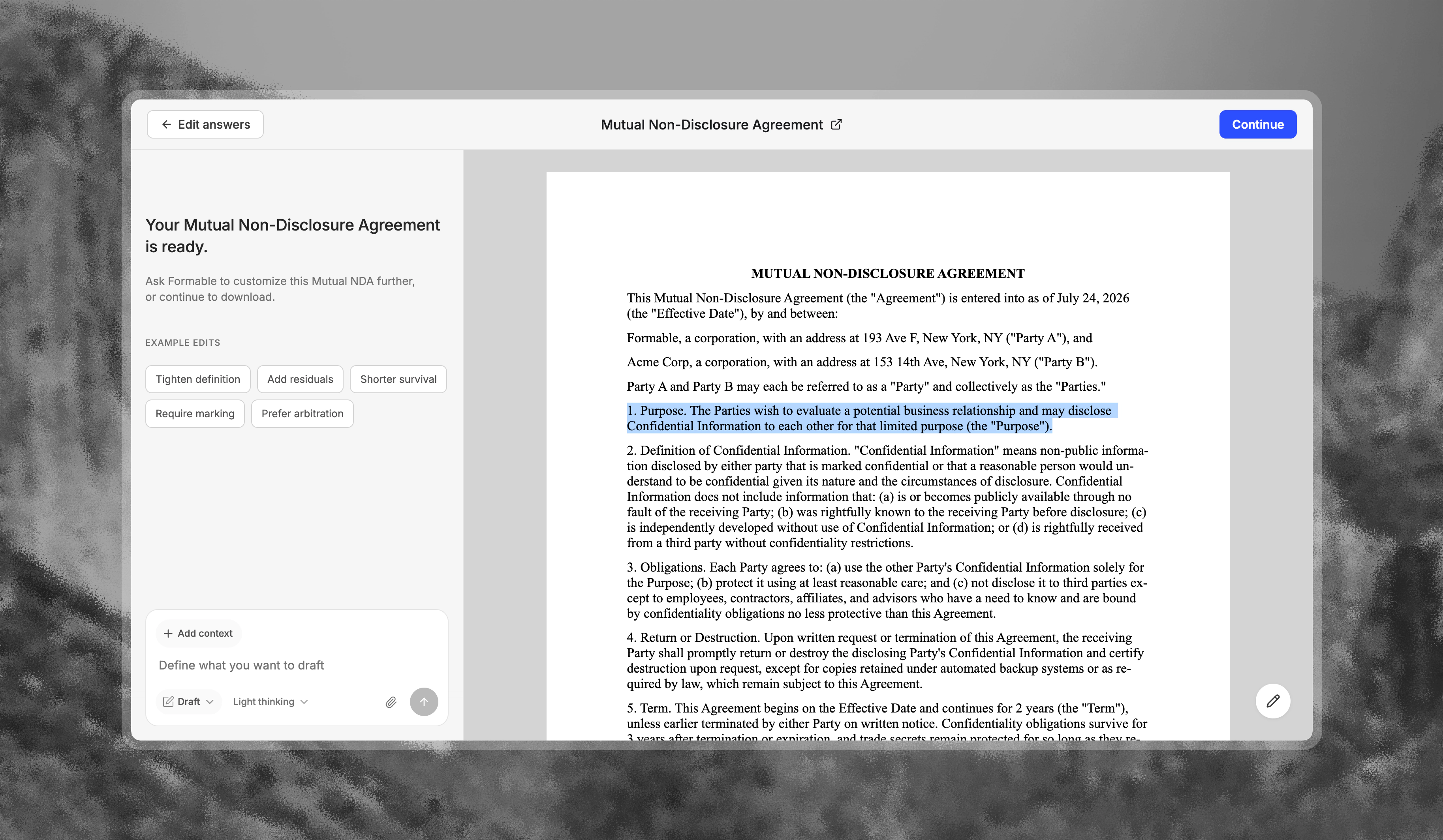
Mutual Non-Disclosure Agreement
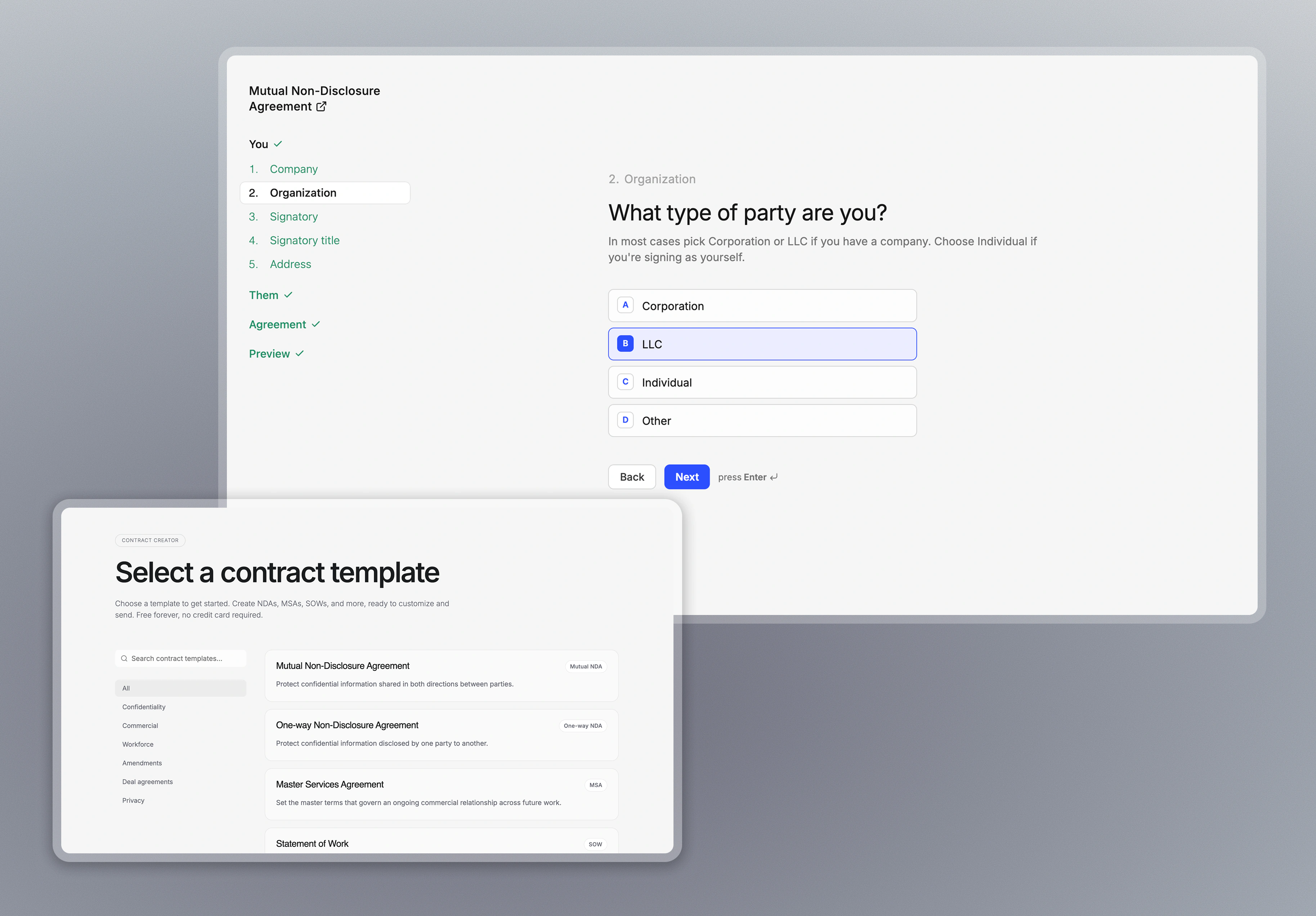
Mutual NDAProtect confidential information shared in both directions between parties.
Contract creator
Choose a contract template to get started. Create NDAs, MSAs, SOWs, and more, ready to customize and send. Free for everyone, and it always will be.
Browse Formable's contract creator by agreement type. Each template is built to customize, review, and send.
Mutual Non-Disclosure Agreement (Mutual NDA): A bilateral confidentiality agreement (also called a mutual or two-way NDA) where each party is both discloser and recipient. Use it before partnership talks, diligence, joint ventures, or vendor evaluations to protect trade secrets, pricing, product roadmaps, and other proprietary information exchanged both ways.
Sources: Cornell LII: Non-disclosure agreement (NDA); Cornell LII: Trade secret
One-way Non-Disclosure Agreement (One-way NDA): A unilateral confidentiality agreement where only one party discloses sensitive information and the receiving party must keep it secret and use it only for an agreed purpose. Common for investor pitches, contractor onboarding, supplier RFPs, and employee or consultant access to confidential business information and trade secrets.
Sources: Cornell LII: Non-disclosure agreement (NDA); Cornell LII: Trade secret
Master Services Agreement (MSA): A master services agreement establishes the overarching legal framework for an ongoing customer and service-provider relationship: liability, intellectual property, confidentiality, payment mechanics, warranties, indemnity, termination, and dispute resolution. Future projects then attach as statements of work or order forms without renegotiating the full boilerplate each time.
Statement of Work (SOW): A statement of work is the project-specific companion to an MSA. It defines scope of work, deliverables, acceptance criteria, milestones, timeline, fees, and responsibilities for a single engagement so commercial details stay clear while the MSA holds the standing legal terms.
Services Agreement (SA): A services agreement (professional services contract) sets the commercial and legal terms for delivering consulting, creative, technical, or other business services in a single engagement: scope, fees, timelines, IP ownership, confidentiality, warranties, and termination when a full MSA and SOW stack is not needed.
Order Form (OF): An order form (sometimes called a work order or ordering document) sits under an MSA to lock SKUs, quantities, pricing, subscription terms, start dates, and commercial options for a purchase. It speeds SaaS and services sales by keeping product and price details out of the master legal terms.
Sources: Nolo: Master service agreements and related work orders
Pilot Agreement (Pilot): A pilot agreement (proof-of-concept or evaluation agreement) covers a time-boxed trial of a product or service before a full MSA or subscription. Typical terms include pilot scope, success criteria, limited licenses, data use, confidentiality, fees or fee waivers, and conversion to a production contract.
Sources: Nolo: Framework contracting for multi-phase engagements
Data Processing Agreement (DPA): A data processing agreement (processor contract) sets controller and processor roles for personal data: subject matter, duration, nature and purpose of processing, data types, data-subject categories, security measures, sub-processor rules, audit rights, and return or deletion at end of processing. Under GDPR Article 28, processing by a processor must be governed by a binding written contract with these elements.
Sources: GDPR.eu: What is a data processing agreement?; ICO: Contracts between controllers and processors; EUR-Lex: Commission SCCs for controllers and processors
Artificial Intelligence Addendum (AI Addendum): An AI addendum allocates rights and risks for artificial intelligence and machine-learning features: permitted model use, customer data for training or fine-tuning, ownership of prompts and outputs, confidentiality, human oversight, transparency to users, and security. Useful when products involve generative AI or high-risk AI systems covered by frameworks such as the EU AI Act and NIST AI RMF.
Sources: EU AI Act: Article 13 (transparency to deployers); NIST: AI Risk Management Framework
Letter of Intent (LOI): A letter of intent captures preliminary deal terms before a definitive purchase, investment, or commercial agreement. Core commercial terms are often non-binding, while confidentiality, exclusivity, and expense allocation are frequently binding so parties can diligence and negotiate without prematurely locking the full deal.
Sources: Baker McKenzie: Preliminary documents (letters of intent)
Term Sheet (TS): A term sheet summarizes headline economics and legal points (valuation, price, governance, closing conditions, and key covenants) that will guide a definitive agreement. Like an LOI, it is usually mostly non-binding except for selected negotiation protections such as confidentiality and exclusivity.
Sources: Baker McKenzie: Preliminary documents (term sheets and LOIs)
Independent Contractor Agreement (ICA): An independent contractor agreement documents a freelance or vendor engagement: scope of services, payment, expenses, intellectual property assignment, confidentiality, and termination. Clear written terms help show behavioral and financial independence for worker classification questions under IRS common-law guidance.
Sources: IRS: Independent contractor or employee?; IRS: About Form SS-8 (worker status determination)
Contract Amendment (Amendment): A contract amendment (modification) updates an existing signed agreement: fee changes, renewals, scope expansions, party changes, or corrected terms. Written amendments keep the original contract intact while documenting what changed, when it takes effect, and which provisions remain in force.
Sources: Cornell LII: Contract modification; Cornell LII: Amend