
A letter of intent (LOI) is a formal document that outlines the preliminary understanding between two parties before a binding agreement is signed. It defines the key deal terms, sets negotiation boundaries, and signals serious intent without locking either side into a final contract. Understanding what is an LOI and how it functions is critical for any founder or executive entering a merger, acquisition, partnership, or major commercial deal. The LOI sits between a handshake and a signed contract, and misreading its legal weight can cost you time, money, and trust.
What is a letter of intent and what does it include?
A letter of intent is a preliminary document that outlines the proposed terms of a deal before a formal contract is drafted. It is not an offer, and it is not a purchase agreement. Its purpose is to record mutual understanding and guide the next phase of negotiations. Most LOIs run 2–3 pages, which keeps deal momentum alive while giving both parties a shared reference point.

The LOI acronym covers a document that typically contains two types of content: deal terms and process terms. Deal terms describe the substance of the transaction. Process terms govern how the negotiation itself will run.
Common deal terms in an LOI include:
- Purchase price or valuation range
- Assets and liabilities included in the transaction
- Payment structure (cash, stock, earnout, or a mix)
- Representations and warranties expected from each party
- Conditions that must be met before closing
Common process terms in an LOI include:
- Confidentiality obligations for information shared during due diligence
- Exclusivity (also called a no-shop clause), preventing the seller from talking to other buyers
- A timeline for completing due diligence
- A termination date, also called a sunset clause
- Dispute resolution procedures
The distinction between these two categories matters enormously, and the next section explains why.
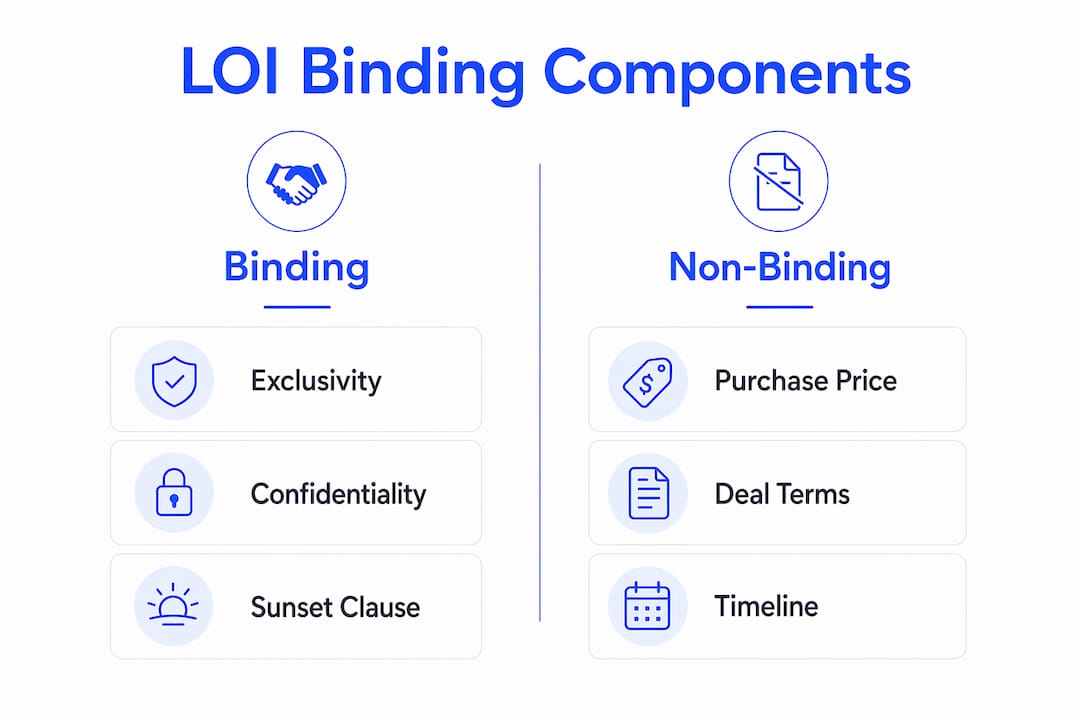
| LOI Component | Binding? | Purpose |
|---|---|---|
| Purchase price | Typically no | Establishes a starting valuation |
| Exclusivity clause | Yes | Prevents seller from soliciting other offers |
| Confidentiality clause | Yes | Protects sensitive information shared in due diligence |
| Asset list | Typically no | Defines scope of the transaction |
| Sunset clause | Yes | Sets a deadline for process obligations |
Is an LOI legally binding, and which parts are?
The LOI has what legal experts call a split personality. Deal terms are typically non-binding. Process terms are typically binding the moment both parties sign.
This distinction is not automatic. It depends entirely on the language used in the document. Courts analyze LOIs to determine which provisions the parties intended to enforce. Careless language can make the entire LOI binding accidentally, trapping both sides in obligations they never intended to accept.
The following process provisions are almost always enforceable:
- Confidentiality: Both parties agree not to disclose information shared during negotiations.
- Exclusivity (no-shop): The seller agrees not to solicit or entertain competing offers for a defined period.
- No-solicitation: Neither party will recruit the other's employees during the deal process.
- Governing law: The jurisdiction that will interpret any disputes.
Violating an exclusivity provision can result in damages, even if the deal never closes. That is a real legal risk, not a theoretical one.
The concept of "hard" versus "soft" LOIs matters here. A soft LOI uses clear non-binding language for deal terms and reserves binding force only for process clauses. A hard LOI includes fixed deal terms with specific language that courts may treat as a binding contract. Executives who use hard LOIs without understanding this risk can find themselves in litigation over a document they thought was just a formality.
Pro Tip: Always include an explicit disclaimer in the LOI stating which sections are non-binding. A sentence like "Except for Sections 4, 5, and 6, this letter of intent does not constitute a binding agreement" removes ambiguity and protects both parties.
A sunset clause is equally critical. Without a termination date, binding obligations like exclusivity may remain active long after negotiations collapse. That creates legal exposure with no upside for either side.
Why and when do businesses use an LOI?
An LOI signals that a buyer is serious. In competitive deal processes, where multiple buyers are circling the same target, accepting an LOI triggers the due diligence phase and gives one buyer exclusive access to private financial information. That is a significant advantage, and sellers grant it only when they believe the buyer is credible and committed.
The LOI serves four practical functions in a deal:
- Establishes negotiation boundaries. Both parties agree on the general shape of the deal before spending money on lawyers, accountants, and advisors. This prevents wasted effort on deals that were never going to close.
- Protects sensitive information. The confidentiality clause in the LOI governs what happens to financial records, customer lists, and proprietary data shared during due diligence. Without it, that information has no formal protection.
- Manages expectations. The LOI specifies which terms are fixed and which remain open for negotiation. Both parties enter due diligence knowing what is settled and what is not.
- Reduces upfront legal costs. Drafting a full purchase agreement before the parties agree on fundamentals is expensive. The LOI promotes clarity and trust while letting both sides avoid that cost until terms are aligned.
The LOI is most common in mergers and acquisitions, real estate transactions, joint ventures, and large commercial partnerships. In the startup world, it also appears in term sheets for investment rounds, though term sheets follow a slightly different convention. The underlying logic is the same: record intent, protect the process, and move toward a binding agreement efficiently.
Best practices for drafting an effective LOI
A well-drafted LOI protects your interests without slowing the deal down. The goal is clarity, not comprehensiveness. Experienced practitioners keep LOIs under 3 pages and focus on strategic fit rather than detailed legal provisions. Lengthy LOIs signal either inexperience or an attempt to lock in terms prematurely.
Follow these practices when drafting:
- Keep it concise. Two to three pages is the professional standard. A longer document suggests the parties are trying to negotiate the final contract before due diligence is complete.
- Label binding and non-binding sections explicitly. Do not rely on implication. Name the specific sections that carry legal force.
- Include a sunset clause. Set a clear termination date for all process obligations, especially exclusivity. Thirty to sixty days is typical for most transactions.
- Define the due diligence scope. Specify what information will be shared, in what format, and within what timeframe. This prevents disputes about access and delays.
- Avoid locking in price too firmly. A price range is acceptable. A fixed price in a non-binding LOI can still create anchoring effects that make later negotiation difficult.
Pro Tip: Have your attorney review the LOI before you sign, even if it looks straightforward. The binding process clauses carry real legal weight, and a 30-minute review is far cheaper than litigating a violated exclusivity agreement.
The LOI template you use matters. Generic templates pulled from the internet often omit sunset clauses or use ambiguous language around binding intent. A template built for your deal type and jurisdiction is worth the extra effort.
Key takeaways
An LOI is a non-binding framework for deal terms that simultaneously enforces binding process obligations like confidentiality and exclusivity from the moment of signing.
| Point | Details |
|---|---|
| LOI meaning in business | A preliminary document outlining deal terms and process obligations before a formal contract is signed. |
| Binding vs. non-binding | Deal terms are typically non-binding; process terms like confidentiality and exclusivity are legally enforceable. |
| Sunset clause is required | Always include a termination date to prevent process obligations from lingering after negotiations end. |
| Keep it under 3 pages | Concise LOIs signal professionalism and maintain deal momentum without premature legal complexity. |
| Hard LOIs carry real risk | Overly detailed LOIs with fixed terms can be treated as binding contracts by courts, creating unintended obligations. |
The part most executives get wrong about LOIs
I have reviewed a lot of LOIs over the years, and the most common mistake is not a drafting error. It is a mindset error. Executives treat the LOI as a formality, something to sign quickly so the real work can begin. That attitude is how you end up in a dispute over a document you thought had no teeth.
The process clauses in an LOI are real contracts. Exclusivity means the seller cannot talk to other buyers. Confidentiality means the financial data you receive cannot leave the room. These obligations exist from the moment both parties sign, regardless of whether the deal closes. I have seen founders violate exclusivity clauses without realizing it, simply by continuing conversations with a backup buyer "just in case." That is a breach, and it is expensive.
The other mistake is using the LOI to negotiate too aggressively. The LOI is a signal of intent, not a place to win every point. Shifting terms after the LOI is signed damages trust in a way that is very hard to recover from. Sellers talk to each other, especially in tight-knit industries. A reputation for LOI games follows you into the next deal.
Treat the LOI as a commitment to a process, not a commitment to a price. Get the process terms right, keep the deal terms directional, and use the due diligence period to validate the numbers before the final contract locks everything in.
— Alex
How Formable supports LOI and contract workflows
Managing an LOI involves more than drafting a document. You need to track versions, collect signatures, and move into due diligence without losing momentum.
Formable is an AI-enabled document workflow platform built for exactly this kind of work. It supports LOI drafting, redlining, negotiation, and e-signing in a single environment, so your deal team is not bouncing between email threads and disconnected tools. Formable's contract signing tools handle the full signature workflow, from sending to audit trail, with the compliance and security that executives and legal teams require. If you are managing LOIs alongside MSAs, SOWs, and order forms, Formable keeps every agreement in one place and moves each one forward faster. Reach out and the team will walk through your specific use case.
FAQ
What does LOI stand for?
LOI stands for letter of intent. It is a preliminary document used in business transactions to outline proposed deal terms and process obligations before a formal contract is signed.
Is an LOI legally binding?
An LOI is typically non-binding for deal terms but legally binding for process provisions like confidentiality and exclusivity. The specific language in the document determines which sections carry legal force.
What is the difference between an LOI and a purchase agreement?
An LOI is a preliminary intent statement, not a final contract. A purchase agreement is the binding document that closes the transaction. The LOI precedes and informs the purchase agreement but does not replace it.
How long should an LOI be?
An LOI should be 2–3 pages. Longer documents risk introducing premature legal complexity and can slow deal momentum before due diligence has even begun.
What happens if you violate an LOI exclusivity clause?
Violating an exclusivity clause can result in financial damages even if the deal never closes. Exclusivity provisions are binding from the moment of signing, and courts treat them as enforceable contracts.