Challenges in contract management are the obstacles that disrupt the efficiency, compliance, and visibility of contractual processes within organizations. The average organization loses approximately 9% of its annual contract value due to poor contract management practices. That figure represents real revenue walking out the door through missed renewals, untracked obligations, and compliance failures. For founders, executives, and legal teams, understanding these obstacles is the first step toward addressing them with precision.
What are the most common operational challenges in contract management?
Contract management issues most often start with a visibility problem. Contracts live in email threads, shared drives, and individual inboxes, with no single source of truth. When a team member needs to locate a specific clause or renewal date, they spend hours searching instead of working.
The most frequent operational obstacles include:
- Scattered contract storage. Contracts stored across multiple systems create data silos. Teams lose track of obligations, and no one has a complete picture of active agreements.
- Manual approval workflows. Review chains that run through email are slow and error prone. A single missed reply can delay a deal by days.
- Inconsistent templates. Without standard language, every contract becomes a negotiation from scratch. This increases legal review time and introduces unnecessary risk.
- Volume outpacing systems. Contract volumes often outpace traditional tools, causing version confusion, duplicate agreements, and workflow breakdowns. Growth exposes every gap in a manual process.
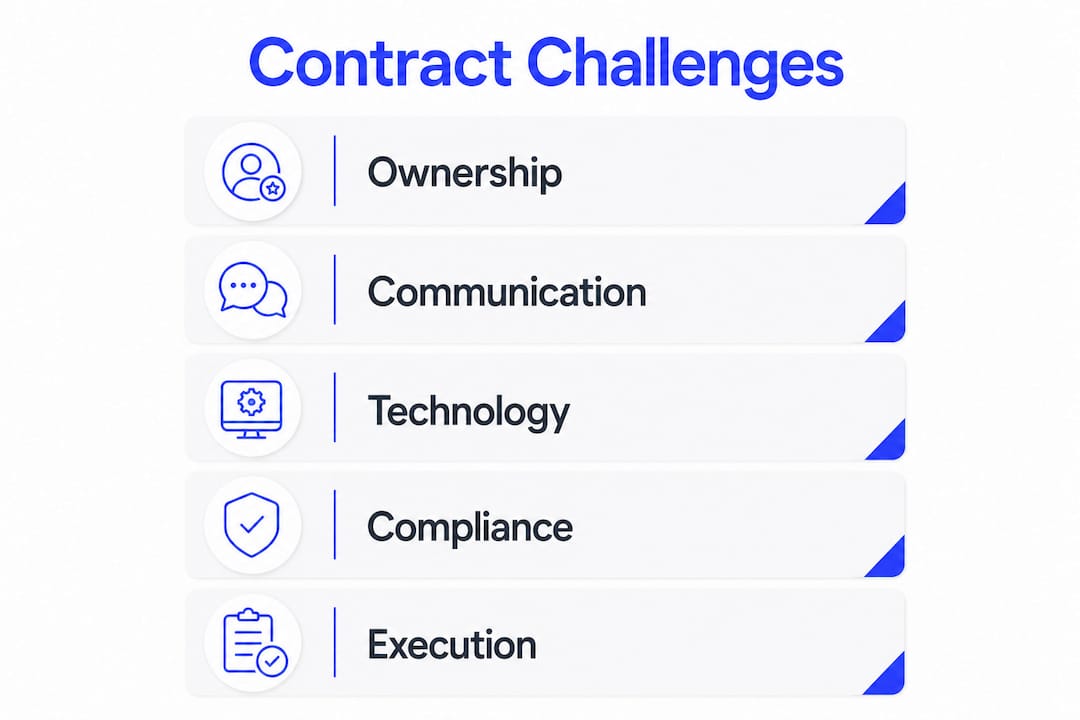
- Unclear contract ownership. When no one is formally responsible for a contract, deadlines slip and obligations go unmet.
These problems compound each other. A team using email for approvals and spreadsheets for tracking will eventually face a missed renewal or a compliance gap that costs far more than the investment in a proper system.
Pro Tip: Assign a named owner to every active contract. Even a simple ownership field in a shared spreadsheet reduces missed deadlines significantly before you invest in a full contract lifecycle management (CLM) platform.
How do technology and integration challenges affect contract management?
Technology is the most common proposed solution to contract oversight problems, but it introduces its own set of obstacles. The 2025 Deloitte CLM study found that the primary concerns when selecting a CLM solution are cost and ROI at 25%, integration capabilities at 19%, and implementation complexity at 13%. These are not abstract worries. They reflect real failures that organizations have experienced.
The most damaging pitfalls in CLM deployment, as identified by Deloitte, follow a consistent pattern:
- Insufficient communication. Teams adopt a new platform without telling stakeholders why or how it changes their work. Adoption fails before it starts.
- Excessive customization. Organizations build so many custom workflows that the platform becomes brittle and expensive to maintain.
- Lack of internal expertise. Without someone who understands both the technology and the legal process, implementations drift from their original goals.
- Under-budgeting. Initial cost estimates rarely account for training, change management, or integration work.
- Neglected change management. The platform goes live, but people keep using email and spreadsheets because no one enforced the transition.
Integration with existing systems is a separate challenge. Connecting a CLM tool to an ERP, CRM, or procurement platform requires technical resources and clear data mapping. Without that work, the CLM becomes another silo rather than a solution.
Pro Tip: Before selecting any CLM platform, map every system it needs to connect with. A tool that cannot integrate with your CRM or ERP will create more manual work, not less.

What are the financial and compliance risks from poor contract management?
Poor contract oversight creates direct financial losses. Organizations lose close to 9% of contract value annually through inefficient processes. For a company with $10 million in annual contract value, that is $900,000 in preventable losses.
The financial and compliance risks break down into two distinct categories:
| Risk type | Example | Business impact |
|---|---|---|
| Revenue leakage | Untracked deliverables, pricing errors | Direct loss of billed revenue |
| Missed renewals | Auto-renewals at unfavorable terms | Locked into poor pricing or terms |
| Compliance failure | Missed regulatory deadlines | Fines, operational restrictions |
| Obligation gaps | Unmonitored SLAs or warranties | Penalty clauses triggered |
| Audit exposure | No immutable record of contract events | Legal liability in disputes |
Missed renewal deadlines deserve specific attention. When a contract auto-renews without review, the organization loses its negotiation window. The vendor retains pricing power, and the team is locked in for another term under terms that may no longer reflect market rates or business needs.
Compliance failures carry a different kind of cost. Regulatory bodies in industries like healthcare, finance, and government contracting impose fines and operational restrictions when organizations cannot demonstrate proper contract controls. The absence of a clear audit trail is itself a compliance risk.
The risks compound when workarounds replace proper processes. Workarounds to poor contract processes create a false sense of stability while compounding risk and missed renewals. Teams believe the situation is under control because nothing has broken yet. Then a missed deadline or a disputed clause surfaces, and the cost is far higher than any earlier investment in process improvement would have been.
What organizational obstacles hinder effective contract execution?
Contract execution slows down when internal coordination breaks down. Multi-department collaboration is one of the hardest obstacles in contract execution to solve, because it involves people, authority, and communication, not just tools.
The most common organizational obstacles include:
- Approval authority confusion. When it is unclear who can approve a contract above a certain value, deals stall at the executive level. Legal waits for finance. Finance waits for the business unit. The counterparty loses patience.
- Communication gaps between teams. Sales, legal, and procurement often operate with different priorities and timelines. A contract that sales considers closed may still be under legal review.
- Informal processes that mask risk. Informal contract management processes fail as volume and complexity increase, with silent risk compounding until costly errors occur. The team that managed 20 contracts a year with a shared folder cannot manage 200 contracts the same way.
- Manual handoffs between stages. Every time a contract moves from drafting to review to signature through manual steps, there is an opportunity for delay or error.
The organizational dimension is often underestimated. A company can deploy a world-class CLM platform and still see slow contract cycles if the approval matrix is undefined or if legal and sales have conflicting incentives. Technology does not resolve misaligned incentives. Process design and clear authority structures do.
What best practices help overcome contract management challenges?
The most effective approach to improving contract management combines process standardization, clear ownership, and technology that fits the organization's actual workflow. Success in contract management transformation depends on nuanced understanding of operational challenges and strong stakeholder alignment, not just technology selection.
The practices that produce consistent results are:
- Centralize contract storage. A centralized contract repository with workflow automation reduces errors from manual email approval chains. Every contract should have a single, searchable location with metadata: counterparty, value, renewal date, and owner.
- Define approval workflows explicitly. Document who approves what, at what value threshold, and within what timeframe. Post this publicly so every team knows the process.
- Standardize templates. Pre-approved templates for common agreement types, such as MSAs, SOWs, and NDAs, reduce negotiation time and legal review cycles.
- Align stakeholders before deployment. Adopting technology alone is insufficient. Internal change management and process standardization are critical to success. Run workshops with legal, sales, and finance before any platform goes live.
- Balance AI with human judgment. AI automation paired with human oversight produces the best outcomes for risk and negotiation management. Use AI to flag issues and surface data. Use experienced reviewers to make final calls.
- Track metrics and improve continuously. Measure cycle time, approval delays, and renewal miss rates. Use that data to identify where the process breaks down and fix it iteratively.
Pro Tip: Start with a contract audit before selecting any technology. Catalog your existing agreements, identify the five most common contract types, and build your templates around those. This gives any new platform a clean foundation to work from.
Key takeaways
Poor contract management costs organizations an average of 9% of annual contract value, and the root causes span process, technology, and organizational alignment.
| Point | Details |
|---|---|
| Financial loss is measurable | Organizations lose close to 9% of contract value annually through inefficient processes and missed renewals. |
| Technology alone is not enough | CLM success depends on stakeholder alignment and change management, not just platform selection. |
| Centralized storage reduces risk | A single contract repository with metadata and automated workflows prevents version confusion and missed deadlines. |
| Approval clarity speeds execution | Defined authority thresholds and documented workflows eliminate the bottlenecks that slow contract cycles. |
| AI works best alongside humans | Automated tools flag risk and surface data effectively, but expert human review remains necessary for final decisions. |
What I've learned from watching CLM projects succeed and fail
Most contract management failures I have observed share one trait: the organization treated the problem as a software problem. They selected a platform, ran a brief implementation, and expected the process to fix itself. It never does.
The Deloitte finding that resonates most with me is the one about neglected change management. Every organization I have seen struggle with contract oversight had people who knew the old process and saw no reason to change it. The platform sat underused while email chains and spreadsheets continued to run the actual work.
The teams that get this right do something different. They start with the process, not the tool. They map every contract type, every approval step, and every stakeholder before they open a vendor demo. They assign ownership, define escalation paths, and communicate the new workflow clearly before go-live. The technology becomes an accelerant for a process that already works, not a substitute for one that does not.
My honest advice: if your contract volume has grown faster than your process has, do not wait for a costly error to force the change. Audit your current agreements, identify your three biggest pain points, and fix those first. The contract workflow guide from Formable is a practical starting point for legal teams mapping this out. Build the foundation before you build the automation.
— Alex
How Formable addresses the contract management obstacles teams face
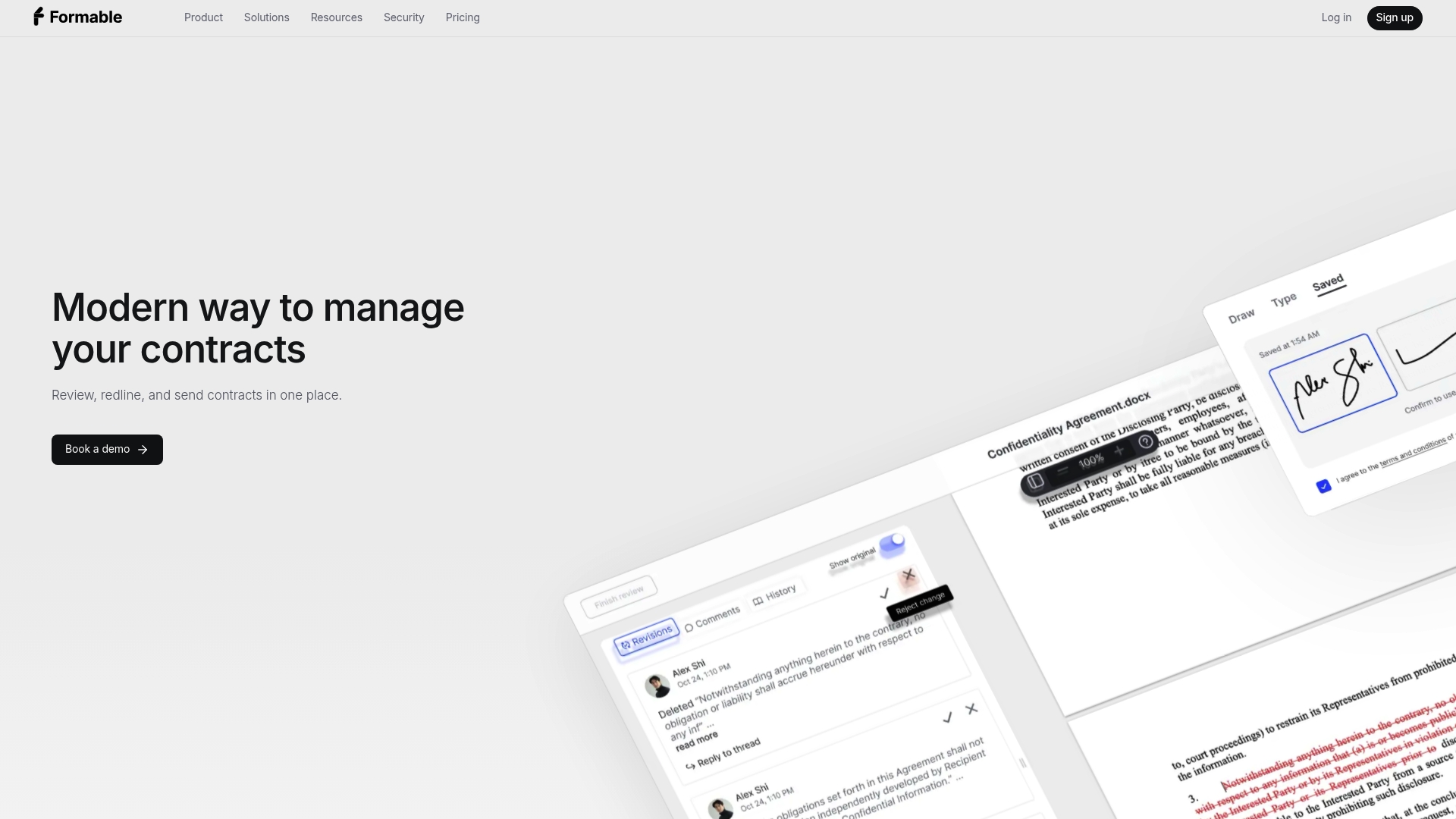
Formable is built for the exact problems described in this article. The platform gives startups and GTM teams a centralized place to manage MSAs, DPAs, SOWs, LOIs, and Order Forms, with AI-assisted review, redlining, and negotiation built in. Approval workflows are defined and tracked, not buried in email. Every contract has a clear audit trail and a renewal date that does not get missed.
For teams that need e-signing without the full CLM stack, Formable also works as a standalone signing solution with API access for developers. If you are ready to close deals faster and reduce contract risk, see how Formable works for your team.
FAQ
What is the average financial loss from poor contract management?
Organizations lose approximately 9% of annual contract value due to inefficient contract management. That loss comes from missed renewals, untracked obligations, and pricing errors.
What are the biggest obstacles in contract execution?
The most common obstacles are unclear approval authority, communication gaps between departments, and manual handoffs that introduce delays and errors at every stage.
Why do CLM implementations fail?
Deloitte's 2025 study identifies insufficient communication, excessive customization, and neglected change management as the leading causes of CLM project failure.
How do missed contract renewals create financial risk?
Missed renewal deadlines trigger auto-renewals at unfavorable terms, locking organizations into pricing and conditions they could have renegotiated with proper tracking.
What is the most effective best practice for contract management?
Centralizing contract storage with defined metadata and automated approval workflows produces the greatest reduction in errors and cycle time, according to industry research.