What are the top CRM with contract management platforms in 2026?
The strongest integrated CRM and contract management solutions in 2026 combine AI-driven automation, audit-ready compliance, and direct CRM data sync to eliminate the gap between closing a deal and executing the agreement. Eight platforms stand out for U.S. business teams right now.
| Platform | Best for | Core features | Automation & AI | Certifications | Rating |
|---|---|---|---|---|---|
| Docusign | AI-driven agreement workflows | E-signatures, intelligent agreement management, workflow automation | AI-powered contract review, Intelligent Agreement workflows | SOC 2 | 3.5★ (122) |
| PandaDoc | Proposal-to-payment compliance | Proposals, eSignatures, embedded payments, document analytics | Automated approvals, document tracking | E-SIGN, UETA, HIPAA, SOC 2 | 2.7★ (34) |
| Conga | Enterprise pricing and contracting | Pricing, quoting, contract management, document automation | AI-driven pricing and contract guidance | SOC 2 | 4.7★ (19) |
| Icertis | Large-scale contract intelligence | AI-native CLM, context-aware analytics, lifecycle management | AI contract risk detection, obligation tracking | SOC 2 | 4.2★ (10) |
| LinkSquares | CLM analytics and audit trails | Contract repository, approval workflows, audit trails | AI contract analytics, workflow automation | G2 high usability rating | 3★ (4) |
| Recruit CRM | Recruitment agencies | ATS + CRM, contract automation, AI resume parsing | AI agents, workflow automation | Verified by SoftwareAdvice | 4.7★ (47) |
| CRM Experts Online | Custom AI revenue systems | CRM/ERP integration, workflow automation, Salesforce/HubSpot support | AI-driven revenue system design | — | 4.3★ (15) |
| Commence Corporation | Small business CRM | Sales automation, lead generation, customer service ticketing | Marketing and sales automation | — | 5★ (3) |
Each platform addresses a distinct use case. Docusign leads on e-signature trust and AI agreement workflows, while Icertis is the clearest choice for organizations that want contracts treated as strategic data assets. PandaDoc's compliance certifications make it the go-to for teams in regulated industries. Conga targets complex commercial teams that need pricing, quoting, and contracting unified in one place.

How do these platforms compare on features, integrations, and pricing?
The gap between these platforms becomes clear once you move past the marketing and look at what each actually does at the workflow level.

Docusign has built its 2026 product around Intelligent Agreement workflows, which use AI to extract obligations, flag missing clauses, and route documents automatically. It connects natively with Salesforce, Microsoft 365, and SAP, making it a natural fit for teams already in those ecosystems. Pricing starts free for basic use; enterprise tiers require a sales conversation.
PandaDoc covers the full document lifecycle from proposal creation through e-signature compliance and embedded payment collection. Its E-SIGN, UETA, HIPAA, and SOC 2 certifications are the most complete compliance stack in this comparison, which matters for healthcare, finance, and government contractors. No public pricing is listed; a demo is the entry point.
Conga is built for commercial complexity. It unifies pricing and contract automation with AI-guided recommendations, targeting enterprises that manage high-volume quoting alongside contract execution. Integration depth with Salesforce CPQ and ERP systems is a core differentiator. Pricing is available only through sales.
Icertis takes a different approach entirely. Rather than treating contracts as documents to sign, its AI-native platform treats them as structured data sources. It extracts obligations, tracks performance against contract terms, and surfaces risk across a portfolio. This is the platform for legal and procurement teams that want measurable business impact from contract data, not just a signed PDF.
LinkSquares focuses on what happens after signature. Its AI contract analytics and audit trail capabilities make it strong for teams that need to search, report on, and govern an existing contract repository. Approval workflow automation is built in. No public pricing is listed.
Recruit CRM is purpose-built for staffing and recruitment agencies. Its AI-first ATS and CRM includes contract automation alongside AI resume parsing and candidate workflow management. A 30-day free trial is available.
CRM Experts Online is a consulting and implementation firm rather than a packaged product. It designs AI-driven revenue systems that integrate Salesforce, HubSpot, Zoho, and NetSuite with custom contract and workflow automation. It suits teams that need a tailored build rather than an off-the-shelf platform.
Commence Corporation offers a straightforward CRM with sales and marketing automation for small businesses. It covers lead generation, project management, and customer service ticketing. A free trial is available. For teams that need deep contract lifecycle management, it is a starting point rather than a complete solution.
How to choose the right CRM with contract management for your organization
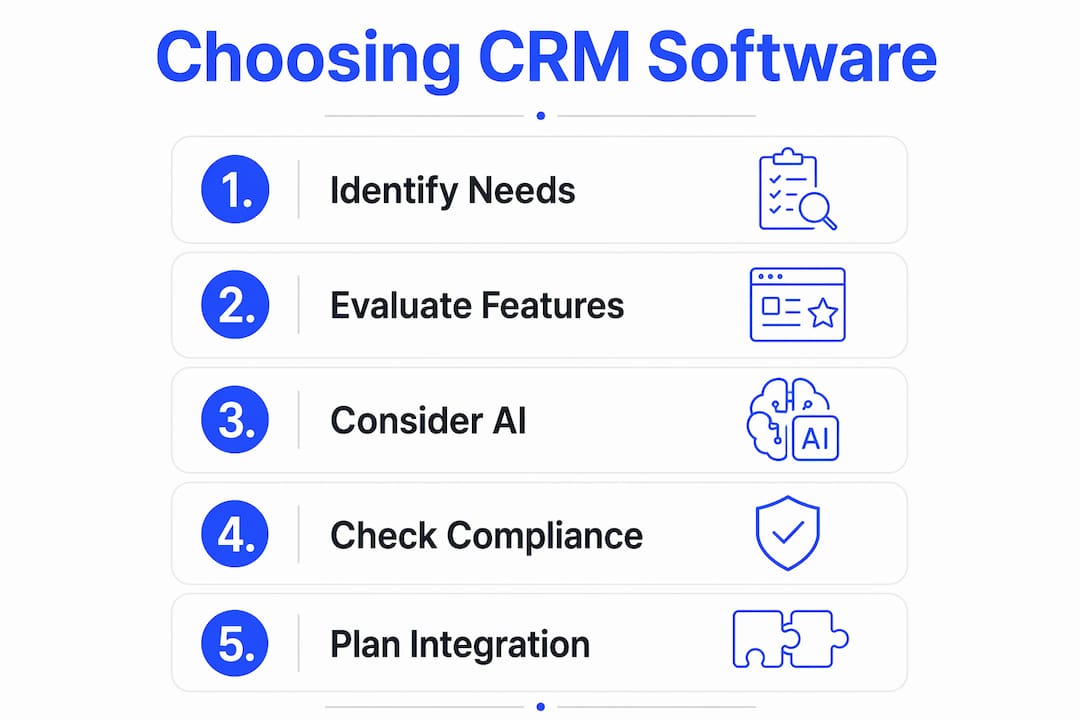
Selecting the right platform depends on where your contracts actually break down today.
Start with your contract volume and complexity. A small sales team closing standard agreements needs something different from a procurement department managing hundreds of vendor contracts with renewal obligations. Icertis and Conga are built for the latter. PandaDoc and Commence Corporation fit the former.
Key selection criteria to evaluate:
- Compliance requirements. If your industry is regulated, verify certifications before anything else. PandaDoc's HIPAA and SOC 2 coverage is publicly documented; others require you to ask during a demo.
- CRM integration depth. A contract tool that syncs only contact names from your CRM is not a true integrated system. Look for platforms that pull opportunity data, pricing, and custom fields directly into contract templates, as this is where contract workflow automation delivers its real time savings.
- AI capabilities vs. vendor claims. Ask specifically what the AI does: clause extraction, risk flagging, obligation tracking, or just template suggestions? Icertis and Docusign have the most documented AI contract functionality in this group.
- User adoption. A platform your team will not use consistently is worse than a simpler one they will. LinkSquares scores well on usability; Conga and Icertis have steeper learning curves suited to dedicated contract teams.
- Pricing transparency. Docusign and Commence Corporation offer free trials or free tiers. Conga, Icertis, and PandaDoc require a sales conversation. Budget accordingly for evaluation time.
Common implementation pitfalls:
- Migrating legacy contracts without a tagging and metadata strategy creates a disorganized repository from day one.
- Skipping user training on AI features leads teams to ignore them and revert to manual processes.
- Failing to map approval workflows before go-live causes bottlenecks that the software was meant to eliminate.
Pro Tip: Before committing to any platform, ask the vendor to demonstrate AI contract review on one of your actual agreements, not a demo document. The gap between a polished demo and real-world performance on your contract types is where most surprises happen.
Security and compliance deserve a dedicated conversation with your IT and legal teams before signing any contract software agreement, especially considering platforms like TrailerCast security that emphasize technology CRM tools automating compliance and contract management processes. SOC 2 Type II certification is the baseline for enterprise procurement; HIPAA compliance is non-negotiable for healthcare-adjacent workflows.
What features matter most when contract management lives inside your CRM?
Effective contract management is a cross-departmental process that touches finance, procurement, HR, and legal, not just the sales team that closes the deal. When it lives inside your CRM, the entire contract lifecycle becomes visible to the people who need it.
The core stages managed inside an integrated CRM system are:
- Initiation. Contract requests triggered automatically from a closed-won opportunity, pulling CRM data into the template.
- Drafting. Template libraries with pre-approved clauses reduce legal review time and enforce compliance from the start.
- Negotiation. Collaborative redlining with version control and comment threads, tracked inside the platform.
- Approval. Automated routing to the right stakeholders based on contract value, type, or risk level.
- Execution. E-signature with identity verification and a timestamped audit trail.
- Post-signature management. Obligation tracking, renewal alerts, and performance monitoring against contract terms.
According to Forrester and Aberdeen research, integrating contract management within CRM reduces approval times and shortens deal cycles significantly. The mechanism is straightforward: CRM opportunity data populates contract templates automatically, removing manual re-entry and the errors that come with it.
The features that separate good platforms from adequate ones are audit trails that capture every document event with an immutable timestamp, AI-assisted clause detection that flags missing or non-standard language before a contract goes out, and renewal management that surfaces expiring agreements before they auto-renew or lapse.
How does AI-native contract management change the way teams work?
Legal teams using AI to manage contracts handle high volumes of agreements without frequent legal escalation, relying on automated workflows and standardized templates to enforce compliance at scale. The shift is from reactive review to proactive governance.
AI in contract management does several concrete things:
- Extracts key terms, dates, and obligations from uploaded documents without manual tagging.
- Flags clauses that deviate from approved standards, reducing the back-and-forth between legal and business teams.
- Predicts renewal risk and surfaces contracts approaching expiration or auto-renewal windows.
- Generates contract performance reports from structured data rather than manual audits.
Contract management is also a strategic business process that improves efficiency across finance, procurement, and HR, not just a legal task. AI makes that cross-functional value visible by turning contract data into dashboards that executives can act on.
For teams evaluating cloud-based contract management options, the practical question is whether the AI layer is embedded in the core platform or bolted on as an add-on. Icertis and Docusign have AI built into their core architecture. Others offer AI features as optional modules, which affects both pricing and reliability.
Formable offers a focused alternative for deal-closing teams
If the platforms above feel like more infrastructure than your team needs right now, Formable takes a different approach. It is built specifically for startups and GTM teams that need to close MSAs, DPAs, SOWs, and Order Forms quickly, without managing a full enterprise CLM deployment.
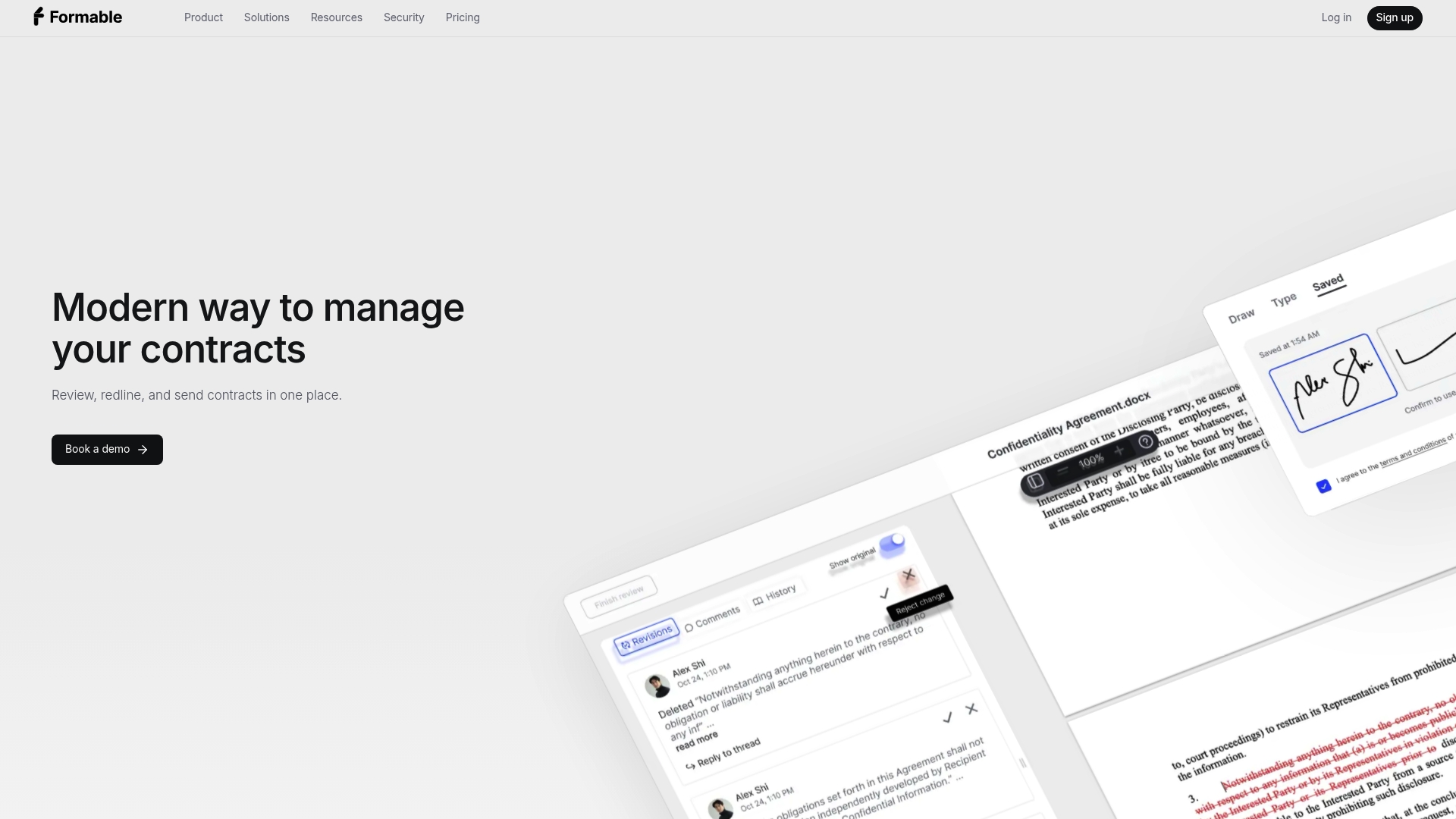
Formable covers AI contract review, collaborative redlining, real-time negotiation, e-signing, audit trails, and template storage in one place. It also offers e-signing APIs so developers can embed signature collection directly into their own platforms. For teams that need a standalone e-signature tool or a lightweight contract workflow layer on top of an existing CRM, Formable is worth a direct look. Reach out and the team will walk through your specific use case.
FAQ
Does Salesforce have a contract management system?
Salesforce does not include a native contract lifecycle management module, but it integrates with dedicated CLM tools like Conga and Docusign, which connect directly to Salesforce opportunity data to automate contract creation and approval workflows.
What is the best CRM for government contracting?
PandaDoc is a strong choice for government-adjacent work given its E-SIGN, UETA, HIPAA, and SOC 2 certifications. Icertis is used by large enterprises with complex compliance requirements and may suit federal contractors needing deep obligation tracking.
Does Microsoft have a contract management system?
Microsoft does not ship a standalone contract management product, but Dynamics 365 supports CLM integrations through the Microsoft AppSource marketplace, including platforms built natively on the Dynamics 365 and Power Platform environment.
Will contract management be replaced by AI?
AI will not replace contract management as a function, but it is already automating the most time-consuming parts of it, including clause extraction, risk flagging, and obligation tracking. Platforms like Icertis and Docusign are built around this model, with human review remaining essential for high-stakes or non-standard agreements.
Key takeaways
The strongest CRM with contract management platforms in 2026 combine AI-driven automation, certified compliance, and direct CRM data integration to close deals faster and reduce legal overhead.
| Point | Details |
|---|---|
| AI is now core, not optional | Platforms like Icertis and Docusign embed AI in contract review, risk detection, and obligation tracking at the architecture level. |
| Compliance certifications vary widely | PandaDoc holds E-SIGN, UETA, HIPAA, and SOC 2; verify certifications against your industry requirements before selecting any platform. |
| CRM data sync drives accuracy | Automatic population of contract templates from CRM opportunity data removes manual re-entry and reduces errors throughout the contract lifecycle. |
| Selection depends on use case | Icertis and Conga suit enterprise complexity; PandaDoc and Commence Corporation fit smaller teams with standard agreement workflows. |
| Formable for GTM teams | Formable covers AI review, redlining, negotiation, and e-signing for startups and GTM teams closing MSAs, SOWs, and similar agreements quickly. |