Creating a pilot agreement for a B2B customer means navigating two decision-makers: the champion who wants the pilot and the economic buyer who approves spending. Run the scoping call with the champion, settle the core terms verbally, draft from a template that handles enterprise procurement requirements, and build in conversion terms so a successful pilot moves straight to a full agreement without restarting negotiation.
Enterprise pilots stall most often at three points: the champion cannot get budget approval, the security team flags missing data protection language, or the pilot succeeds but nobody pre-agreed on pricing for the next step. Fix all three before you draft by confirming verbal agreement on one workflow, one metric, and one conversion path, then putting those terms into a contract that legal and procurement can sign without redrafting.
Note: This article provides general information about pilot agreements. It is not legal advice and does not create an attorney-client relationship.
Before you draft: champion vs economic buyer
The champion is the person who wants the pilot. They attended the demo, they see the value, and they have the internal influence to pull in resources for a test. The economic buyer is the person who approves spending. In a small company, the champion and the buyer are the same person. In an enterprise, they are not.
Your first question after the demo is: "Who signs the pilot agreement?" If the champion says "I do," you are clear to draft. If they say "My VP does" or "Procurement handles contracts," you need to loop in the economic buyer before you send anything. Send a pilot agreement to the wrong person and it sits in an inbox for three weeks before getting forwarded.
Ask the champion directly: "What is the approval process for a pilot like this?" The answer tells you whether you need one signature or three, and whether legal or procurement reviews the terms before the buyer signs. Map that process before you draft, not after.
For enterprise pilots, the champion usually drives the technical scoping, but the economic buyer controls the budget and the timeline. Align with the champion on what success looks like, then confirm with the buyer that the pilot cost and the conversion terms fit their planning cycle.
The scoping call: what to agree verbally first
Run a 30-minute scoping call with the champion and, if possible, the economic buyer. The goal is to settle the pilot terms verbally before you draft. Every term you settle on the call is one fewer redline when the contract goes to legal.
One workflow: Pick the single workflow the customer will test during the pilot. Do not try to pilot your entire platform. Testing one workflow with real data beats testing five workflows superficially. Ask: "Which process do you want to replace or improve with our product?" Get a specific answer: "We want to test it on AP invoice approvals" or "We want to run it on outbound logistics for the northeast region."
One metric: Agree on the success criterion before you hang up. Ask: "What result would make this pilot a clear win for you?" Push for a number: "We need to reduce processing time by 20%" or "We need 80% user adoption in the first 45 days." Write it down during the call. That metric goes directly into the pilot agreement.
For detailed guidance on writing that metric as contract language, see how to define pilot success criteria.
One date: Set the pilot length on the call. Most B2B pilots run 60 days. Shorter than 60 days does not give the customer time to integrate and measure. Longer than 90 days starts to feel like a production commitment without a contract. If the customer has budget cycle constraints, align the pilot end date so the decision lands before their next planning period.
Conversion path: Ask what happens if the pilot succeeds. Get the buyer to state the contract type and the budget range: "If we hit the metric, we will move to a two-year subscription in the $50K to $75K range." Put that range into the pilot agreement as pre-agreed conversion terms. Without it, a successful pilot restarts negotiation from zero.
By the end of the scoping call, you should be able to fill in the pilot agreement template without guessing at any field.
Drafting from the pilot agreement template
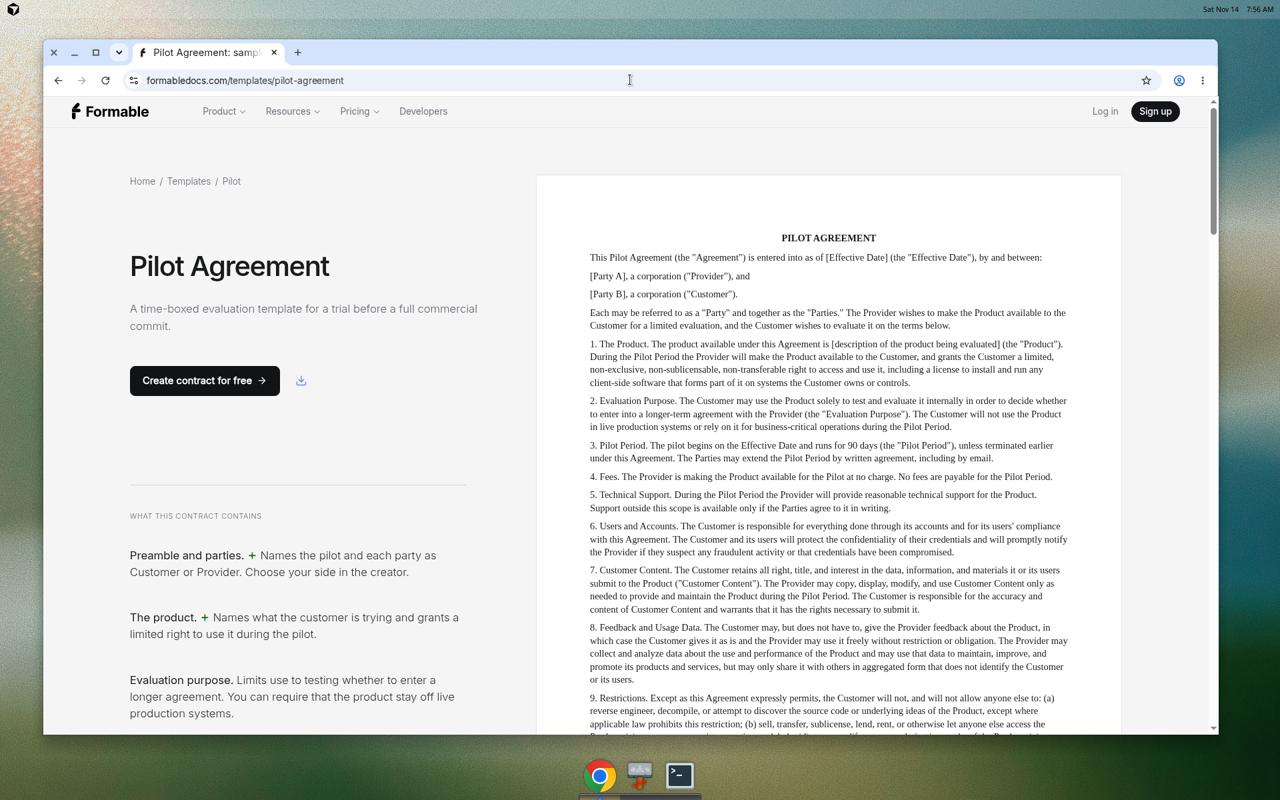
Once you have the scoping call notes, use a pilot program agreement template to generate the draft. The template asks for party names, product description, pilot length, fees, success criteria, and conversion terms. Each field corresponds to a clause in the final agreement.
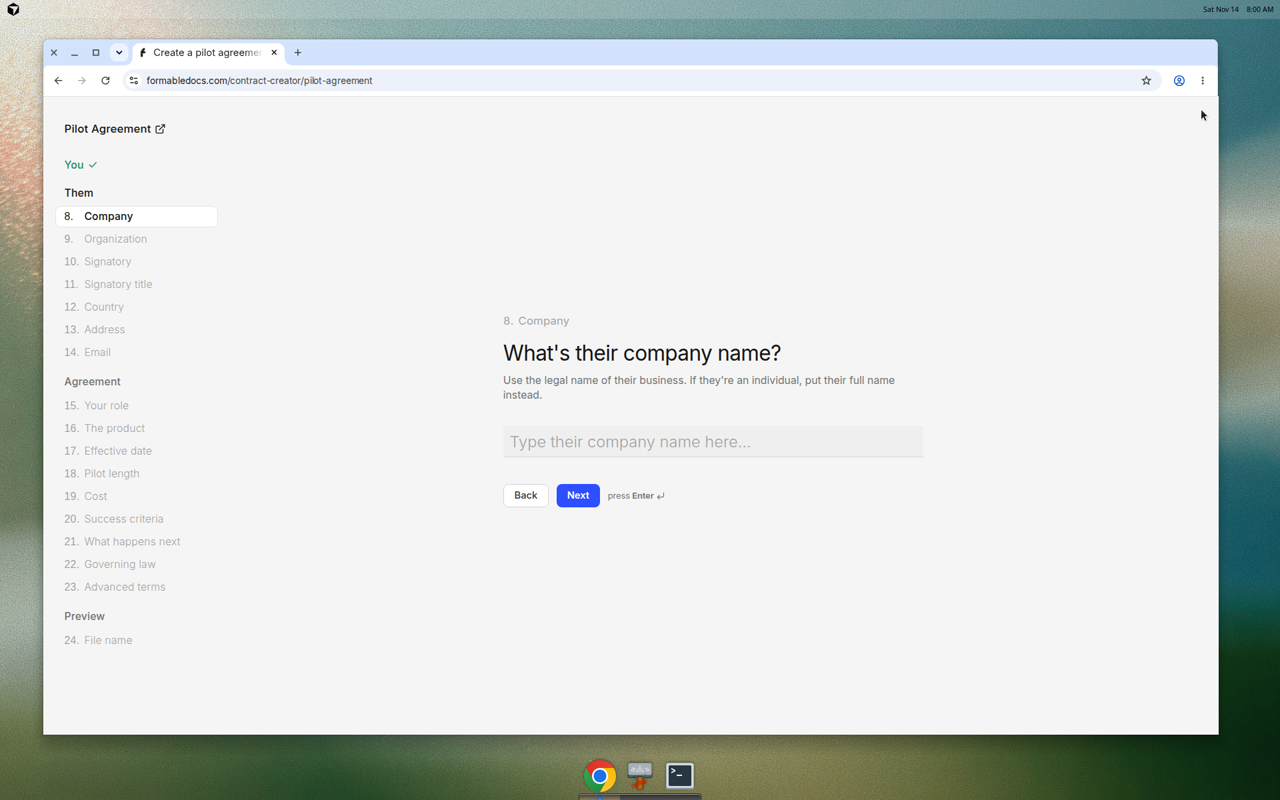
Start with party details. Enter the customer's legal entity name, not their trade name. If the customer is "Acme Logistics LLC," write that, not "Acme." The entity name appears on the signature page, and a mismatch will bounce the agreement back from legal.
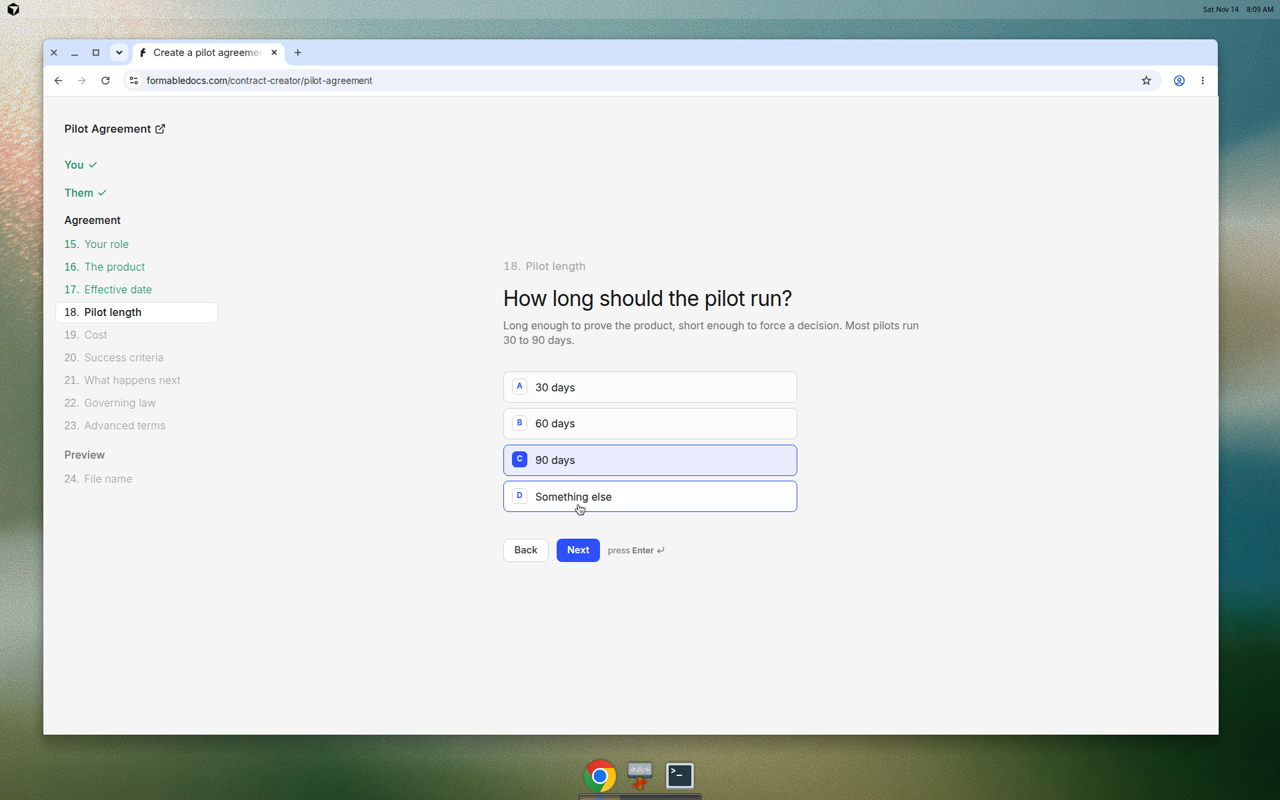
Fill in the product description with the language you and the champion agreed on during the scoping call. Keep it to one or two sentences: "AI-powered route optimization platform for logistics operations." The pilot period matches the length you agreed verbally: 60 days, 90 days, or a custom period.
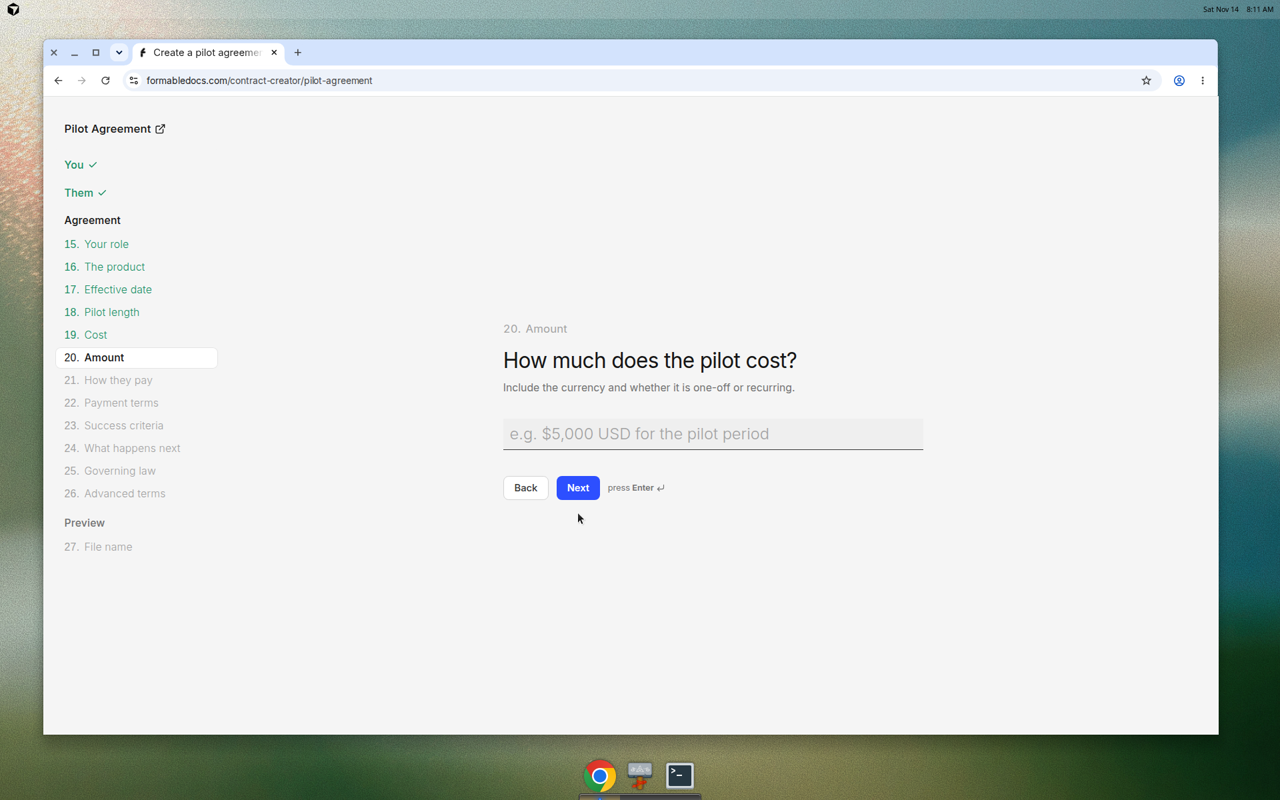
If the pilot is paid, enter the fee and the payment terms. B2B pilots are usually invoiced with Net 30 terms. If the pilot is free, select "Pilot is free" and the template generates a fee-waiver clause automatically.
The success criteria field is where you paste the metric you agreed on the scoping call, written with all five required parts: metric, baseline, target, data source, and owner. The template generates the clause as written, so make it specific here.
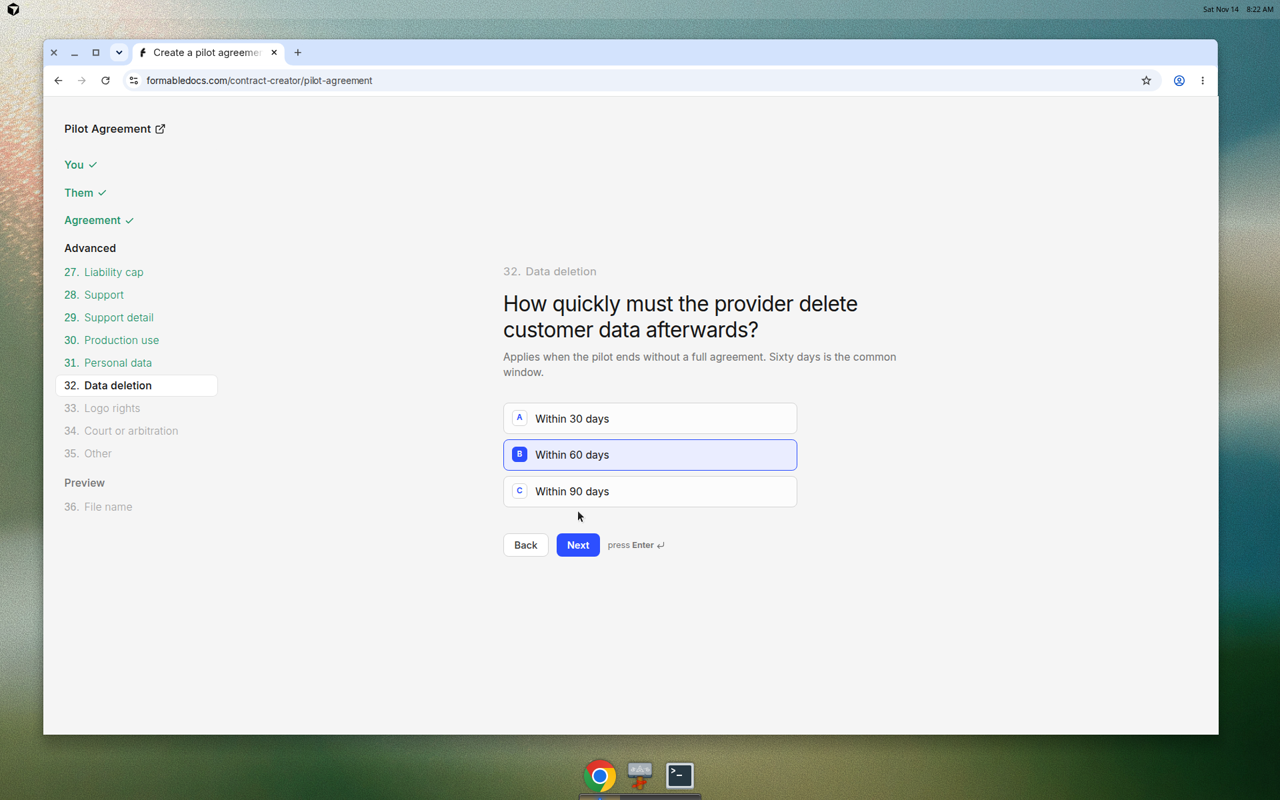
Set data deletion and liability terms. Enterprise customers expect the vendor to delete customer data within 30 days after the pilot ends. Liability is typically capped at fees paid, or a fixed amount like $10,000 for a free pilot.
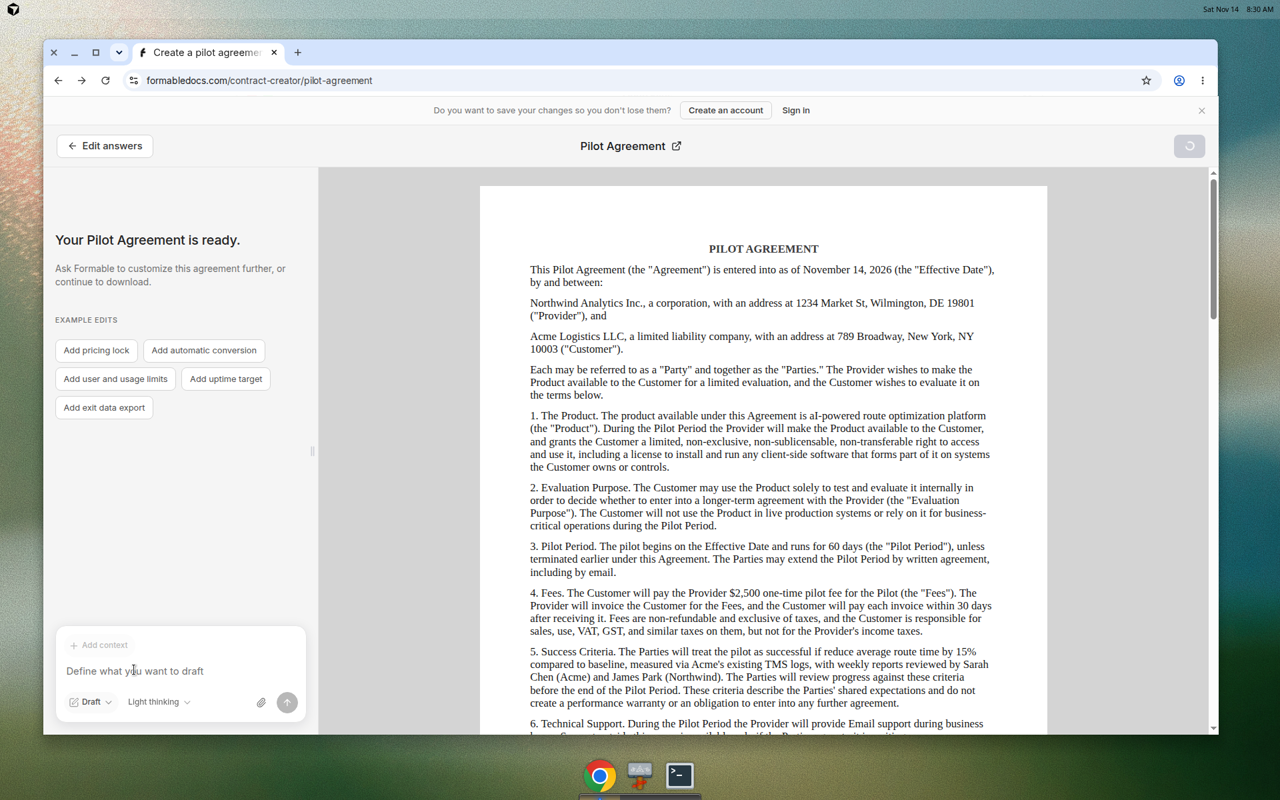
Once you complete the questionnaire, preview the full agreement. The template generates a complete contract with all clauses filled in. Review it for accuracy, download it as a PDF or Word file, or send it directly for e-signature.
Getting through security and procurement review
Enterprise customers route pilot agreements through security and procurement before the business team can sign. Security flags missing data protection language. Procurement flags missing insurance requirements or missing indemnities. Build those clauses into the pilot agreement from the start, so the review does not require a redraft.
Data protection: If the product processes personal data, attach a data processing agreement as an exhibit and reference it in the pilot agreement. The DPA covers GDPR and CCPA requirements. Without it, the security team will block the pilot until you add one.
Confidentiality: Both sides agree not to disclose non-public information about the product, the customer's data, or the pilot terms. The confidentiality clause should survive for three to five years after the pilot ends. Enterprise legal teams expect this clause by default.
Liability cap and indemnities: The pilot agreement should include mutual indemnities for third-party IP claims and a liability cap tied to fees paid. Those two clauses are standard in enterprise contracts, and omitting them will trigger redlines from procurement.
Insurance: Some enterprise customers require the vendor to carry a minimum level of commercial general liability and cyber liability insurance. If the customer asks for it during the scoping call, add an insurance clause to the pilot agreement. If they do not ask, leave it out.
The faster you can answer security and procurement questions with "It is already in the agreement," the faster the pilot moves to signature.
Handling redlines and negotiation
Even with a well-drafted pilot agreement, enterprise customers will redline terms. The most common redlines are liability caps, governing law, and termination rights. Use tracked changes to negotiate those redlines in one sitting instead of three email rounds.
Formable supports redlining with tracked changes, so both sides can see exactly what changed, accept or reject each revision, and finalize terms without losing history. When a redline comes back, review the changes, accept the reasonable ones, push back on the non-starters, and send a revised draft within 24 hours.
The terms worth protecting in a pilot agreement are:
- IP ownership: The vendor retains ownership of the product and platform. The customer gets a limited license to use it during the pilot. Never assign IP to the customer in a pilot.
- No automatic renewal: The pilot ends on the stated date unless both sides agree to extend it. Do not let a pilot auto-renew into a production agreement.
- Conversion is optional: Neither side is obligated to move forward if the success criteria are not met. That protects the customer from being locked into a product that did not work and protects the vendor from liability for a failed pilot.
The terms you can flex on:
- Termination notice: If the customer wants 15 days' notice instead of 30, that is negotiable.
- Liability cap amount: If the customer wants a $25,000 cap instead of $10,000 for a free pilot, that is reasonable for an enterprise deal.
- Governing law: If the customer is based in California and wants California law instead of Delaware, that is usually acceptable unless your terms require a specific jurisdiction for all contracts.
Close redlines within one revision cycle when possible. The longer negotiation drags, the more likely the pilot loses momentum and the champion moves on to the next vendor.
Signing and kickoff
Once terms are final, send the pilot agreement for e-signature. Each signer receives a link, reviews the document, and signs. The signed copy arrives by email with a tamper-proof audit trail. For guidance on the full signing process, see how Formable handles e-signature.
Schedule a kickoff call for the day the pilot agreement is fully executed. The kickoff covers access, onboarding, and the measurement plan for the success criteria. Assign a point of contact on each side and set the cadence for progress reviews: weekly or biweekly check-ins to confirm the pilot is on track.
The champion owns the pilot internally, but the vendor's customer success or implementation team owns the measurement and reporting. Make sure both sides know who is responsible for tracking the success criteria and when the final review happens.
One-week timeline from scoping to signature
A well-run B2B pilot goes from scoping call to signed agreement in one week. Here is the timeline:
| Day | Milestone |
|---|---|
| Day 1 | Scoping call with champion and economic buyer; agree on workflow, metric, pilot length, and conversion terms |
| Day 2 | Draft pilot agreement from template using scoping call notes; send to champion for internal review |
| Day 3 | Champion forwards draft to legal and procurement; internal review begins |
| Day 4-5 | Legal sends redlines; vendor reviews and responds within 24 hours |
| Day 6 | Final terms agreed; send for e-signature |
| Day 7 | Fully executed agreement; kickoff call scheduled |
If the timeline stretches past two weeks, the pilot is losing momentum. Follow up with the champion every two to three days to keep it moving.
After the pilot ends, convert successful pilots to a full commercial agreement. Use an MSA template for long-term software agreements that cover multiple projects or renewals.
For the full pilot drafting process, see how to write a pilot agreement.
FAQ
How do I get the economic buyer involved early?
Ask the champion on the first call: "Who approves the pilot budget?" Then request an introduction to that person before you send the draft. A 15-minute call with the buyer to confirm scope and budget saves two weeks of redlines later.
What if the customer wants a longer pilot?
Pilots longer than 90 days risk turning into unpaid production use. If the customer needs more time, structure it as a 60-day pilot with an optional 30-day extension, both governed by the same agreement. That keeps the pilot feeling finite while allowing flexibility.
Should I charge for B2B pilots?
Paid pilots signal seriousness and pull in more customer resources. A small fee, even $2,500 to $5,000, makes the pilot feel like a business transaction rather than a free trial. Paid pilots also perform better because both sides have more at stake.
What if the customer's legal team redrafts the entire agreement?
Push back. If the customer insists on their paper, review it carefully and confirm that it still protects your IP, caps liability, and includes conversion terms. Do not sign an agreement that assigns your platform IP to the customer or obligates you to a production contract if the pilot succeeds.
How do I handle a pilot that succeeds but the customer does not convert?
If the pilot met the success criteria but the customer does not move forward, ask for feedback on what changed. Often the blocker is budget or timing, not the product. Stay in touch and revisit in the next budget cycle. If the pilot failed on the criteria, use that feedback to improve the product for the next customer.