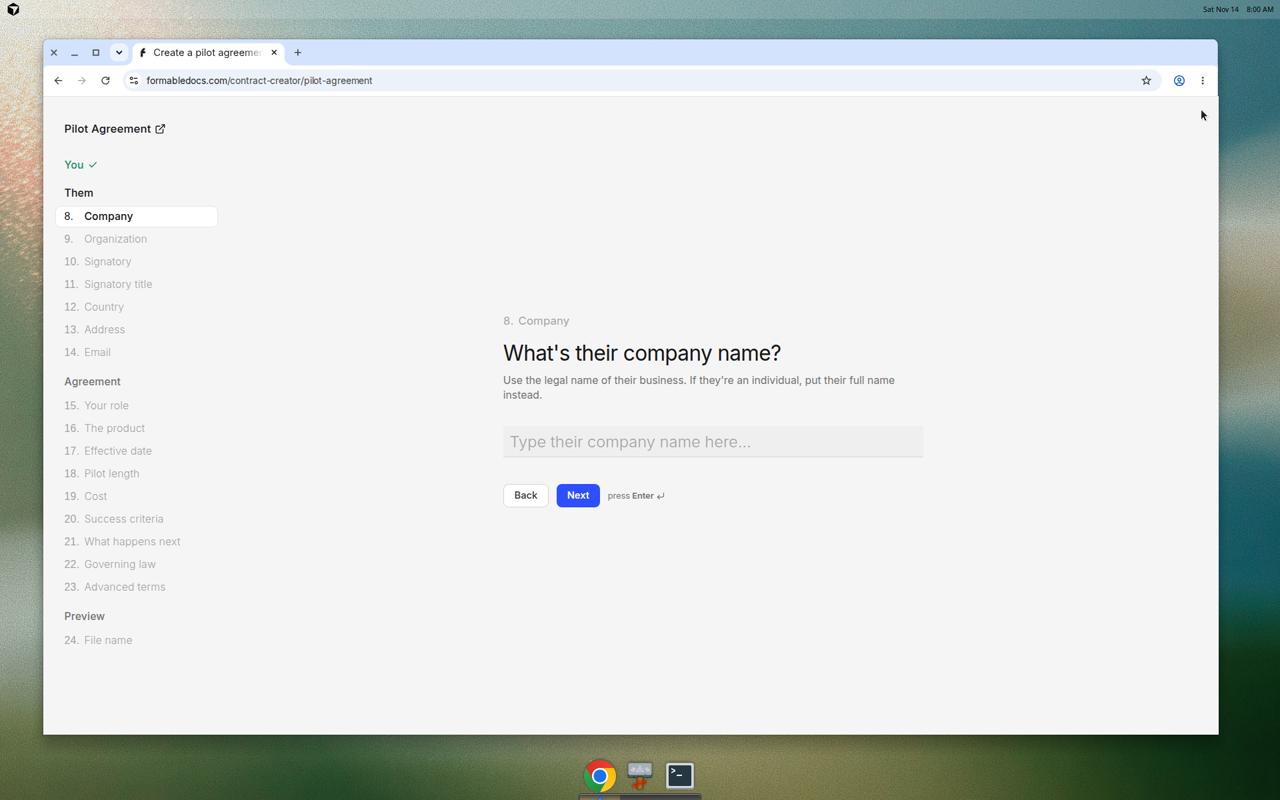
A pilot project proposal is the business brief that comes before the pilot agreement. The proposal defines the problem, the test scope, the success measures, the timeline, and the commercial questions. It aligns both sides on what the pilot will prove before legal terms are negotiated. An approved proposal becomes the input for the pilot agreement, so the contract reflects what both sides already agreed to test.
The difference between a proposal and an agreement is intent: a proposal is a planning document that describes what will be tested and why. An agreement is a legal contract that binds both parties to the terms of that test. Write the proposal first, get it approved by the decision-makers on both sides, then draft the pilot agreement using the proposal as the source of truth.
Note: This article provides general information about pilot project proposals. It is not legal advice and does not create an attorney-client relationship.
Proposal vs agreement: what is the difference?
A proposal is not binding. It describes what the pilot will test, why it matters, and what results will prove success. It is written in business language and circulated internally by the champion to get approval from the economic buyer, IT, and any other stakeholders before legal terms are negotiated.
An agreement is binding. It states the legal obligations of both parties during the pilot: who owns what data, who is liable for what, and what happens if the pilot fails. It is written in legal language and signed by authorized representatives.
| Proposal | Agreement |
|---|---|
| Business brief, not binding | Legal contract, binding |
| Written by the champion or vendor | Drafted by legal or from a template |
| Describes what will be tested and why | States legal terms and obligations |
| Approved internally before legal review | Signed after legal review and negotiation |
| Circulated to decision-makers for buy-in | Executed by authorized signers |
The proposal comes first. Once the proposal is approved, use it as the input for the pilot agreement. The agreement should match the proposal: same scope, same timeline, same success measures. If the proposal says the pilot will test AP automation over 60 days with a 20% cost reduction target, the agreement should say exactly that in its product description, pilot period, and success criteria clauses.
10-section outline for a pilot project proposal
A strong pilot project proposal follows a standard structure. Use this 10-section outline for every proposal, adjusting the content to fit the product and the customer's needs.
1. Problem statement
State the problem the customer is trying to solve in one or two sentences. The problem should be specific: "Manual invoice processing takes 5 days on average, creating cash flow delays and requiring 3 full-time AP staff." Avoid vague statements like "We need to improve efficiency."
2. Proposed solution
Describe the product and how it addresses the problem. One paragraph: "Vendor's AP automation platform will digitize invoice intake, route approvals, and post to the ERP automatically, reducing processing time to under 24 hours."
3. Pilot scope
Define what workflows, departments, or systems will be included in the pilot. Be specific: "The pilot will cover all invoices from the northeast region, approximately 400 invoices per month, processed by the finance team in the New York office." State what is included and what is excluded.
4. Out of scope
List what the pilot will not cover. This section prevents scope creep. Example: "The pilot will not include invoice data from the west coast office, international suppliers, or credit card transactions."
5. Baseline and measurement
State the current baseline performance and how it will be measured. Example: "Current average invoice processing time is 5.2 days, measured from invoice receipt to final posting in the ERP. Baseline data will be captured from the 30 days prior to pilot start using timestamps from the ERP system."
6. Success measures
List the specific results that will prove the pilot succeeded. Use the five-part structure: metric, baseline, target, data source, owner. Example:
Success Measure 1: Reduce average invoice processing time from 5.2 days to 4.0 days or less, measured via ERP timestamps, reviewed weekly by Customer's Controller and Vendor's Implementation Manager.
Success Measure 2: Achieve 90% user adoption rate among the 8 finance team members, measured via login analytics, confirmed at day 45.
For detailed guidance on writing success measures, see how to define pilot success criteria.
7. Roles and owners
Name the point of contact on each side and their responsibilities during the pilot. Example:
- Customer Champion: Jane Smith, VP of Finance. Owns internal coordination, user adoption, and approval of results.
- Vendor Implementation Lead: Mark Johnson, Customer Success Manager. Owns onboarding, training, and weekly progress reporting.
8. Timeline
State the pilot length and key milestones. Example:
- Week 1: Onboarding and data integration setup
- Week 2-8: Live pilot testing
- Week 9: Final review and decision
Be realistic. A 60-day pilot that assumes integration will be complete in 3 days is setting both sides up for failure.
9. Commercial questions
State whether the pilot is paid or free, and what pricing applies if the pilot converts to a full agreement. Example:
The pilot fee is $3,000, payable via invoice within 30 days of pilot start. If Customer meets the success measures and enters a commercial agreement within 30 days of pilot end, the $3,000 pilot fee will be credited toward the first invoice. Commercial pricing for a full agreement is $18,000 per year for up to 50 users.
Pre-agreed commercial terms prevent renegotiation after a successful pilot. If the customer knows the conversion price before the pilot starts, the decision to move forward becomes simpler.
10. Next steps
State what needs to happen for the pilot to move forward. Example:
Next Steps:
- Customer approves this proposal by [date]
- Vendor sends pilot agreement for legal review
- Both parties execute pilot agreement by [date]
- Pilot kickoff call on [date]
The next steps section turns the proposal into a roadmap for getting the pilot signed and started.
Copyable proposal template
Use this template as a starting point for your pilot project proposal. Replace the bracketed placeholders with your own details.
PILOT PROJECT PROPOSAL
[Customer Name] – [Product Name] Pilot
Date: [Proposal Date]
Prepared by: [Vendor Name]
1. Problem Statement
[State the customer's problem in 1-2 sentences. Be specific.]
2. Proposed Solution
[Describe the product and how it solves the problem in 1 paragraph.]
3. Pilot Scope
The pilot will test [product name] on [specific workflow, department, or region]. Approximately [volume: number of transactions, users, or records] will be processed during the pilot. The pilot will run for [length: 30, 60, or 90 days] starting on [start date].
4. Out of Scope
The pilot will not include:
- [Excluded workflow or department]
- [Excluded data type or system]
- [Excluded geography or business unit]
5. Baseline and Measurement
Current baseline: [metric and current performance]. Baseline data will be captured from [source and timeframe]. All pilot results will be compared to this baseline.
6. Success Measures
Success Measure 1: [Metric, baseline, target, data source, owner]
Success Measure 2: [Metric, baseline, target, data source, owner]
7. Roles and Owners
- Customer Champion: [Name, title]. Responsible for [responsibilities].
- Vendor Implementation Lead: [Name, title]. Responsible for [responsibilities].
8. Timeline
- Week 1: [Milestone]
- Week 2-[X]: [Milestone]
- Week [X+1]: [Milestone]
9. Commercial Questions
Pilot fee: [Amount or "Fee-waived"]. Payment terms: [Invoice, Net 30, or other terms].
If Customer meets the success measures and enters a commercial agreement within [timeframe] of pilot end, [state pricing and any pilot fee credit].
10. Next Steps
- Customer approves this proposal by [date]
- Vendor sends pilot agreement for legal review by [date]
- Both parties execute pilot agreement by [date]
- Pilot kickoff call on [date]
From approved proposal to signed pilot agreement
Once the proposal is approved, use it to fill in the pilot agreement template. The template asks for the same information the proposal already contains: product description, pilot length, success criteria, fees, and conversion terms.
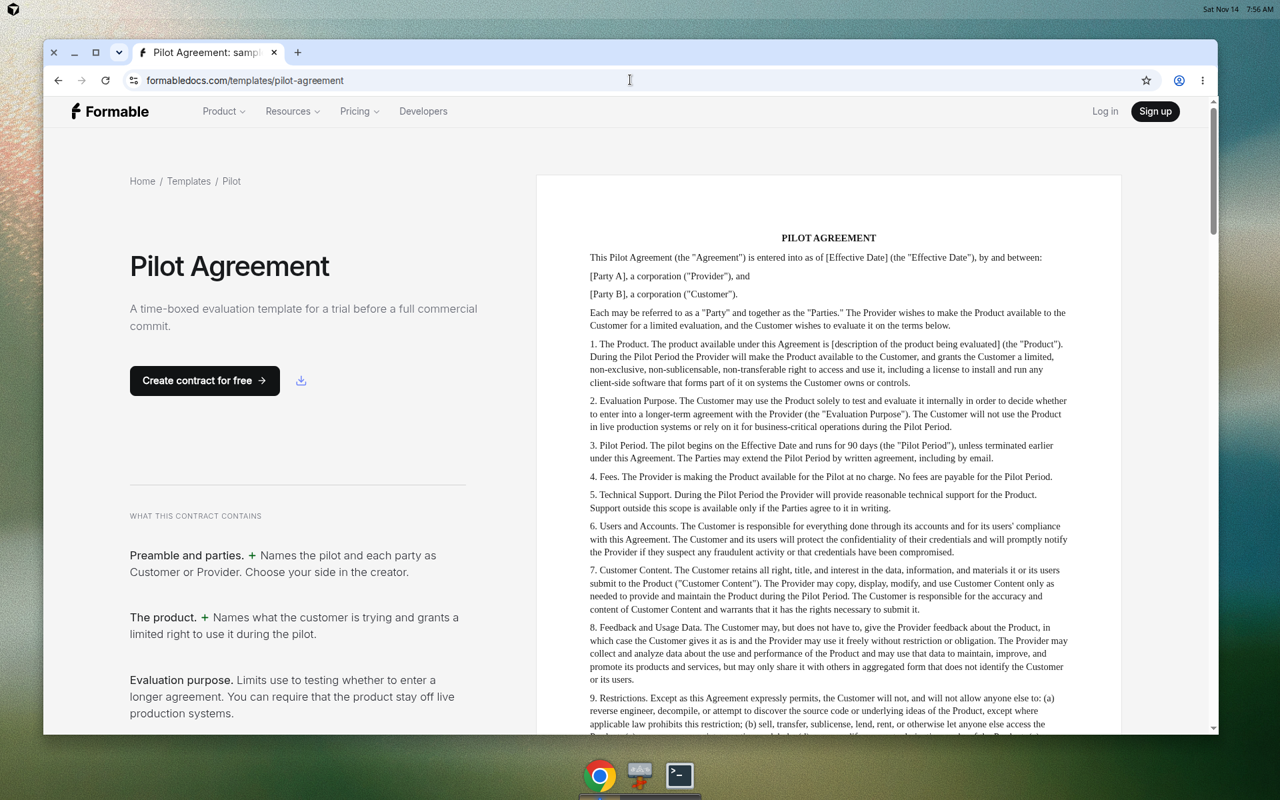
Start with party details from your approved proposal:
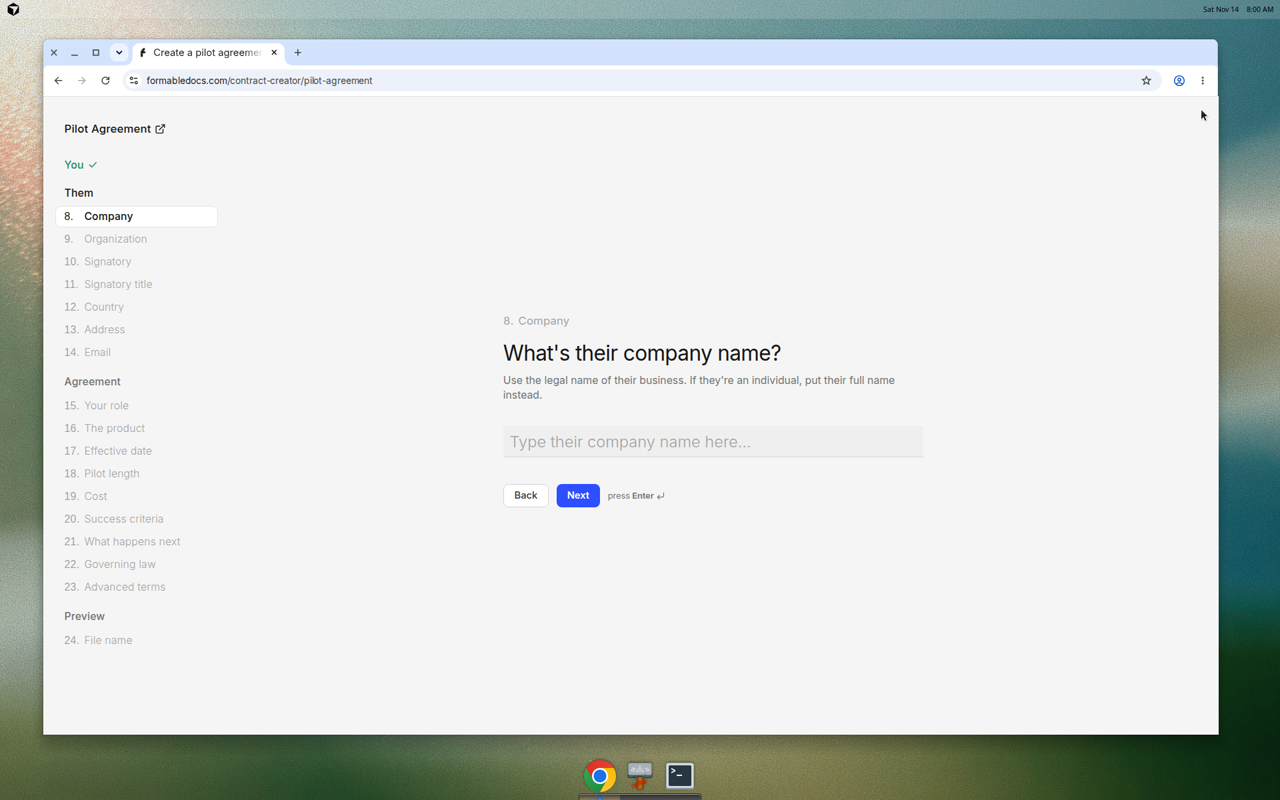
Copy the product description from the proposal into the product field. Copy the pilot length into the pilot period field. Copy the success measures verbatim into the success criteria field. The agreement should match the proposal exactly, so both sides sign the contract they already approved internally.
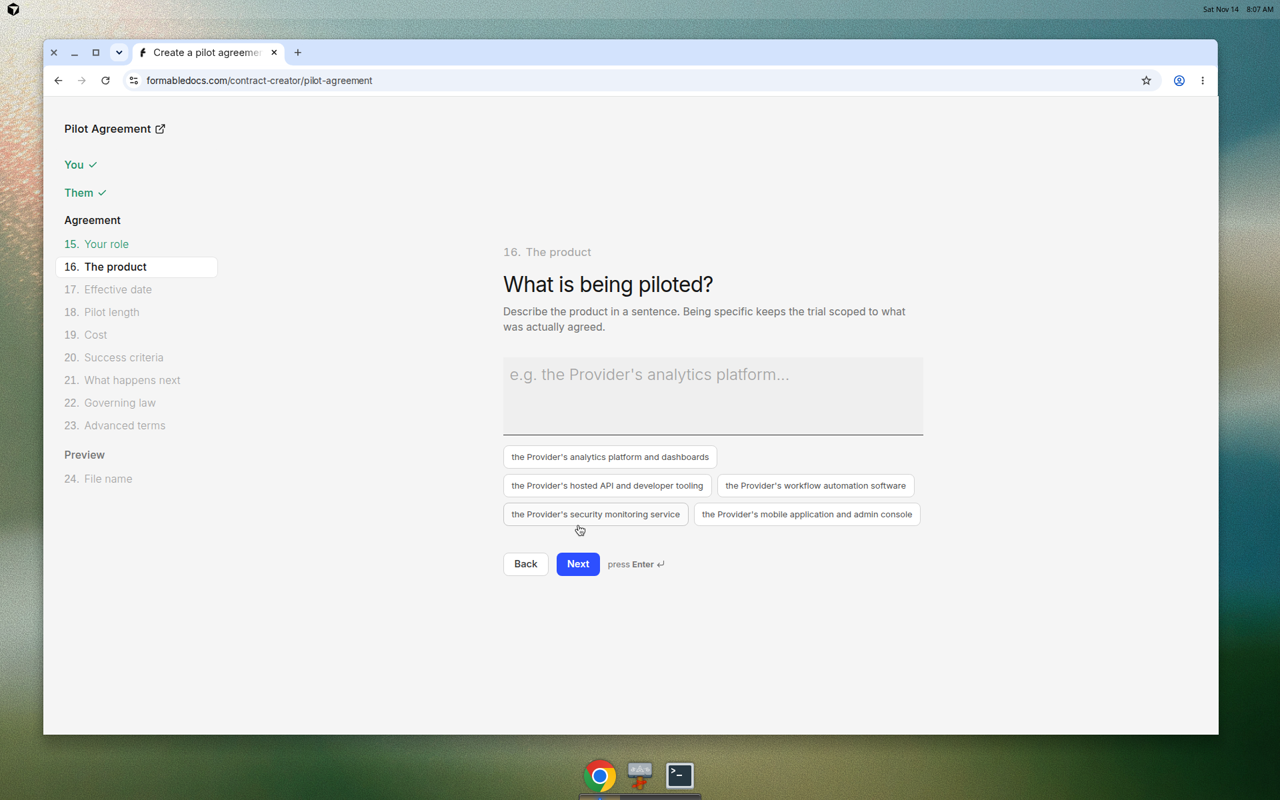
The preview shows how your proposal terms appear in the final contract:
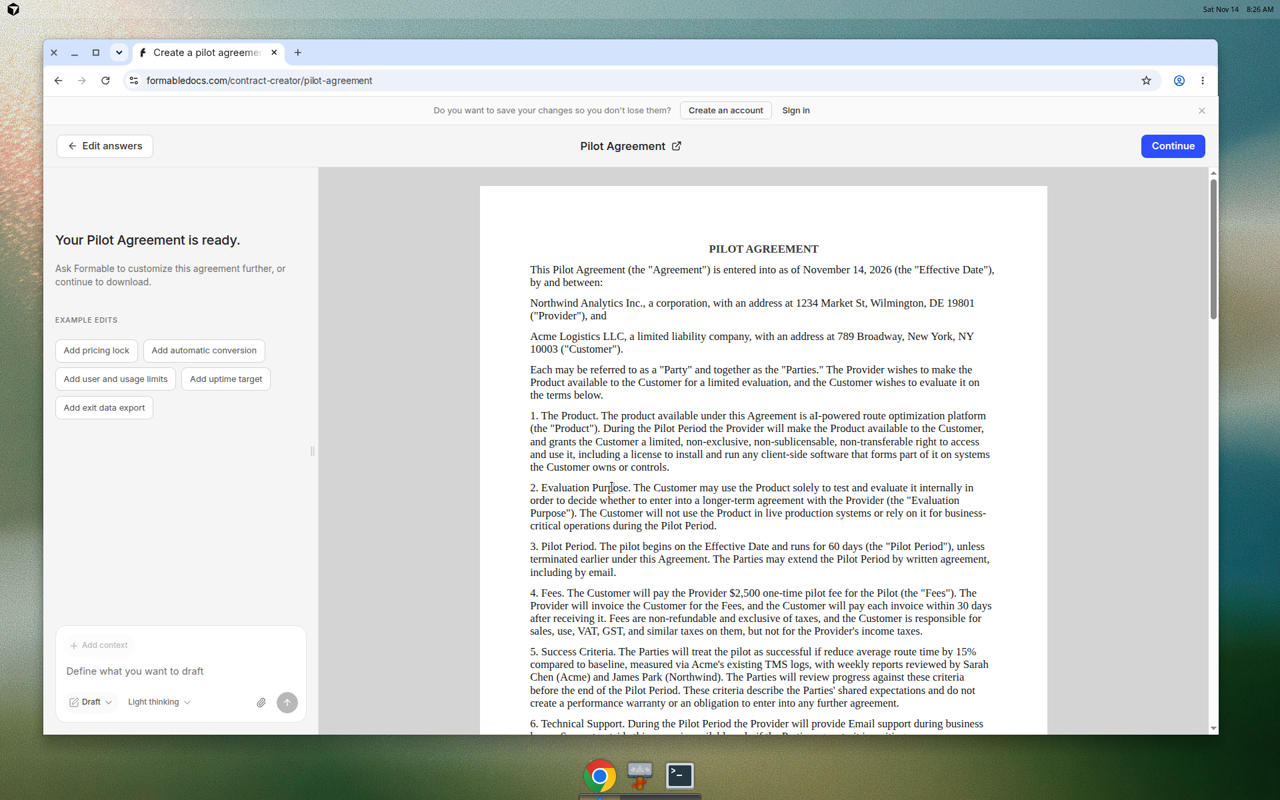
If legal asks for changes during contract review, update the proposal to match. The proposal and the agreement should never diverge. When they do, confusion follows: the business team thinks the pilot covers one scope, and the legal team thinks it covers another.
For detailed guidance on using the contract creator, see how to create a pilot agreement for a B2B customer.
Use a free pilot agreement template to turn an approved proposal into a binding contract. The template walks through every clause and generates the full agreement in minutes.
FAQ
Should I send the proposal before or after the demo?
Send the proposal after the demo and the scoping call. The demo confirms interest; the proposal documents what will be tested; the pilot agreement makes it binding.
Who approves the proposal on the customer side?
The champion circulates the proposal to the economic buyer, IT, and any other stakeholders who need to approve the pilot. Get written approval from the buyer before drafting the agreement.
Can the proposal include legal terms?
No. The proposal is a business document, not a legal document. Legal terms belong in the pilot agreement. The proposal focuses on what will be tested and why, not on liability, IP, or indemnities.
What if the customer wants to change the proposal after it is approved?
If the changes are minor, update the proposal and resend it for approval. If the changes are significant, treat it as a new proposal and restart the approval process. Do not draft the pilot agreement until the final proposal is approved.
How long should a pilot project proposal be?
Most proposals are 2 to 3 pages. Longer than that and you are overspecifying the test. Shorter than that and you probably skipped critical details like success measures or baseline data.