
An MFN clause guarantees the beneficiary will receive pricing or terms no less favorable than those the vendor gives comparable customers. Enterprise buyers ask for this language to lock in a competitive rate over a multi-year term. Vendors resist it because it caps their pricing flexibility and, in wide or systemic use, invites antitrust scrutiny. The trade-off is simple: buyer protection against future price discrimination versus vendor exposure to operational drag and regulatory risk.
TL;DR:
- Narrow, objective comparability metrics and fixed look-back windows help ensure MFN clauses remain enforceable and administrable.
- Wide or retroactive MFN clauses used systemically by dominant vendors can trigger antitrust scrutiny and dampen market competition.
- Clear remedies such as price adjustments or refunds, combined with limited scope and sunset dates, reduce legal and regulatory risks.
- Verification methods ranging from self-certification to independent audits balance enforcement with confidentiality concerns.
- For lower-risk deals, simpler alternatives like renewal caps or benchmarking clauses may provide sufficient protection with less complexity.
What is an MFN clause in a SaaS contract?
A most favored nation clause, sometimes called a price parity clause, is a contractual promise that one party won't be treated worse than the vendor's other customers on price or terms. The concept originated in international trade agreements, but it migrated into commercial licensing and now shows up constantly in enterprise SaaS contract negotiation.
The clause comes in a few recognizable shapes, and the differences matter more than most buyers realize when they first see the term in a redline.
- Narrow parity ties the promise to a specific, limited comparison group, such as customers buying the same module set at the same seat count.
- Wide parity extends the promise across an entire customer base or even across sales channels, including resellers and marketplace listings.
- Price-only parity covers just the unit price, leaving payment terms, SLAs, and liability caps untouched.
- Terms parity extends the promise beyond price to things like renewal caps, support tiers, or termination rights.
- Retroactive obligations require the vendor to true up past invoices if a better deal surfaces later; prospective obligations apply only going forward.
Most enterprise SaaS deals land somewhere between narrow price parity and a modest terms parity. Wide, retroactive MFNs are rarer, and for good reason: they're harder to administer and carry more legal weight.
How do you draft an enforceable MFN clause?
An MFN clause is only as good as its comparability definition. Vague language ("similar customers," "comparable deals") gives the vendor room to argue that no comparison ever applies, which makes the clause decorative rather than protective.
Four elements decide whether the clause has teeth:
- Comparable customer definition. Anchor it to objective, measurable criteria: per-seat annual recurring revenue, the specific module bundle, contract term length, and purchase volume. "Similarly situated" is not a metric; ARR per seat is.
- Scope of terms covered. Decide explicitly whether the clause reaches only unit price, or also payment terms, SLA credits, and liability caps. Silence here gets litigated later.
- Trigger mechanism. Some clauses auto-adjust the moment a better deal is signed; most require the buyer to request a review, often annually, which is far less burdensome for the vendor to administer.
- Remedies. State exactly what happens on a violation, rather than leaving it to a generic breach clause.
Pro Tip: Push for a fixed look-back window, such as 90 days, instead of unlimited retroactivity. It gives you real protection without forcing the vendor to reopen every invoice since the contract started, which is the kind of detail that Cornell Law's overview of MFN provisions flags as central to making the clause administrable.
Remedies typically include retroactive price adjustments, a credit or refund, a termination right if the gap is large enough, or a set-off against future invoices. Pick at least two so the buyer has options if the vendor drags its feet.
When do MFN clauses trigger antitrust scrutiny?
Regulators care about scale and market power, not one-off enterprise deals. A narrow MFN negotiated between a mid-size buyer and a SaaS vendor with no dominant market position rarely draws attention. A wide MFN used systemically by a platform with significant market share is a different story entirely.
The core antitrust theories are consistent across jurisdictions: MFNs can act as a price floor, they can reduce a vendor's incentive to compete on price with anyone, and in extreme cases they can facilitate tacit coordination across a market. Legal and economic analysis of MFN clauses shows enforcement attention concentrates on systemic, wide-scale use rather than isolated arms-length contracts.
Empirical work on the EU's Booking.com case found that narrowing or banning wide parity clauses led to lower prices in the markets studied, a real-world signal that wide MFNs can dampen competition rather than just protect a single buyer.
That finding comes from research on price parity clauses in EU platform markets, and it lines up with the academic consensus that narrow MFNs often have procompetitive justifications while wide MFNs are more likely to cause competitive harm. If you're drafting or reviewing an MFN in a SaaS deal, three choices reduce regulatory exposure: keep the scope narrow, add carve-outs for promotions and legacy pricing, and attach a sunset date rather than letting the obligation run indefinitely.
What should be on your MFN negotiation checklist?
Buyers and vendors both walk into MFN negotiations with predictable asks. Knowing which ones are worth fighting for speeds up the whole process.
What buyers typically request:
- An objective comparability standard tied to a pricing metric, not a subjective "similar customer" test.
- Verification rights, whether through vendor certification, a limited audit, or third-party benchmarking.
- A defined retroactivity or look-back window, commonly 60 to 90 days.
- Concrete remedies: adjustment, refund, termination, or set-off, stated in the clause itself.
What vendors typically concede in exchange for carve-outs:
- Promotional or time-limited discounts excluded from the comparison.
- Reseller and channel-partner pricing excluded, since those carry different cost structures.
- Legacy or grandfathered contracts excluded from triggering the clause.
- A minimum volume or ARR threshold before the MFN applies at all.
Treat objective comparability metrics and clear remedies as must-haves. Treat things like automatic (versus on-request) adjustment triggers as nice-to-haves you can trade away to close faster. Formable's MSA drafting guidance walks through where this kind of language typically sits inside a broader master agreement.
What does sample MFN clause language look like?
Short, operative sentences work better than dense paragraphs, both for negotiation speed and for later enforcement. Three positions, adapted to fit your leverage:
- Buyer-favorable: "If Vendor offers any similarly situated customer a lower effective per-seat price for substantially the same package during the term, Vendor shall retroactively apply that price to Customer for the preceding 90 days and prospectively thereafter."
- Balanced: "Vendor shall notify Customer within 30 days if it enters a new agreement with a customer of comparable ARR and module scope at a lower per-seat price, and shall offer Customer the option to adopt that pricing prospectively."
- Vendor-favorable: "Vendor's most favored pricing commitment applies solely to Vendor's direct sales channel, excludes promotional, partner, and legacy pricing, and expires on the second anniversary of the Effective Date."
Notice the geographic and temporal limits doing real work in each version. A clause with no sunset date and no channel exclusion is the one most likely to become a vendor's biggest headache three years later. Formable's MSA template resources include comparable clause starters you can adapt directly.
How do you verify compliance without overburdening the vendor?
Verification is where most MFN clauses actually fail in practice. A promise with no way to check it is a promise on paper only.
- Vendor self-certification, delivered annually, is the lightest-touch option and works fine for lower-risk relationships.
- Scheduled reporting on a fixed cadence gives the buyer visibility without a full audit.
- Limited-scope audit rights, capped to a single review per year with a defined document list, balance verification against confidentiality.
- Independent auditor on demand is the strongest option, reserved for high-value contracts where the buyer needs real teeth.
Pro Tip: Cap the document set an auditor can request, and require redaction of other customers' identifying details. That single limitation resolves most of the vendor's confidentiality objections before they're raised.
What are the most common MFN drafting mistakes?
Most MFN clauses that fail do so quietly, long before anyone notices a violation.
- Vague comparability language ("similar customers") with no trigger event defined lets a vendor argue the clause never actually applies.
- Overbroad retroactivity with no look-back cap forces a vendor to reopen years of invoices over a single pricing change.
- Unlimited geographic scope drags in jurisdictions with entirely different pricing models and currencies.
- Silence on partner and channel pricing lets a vendor route discounts through a reseller and technically stay compliant.
- No stated remedy means the buyer's only recourse is a breach claim, which is slower and weaker than a defined adjustment or set-off right.
The fix in most cases is the same: replace open-ended language with a specific metric, a specific window, and a specific consequence.
How counsel and procurement actually use MFNs in practice
MFNs earn their place in high-spend, multi-year SaaS deals where the buyer has real negotiating leverage and the vendor's pricing is opaque. In lower-stakes renewals, a simple renewal-price cap or a benchmarking clause often gets you similar protection with far less drafting friction. Where an MFN does apply, the bottleneck is rarely the concept. It's tracking obligations, comparability data, and audit windows across dozens of active contracts. AI-assisted contract review and redlining tools cut that administrative load substantially by flagging missing triggers and remedies before signature.
— Alex
How Formable operationalizes MFN clauses
Drafting a strong MFN clause is only half the work. Someone still has to track the trigger windows, compare pricing across contracts, and prove compliance when a buyer asks. Formable handles that operational layer directly.
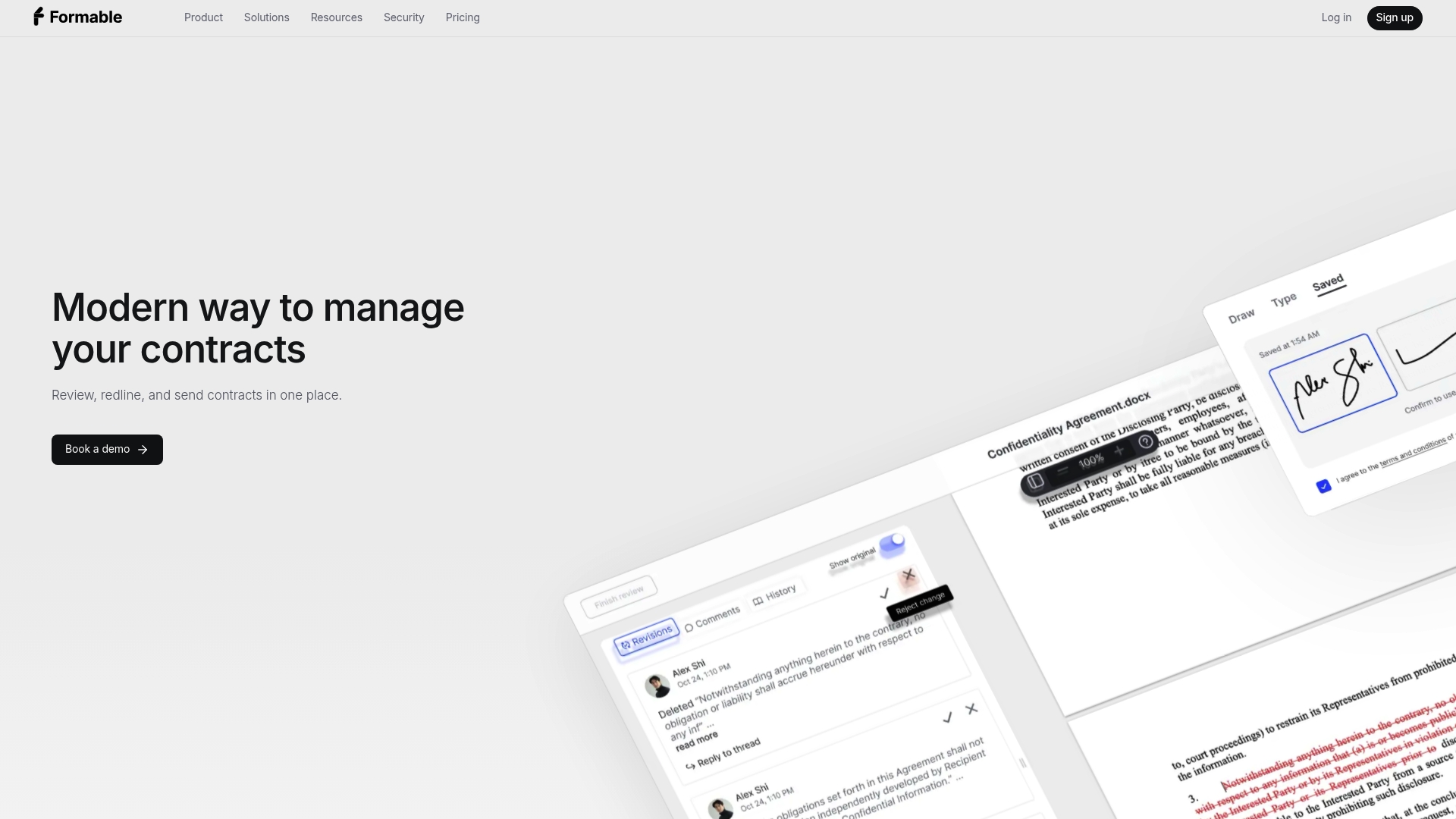
Formable's contract creation tool combines templates with generative AI, so you can start from a balanced MFN clause and adjust scope, triggers, and remedies without rebuilding the language from scratch. The redlining and negotiation workflow lets both sides align on comparability definitions and look-back windows before signature, instead of trading email versions back and forth. Once signed, Formable's AI review engine flags missing triggers or vague comparability language during intake, and every adjustment, notice, or audit request gets logged in an immutable audit trail. Add embedded e-signing to close the loop, and the whole MFN lifecycle, from draft to enforcement, runs through one system. Start a draft at Formabledocs to see how your next SaaS contract holds up.
Sources
For deeper research: the American University law review analysis covers antitrust theory; the Booking.com parity clause study offers empirical pricing data; Cornell Law's Wex entry gives a concise legal definition; and SEC filing exhibits show real contract language in practice.
- Most-favored-nation clauses in commercial contracts: legal and economic analysis and proposal for a guideline
- Online platform price parity clauses: Evidence from the EU Booking.com case
- Most-favored-nation clauses in commercial contracts: legal and economic analysis and proposal for a guideline
- Most favored nation (definition) — Cornell Law
FAQ
What is an MFN clause?
An MFN, or most favored nation, clause is a contract term guaranteeing that one party receives pricing or terms no less favorable than those offered to comparable customers. In SaaS contracts, it typically protects a buyer's per-seat or ARR pricing against future discounts given to similar accounts.
Does antitrust law treat MFN clauses differently based on market power?
Yes. Enforcement attention concentrates on wide, systemic use of MFNs by firms with market power, while narrow MFNs in isolated enterprise deals rarely draw regulatory scrutiny.
Can you give an example of MFN clause language in a contract?
A common balanced version reads: "Vendor shall notify Customer within 30 days if it enters a new agreement with a customer of comparable ARR and scope at a lower per-seat price, and shall offer Customer that pricing prospectively." Vendor-favorable versions add channel and promotional carve-outs.
What are the disadvantages of an MFN clause for a vendor?
Wide or retroactive MFNs restrict a vendor's pricing flexibility, create administrative burden tracking comparable deals, and can raise antitrust exposure if used broadly across the vendor's customer base. They can also discourage vendors from offering short-term promotions to anyone.
How does an MFN clause differ from a price parity clause?
They're generally the same concept in commercial contracts. "Price parity clause" is more common in platform and marketplace agreements, while "MFN clause" is the broader legal term also used in SaaS contract negotiation and licensing agreements.