
A master service agreement (MSA) is the baseline legal framework that governs all future work between two parties, letting them launch new projects through Statements of Work (SOWs) without renegotiating core terms each time. According to Thomson Reuters, every well-drafted MSA covers defined parties, scope, payment terms (net 30 days is the standard US baseline), IP ownership, confidentiality, liability limits, warranties, and dispute resolution.
TL;DR
- The MSA holds the permanent legal ground rules. The SOW carries project-level details: fees, scope, schedule, and acceptance criteria. Together they form a two-tier system that speeds repeat deals without sacrificing legal protection.
- Must-have clauses: IP ownership, indemnity, limitation of liability, confidentiality, payment terms, termination (with cure periods), dispute resolution, and a clear order-of-precedence provision.
- Authoritative drafting resources include Practical Law's US-style MSA, SEC exhibit filings, and Formable's MSA template and clause guide.
What an MSA actually does for your business
An MSA sets the rules once so every subsequent engagement can start from a signed baseline rather than a blank page. The commercial logic is straightforward: negotiate the hard clauses — IP, indemnity, liability caps, confidentiality — once, then let each SOW handle the project-specific details. That structure is what legal operations teams call the hybrid model, and it is the dominant pattern in US B2B contracting.
Core business benefits:
- Faster onboarding for repeat work. Once the MSA is signed, a new SOW can be executed in days rather than weeks because neither party needs to revisit governing law, indemnity scope, or IP ownership.
- Centralized risk controls. Liability caps, indemnity carve-outs, and insurance requirements live in one document, so they cannot drift across individual project contracts.
- Predictable payment and acceptance processes. Standard invoicing and acceptance criteria help reduce payment and deliverable disputes.
- Reduced legal spend over time. The upfront investment in a well-drafted MSA pays back quickly when the same framework governs ten or twenty SOWs.
Common use cases by function:
- Consulting retainers: a professional services firm and its client sign one MSA, then issue monthly or quarterly SOWs as the engagement scope evolves.
- SaaS vendor relationships: a software vendor and enterprise buyer use an MSA to fix data protection, IP, and liability terms, with Order Forms handling subscription pricing and seat counts.
- Marketing agency engagements: the MSA covers confidentiality and IP assignment for all creative work; individual campaign SOWs set budgets and deliverable schedules.
- IT services and managed services: the MSA defines service standards and termination rights; SLAs attached to SOWs set uptime targets and response times.
Pro Tip: Calibrate the complexity of your MSA to your bargaining position and transaction volume. A startup signing its first enterprise customer needs a tighter, more protective MSA than a large vendor with established market leverage. One-size-fits-all templates create unnecessary friction — tailor the depth to the risk.
Essential MSA clauses: a clause-by-clause drafting checklist

The table below maps each core clause to its protective purpose, common negotiation positions, and a priority flag. Sample language follows the table.
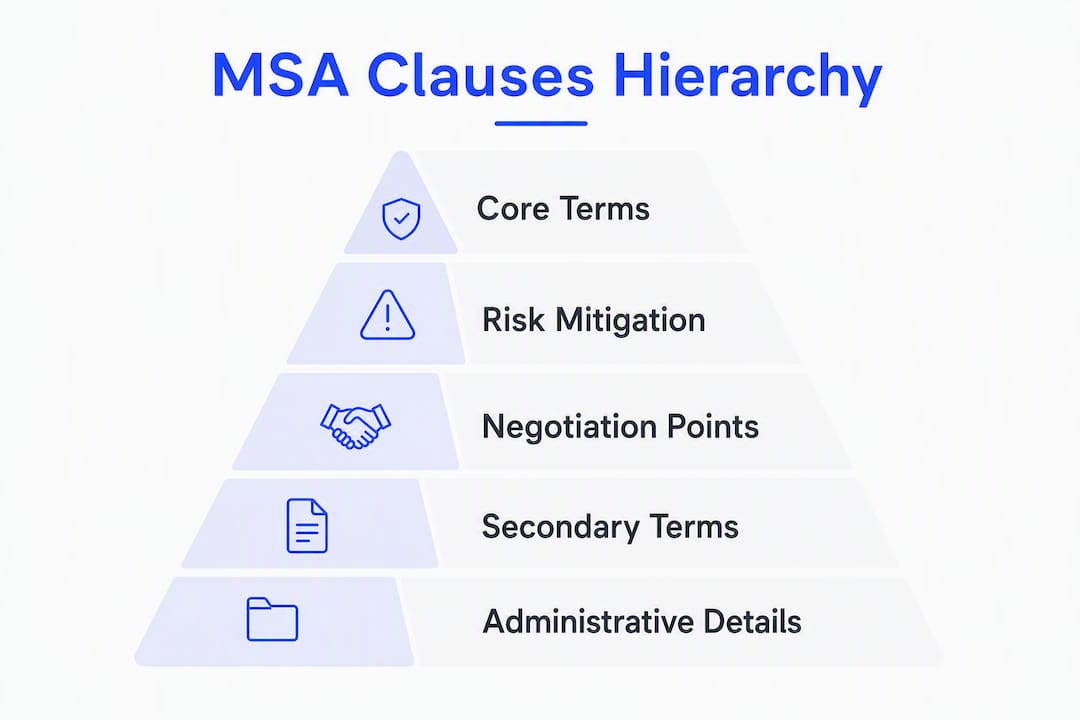
| Clause | What it protects | Common negotiation positions | Priority |
|---|---|---|---|
| Parties and recitals | Identifies contracting entities and affiliates | Vendor wants broad affiliate coverage; buyer wants named entities only | Must-have |
| Scope and SOW incorporation | Defines what services are covered and how SOWs attach | Vendor prefers broad scope; buyer prefers narrow to limit implied obligations | Must-have |
| Order of precedence | Resolves conflicts between MSA and SOW | MSA-controls, SOW-controls, or hybrid by topic | Must-have |
| Payment terms | Sets invoicing cycle and payment period | Net 30 is the standard US baseline; vendors and buyers have varying preferences for shorter or longer payment terms. | Must-have |
| Taxes | Allocates tax obligations | Vendor typically excludes taxes from fees; buyer confirms withholding obligations | Must-have |
| IP ownership and license grants | Fixes who owns deliverables and background IP | Buyer wants full assignment; vendor wants to retain background IP and grant a license | Must-have |
| Confidentiality | Protects non-public information | Mutual NDA language; carve-outs for legal disclosure and prior knowledge | Must-have |
| Data protection | Addresses personal data handling | Reference to DPA or addendum; CCPA/GDPR applicability | Must-have |
| Warranties | Allocates risk for defective services | Vendor limits to re-performance; buyer wants broader remedy rights | Must-have |
| Limitation of liability | Caps total exposure | Cap tied to fees paid in prior 12 months; mutual or asymmetric | Must-have |
| Indemnification | Allocates third-party claim risk | IP infringement, gross negligence, and data breach are standard triggers | Must-have |
| Insurance | Requires minimum coverage | General liability, E&O, cyber, and workers' comp are common minimums | Must-have |
| Acceptance criteria | Defines when deliverables are accepted | Objective criteria preferred; deemed-acceptance fallback after notice period | Must-have |
| Change control | Manages scope changes | Written change order required; no verbal amendments | Negotiable |
| Termination for cause | Allows exit on material breach | A cure period is commonly included to allow remedy time before termination. | Must-have |
| Termination for convenience | Allows exit without cause | Notice periods and wind-down fees are often included but vary by agreement. | Negotiable |
| Transition assistance | Ensures continuity after termination | Duration and cost of transition services | Negotiable |
| Assignment and subcontracting | Controls who can perform or transfer the contract | Buyer approval for subcontractors; no assignment without consent | Must-have |
| Governing law and jurisdiction | Sets the legal framework | Delaware or New York law is common in US commercial contracts | Must-have |
| Dispute resolution | Sets the resolution path | Negotiation, then mediation, then arbitration or litigation | Must-have |
| Amendments | Controls how the MSA is modified | Written amendment signed by both parties | Must-have |
| Audit rights | Allows verification of compliance | Scope limited to relevant records; reasonable notice required | Negotiable |
| Survival | Identifies clauses that survive termination | IP, confidentiality, indemnity, and liability typically survive | Must-have |
Order-of-precedence drafting note. Three canonical patterns exist: MSA-controls (the MSA wins all conflicts), SOW-controls (the SOW wins), and hybrid by topic. Best practice is the hybrid: keep IP, indemnity, liability, confidentiality, and dispute resolution in the MSA; let fees, scope, schedule, and acceptance live in the SOW. When a specific project needs to deviate from an MSA clause, the SOW must expressly reference and override that clause by name. Absent explicit override language, most legal teams default to the MSA.
Sample clause snippets (adapt for your engagement):
IP assignment: "All work product and deliverables created by Vendor specifically for Buyer under a Statement of Work shall be the sole property of Buyer upon full payment of all fees due under the applicable SOW. Vendor retains all rights in its pre-existing tools, methodologies, and background intellectual property."

Limitation of liability: "In no event shall either party's aggregate liability arising out of or related to this Agreement exceed the total fees paid or payable by Buyer to Vendor in the twelve (12) months immediately preceding the event giving rise to the claim."
Termination for cause with cure period: "Either party may terminate this Agreement upon written notice if the other party materially breaches this Agreement and fails to cure such breach within thirty (30) days after receiving written notice specifying the breach in reasonable detail."
SOW incorporation and precedence: "Each Statement of Work is incorporated into and governed by this Agreement. In the event of a conflict between this Agreement and a Statement of Work, the terms of this Agreement shall control unless the Statement of Work expressly identifies the specific provision of this Agreement it intends to supersede."
Pro Tip: Flag your top three risk clauses before you open negotiations. For most US B2B deals, those are IP ownership, the liability cap, and the indemnity scope. Resolving those three first prevents them from becoming late-stage blockers.
How MSAs, SOWs, and SLAs differ and how to use them together
The three documents serve distinct functions. Treating them as interchangeable is one of the most common drafting mistakes in US commercial contracting.
| Document | Primary purpose | Renegotiation frequency | Fixes IP/liability/pricing? | Level of detail |
|---|---|---|---|---|
| MSA | Legal and commercial ground rules for the relationship | Rarely (typically every 3–5 years or on major relationship change) | IP and liability: yes. Pricing: no | Relationship level |
| SOW | Project-specific scope, fees, schedule, and acceptance | Per project or engagement | Pricing and scope: yes. IP and liability: inherits from MSA unless expressly overridden | Project level |
| SLA | Service performance standards and remedies | Annually or per contract term | No — references MSA and SOW terms | Metric level |
The MSA is the permanent document. The SOW is the working document. The SLA is the performance scorecard.
Two practical examples of when each document controls:
- SOW overrides MSA on a narrow topic. A software development SOW includes a clause stating: "Notwithstanding Section 8.2 of the Master Services Agreement, all source code deliverables under this Statement of Work shall be licensed to Buyer on a perpetual, royalty-free basis rather than assigned." That express reference and override is valid. Without it, the MSA's IP assignment clause would govern.
- MSA retains control despite SOW silence. A marketing agency SOW says nothing about confidentiality. The MSA's mutual confidentiality clause applies automatically to all information exchanged during the engagement. The SOW does not need to repeat it.
For a ready-to-use SOW template that pairs with a standard MSA structure, Formable's template library covers the key project-level fields.
Negotiation strategy, timeline, and cost drivers
Effective MSA negotiation follows a predictable sequence. Skipping steps — especially the preparation phase — is where deals slow down.
Stepwise negotiation checklist:
- Prepare your template and playbook. Start from your own paper whenever possible. Define your non-negotiable positions (liability cap floor, IP ownership, governing law) before the first redline exchange.
- Issue the first draft with a cover note. Flag your key positions in a short cover email so the counterparty's counsel can focus their review.
- First redline round. Counterparty returns marked-up draft. Review against your playbook; accept, reject, or counter each redline with a clear rationale.
- Negotiation call. Resolve open issues verbally, then confirm agreed positions in writing before the next draft.
- Second redline round. Circulate a clean draft reflecting agreed changes. Limit this round to genuinely open items.
- Executive sign-off checkpoint. Before final execution, confirm that commercial terms in the MSA align with what the account team has committed to in the SOW.
- Execution and intake. Route for e-signature, capture the signed MSA in your contract repository, and trigger the SOW intake process.
Timeline and cost estimates:
| Scenario | Typical timeline | Primary cost drivers |
|---|---|---|
| Template reuse (your paper, low negotiation) | 1–2 weeks | Internal review time only |
| Moderate negotiation (2–3 redline rounds) | 3–6 weeks | Outside counsel review; IP and liability issues |
| Highly negotiated bespoke MSA | 8 weeks | Specialist counsel (IP, data privacy, cross-border); insurance requirements; custom data protection obligations |
ContractsCounsel notes that drafting costs rise significantly when IP allocation, data complexity, or industry-specific regulatory requirements bring in specialist counsel beyond a standard template review.
When to use each resource:
- In-house counsel: standard template negotiations, low-to-moderate liability exposure, familiar counterparty.
- Outside counsel: novel IP allocations, high liability caps, cross-border data obligations, unusual indemnity structures, or regulated industries (healthcare, financial services, defense).
- Fixed-price drafting engagement: when you need a clean first draft fast and your in-house team is at capacity. Many commercial law firms offer fixed-fee MSA drafting for standard B2B engagements.
Common MSA red flags and how to fix them
Most MSA disputes trace back to a small set of drafting failures. Knowing what to look for during review saves significant downstream friction.
Pro Tip: Run every incoming MSA against a written playbook before you start redlining. A playbook that flags your top ten risk clauses automatically — using contract review software — cuts review time and prevents reviewers from missing issues under deadline pressure. Contract management platforms that automate risk checks surface nonstandard SOW language before signature.
Red flags and mitigations:
- Ambiguous precedence language. "This Agreement shall govern except as otherwise set forth herein" is circular and unenforceable in a conflict. Fix: use the hybrid precedence clause from the Essential Clauses section above, naming which document controls for which topic.
- Vague SOW references. An MSA that says "services shall be as agreed in writing" without defining how SOWs attach creates disputes about which documents are incorporated. Fix: require SOWs to be signed by authorized representatives of both parties and expressly reference the MSA by name and date.
- Open-ended indemnities. Indemnity clauses with no carve-outs for the indemnitee's own negligence expose one party to unlimited risk. Fix: limit indemnity triggers to IP infringement, gross negligence, willful misconduct, and data breaches caused by the indemnifying party.
- Uncapped liability. An MSA with no liability cap is a material risk for any vendor. Fix: set a mutual cap tied to fees paid in the prior 12 months, with carve-outs for indemnity obligations, confidentiality breaches, and willful misconduct.
- Missing cure periods. Termination for cause without a defined cure period can allow one party to terminate immediately on any alleged breach. Fix: require 30 days written notice and a reasonable opportunity to cure before termination becomes effective.
- Vague acceptance criteria. "Deliverables shall be satisfactory to Buyer" gives the buyer unlimited rejection rights. Fix: define objective acceptance criteria in each SOW and include a deemed-acceptance fallback (e.g., acceptance if no written objection within 10 business days of delivery).
- Missing transition assistance. An MSA that allows immediate termination without transition obligations can strand the buyer mid-project. Fix: require the vendor to provide transition assistance for a defined period (typically 30–90 days) at cost, regardless of which party terminates.
- Weak or missing data protection provisions. An MSA that does not reference a Data Processing Addendum (DPA) or address CCPA/GDPR applicability creates compliance gaps. Fix: include a data protection clause that requires execution of a DPA for any processing of personal data.
Actionable template language and a sample clause library
The snippets below are generic, non-vendor-specific starting points. Adapt them to your risk profile and governing law before use.
Confidentiality: "Each party agrees to hold the other party's Confidential Information in strict confidence and not to disclose it to any third party without prior written consent, except as required by law or to employees and advisors with a need to know who are bound by obligations of confidentiality no less protective than those set forth herein."
Warranty disclaimer: "EXCEPT AS EXPRESSLY SET FORTH IN THIS AGREEMENT, VENDOR MAKES NO WARRANTIES, EXPRESS OR IMPLIED, INCLUDING ANY IMPLIED WARRANTIES OF MERCHANTABILITY, FITNESS FOR A PARTICULAR PURPOSE, OR NON-INFRINGEMENT."
Indemnity (short form): "Vendor shall defend, indemnify, and hold harmless Buyer from and against any third-party claims arising out of Vendor's gross negligence, willful misconduct, or infringement of a third party's intellectual property rights in the deliverables."
Change order language: "No change to the scope, fees, or schedule of a Statement of Work shall be effective unless documented in a written change order signed by authorized representatives of both parties."
Payment and invoicing: "Vendor shall invoice Buyer monthly in arrears. Buyer shall pay each invoice within thirty (30) days of receipt. Amounts not paid within thirty (30) days shall accrue interest at the lesser of 1.5% per month or the maximum rate permitted by applicable law."
Acceptance criteria: "Buyer shall notify Vendor in writing of any non-conformance within ten (10) business days of delivery of a deliverable. If Buyer does not provide written notice within such period, the deliverable shall be deemed accepted. Vendor shall correct confirmed non-conformances within a mutually agreed timeframe at no additional charge."
Termination for convenience: "Either party may terminate this Agreement or any Statement of Work for convenience upon thirty (30) days' prior written notice to the other party. Buyer shall pay Vendor for all work performed and non-cancellable commitments incurred prior to the effective date of termination."
Authoritative template sources. Practical Law's US-style MSA includes drafting notes and alternative provisions for each clause. The RTI International MSA template is a 21-page public example with appendices and standard terms illustrating government and indefinite-delivery language. SEC EDGAR filings contain real executed MSAs filed as exhibits, which show how publicly traded companies draft and structure these agreements in practice. Formable's MSA template and clause guide is a ready-to-adapt resource built for US technology and services companies.
Pro Tip: When adapting sample clauses for high-risk engagements, add a "materiality" qualifier to breach definitions and a "knowledge" qualifier to representations. Those two adjustments reduce the risk of technical breaches triggering disproportionate remedies.
Who should review what, and how to manage an MSA after signature
Execution is not the end of the MSA lifecycle. Most operational problems with master service agreements arise after signature, not before.
Escalation criteria for outside counsel involvement:
- Novel IP allocations (joint development, open-source licensing, platform integrations).
- Liability exposure above your standard cap threshold.
- Unusual indemnity structures (cross-indemnity, uncapped IP indemnity).
- Cross-border data obligations (EU Standard Contractual Clauses, CCPA service provider terms).
- Regulated industries: healthcare (HIPAA BAA requirements), financial services (SOC 2, GLBA), or government contracting.
Post-signature lifecycle checklist:
- Version control: store the executed MSA with a clear naming convention (e.g., CompanyName_MSA_v1_ExecutedDate) and track all amendments against the original.
- Signature audit trails: retain timestamped e-signature records for the life of the agreement plus any applicable statute of limitations period.
- SOW intake process: require all new SOWs to reference the MSA by name and date, and route them through the same review and approval workflow.
- Renewal notice periods: calendar renewal and expiration dates at least 90 days in advance. Many MSAs auto-renew unless notice is given within a defined window.
- Amendment workflow: use a written amendment template that references the original MSA, identifies the specific clauses being modified, and is signed by authorized representatives. Formable's contract amendment template covers this workflow.
- Termination close-out: on termination, confirm which obligations survive (IP, confidentiality, indemnity), issue final invoices, and document transition assistance completion.
Pro Tip: Build a clause library from your executed MSAs. Every time you negotiate a clause to a final agreed position, save that language as a named variant in your template library. Over time, that library becomes a negotiation playbook that cuts redline cycles from weeks to days.
For a broader view of how contract management software supports the full MSA lifecycle, Formable's contract workflow management guide covers intake, review, negotiation, and renewal in one place.
How Formable supports MSA workflows from draft to signature
Formable is built for the full MSA workflow, not just the signing step. Here is how the platform maps to the tasks covered in this guide.
Relevant Formable capabilities for MSA management:
- Template storage and contract creation: generate a new MSA from a stored template using Formable's contract creator, which combines clause libraries with generative AI to produce a first draft in minutes.
- AI contract review: upload an incoming MSA and Formable's review engine flags missing clauses, nonstandard language, and risk items against your playbook automatically.
- Redlining and collaborative negotiation: both parties can exchange and resolve redlines inside Formable's negotiation interface, with a full audit trail of every change.
- E-signing: route the final MSA for e-signature with timestamped, immutable signature records. Formable also provides an e-signing API for teams that want to embed signature collection into their own platforms.
- SOW onboarding: after MSA execution, use the same platform to generate, negotiate, and sign each subsequent SOW, keeping all related documents linked in one repository.
A short workflow example. A legal operations manager at a SaaS company receives an incoming MSA from a new enterprise customer. She uploads it to Formable's review engine, which surfaces three issues: the liability cap is asymmetric (vendor-only), the cure period is missing, and the data protection clause does not reference a DPA. She applies her team's playbook, generates a redlined version with proposed corrections, and routes it to the counterparty through Formable's negotiation tool. Two redline rounds later, both parties sign via e-signature. The executed MSA, all redline versions, and the audit trail are stored in the same workspace, ready for the first SOW.
Pro Tip: Use Formable's playbook upload feature to encode your top risk positions as automated flags. When a new MSA comes in, the system checks it against your playbook before a human reviewer touches it — so your team's attention goes to genuine issues, not routine clause verification.
Key takeaways
An MSA agreement is most effective when it separates permanent legal terms from project-level commercial terms, uses explicit SOW override language for exceptions, and is actively managed across its full lifecycle with version control, renewal calendars, and a clause library.
| Point | Details |
|---|---|
| Use the hybrid precedence model | Keep IP, indemnity, and liability in the MSA; put fees, scope, and schedule in the SOW. |
| Require explicit SOW overrides | A SOW must name the specific MSA clause it supersedes; silence defaults to the MSA. |
| Set 30-day cure periods | Define cure periods (30 days is standard) for termination for cause to prevent abrupt project stoppage. |
| Centralize liability caps | A single cap in the MSA (typically tied to fees paid in the prior 12 months) prevents contradictory project-level terms. |
| Operationalize with Formable | Formable's contract creator, AI review, redlining, and e-signing tools support the full MSA workflow from first draft to executed agreement. |
The clause that teams keep getting wrong
The order-of-precedence provision is the most underestimated clause in any MSA. Most teams treat it as boilerplate and accept whatever language the other side proposes. That is a mistake with real consequences.
The problem is not that teams choose the wrong precedence model. It is that they choose one without thinking through the downstream implications for their SOW workflow. An MSA that says "the SOW controls in all conflicts" sounds flexible, but it means every SOW becomes a potential vehicle for quietly overriding your liability cap or IP assignment clause. A vendor's account team issues a SOW with a custom IP clause, and suddenly the MSA's carefully negotiated IP terms are gone.
The hybrid model — MSA controls on legal framework terms, SOW controls on commercial terms, with express override language required for any deviation — is the right answer for most US B2B relationships. But it only works if your SOW template is designed to enforce it. A SOW that does not reference the MSA by name and date, or that does not include a field for express overrides, will create ambiguity the moment a dispute arises.
The operational fix is simpler than most teams expect. Build the override requirement into your SOW template as a named field. Require the account team to either confirm "no MSA deviations" or list the specific clauses being modified. That single structural change eliminates most precedence disputes before they start.
Operationalize your MSA process with Formable
Drafting a solid MSA is one thing. Running it at scale across dozens of vendor and customer relationships is another. Formable gives legal and commercial teams a single platform to create MSAs from AI-assisted templates, enforce clause playbooks during review, collaborate on redlines in real time, and collect e-signatures with a full audit trail.
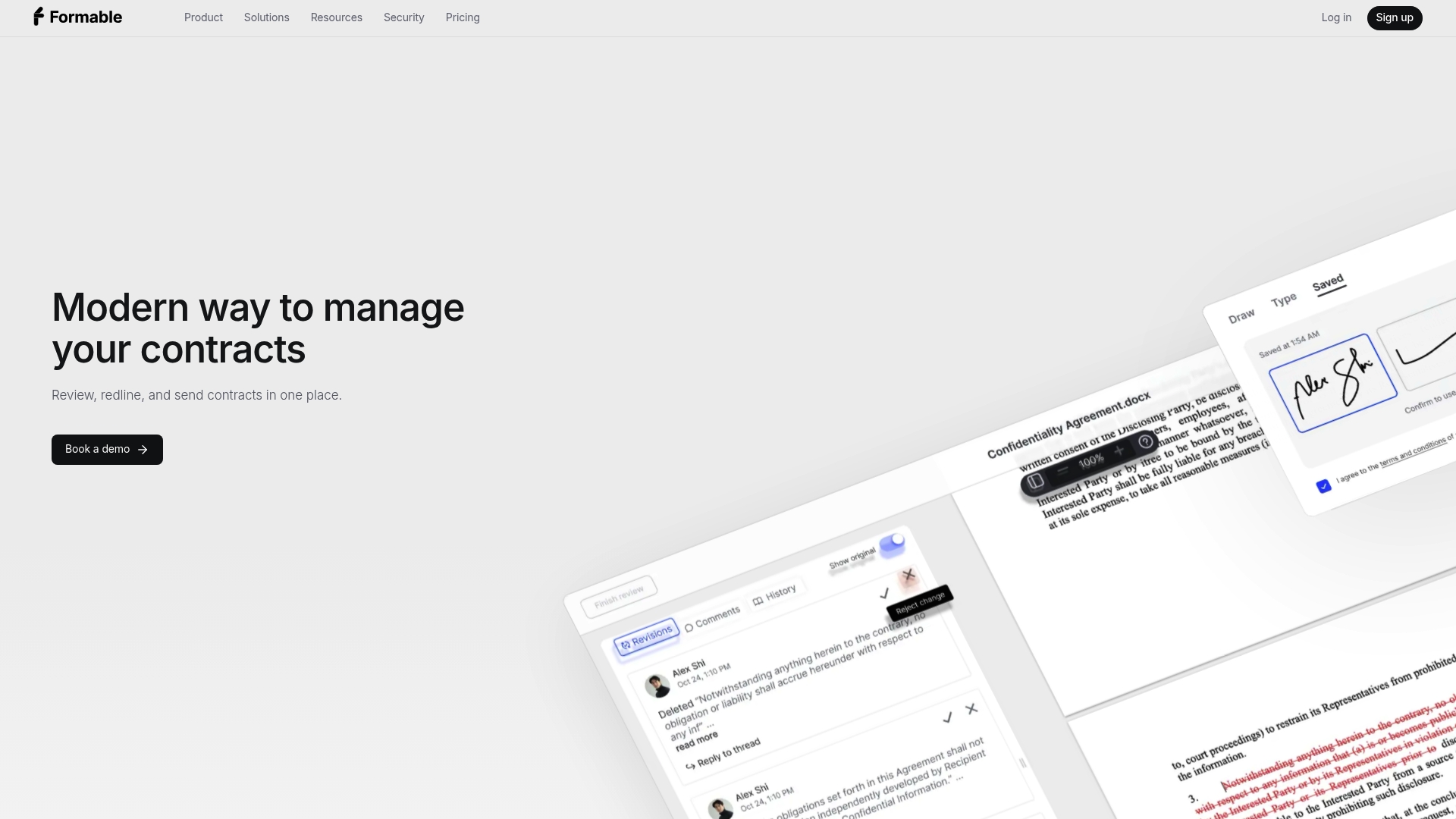
The contract creator generates a first draft from your stored templates in minutes. The review engine checks incoming agreements against your playbook automatically. The negotiation tool keeps all redline versions in one place, so nothing gets lost in email threads. And when both parties are aligned, e-signing closes the loop with timestamped, immutable records.
If your team is managing MSAs, SOWs, DPAs, or NDAs and wants to cut cycle time without cutting corners, start with Formable and reach out to walk through your specific workflow.
Useful sources and further reading
The sources below are vetted references for US MSA drafting, negotiation, and lifecycle management.
- Master Services Agreement (US Style) — Practical Law / Thomson Reuters: The authoritative US-style MSA standard document with drafting notes, alternative provisions, and negotiating tips for each clause. Requires a Practical Law subscription but is the gold standard for US commercial drafting.
- SEC EDGAR MSA exhibit: A real executed MSA filed as a public exhibit by a publicly traded company. Useful for seeing how commercial parties actually draft and structure these agreements, including IP, liability, and termination provisions.
- RTI International MSA template (PDF): A 21-page publicly available MSA template with appendices. Illustrates government and indefinite-delivery language, subagreement procedures, and standard terms. Good reference for organizations working with government-adjacent counterparties.
- Master Services Agreement (MSA) — Chaindoc Docs: Practitioner handbook covering hybrid precedence patterns, SOW override language, and common drafting pitfalls. Particularly useful for the order-of-precedence section.
- What is an MSA? — Thomson Reuters: Accessible overview of MSA components, payment term conventions, and the two-tier MSA/SOW model. Good starting point for teams new to the structure.
- Formable MSA template and clause guide: Ready-to-adapt MSA template built for US technology and services companies, with clause guidance and AI-assisted drafting via Formable's contract creator.
| Source | Best for |
|---|---|
| Practical Law (Thomson Reuters) | Clause-level drafting notes and alternative provisions |
| SEC EDGAR exhibits | Real-world executed MSA examples from public companies |
| RTI MSA template | Government and indefinite-delivery contract language |
| Chaindoc MSA handbook | Hybrid precedence and SOW override guidance |
| Formable MSA template | Ready-to-use US B2B template with AI-assisted drafting |
FAQ
What is an MSA in an agreement?
An MSA (master service agreement) is a contract that sets the governing legal terms for all future work between two parties, allowing individual projects to be executed via Statements of Work without renegotiating core terms each time.
What does MSA stand for in a contract?
MSA stands for master service agreement. It is sometimes called a framework agreement and functions as the permanent legal baseline for an ongoing B2B relationship.
What is the difference between an SLA and an MSA?
An MSA sets the legal and commercial ground rules for the entire relationship. An SLA (service level agreement) defines specific performance standards, uptime targets, and remedies for a particular service, and typically operates within the framework the MSA establishes.
How much does drafting an MSA cost?
Cost varies widely based on complexity. A template-based MSA with minimal negotiation may require only internal review time, while a highly negotiated agreement involving IP allocation, cross-border data obligations, or specialist counsel can take significantly longer and cost more. ContractsCounsel identifies IP complexity, industry-specific requirements, and the need for specialist counsel as the primary cost drivers.
What is the difference between an MSA and a SOW?
The MSA is the permanent legal framework covering IP, liability, confidentiality, and dispute resolution. The SOW is a project-level document that sets fees, scope, schedule, and acceptance criteria for a specific engagement, operating within the terms the MSA establishes.