Software license agreement template: a practical guide

Alex Shi

A software license agreement template gives you a ready legal framework to define exactly how your software can be used, by whom, and under what conditions. It protects your intellectual property, limits your liability, and sets clear expectations before a single user installs or accesses your product. Whether you are a startup shipping your first SaaS product or a business licensing enterprise software, the right template saves time and prevents costly disputes.
Table of Contents
- What a software license agreement template looks like
- What is a software license agreement and why it matters
- Who are the parties in a software license agreement?
- Key terms and clauses in a software license agreement
- How to create or customize a software license agreement template
- Enforceability and legal considerations
- Formable makes software license agreements faster to close
- FAQ
- Key takeaways
What a software license agreement template looks like
A software license agreement is a legally binding contract between a software vendor and an end user. It grants the user a limited right to use the software without transferring ownership. The template version of this agreement gives you a pre-structured document with placeholder fields you fill in to match your specific product, pricing model, and user base.
Every solid template covers the same core ground:
- Parties: Full legal names of the licensor and licensee
- License grant: The specific rights being granted (non-exclusive, non-transferable, limited use)
- Scope and restrictions: What the user can and cannot do with the software
- Payment terms: License fees, billing cycles, and renewal conditions
- Intellectual property: Confirmation that the vendor retains all ownership rights
- Warranties and disclaimers: What the vendor guarantees and what it does not
- Liability limitations: Caps on damages the vendor can be held responsible for
- Termination: Conditions under which either party can end the agreement
- Governing law: The jurisdiction whose laws apply to the contract
The SEC's EDGAR database hosts real executed agreements filed by public companies, which are useful as structural references. Reuters Practical Law also publishes a short-form template with integrated drafting notes for off-the-shelf software licensing.
Pro Tip: Before customizing any template, read the license grant clause first. That single clause defines the entire scope of what the user is allowed to do. Everything else in the agreement flows from it.
What is a software license agreement and why it matters
A software license agreement is not a transfer of ownership. The software is licensed, not sold. Microsoft's own license terms state this explicitly: "Microsoft reserves all other rights." That distinction shapes every clause in the agreement and determines what recourse a vendor has if a user violates the terms.
These agreements appear in several forms depending on the context:
- End-user license agreement (EULA): The most common type, presented during installation or account creation. Usually non-negotiable.
- Proprietary license: Restricts copying, modification, and redistribution. The vendor controls all rights.
- Open-source license: Grants broad rights to use, modify, and distribute, subject to conditions like attribution or share-alike requirements. The Apache License, MIT License, and GPL are the most widely used as of 2022.
- Freeware license: Allows free use but typically prohibits modification or redistribution.
- SaaS agreement: Governs access to cloud-hosted software, often paired with a data processing agreement and service-level terms.
The core purpose of any software licensing contract is to protect the vendor's intellectual property while giving the user enough clarity to stay compliant. Without a written agreement, both sides operate on assumptions, and assumptions are where disputes start.
Who are the parties in a software license agreement?
Every software agreement contract names at least two parties: the licensor and the licensee.
The licensor is the software owner, typically the developer or the company that holds the copyright. The licensor sets the terms, retains all intellectual property rights, and has the authority to grant or revoke access. In enterprise deals, the licensor may be a vendor's legal entity rather than the product team itself.
The licensee is the individual or organization receiving the right to use the software. Their obligations include paying any required fees, staying within the defined scope of use, and not violating restrictions like reverse engineering or sublicensing.
Beyond these two, agreements often address:
- Authorized users: Specific individuals within the licensee's organization permitted to access the software
- Affiliates: Related companies of the licensee that may or may not be covered under the same license
- Sublicensees: Third parties the licensee wants to extend rights to, which typically requires explicit written permission from the licensor
- Third-party beneficiaries: Parties not named in the contract who may still have enforceable rights under certain provisions
In enterprise software deals, the licensee is often a company rather than an individual, and the agreement will specify how many seats or instances are covered. Salesforce's standard software purchase terms illustrate this well: the license grant is explicitly "non-exclusive, non-transferable" and tied to a specific purchasing document that defines the number of authorized copies.
Key terms and clauses in a software license agreement
Getting the clauses right is where most templates either earn their value or fall short. Here are the provisions that carry the most legal weight.
License grant
This clause defines what the licensee can actually do. A typical grant reads as a "non-exclusive, non-transferable, limited license" to install and use the software for internal business purposes. Every word matters. "Non-exclusive" means the vendor can license the same software to others. "Non-transferable" means the licensee cannot hand the license to a third party.

Restrictions
Common restrictions include prohibitions on reverse engineering, decompiling, creating derivative works, and sublicensing without consent. These clauses protect the vendor's source code and prevent competitors from dissecting the product.
Licensing models
The model you choose shapes the entire payment and duration structure:
- Perpetual license: A one-time fee grants indefinite use of a specific version. The licensee owns no rights to future updates unless separately purchased.
- Subscription license: Recurring fees (monthly or annual) grant access for the payment period. Access ends when payment stops.
- Concurrent use license: A set number of users can access the software simultaneously, regardless of total users registered.
- Usage-based license: Fees scale with actual consumption, common in API-driven or cloud products.
Warranties and disclaimers
Most commercial software is licensed "as is," meaning the vendor disclaims implied warranties of merchantability and fitness for a particular purpose. Microsoft's Azure Information Protection terms, for example, state: "YOU BEAR THE RISK OF USING IT." Vendors typically cap their total liability at the fees paid in the prior 12 months, or a modest fixed amount in consumer agreements.
Intellectual property
This clause confirms the vendor owns all rights, title, and interest in the software, including any modifications or derivative works. It also addresses what happens if a third party claims the software infringes their IP, which is where indemnification language becomes critical.
Termination
Either party should have a defined path to exit. Vendors typically reserve the right to terminate immediately for material breach, while licensees may terminate on 30 days' written notice. The agreement should specify what happens to the licensee's data and access upon termination.

Pro Tip: Always include a "survival" clause listing which provisions remain in effect after termination, such as confidentiality, IP ownership, and liability limitations. Without it, those protections may lapse the moment the agreement ends.
Confidentiality
If the software involves access to proprietary data or trade secrets, a confidentiality clause restricts both parties from disclosing that information to third parties. SaaS agreements almost always include this alongside a separate data processing agreement.
Governing law and dispute resolution
Specify the state whose laws govern the contract and whether disputes go to arbitration or litigation. For US-based vendors, Delaware and California are common choices, though the governing law should match where the vendor is incorporated or primarily operates.
How to create or customize a software license agreement template
Starting from a blank document is rarely the right move. A well-structured template gives you the legal scaffolding; customization makes it specific to your product and business model.
Step 1: Identify your licensing model
Before touching the template, decide whether you are granting a perpetual license, a subscription, or usage-based access. That decision drives the payment terms, termination rights, and renewal clauses throughout the entire document.
Step 2: Define the scope precisely
Vague scope language is the most common source of disputes. Specify the number of authorized users, the permitted devices or environments (on-premises, cloud, both), and any geographic restrictions. If the license covers a specific version, name it.
Step 3: Customize restrictions to match your product
Generic templates list standard restrictions, but your product may need more. A developer tool might prohibit use in production environments without an upgraded license. A data analytics platform might restrict the licensee from exporting data to competing services. Write restrictions that reflect how your software actually works.
Step 4: Address support and updates
Clarify whether the license includes technical support, bug fixes, or version updates. If not, state that explicitly. Enterprise buyers will negotiate this; consumer products usually disclaim it entirely.
Step 5: Review liability and indemnification caps
The default "as is" disclaimer and liability cap may not be appropriate for all contexts. B2B agreements often negotiate mutual indemnification for IP infringement claims. Make sure the cap reflects your actual risk exposure.
Step 6: Use AI-assisted review before finalizing
AI-enabled contract tools can flag missing clauses, inconsistent definitions, and high-risk language before you send the agreement to the other side. This is faster and more reliable than a manual read, especially when adapting a template you did not originally draft.
Best practices for customization:
- Never delete a clause without understanding what it protects; replace it with language that achieves the same goal
- Keep defined terms consistent throughout; if you call it "Licensed Software" in the grant clause, use that exact term everywhere
- Have a licensed attorney review any agreement before it governs a significant commercial relationship
- Version-control your templates so you always know which version a given customer signed
Pro Tip: If you manage multiple license agreements across different customers, upload your standard template as a playbook in a contract review tool. That way, any deviation from your standard terms gets flagged automatically during negotiation.
Enforceability and legal considerations
A software license agreement is only as useful as its enforceability. Several factors determine whether a US court will uphold the terms.
Clickwrap vs. browsewrap
The format of acceptance matters enormously. Clickwrap agreements require the user to take an affirmative action, such as checking a box or clicking "I Agree," before proceeding. Courts in the United States have generally upheld clickwrap agreements as enforceable because they demonstrate active consent. Browsewrap agreements, by contrast, assume consent based on continued use of a website or product, with terms linked somewhere on the page. Courts have frequently found browsewrap agreements unenforceable due to insufficient evidence that the user actually saw or agreed to the terms.
Adhesion contracts and mass-market EULAs
Most consumer-facing EULAs are contracts of adhesion): take-it-or-leave-it agreements that the user cannot negotiate. Courts will enforce them, but they scrutinize unconscionable provisions more closely. Enterprise agreements, by contrast, undergo actual negotiation and carry stronger enforceability because both parties had a genuine opportunity to review and modify the terms.
Key legal considerations for US-based agreements:
- Conspicuous presentation: Terms must be reasonably accessible and visible. Burying the agreement in a footer link weakens enforceability.
- Mutual assent: The user must have a meaningful opportunity to review terms before accepting. Presenting terms after payment is a common mistake that courts have penalized.
- Unenforceable provisions: Clauses that waive statutory rights, impose unreasonable penalties, or violate consumer protection laws may be struck down even if the user agreed to them.
- Copyright law: Software is protected under US copyright law, which gives the copyright holder exclusive rights to reproduction, distribution, and derivative works. A license agreement is the mechanism through which the vendor grants limited exceptions to those rights.
- Jurisdiction: Specify governing law and venue clearly. Without it, a dispute could be litigated in a jurisdiction you did not anticipate.
Patterns from real contract data show that agreements with clear section headings, plain-language summaries, and prominent acceptance mechanisms are significantly less likely to face enforceability challenges. The structure of the document is not just a formatting preference; it is a legal risk factor.
Formable makes software license agreements faster to close
Drafting a software license agreement from a template is a good start. Getting it negotiated, redlined, and signed without losing weeks in email threads is where most teams hit friction.
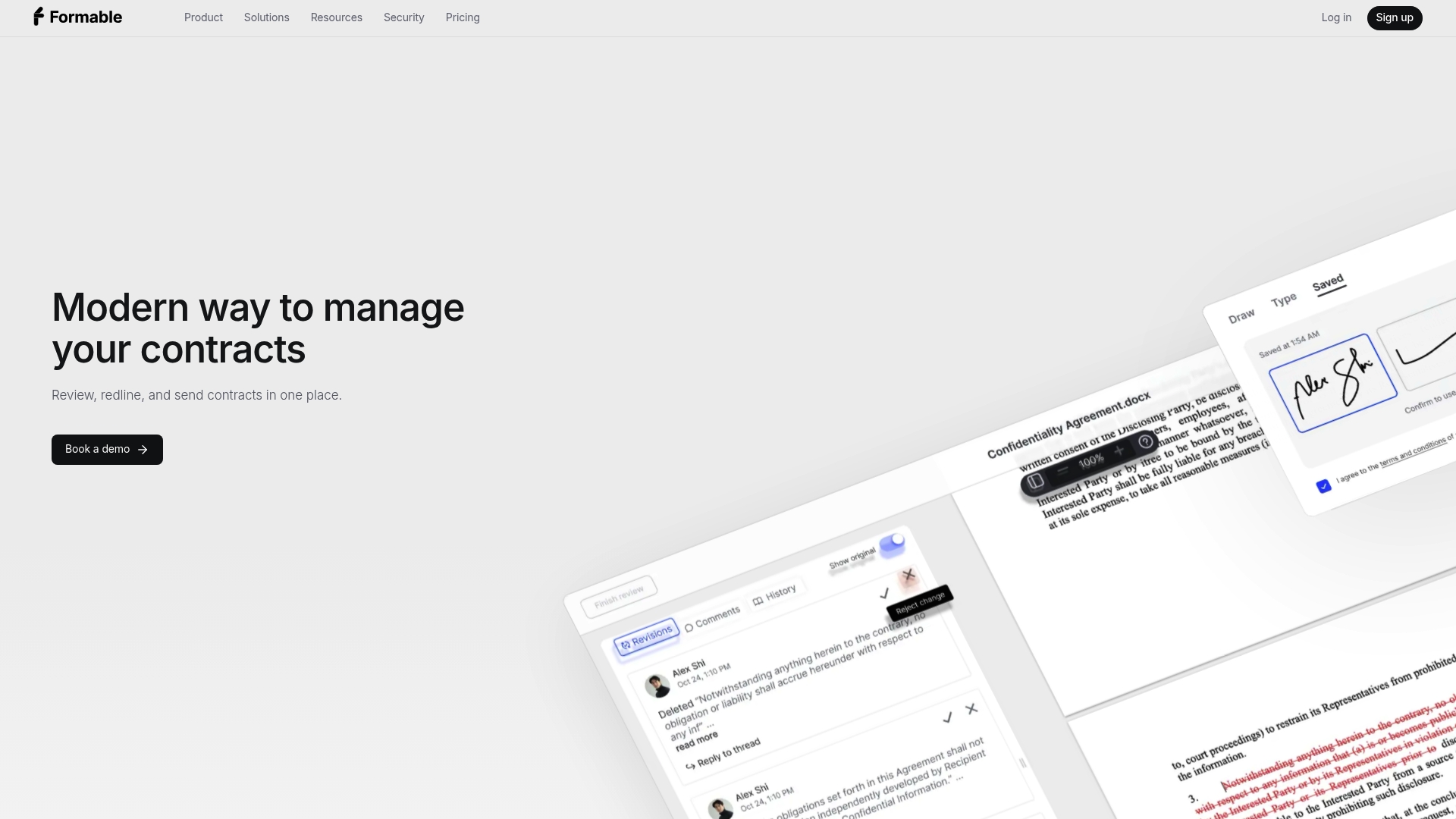
Formable is built for exactly that workflow. You can start in Formable's contract creator to draft related agreements from guided templates, then send them for negotiation with Formable's redlining tool. Both parties align on terms in real time before moving to signature. Formable also runs AI-powered contract review at intake, catching missing clauses and flagging risk automatically against your playbook. For teams that need e-signing without a separate tool, Formable handles that too, with a full audit trail and API access for developers who want to embed signing into their own platform. If you are managing SaaS contracts, NDAs, MSAs, or custom license agreements, start with Formable and see how much faster your contract cycle moves.
FAQ
What is a software license agreement?
A software license agreement is a legally binding contract that grants a user the right to use software under defined conditions, without transferring ownership of the software itself.
What is an example of a software licensing agreement?
Microsoft's Azure Information Protection license terms are a widely referenced example: they specify installation rights, scope of use, warranty disclaimers, and liability limitations in a standard commercial format.
How do you create a software license agreement?
Start with a template that covers the core clauses (license grant, restrictions, payment, termination, and governing law), then customize the scope, user count, and licensing model to match your specific product and business relationship.
What are the four main types of software licenses?
The four main types are proprietary licenses, open-source licenses, freeware licenses, and SaaS subscription licenses, each defining different rights around use, modification, and distribution.
Key takeaways
A well-drafted software license agreement template is the foundation of any enforceable software distribution or access arrangement, covering parties, scope, restrictions, and liability in a single document.
| Point | Details |
|---|---|
| Template structure | Every template needs a license grant, restrictions, payment terms, IP clause, and termination rights to be complete. |
| Licensing models | Perpetual, subscription, concurrent use, and usage-based licenses each require different payment and termination language. |
| Enforceability | Clickwrap agreements with active user consent are upheld by US courts far more reliably than browsewrap formats. |
| Customization | Define authorized users, permitted environments, and version scope precisely to avoid disputes over what the license covers. |
| Formable | Formable combines AI-powered contract creation, redlining, and e-signing to take a license agreement from template to signed in one workflow. |