Free standard NDA template: what you need to know

Alex Shi

Where to find a standard NDA template that actually holds up
Free, fill-in-the-blank NDA templates are widely available in Word, PDF, and Google Docs formats. Providers like DocuSign and LawDepot offer downloadable forms you can customize in minutes. Formable's contract creator also lets you generate an NDA from a template using AI, with built-in review and e-signing in the same workflow.
A free template is legally enforceable when it meets the foundational elements of a valid contract:
- Offer and acceptance: both parties agree to the confidentiality terms
- Consideration: each party receives something of value (access to information, a business relationship)
- Capacity: all signers are legally competent adults
- Lawful purpose: the agreement cannot be used to conceal illegal activity
Cost has no bearing on enforceability. A template downloaded for free carries the same legal weight as one drafted by outside counsel, provided it is properly customized and executed.
Table of Contents
- What an NDA actually is and when U.S. law enforces it
- Key clauses every standard NDA template should include
- Common situations where you need an NDA
- Related contracts that work alongside an NDA
- Best practices for using a standard NDA template effectively
- How Formable fits into your NDA workflow
- FAQ
- Key takeaways
What an NDA actually is and when U.S. law enforces it
A non-disclosure agreement (NDA) is a legally binding contract in which one or more parties agree to keep specified information confidential. Under U.S. contract law, an NDA creates an enforceable obligation: if a recipient shares protected information without authorization, the disclosing party can seek injunctive relief or damages in court.

NDAs come in two forms. A unilateral NDA protects information flowing from one disclosing party to a single recipient, which is typical when hiring a contractor or vendor. A mutual NDA protects both parties simultaneously, making it the right choice for partnerships, joint ventures, or any situation where both sides share sensitive data. Understanding which type you need before drafting saves time and prevents gaps in coverage.
One compliance point that most free templates miss: employment-related NDAs must include a federal whistleblower immunity notice under 18 U.S.C. §1833(b). Without it, the agreement may be unenforceable against employees who report potential violations to government agencies.
Key clauses every standard NDA template should include
A well-drafted NDA is not just a promise to stay quiet. Each clause serves a specific protective function, and leaving one out can create real enforcement gaps. Here are the core components:
- Purpose clause: defines why confidential information is being shared. Narrow this to the specific transaction or relationship.
- Definition of confidential information: specifies what is protected. Overly broad definitions ("all information shared between the parties") invite disputes; overly narrow ones leave gaps.
- Exclusions: carves out information that is already public, independently developed, or received from a third party without restriction.
- Obligations of the receiving party: states what the recipient must and must not do with the information, including security measures.
- Term and survival: sets how long the NDA lasts and how long confidentiality obligations survive after it ends. Trade secrets often warrant indefinite protection.
- Compelled disclosure: allows the recipient to disclose information if required by law or court order, provided they give the disclosing party prompt notice.
- Return or destruction of information: requires the recipient to return or destroy confidential materials at the end of the relationship.
- No license: clarifies that sharing information does not grant any intellectual property rights.
- Remedies: acknowledges that monetary damages may be insufficient and that injunctive relief is appropriate.
- Governing law: specifies which state's law governs the agreement and where disputes will be resolved.
Pro Tip: Set the confidentiality survival period to match the actual useful life of the information. A two-year term may be reasonable for a product pitch, but source code or customer data often warrants five years or more.
Common situations where you need an NDA
NDAs are not one-size-fits-all documents, but they do fit a wide range of business scenarios. Here are the most common:
-
Business negotiations: before sharing financials, pricing models, or strategic plans with a potential partner, an NDA establishes the ground rules. A mutual form works best here since both sides typically share sensitive data.
-
Hiring contractors or freelancers: when a developer, designer, or consultant needs access to proprietary systems or client data, a unilateral NDA protects the employer without requiring the contractor to disclose anything in return.
-
Partnerships and joint ventures: two companies exploring a collaboration will each share internal information. A mutual NDA covers both directions of disclosure from the start.
-
Fundraising and investor conversations: founders sharing revenue figures, cap tables, or product roadmaps with potential investors should have a signed NDA in place before the first detailed conversation.
-
Mergers and acquisitions due diligence: M&A processes involve extensive data sharing. NDAs in this context often include specific provisions about data rooms, permitted disclosers, and standstill obligations.
-
Product development with third parties: co-developing a product with an outside firm means sharing technical specifications, designs, and test data. An NDA with a clear IP ownership clause alongside it is standard practice.
-
Employee onboarding: while employment agreements often include confidentiality provisions, a standalone NDA gives clearer, more enforceable terms for employees with access to trade secrets or sensitive client information.
Related contracts that work alongside an NDA
An NDA covers confidentiality, but most business relationships need additional agreements to be fully protected. These are the contracts most commonly used alongside a standard NDA:
- Master Services Agreement (MSA): governs the overall terms of a service relationship, including payment, liability, and intellectual property. An NDA is often signed first, then an MSA formalizes the engagement. Reviewing key contract terms before signing an MSA is worth the time.
- Statement of Work (SOW): a project-specific document that sits under an MSA, defining deliverables, timelines, and fees. NDAs protect the information exchanged during SOW execution.
- Data Protection Agreement (DPA): required when a vendor processes personal data on your behalf under laws like the CCPA or GDPR. A DPA addresses data security obligations that go beyond what a standard NDA covers.
- Letter of Intent (LOI): a preliminary document outlining the key terms of a deal before a formal contract is signed. NDAs are almost always executed alongside or before an LOI in M&A and partnership contexts.
Formable supports all of these agreement types in a single platform, so you are not managing separate tools for each contract stage.
Best practices for using a standard NDA template effectively
A template is a starting point, not a finished product. How you customize and execute it determines whether it actually protects you.
Customize for the specific relationship. Replace generic placeholders with the legal names of all parties, a precise purpose statement, and a defined list of confidential information categories. Vague language is the most common reason NDAs fail in disputes.

Add the federal whistleblower immunity clause. Most generic templates omit the notice required under 18 U.S.C. §1833(b). If the NDA covers employees or contractors, this clause is not optional.
Avoid overbroad confidentiality definitions. Integrated drafting notes from sources like Practical Law flag this as one of the most common drafting errors. Courts have refused to enforce NDAs where the definition of confidential information was so broad it was effectively meaningless.
Consider standardized templates to reduce friction. The oneNDA initiative offers a crowd-sourced, pre-negotiated NDA template that many companies accept without redlining. When both parties recognize the template, negotiation time drops significantly, letting legal teams focus on the commercial terms that actually vary deal to deal.
Using a standardized NDA template means both parties spend less time debating boilerplate and more time closing the deal. The oneNDA model demonstrates that pre-agreed confidentiality language can become an industry norm, the same way standard payment terms did.
Execute the agreement correctly. Both parties must sign before any confidential information is shared. Digital signatures through a compliant e-signing platform carry the same legal weight as wet ink under the federal E-SIGN Act. Date the agreement, retain a copy, and confirm that the right authorized signers are on the document.
Use AI-assisted review before you sign. Formable's contract review engine flags missing clauses, risky terms, and deviations from your playbook automatically. For NDAs received from counterparties, this catches problems in minutes rather than hours.
How Formable fits into your NDA workflow
Downloading a free NDA form gets you started. Formable takes you the rest of the way.
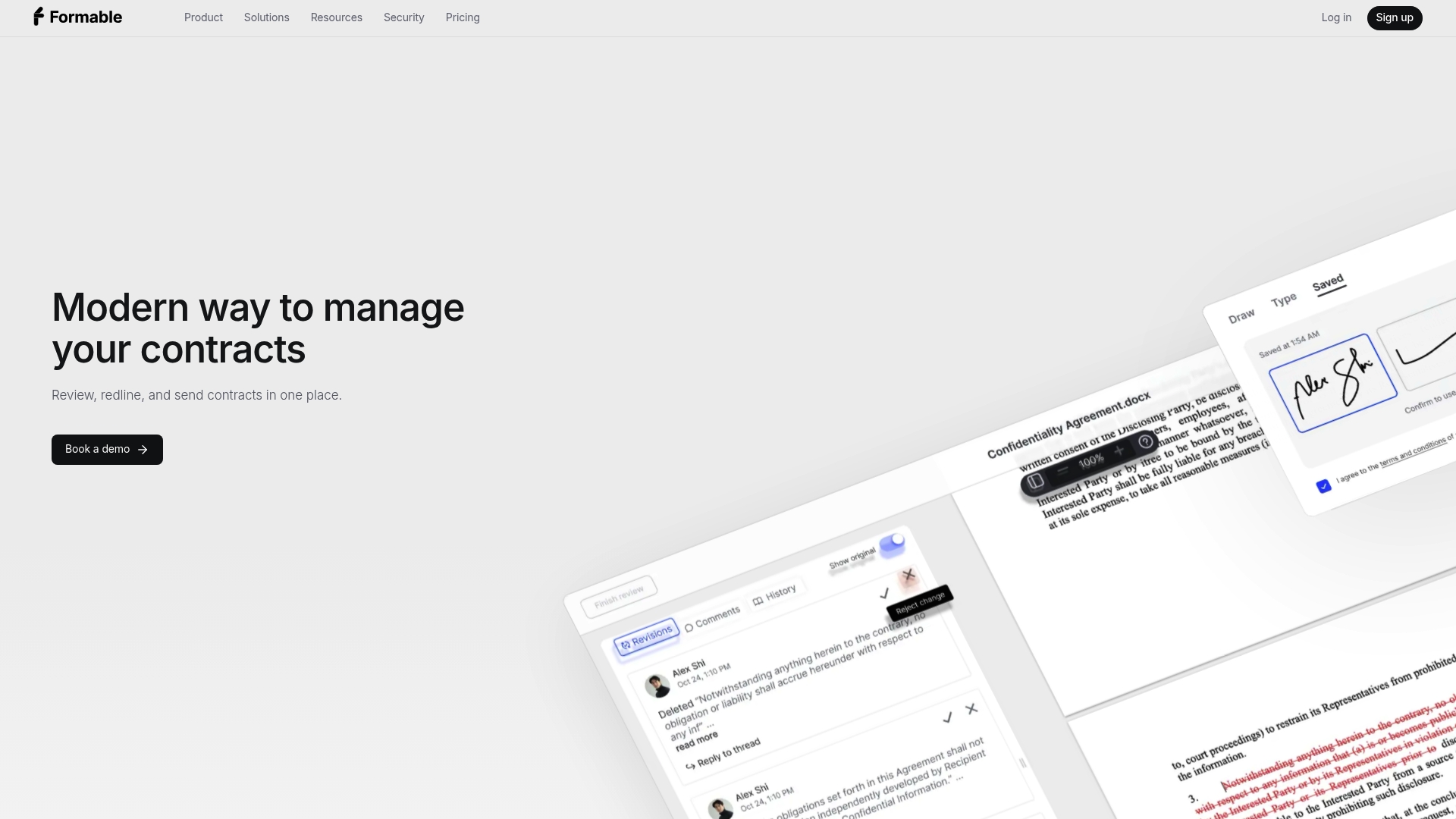
Formable is built for startups and GTM teams that need to move fast without cutting corners on contract quality. You can generate a standard NDA directly from Formable's contract creator, which combines pre-built templates with generative AI to produce a customized draft in seconds. From there, you can send it for negotiation using Formable's redlining tool, collect a legally binding e-signature, and store the executed agreement with a full audit trail, all in one platform.
For teams receiving NDAs from counterparties, Formable's AI review catches missing clauses (including the federal whistleblower notice), flags overbroad definitions, and surfaces risk before you sign. Reach out and the Formable team will walk through your specific use case.
FAQ
Is a free NDA template legally binding?
Yes. A free NDA is enforceable if it meets the basic elements of a valid contract: offer, acceptance, consideration, capacity, and lawful purpose. The cost of the template has no effect on its legal validity.
What is the difference between a mutual and a unilateral NDA?
A mutual NDA protects confidential information shared by both parties, while a unilateral NDA protects information disclosed by only one party. Use a mutual form for partnerships and joint ventures; use a unilateral form when hiring vendors or contractors.
What clause do most free NDA templates leave out?
Most generic templates omit the federal whistleblower immunity notice required by 18 U.S.C. §1833(b). Employment-related NDAs that lack this clause may be unenforceable against employees who report potential violations to government agencies.
How long should an NDA last?
Confidentiality terms typically run two to five years for general business information. Trade secrets and source code often warrant indefinite protection. Align the survival period with the actual useful life of the information being protected.
Can Formable help me create and manage NDAs?
Yes. Formable lets you generate, review, negotiate, and e-sign NDAs in a single platform. Its AI review engine flags missing clauses and risky terms automatically, and its redlining tool lets both parties align on terms before signing.
Key takeaways
A free, properly customized standard NDA template is fully enforceable under U.S. law when it includes the right clauses and is signed by authorized parties before any confidential information changes hands.
| Point | Details |
|---|---|
| Free templates are enforceable | Validity depends on contract fundamentals, not the cost of the template. |
| Whistleblower clause is mandatory | Employment NDAs must include the federal immunity notice under 18 U.S.C. §1833(b). |
| Mutual vs. unilateral matters | Choose mutual NDAs for partnerships; unilateral for one-way disclosures like vendor engagements. |
| Standardization reduces friction | The oneNDA initiative shows that pre-agreed templates cut negotiation time significantly. |
| Formable manages the full cycle | Generate, review, redline, and e-sign NDAs in one platform with AI-assisted risk detection. |