An electronic signature is any electronic sound, symbol, or process attached to a document that a person adopts with intent to sign it. Under the ESIGN Act, a signature can't lose its legal effect just because it's electronic instead of ink. That covers typed names, click to agree checkboxes, and drawn signatures, and platforms like Formable exist to make that process auditable and secure.
TL;DR:
- Most low-value or routine agreements can be signed electronically with minimal risk, but high-stakes transactions benefit from certificate-backed digital signatures.
- The legal validity of electronic signatures depends on clear intent to sign and proper verification, with stronger safeguards reducing dispute risks.
- Certain documents like wills, court filings, or notarized papers still require traditional signatures or notarization regardless of electronic methods used.
- Digital signatures using cryptography provide tamper evidence and better identity assurance than simple electronic signatures, making them essential for significant transactions.
- Maintaining a detailed audit trail, including timestamps and identity verification, is crucial to protecting the validity of electronic signatures in legal disputes.
What counts legally as an electronic signature?
The federal definition is broader than most people expect. Under 15 U.S.C. § 7006, an electronic signature is "an electronic sound, symbol, or process attached to or logically associated with a contract or other record and executed or adopted by a person with the intent to sign the record." That's deliberately technology neutral. Section 7001 backs this up by stating a contract or signature can't be denied legal effect solely because it exists in electronic form.
The pivot point in every case is intent to sign, not the tool used to create the mark. A tick box means nothing on its own; a tick box next to language that says "I agree to these terms, signed electronically" carries real legal weight, according to legal explainers from the Legal Information Institute.
A few caveats matter here:
- Some state laws layer additional requirements on top of federal rules, particularly for consumer disclosures.
- Certain documents require notarization or witness signatures regardless of format.
- International transactions may need to satisfy a different framework, like the EU's eIDAS regulation.
What are common types and examples of electronic signatures?
Electronic signatures range from casual to formal, and the method you choose should match what's at stake.
- Typed name at the end of an email or document — fast, but weak on its own without surrounding context showing intent.
- Click to agree checkboxes — common for terms of service and online purchases; courts generally uphold these when the interface clearly discloses what the user is agreeing to.
- Drawn signature using a mouse, stylus, or finger — visually resembles a handwritten signature and is popular for lease agreements and HR paperwork.
- Scanned image of a wet signature inserted into a PDF — legally an electronic signature the moment it's placed in a digital record, even though the mark itself was originally handwritten.
- Email signature blocks with signing language — often overlooked, but courts have treated these as binding when the email shows clear agreement to terms.
- Automated electronic agent signing — used in high-volume workflows where a system signs on behalf of a party under pre-set authorization rules.
A rental application, an online purchase confirmation, and an HR onboarding form might each use a different one of these methods, and all can hold up legally if intent and consent are documented.
How do electronic signatures work compared to digital signatures?
This is where most people get confused, and it's worth untangling cleanly. Every digital signature is an electronic signature, but not every electronic signature is a digital signature. The difference comes down to cryptography.
A digital signature uses public key infrastructure (PKI). The document gets run through a hashing algorithm to create a unique fingerprint, then that hash is signed with the sender's private key. The recipient's system verifies the signature using the sender's public key and a digital certificate, confirming both that the signer is who they claim to be and that the document hasn't been altered since signing, as TechTarget's technical breakdown explains.
Here's what that buys you over a simple e-signature:
- Tamper evidence: any change to the document after signing invalidates the cryptographic seal.
- Stronger identity assurance through certificate authorities.
- An audit trail that holds up better under legal scrutiny.
Pro Tip: If a document will end up in a courtroom or regulatory audit, a certificate-backed digital signature gives you a much stronger paper trail than a typed name ever will.
The eIDAS framework in the EU formalizes this distinction into three tiers: simple, advanced, and qualified, with qualified signatures requiring a certificate issued by a licensed provider and a dedicated signing device.
Are electronic signatures legally binding, and can they be challenged?
Yes, in most everyday transactions, an electronic signature carries the same legal weight as ink on paper under the ESIGN Act's core rule of validity. That doesn't mean every electronic signature is bulletproof in a dispute.
Challenges usually come down to three things: whether the person actually intended to sign, whether their identity was properly verified, and whether the document was altered afterward. A simple typed name with no surrounding audit data is easier to contest than a signature backed by timestamps, IP logs, and identity checks.
Ways to reduce that risk:
- Use a platform that logs timestamps, IP addresses, and each step a signer takes.
- Verify identity through email confirmation, SMS codes, or ID matching for higher-value agreements.
- Retain the completed audit trail alongside the signed document, not just the signature page.
For routine paperwork, a basic method is fine. For contracts involving significant money or regulatory exposure, stronger verification is worth the extra step, an approach practitioner guidance from Signatures backs up directly.
What documents can't be signed electronically?
Some categories still require traditional signing methods or notarization, and the exceptions exist because a specific statute or agency rule demands it, not because electronic signing is inherently weaker.
- Certain wills and testamentary trusts in many states.
- Some court filings and orders that require a judge's physical signature.
- Documents requiring notarization where the notary's process hasn't adopted remote online notarization.
- Certain real estate filings, depending on state recording requirements.
Rules here vary by state and by document type, so checking the governing statute, or asking counsel when the stakes are high, beats assuming your everyday e-signing method will work universally. Mortgage transactions in particular carry their own verification steps under ESIGN and UETA that lenders must follow, as outlined in this ESIGN and UETA mortgage compliance guide.
How do you create an electronic signature safely?
Signing something electronically takes minutes, but doing it in a way that holds up later takes a bit more care.
- Choose your method based on the stakes. A typed name works for low-risk agreements; a certificate-backed signature suits contracts, leases, or anything regulatory.
- Establish intent clearly. Make sure the document or interface states what you're agreeing to before you sign.
- Sign using your chosen method, whether that's typing your name, drawing on a touchscreen, or uploading a scanned signature.
- Verify identity when needed, especially for anything involving money, property, or legal obligations.
- Save the signed copy and its audit trail together, not just the final PDF. The trail is what proves who signed, when, and from where.
Pro Tip: Keep signed documents and their audit logs in one place you control, not just in your email inbox. If a dispute ever comes up, you want that record accessible in seconds.
Developers building signing into their own product can find a full walkthrough in this guide to implementing e-signing.
What security risks affect electronic signatures, and how do you reduce them?
The convenience of electronic signing comes with real risks if the process is sloppy. Forgery, identity spoofing, and post-signature tampering are the three biggest threats worth understanding.
- Forgery: someone signs on another person's behalf without authorization.
- Identity spoofing: a signer's identity is faked through a compromised email account or stolen credentials.
- Document tampering: a signed file gets altered after the fact, especially if it's a plain PDF with no cryptographic seal.
Mitigations that actually work:
- Certificate-backed digital signatures that cryptographically seal the document at the moment of signing.
- Detailed audit trails capturing timestamps, IP addresses, and device information.
- Two-factor authentication before allowing someone to sign.
- Secure, access-controlled storage for signed records and retention policies that match your industry's requirements.
High-volume contracting teams increasingly treat certificate-backed signing as a built-in risk control rather than an optional upgrade, since it cuts manual verification work while strengthening the paper trail if a dispute ever lands in front of a judge. When something looks genuinely tampered with or fraudulent, escalate to legal counsel or a digital forensics specialist rather than trying to sort it out internally. Formable's security documentation covers how audit trails and access controls get applied across signed agreements.
When should you use a simple signature vs. a certificate-backed one?
The right method depends entirely on what's riding on the document, not personal preference.
Simple electronic signatures make sense for routine, low-value agreements: internal approvals, standard HR forms, basic vendor acknowledgments, or online purchase confirmations. Speed matters more than forensic-grade proof in these cases, and the ESIGN Act's rule of validity covers them without issue.
Certificate-backed digital signatures earn their extra friction in higher-stakes situations:
- Real estate transactions and mortgage documents.
- Contracts involving significant financial commitments, like MSAs or multi-year service agreements.
- Regulated industries such as healthcare, finance, or legal services where compliance audits are routine.
- Any agreement likely to face scrutiny in litigation.
A software subscription renewal doesn't need the same rigor as a $2 million supply agreement. Matching the assurance level to the actual risk keeps signing fast where it can be and secure where it needs to be.
How Formable handles secure, auditable signing
Formable was built around the idea that signing shouldn't be separated from the negotiation that happens before it. Teams draft agreements using templates paired with generative AI, redline terms with counterparties in real time, and move straight into signing once both sides align, all inside one audit trail.
The platform works as a standalone e-signing tool for teams that just need signatures collected quickly, and it also offers an embedded signing API for developers who want signing built directly into their own product. Every signed document carries timestamped audit data, which matters when a deal later gets questioned.
For startups and GTM teams juggling MSAs, DPAs, SOWs, and order forms, keeping negotiation and signing in one system cuts the back and forth that usually stalls a closing.
Statutes and explainers worth bookmarking
For the primary legal text, read 15 U.S.C. Chapter 96, the ESIGN Act itself. For a comparative look at tiered assurance levels, the European Commission's eIDAS explainer is useful. Cornell's Legal Information Institute offers a clear plain-language primer. Always confirm state-specific rules or consult counsel for edge cases.
Where the conventional advice on e-signatures falls short
Most explainers stop at "electronic signatures are legal" and leave it there, as if that settles the matter. It doesn't. The law sets a floor, not a ceiling, and treating every signing method as interchangeable is where people get burned.
What the research actually supports is a risk-matching mindset. A typed name on a low-stakes vendor form is fine. That same typed name on a six-figure services agreement is an unnecessary gamble when certificate-backed signing exists and costs almost nothing extra in time. The gap isn't in the law, it's in how casually people apply it across wildly different levels of risk.
The other thing conventional advice underplays: the audit trail matters more than the signature mark itself. A drawn signature with a solid timestamp, IP log, and identity check beats a notarized-looking scrawl with none of that context. If you take one thing from this, prioritize the record keeping around the signature, not just the signature's appearance.
— Alex
Sign, negotiate, and close in one place with Formable
Formable gives you a faster path from drafted agreement to signed contract, without bouncing between a redlining tool, a separate e-signature app, and a folder of email threads to track versions. Founders, account executives, and legal teams use it to draft from templates with generative AI, negotiate terms directly with counterparties, and collect signatures with a built-in audit trail, all in the same workflow.
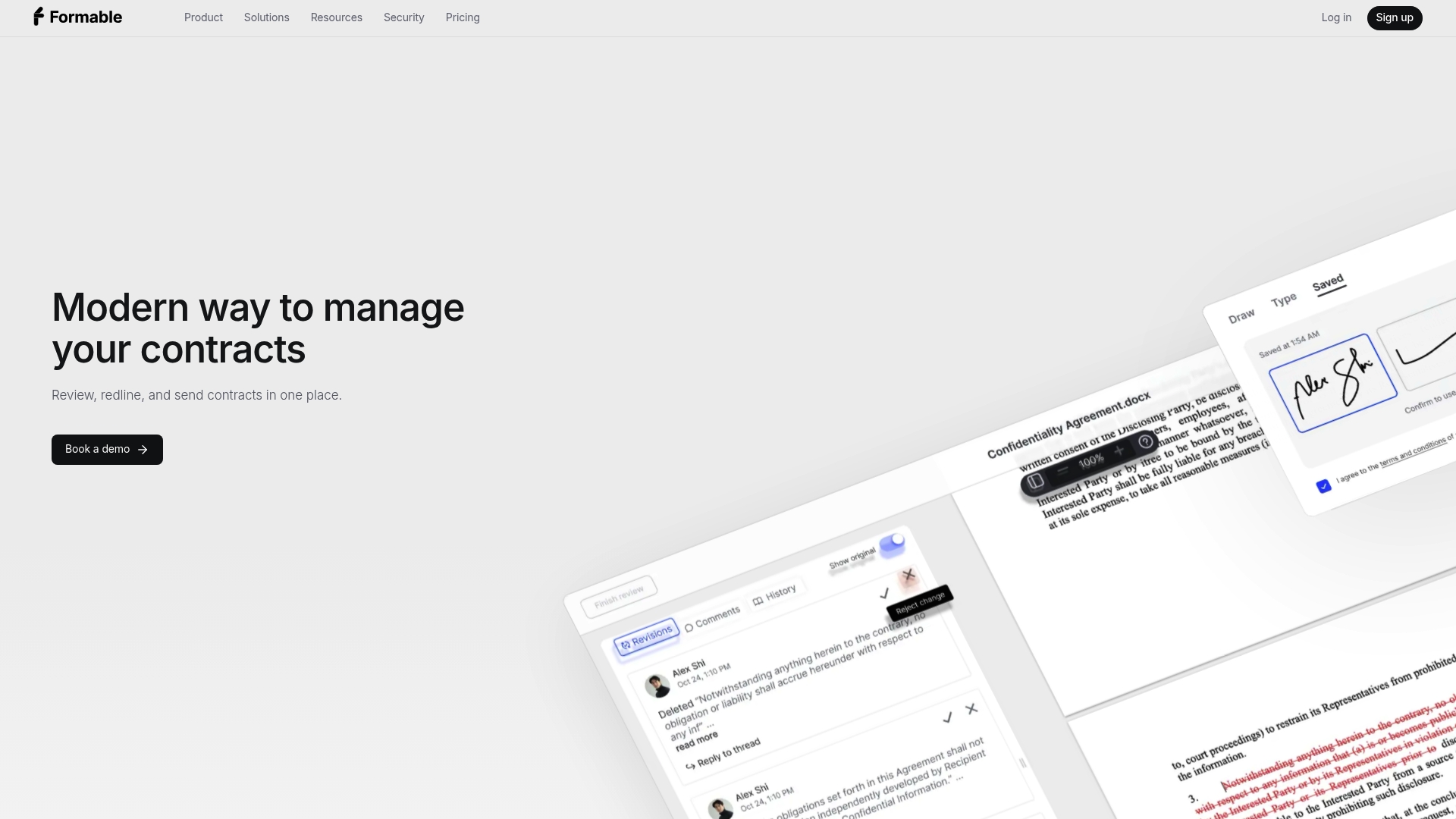
If you're a developer, the embedded signing API lets you drop signing directly into your own product instead of routing users to a third-party portal. If you're managing a growing stack of MSAs, DPAs, and order forms, the contract review tool catches missing clauses and risk before anything gets signed. Start by uploading your next agreement at Formabledocs and see how quickly it moves from draft to signed.
Sources
- U.S. Code, Chapter 96 — Electronic Signatures in Global and National Commerce (ESIGN)
- What is eSignature — European Commission (eIDAS explainer)
- electronic signature | Wex | Legal Information Institute
FAQ
What is an example of an electronic signature?
A typed name at the bottom of an emailed contract, a checkbox marked "I agree" on a website, or a signature drawn with a finger on a tablet are all valid examples under the ESIGN Act.
How do I make an electronic signature?
Choose a method that matches the document's stakes, whether typing your name, drawing it on a touchscreen, or using a platform like Formable, then confirm your intent to sign is clearly documented alongside the signed file.
Is DocuSign considered an electronic signature?
Yes, platforms like DocuSign and Formable generate electronic signatures, and many also offer certificate-backed digital signature options for transactions needing stronger identity assurance.
What documents cannot be electronically signed?
Certain wills, some court orders, documents requiring in-person notarization, and specific real estate filings often still require traditional signing, depending on state law.
What's the difference between an electronic signature and a digital signature?
An electronic signature is any method showing intent to sign, while a digital signature specifically uses public key infrastructure and cryptographic hashing to add tamper detection and stronger identity verification, as explained in TechTarget's technical overview.