Formable is the recommended pick for teams that need AI-enabled contract approvals with collaborative redlining, built-in e-signing, and developer-ready APIs. It covers the full approval cycle from intake review to executed signature, without requiring a separate e-sign vendor or a custom integration project.
Top picks at a glance:
- Formable — best for mid-market and GTM teams needing AI review at intake, redlining, and embedded signing APIs
- Ironclad — best for in-house legal teams at larger enterprises running complex workflow automation
- Docusign CLM — best for organizations where e-signature audit trails and configurable approval routing are the primary requirement
- Icertis Contract Intelligence (ICI) — best for global enterprises managing high-volume, multi-jurisdiction contract portfolios
- Agiloft CLM Platform — best for organizations that need deep workflow customization without writing code
- PandaDoc — best for sales teams that need proposal generation and lighter contract workflows
When to choose Formable over alternatives: Your team closes deals on MSAs, DPAs, SOWs, or NDAs and needs AI risk detection at intake, real-time redlining, and signing in one place. If you are evaluating a standalone e-sign tool or a heavy enterprise CLM, Formable sits squarely between those two categories and handles both jobs.
Structured approval workflows can significantly reduce compliance approval delays, which makes the choice of platform a direct lever on deal velocity, not just a back-office IT decision.
What does the best contract approval software look like side by side?
The table below covers the 36 platforms most frequently cited in enterprise and mid-market evaluations. Formable leads as the featured option; remaining entries follow in category order.
| Platform | Best for | AI contract review | Redlining & negotiation | E-signature | Pricing model |
|---|---|---|---|---|---|
| Formable | Mid-market and GTM teams: fast approvals, embedded signing, developer APIs | AI intake review, playbook-driven risk detection | Collaborative real-time redlining | Built-in + API | Subscription + usage-based API |
| Ironclad | In-house legal at larger enterprises | Workflow AI | Supported | Integrations | Subscription |
| Ironclad CLM | Enterprise legal ops | Workflow AI | Supported | Integrations | Subscription |
| Conga CLM | Clause library and document generation needs | Clause AI | Supported | Integrations | Subscription |
| Docusign CLM | E-signature-first teams needing audit trails | Moderate | Supported | Native (Docusign) | Subscription |
| Icertis Contract Intelligence (ICI) | Global enterprises, complex portfolios | AI-native analytics | Supported | Integrations | Enterprise |
| Icertis | Enterprise contract intelligence | AI-native analytics | Supported | Integrations | Enterprise |
| Agiloft CLM Platform | Deep customization, no-code workflows | Moderate | Supported | Integrations | Subscription |
| Agiloft | No-code workflow customization | Moderate | Supported | Integrations | Subscription |
| PandaDoc | Sales and revenue teams, proposals | Basic | Limited | Native | Subscription |
| LinkSquares CLM | Post-execution analytics and discovery | Advanced analytics | Limited | Integrations | Subscription |
| LinkSquares | Post-signature visibility | Advanced analytics | Limited | Integrations | Subscription |
| Sirion | Supplier and third-party contract management | AI-native automation | Supported | Integrations | Enterprise |
| Sirion Agentic CLM Platform (Sirion) | Complex supplier contracts | AI-native automation | Supported | Integrations | Enterprise |
| Juro | Browser-native authoring, in-house legal | Moderate | Supported | Native | Subscription |
| Coupa | Procurement and finance-led programs | AI metadata + risk scoring | Supported | Integrations | Enterprise |
| Workday Contract Lifecycle Management (Evisort-powered) | Workday customers | AI-native analytics | Supported | Integrations | Enterprise |
| Workday Contract Lifecycle Management | Workday ecosystem | AI-native analytics | Supported | Integrations | Enterprise |
| SpotDraft | Fast-moving legal teams | Moderate | Supported | Native | Subscription |
| CobbleStone Contract Insight | Comprehensive lifecycle and compliance | Moderate | Supported | Integrations | Subscription |
| Gatekeeper Platform | Procurement and vendor management | Moderate | Limited | Integrations | Subscription |
| Oneflow | Real-time collaborative editing and signing | Basic | Real-time editing | Native | Subscription |
| SAP Ariba Contracts | Large SAP ecosystem corporations | Moderate | Supported | Integrations | Enterprise |
| Outlaw | Modern negotiation UX, API-first teams | Basic | Supported | Native | Subscription |
| ContractWorks | Small legal teams, simple repository | Basic | Limited | Integrations | Subscription |
| ContractSafe | Simple contract repository and search | Basic | Limited | Integrations | Subscription |
| GetAccept | Sales proposal-to-signature workflows | Basic | Limited | Native | Subscription |
| Proposify | Agencies and services businesses | Basic | Limited | Native | Subscription |
| DealHub | Revenue ops, CPQ and contract orchestration | Moderate | Supported | Integrations | Subscription |
| ContractPodAi (Leah) / ContractPodAi (Now Leah) | Legal ops AI-driven lifecycle automation | Advanced AI | Supported | Integrations | Enterprise |
| Evisort | Contract intelligence and search at scale | AI-native analytics | Limited | Integrations | Subscription |
| Concord | Small to mid-market, simple CLM with signing | Basic | Limited | Native | Subscription |
| Contractbook | SMBs with template-driven needs | Basic | Limited | Native | Subscription |
| Malbek CLM | Mid-market CLM with workflow focus | Moderate | Supported | Integrations | Subscription |
| GEP SMART | Procurement and sourcing teams | Moderate | Supported | Integrations | Enterprise |
| JAGGAER Contract Management | Complex procurement and sourcing | Moderate | Supported | Integrations | Enterprise |
| Zycus Source to Pay Suite | Source-to-pay procurement programs | Moderate | Supported | Integrations | Enterprise |
| smartContract CLM | Mid-market CLM automation | Moderate | Supported | Integrations | Subscription |
Key insight: The clearest dividing line in this market is not features — it is AI maturity. Vendors split into three tiers: those with basic metadata extraction, those with advanced analytics, and a smaller group with AI-native review that drives decision-making at intake. Buyers who conflate these tiers end up paying enterprise prices for what is essentially a smarter search index.
Pro Tip: Before shortlisting, map your contract volume by type (MSA, NDA, SOW) and identify where approvals stall most often. That single exercise will tell you whether you need AI-native intake review, a better approval routing engine, or simply a cleaner template library.
Modern CLM platforms deliver AI-powered clause analysis, workflow automation, and deep ERP/CRM integration — but the Info-Tech Research Group recommends prioritizing core operational needs over chasing emerging features during vendor selection.
Detailed profiles: what each platform actually does
Formable
Formable covers the full pre-signature workflow: AI contract review at intake with playbook-driven risk and missing-clause detection, collaborative redlining so both parties align on terms before signing, template-based contract creation with generative AI, and built-in e-signing with a developer API for embedding signing and redlining into external platforms. It supports MSAs, DPAs, SOWs, LOIs, Order Forms, NDAs, and Pilot Agreements. The free tier gives individual users and developers access to evaluate the API without a sales cycle.
Strengths: AI risk detection at intake, real-time collaborative redlining, unlimited templates, e-signing plus API, audit trails, team dashboard.
Limitations: Positioned for mid-market and growth-stage teams; organizations with very large, multi-jurisdiction contract portfolios may need additional enterprise configuration.
Pricing: Subscription for teams and companies; usage-based for API e-signature and negotiation events; free tier for individuals and developers.
Best for: Founders, account executives, general counsel, and developer teams at startups and growing companies that need fast, auditable approvals without stitching together multiple tools.
Ironclad and Ironclad CLM
Ironclad is built around workflow automation for in-house legal teams. Its Workflow Designer lets legal ops configure multi-step approval routes without engineering support, and it handles high-volume contract programs at larger enterprises. The platform integrates with Salesforce, Workday, and major document storage providers. Implementation timelines tend to run longer than lighter-weight tools, and pricing is enterprise-tier.
Best for: Legal ops teams at companies with 500+ employees running structured, repeatable contract programs.
Conga CLM
Conga's strength is clause and template management. Its clause library supports complex document assembly, and it pairs well with Salesforce CPQ for revenue teams. AI capabilities focus on clause suggestions rather than full intake review. Organizations that generate high volumes of customized agreements from a defined clause set will find it well-suited; teams that need deep post-signature analytics may want to supplement it.
Best for: Organizations with Salesforce-centric revenue operations and a need for structured clause management.
Docusign CLM
Docusign CLM's primary advantage is its native connection to Docusign e-signature, which is the most widely deployed signing platform in the US market. Approval routing is configurable, and audit trails are detailed. G2 user reviews consistently flag implementation complexity as a friction point for mid-market buyers. The platform suits teams that have already standardized on Docusign and want to extend it upstream into contract authoring and approval. Teams primarily evaluating negotiation should also compare Docusign's redlining workflow with dedicated redlining tools.
Best for: Teams that have standardized on Docusign e-signature and need configurable approval routing with full audit trails.
Icertis Contract Intelligence (ICI) and Icertis
Icertis is one of the most cited platforms for global enterprise contract intelligence. Its AI analytics layer extracts obligations, milestones, and risk signals across large contract portfolios. It integrates with SAP, Microsoft 365, and Salesforce at depth. The tradeoff is implementation complexity: most deployments require a dedicated implementation partner and a multi-month rollout.
Best for: Global enterprises with complex, multi-jurisdiction contract portfolios that need obligation tracking and AI-driven analytics at scale.
Agiloft CLM Platform and Agiloft
Agiloft's defining characteristic is its no-code workflow builder. Legal and IT teams can configure approval routes, escalation rules, and data fields without writing code, which reduces dependency on engineering during setup. Gartner Peer Insights lists it among the more configurable options in the CLM market. The depth of configuration also means initial setup takes longer than out-of-the-box tools.
Best for: Organizations that need highly customized approval workflows and want to own configuration without an ongoing engineering dependency.
PandaDoc
PandaDoc focuses on document generation and proposal-to-signature workflows for sales teams. It handles NDAs, order forms, and proposals well, with a clean UI and native e-signing. AI features are basic compared to dedicated CLM platforms. It is not designed for complex multi-party negotiation or post-signature obligation tracking.
Best for: Sales and revenue teams that need fast proposal generation and simple contract signing without full CLM overhead.
LinkSquares CLM and LinkSquares
LinkSquares leads on post-execution analytics. Its AI extracts key terms, dates, and obligations from executed contracts, giving legal teams visibility into what they have already signed. Approval workflow features exist but are not the platform's primary strength. Teams that need pre-signature workflow automation as their first priority may find the balance skewed toward analytics.
Best for: Legal teams that need to understand and report on an existing contract portfolio, with approval automation as a secondary need.
Sirion and Sirion Agentic CLM Platform
Sirion is built for supplier and third-party contract management. Its AI automates performance tracking, obligation monitoring, and risk scoring across supplier relationships. The "Agentic CLM" positioning reflects its use of AI agents to drive workflow steps autonomously. It suits procurement-heavy organizations managing hundreds of supplier agreements.
Best for: Enterprises with complex supplier ecosystems that need AI-driven performance and obligation monitoring alongside approval workflows.
Juro
Juro runs entirely in the browser, which removes the friction of desktop installs and file-based redlining. Its template editor and approval workflows are designed for in-house legal and commercial teams that want fast turnaround on standard agreements. The platform integrates with Slack, Salesforce, and HR systems. It is less suited to organizations that need deep clause library management or complex multi-party negotiations.
Best for: In-house legal and commercial teams that want browser-native contract authoring and approval without heavy IT involvement.
Coupa
Coupa's contract management module is embedded within its broader procure-to-pay suite. AI-driven metadata extraction and clause recommendations based on supplier risk profiles are genuine differentiators for procurement teams. The platform routes high-risk terms automatically for legal review. It is most valuable when the buyer already uses Coupa for procurement; as a standalone CLM, the value proposition narrows.
Best for: Procurement and finance teams already operating within the Coupa procure-to-pay ecosystem.
Workday Contract Lifecycle Management (Evisort-powered) and Workday Contract Lifecycle Management
Workday's CLM is powered by Evisort's AI engine, giving it strong contract intelligence capabilities within the Workday suite. For organizations already running HR, finance, and procurement on Workday, the integration is a significant advantage. Outside the Workday ecosystem, the platform is rarely the right starting point.
Best for: Workday customers who want embedded contract intelligence without a separate CLM vendor.
SpotDraft
SpotDraft offers configurable approval workflows, a template library, and contract lifecycle automation aimed at legal teams that move fast. It supports integrations with CRM and HR tools and has a cleaner onboarding experience than most enterprise CLMs. AI features are moderate, covering metadata extraction and basic clause flagging.
Best for: Legal teams at growth-stage companies that need lifecycle automation and fast onboarding.
CobbleStone Contract Insight
CobbleStone is a feature-rich platform with strong document management, compliance tracking, and lifecycle tooling. Capterra reviews highlight its depth of features alongside a steeper learning curve. It suits organizations with dedicated contract administrators who can invest in configuration and training.
Best for: Organizations that need comprehensive lifecycle and compliance features and have the internal resources to configure and maintain the platform.
Remaining platforms: brief profiles
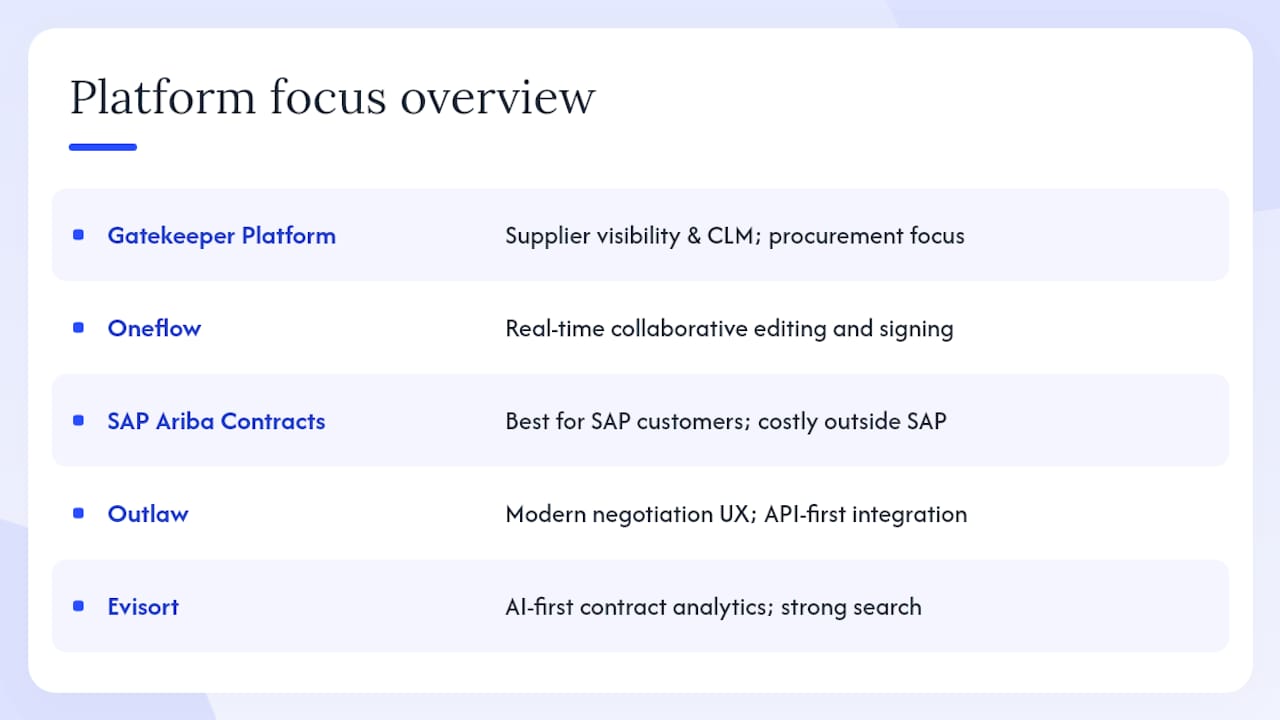
Gatekeeper Platform focuses on supplier relationship and spend visibility alongside contract lifecycle management. Strong for procurement teams managing vendor risk.
Oneflow offers real-time collaborative editing and signing in a single flow, making it well-suited to teams that want a modern, interactive signing experience.
SAP Ariba Contracts is the natural choice for large corporations already running SAP for procurement and spend management. Outside the SAP ecosystem, implementation cost is hard to justify.
Outlaw targets teams that want a modern negotiation UX and API-first workflows. Developer integration is a genuine strength.
ContractWorks and ContractSafe both serve smaller legal teams that need a clean contract repository with alerts and search, without full CLM complexity.
GetAccept and Proposify are sales-oriented tools. GetAccept covers proposal-to-signature workflows; Proposify focuses on proposal templating for agencies and services businesses.
DealHub combines CPQ and contract orchestration for revenue operations teams that need both quoting and contracting in one platform.
ContractPodAi (Leah) and ContractPodAi (Now Leah) deliver AI-driven legal operations tooling with a focus on lifecycle automation for legal ops teams.
Evisort is an AI-first contract analytics platform. Its search and intelligence capabilities are strong; it is less focused on pre-signature workflow automation.
Concord and Contractbook serve SMBs that need simple CLM with e-signing and templates. Contractbook has Nordic roots and a clean SMB-focused UX.
Malbek CLM, GEP SMART, JAGGAER Contract Management, Zycus Source to Pay Suite, and smartContract CLM all serve procurement and mid-market CLM use cases with varying degrees of AI maturity and workflow depth. GEP SMART, JAGGAER, and Zycus are procurement-suite platforms where contract management is one module among many.
How do the critical features actually differ across platforms?
Approval workflows
Approval routing is table stakes, but the implementation quality varies widely. Platforms like Agiloft and Ironclad let you build multi-step, conditional approval routes with escalation rules and SLA timers. Lighter tools like PandaDoc and Concord offer linear approval chains that cover most sales team needs. The gap shows up when a contract requires parallel approvals from legal, finance, and a business unit simultaneously. Formable handles approval workflows as part of its end-to-end flow, connecting intake review directly to the redlining and signing stages so approvals do not stall between tools.
AI contract review and analytics
AI capabilities now split into three distinct tiers. Basic metadata extraction (dates, parties, renewal terms) is present in almost every platform. Advanced analytics, including obligation tracking and portfolio-level reporting, characterize platforms like LinkSquares, Evisort, and Icertis. AI-native review, where the system flags risks and missing clauses at intake using configurable playbooks, is a smaller group that includes Formable, Coupa, and Workday CLM (Evisort-powered). Coupa's AI-driven metadata extraction and risk scoring illustrates what advanced AI-assisted contract management looks like in a procurement context. Buyers should ask vendors to demonstrate the AI on a real contract from their own library, not a vendor-supplied sample.
Redlining and negotiation
Browser-native redlining, where both parties edit in real time without emailing Word documents, is still not universal. Juro and Oneflow offer it natively. Formable's collaborative redlining tool lets both parties align on terms before the signing stage, with changes tracked and timestamped. Most enterprise CLMs support redlining through Microsoft Word integration, which works but adds friction. Outlaw and Formable are the clearest options for teams that want API-accessible negotiation workflows.
For teams evaluating e-signature and document workflow integration, the choice of redlining approach often determines which signing tool fits naturally downstream.
E-signature options
| Platform | E-sign approach | API available |
|---|---|---|
| Formable | Built-in + standalone API | Yes |
| Docusign CLM | Native Docusign | Yes |
| PandaDoc | Native | Yes |
| Juro | Native | Yes |
| Oneflow | Native | Yes |
| GetAccept | Native | Yes |
| Proposify | Native | Limited |
| Concord | Native | Limited |
| Contractbook | Native | Limited |
| Ironclad | Third-party integrations | Via integrations |
| Icertis | Third-party integrations | Via integrations |
| Agiloft | Third-party integrations | Via integrations |
| Coupa | Third-party integrations | Via integrations |
| SAP Ariba | Third-party integrations | Via integrations |
Formable's e-signing API is designed for developers who need to embed signing into their own platforms, which is a distinct use case from teams that just want a button in their CLM.
Integrations and API
CRM integration (Salesforce, HubSpot) and ERP connectivity (SAP, Workday, NetSuite) are the two most common integration requirements in enterprise evaluations. Icertis, Conga, and SAP Ariba lead on ERP depth. Ironclad and Docusign CLM lead on Salesforce integration maturity. Formable provides APIs for embedding both redlining and e-signing into external platforms, which suits developer teams building contract workflows into their own products.
Security and compliance
SOC 2 Type II certification is the baseline expectation for US enterprise buyers. ISO 27001 is increasingly required for global deployments. Audit trails with immutable timestamps are standard across the platforms in this list. When evaluating AI features specifically, ask vendors about their data retention policy for LLM calls. Checkbox's approach of using a zero-retention policy for OpenAI model calls is one example of how vendors are addressing this concern. Formable maintains audit trails across all contract events, supporting regulatory inquiries and internal compliance reviews.
How to choose the right contract approval software for your organization
Demo questions worth asking
- "Show me a contract with a missing indemnification clause being reviewed at intake. What does the system flag and how?"
- "Walk me through a parallel approval route where legal and finance must both approve before signing."
- "Export the audit trail for a contract that went through two rounds of redlining. What does the log contain?"
- "What is your SOC 2 Type II report date, and can we see it before signing?"
- "What is your data retention policy for AI model calls?"
Red flags
- Vendors who cannot demonstrate AI review on a real contract during a trial.
- Platforms where audit trail export requires a support ticket.
- Pricing models that charge per contract executed rather than per user, which penalizes high-volume teams disproportionately.
- Implementation timelines quoted in months for a team under 50 users.
Typical implementation timelines
| Platform tier | Typical time to first live contract |
|---|---|
| Lightweight (Concord, ContractWorks, Formable free tier) | Days to 1 week |
| Mid-market SaaS (Formable, SpotDraft, Juro, PandaDoc) | 1–3 weeks |
| Enterprise CLM (Ironclad, Agiloft, Docusign CLM) | 4–12 weeks |
| Global enterprise (Icertis, SAP Ariba, Coupa) | 3–9 months |
Pro Tip: Run a two-to-three vendor pilot on a real contract type from your own library, not a demo template. The gap between a polished demo and a live workflow on your actual MSA or DPA is where most selection mistakes happen.
For a deeper look at contract workflow design for legal teams, including how to structure approval stages and adoption plans, the Formable blog covers the practical setup in detail.
How this shortlist was built
This list was built using a structured evaluation across seven criteria: feature coverage, AI maturity, integration depth, security and compliance posture, ease of implementation, support quality, and value relative to pricing model. Each vendor was assessed against published product documentation, third-party review data, and marketplace research.
Sources used:
- Gartner Peer Insights for feature coverage benchmarks and vendor landscape context across the CLM market.
- G2 review pages for user-sourced usability, support, and integration pain points. Reviews for platforms like Juro and Docusign CLM provided real-world friction signals that vendor marketing does not surface.
- Capterra for onboarding and ease-of-use signals, particularly for mid-market platforms like CobbleStone Contract Insight.
- Info-Tech Research Group's CLM Platform Selection Guide for evaluation methodology and integration-first prioritization guidance.
- Vendor product pages and published API documentation for feature verification.
Weighting: Integration depth and AI maturity were weighted most heavily, because these are the dimensions where vendor claims diverge most from real-world performance. Security certifications (SOC 2 Type II, ISO 27001) were treated as pass/fail requirements for enterprise-tier entries.
Conflicts of interest: Formable is the publisher of this article and is included in the shortlist. It was evaluated against the same criteria as every other entrant. Readers should treat the Formable entries with that context in mind and run their own proof-of-concept.
Third-party review sites like G2, Capterra, and Gartner Peer Insights are valuable for adoption and support signals, but they should be weighted after integration fit, security verification, and proof-of-concept results — not before. A platform with strong reviews but poor API documentation will cost you more in implementation than the subscription savings justify.
Key takeaways
The single most important decision in selecting contract approval software is matching AI maturity to your actual workflow bottleneck: teams that stall at intake need AI-native review, while teams that stall at signature routing need a better approval engine.
| Point | Details |
|---|---|
| AI maturity tiers matter | Distinguish basic metadata extraction from AI-native intake review before shortlisting; the gap in real-world value is significant. |
| Approval workflow depth | Confirm parallel routing, SLA escalation, and audit trail export before committing to any platform. |
| Implementation timeline | Mid-market SaaS tools typically go live in 1–3 weeks; global enterprise CLMs can take 3–9 months. |
| Integration-first evaluation | Poor CRM or ERP integration is the most common cause of CLM adoption failure, per Info-Tech Research Group guidance. |
| Formable for GTM teams | Formable covers AI intake review, collaborative redlining, e-signing, and developer APIs in one subscription, suited to mid-market and growth-stage teams. |
What most buyers get wrong about contract approval software
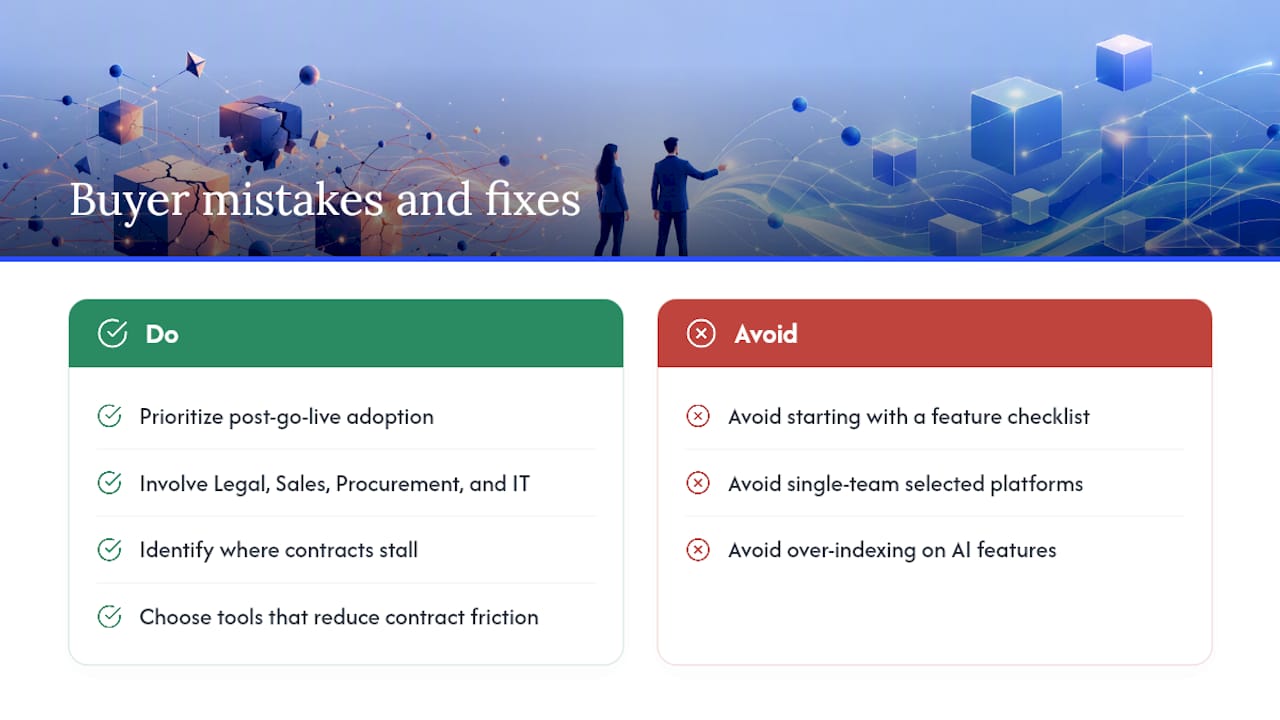
The conventional wisdom says to start with a feature checklist and score vendors against it. That approach consistently produces the wrong outcome. The real failure mode in CLM selection is not choosing a platform with the wrong feature set. It is choosing a platform that no one actually uses six months after go-live.
Adoption is a cross-functional problem. Legal wants clause control. Sales wants speed. Procurement wants spend visibility. IT wants a documented API and a clear security posture. When a platform is selected by one of those groups without the others at the table, the result is a tool that solves one team's problem and creates friction for everyone else. The contracts that matter most, the ones with real commercial risk, tend to be the ones that cross all four functions simultaneously.
There is also a tendency to over-index on AI features during evaluation. AI-native intake review is genuinely valuable when your team reviews dozens of inbound third-party paper agreements per month. For a team that sends out its own standard templates and negotiates on a handful of terms, a clean redlining tool and a reliable approval route will deliver more measurable time savings than a sophisticated AI layer.
The platforms that tend to succeed in practice are the ones that reduce friction at the specific point where contracts stall in your organization, not the ones with the longest feature list. That is worth identifying before you open a single demo call.
Formable covers the full approval cycle without the enterprise overhead
Most contract approval tools force a choice: either a lightweight e-sign tool that cannot handle negotiation, or a full enterprise CLM that takes months to implement and requires a dedicated administrator. Formable sits between those two options and handles both jobs.
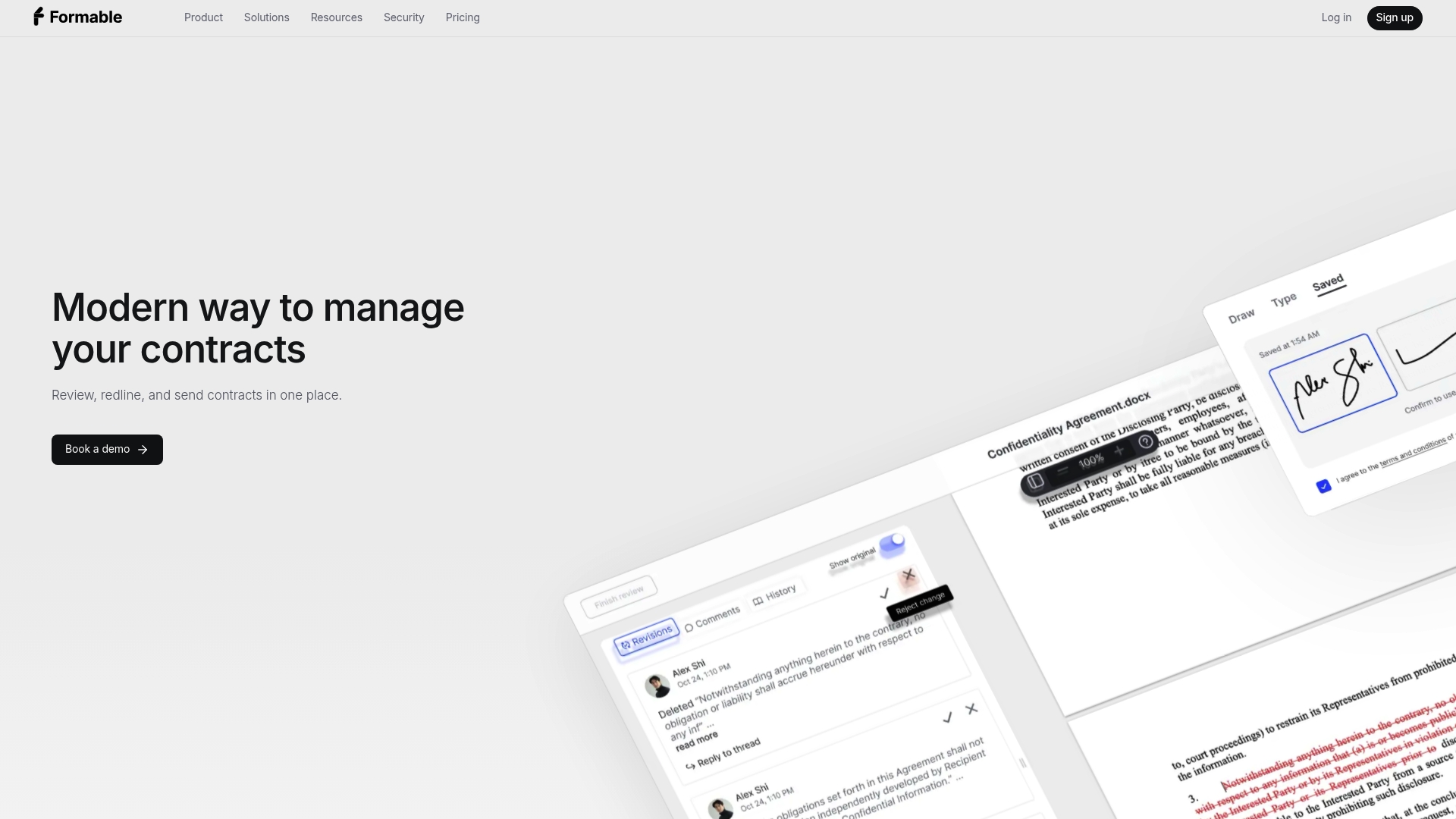
For mid-market and GTM teams, Formable provides AI contract review at intake using configurable playbooks that flag risks and missing clauses automatically. Collaborative redlining lets both parties align on terms in real time before the signing stage, with every change timestamped in an immutable audit trail. Built-in e-signing and a developer API mean you can collect signatures in Formable or embed the signing flow directly into your own platform. Template-based contract creation with generative AI covers MSAs, DPAs, SOWs, NDAs, LOIs, and Order Forms out of the box.
The free tier lets developers and individuals evaluate the API and core features without a sales conversation. For teams ready to run a proof-of-concept on a real contract, start at formabledocs.com and reach out to walk through your specific use case.
Useful sources for deeper evaluation
- Contract Lifecycle Management Platform Selection Guide | Info-Tech Research Group
- Best Contract Life Cycle Management Reviews 2026 | Gartner Peer Insights
- Contract Lifecycle Management Software | Coupa
- Contract Approval Software for Faster Deal Closures | Cflow
- Contract Approval Software - Checkbox
- g2.com
- Formable — Modern way to manage contracts
FAQ
What is the most popular contract management software in the US?
Docusign CLM, Ironclad, and Icertis are among the most widely deployed platforms in US enterprise evaluations, based on Gartner Peer Insights coverage and G2 review volume. For mid-market and growth-stage teams, Formable, PandaDoc, and Juro are frequently shortlisted.
What is the difference between CLM and ERP?
A CLM (contract lifecycle management) platform manages the creation, approval, negotiation, execution, and post-signature tracking of contracts. An ERP (enterprise resource planning) system manages core business operations like finance, procurement, and HR. Many enterprise CLMs integrate with ERPs to pull vendor data and trigger purchase orders, but they serve distinct functions.
What software do contractors and legal teams typically use for contract approvals?
Legal teams at larger organizations commonly use Ironclad, Docusign CLM, or Icertis. Sales and GTM teams tend to use PandaDoc, Formable, or Juro. Procurement teams often work within Coupa, SAP Ariba, or GEP SMART. The right choice depends on where approvals stall and which systems the team already uses.
How long does it take to implement contract approval software?
Mid-market SaaS platforms like Formable, SpotDraft, and Juro typically go live within 1–3 weeks. Enterprise CLMs like Ironclad and Agiloft generally take 4–12 weeks. Global enterprise platforms like Icertis and SAP Ariba can require 3–9 months, particularly when deep ERP integration is involved.
What is the best contract approval software for a startup or GTM team?
Formable is built specifically for this use case: AI review at intake, collaborative redlining, e-signing, and developer APIs in one subscription, with a free tier for initial evaluation. PandaDoc and Juro are also strong options for teams that prioritize proposal generation or browser-native editing respectively.