
A clickwrap agreement is a binding digital contract formed when a user actively clicks "I Agree," checks a box, or takes another explicit action to accept terms before accessing a service or completing a transaction. Unlike a passive notice buried in a footer, this mechanism creates a clear record of consent. Courts across the United States have consistently enforced click-through contracts when businesses implement them correctly. The key word is "correctly." The legal text matters far less than how the agreement is presented and captured.
What makes a clickwrap agreement legally enforceable?
Two requirements define enforceability: reasonable notice and affirmative assent. Courts apply both tests together. Meeting only one is not enough.
Reasonable notice means the user must be able to see the terms before agreeing to them. Conspicuous links placed close to the acceptance button satisfy this standard. A link buried in a footer, surrounded by unrelated text, does not. In Nguyen v. Barnes & Noble, the court found the footer-only placement unenforceable because users had no clear reason to look there before clicking.

Affirmative assent means the user must do something deliberate to signal agreement. Clicking "I Agree" or checking an unchecked box both qualify. Scrolling past a page or simply visiting a website does not. Judicial precedents like Meyer v. Uber and Specht v. Netscape draw a sharp line between active and passive consent, consistently ruling in favor of the party that required an explicit click.
The third element courts examine is evidence. A business that cannot produce a record of what the user saw and when they clicked is in a weak position. Timestamped audit trails capturing the IP address, user agent, document version hash, and click event are the minimum standard. Courts decide assent based on the actual screen and click record, not on what the business claims the flow looked like.
Pro Tip: Capture a screenshot or rendering of the exact terms version the user saw at the moment of consent. Store it alongside the timestamp and IP address. If the terms change later, that snapshot proves which version the user accepted.
One insight that surprises many founders: the legal text is less critical than the implementation. Attorney Jeremy Aber puts it plainly: "The implementation is where deals get won or lost." A well-drafted terms of service agreement presented poorly will lose in court. A simpler document presented with clear notice and a clean click record will hold up.
How do clickwrap agreements differ from browsewrap agreements?
A browsewrap contract is a passive agreement. The website posts terms somewhere, usually in a footer link, and assumes the user consents simply by continuing to use the site. No click is required. No box is checked. The user may never read or even notice the terms.
Browsewrap agreements carry significant legal risk because they lack explicit consent. Courts in the United States have repeatedly refused to enforce them when the user had no clear notice of the terms. The logic is straightforward: you cannot bind someone to a contract they had no reason to know existed.
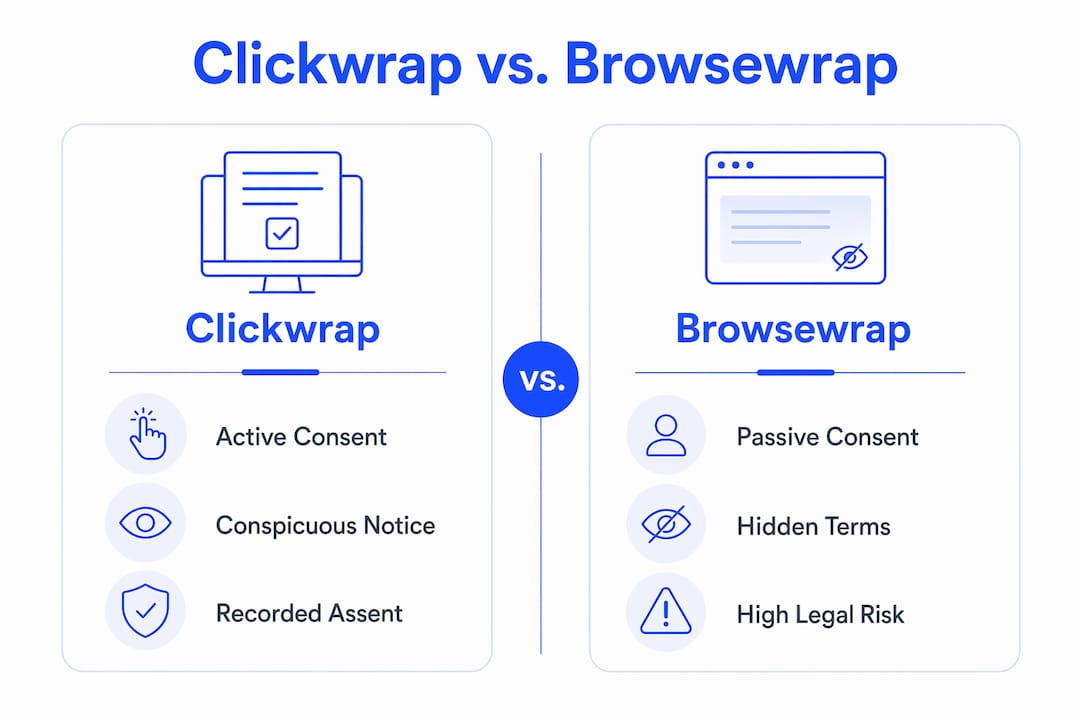
The contrast with a click-through contract is stark. The table below maps the core differences.
| Feature | Clickwrap | Browsewrap |
|---|---|---|
| Consent method | Active click or checkbox | Passive site use |
| User notice | Conspicuous, near the action | Often footer-only |
| Enforceability | High, when implemented correctly | Low to moderate |
| Audit evidence | Timestamped click record | Typically none |
| Legal risk | Low | High |
A hybrid model offers a middle path. It pairs a conspicuous link to the full terms with a mandatory acceptance click. The Berman test and industry consensus favor this design because it combines the visibility of a browsewrap notice with the explicit consent of a clickwrap mechanism. For businesses that want maximum protection, the hybrid approach is the current best practice.
International context matters too. In the United Kingdom and Ireland, consumer protection laws impose strict transparency and fairness standards that browsewrap agreements routinely fail. The Consumer Rights Act 2015 in the UK and its 2022 Irish equivalent both favor explicit consent models. If your product serves users in those markets, a passive notice is not just risky. It is likely non-compliant.
What are best practices for designing enforceable clickwrap agreements?
Design is the deciding factor. A court reviewing a disputed digital contract acceptance will look at the actual user interface, not just the legal text. The following practices reflect current judicial expectations and legal compliance standards.
-
Never use pre-checked boxes. A pre-checked box signals that the user did not make an active choice. Courts treat this as a design trick, not genuine consent. The box must start unchecked and require the user to check it.
-
Place the terms link directly above or beside the acceptance button. The link must be visible without scrolling. Using a small gray font or tucking the link below the fold undermines the reasonable notice standard.
-
Use separate checkboxes for each distinct document. If your online agreement form covers both a terms of service agreement and a privacy policy, require a separate checkbox for each. Separate consent checkboxes create cleaner records and prevent disputes about which document the user actually accepted.
-
Make the accept and decline options symmetrical. The "Accept" and "Decline" buttons should be the same size, color, and prominence. Hiding the decline option or making it visually subordinate is a dark pattern that courts notice.
-
Test your flow for accessibility. Screen readers must be able to interpret the checkbox and the associated terms link. An inaccessible consent flow creates both legal exposure and a weaker argument that the user had genuine notice.
-
Version your terms and link each version to its consent records. When you update your terms, users who accepted the old version did not accept the new one. Treat a material update as a new agreement requiring fresh consent.
Pro Tip: Run your signup flow through a legal review at least once a year. UI changes made by a developer for aesthetic reasons can inadvertently break the reasonable notice standard without anyone realizing it.
The shift toward explicit user consent reflects broader trends in privacy law and consumer protection. Passive agreements are becoming harder to defend as regulators and courts raise their expectations. Building the consent flow correctly from the start is far cheaper than litigating it later.
How should businesses document and audit clickwrap consent?
Documentation is the difference between a contract that holds up in court and one that collapses under scrutiny. Many businesses invest in well-drafted terms but neglect the consent capture layer entirely.
A complete audit trail for each consent event must include:
- Timestamp: The exact date and time of the click, recorded in UTC.
- IP address: The network address of the device used at the time of consent.
- User agent string: The browser and operating system, which helps confirm the device type.
- Document version hash: A cryptographic fingerprint of the exact terms document the user saw. This proves the version has not changed since consent was given.
- User identifier: The account ID or email address tied to the consent event.
- Screenshot or rendering: A stored image of the consent screen as it appeared to the user.
Segregate consent records by document. If a user accepted both a master service agreement and a data processing agreement in the same session, store two separate records. Bundled records create ambiguity about which terms were accepted.
Courts examine the actual screen the user saw, not a reconstructed version. Businesses that cannot produce the original interface rendering are at a disadvantage. Storing rendered snapshots alongside log data closes this gap.
Proxy clicks are a specific risk worth flagging. Allowing a reseller or agent to click the agreement on behalf of the end user can invalidate consent entirely. The actual party who will be bound by the terms must be the one who clicks. If your distribution model involves intermediaries, build a flow that presents terms directly to the end user, not to the reseller.
Retention periods matter. Store consent records for at least as long as the underlying contract is active, plus any applicable statute of limitations. For most commercial agreements in the United States, that means a minimum of six years after the relationship ends.
Key takeaways
A clickwrap agreement is only as enforceable as the implementation behind it. Courts evaluate the user interface, the consent record, and the notice placement, not just the legal text.
| Point | Details |
|---|---|
| Reasonable notice is required | Terms links must appear conspicuously near the acceptance button, not in a footer. |
| Active consent beats passive notice | A click or checkbox creates enforceable assent; browsing alone does not. |
| Audit trails are non-negotiable | Capture timestamps, IP addresses, document hashes, and user identifiers for every consent event. |
| Separate checkboxes per document | Distinct records for each agreement prevent disputes about which terms were accepted. |
| Proxy clicks risk invalidating consent | The actual contracting party must click, not a reseller or agent acting on their behalf. |
The part most founders get wrong about clickwrap
After reviewing contract workflows across many businesses, one pattern stands out: founders treat the signup flow as a product decision and the legal terms as a legal decision, and the two teams never talk to each other. That disconnect is where enforceability breaks down.
The legal team drafts thorough terms. The product team ships a signup flow that pre-checks the box, buries the link below the fold, or lets a reseller click through on behalf of the customer. Nobody flags the problem until there is a dispute. By then, the audit logs are incomplete, the UI has been updated three times, and nobody can produce the screen the user actually saw.
The fix is treating the signup flow as a legal artifact from day one. Every UI change that touches the consent area should require sign-off from legal. The consent record structure should be defined before the first line of code is written, not retrofitted after launch.
The other mistake I see consistently is ignoring renewed consent. Businesses update their terms, send a generic email, and assume that is enough. It is not. A material change to a terms of service agreement requires a fresh click from the user. If you cannot produce a new consent record dated after the update, you are still bound by the old version in any dispute.
The legal landscape will keep tightening. Privacy regulations and consumer protection enforcement are moving in one direction. Businesses that build explicit, documented consent flows now will be ahead of the next wave of requirements, not scrambling to catch up.
— Alex
How Formable supports digital agreement workflows
Managing consent records, version control, and e-signatures across dozens of agreement types is operationally complex. Formable is a contract management platform built for exactly this kind of work.
Formable handles the full agreement lifecycle, from creating contracts from templates like MSAs, DPAs, and order forms, to redlining, negotiation, and collecting e-signatures with a full audit trail. Every signed document includes an immutable timestamp and version record, which directly supports the consent documentation standards described above. Teams that need to integrate signing into their own platform can use Formable's e-signing API. Reach out at formabledocs.com and the team will walk through your specific use case.
FAQ
What is a clickwrap agreement?
A clickwrap agreement is a digital contract formed when a user actively clicks "I Agree" or checks a box to accept terms before using a service. Courts enforce these agreements when the terms are conspicuously displayed and the user's action is unambiguous.
Are clickwrap agreements legally binding in the United States?
Yes. U.S. courts routinely enforce click-through contracts when two conditions are met: the user had reasonable notice of the terms, and the user took an affirmative action to accept them. Cases like Meyer v. Uber confirm this standard.
What is the difference between clickwrap and browsewrap?
A clickwrap agreement requires an explicit action such as a click or checkbox. A browsewrap contract assumes consent from site use alone, with no active step required. Browsewrap agreements are far more likely to be unenforceable in U.S. courts.
What records should businesses keep to prove clickwrap consent?
Businesses should retain the timestamp, IP address, user agent string, document version hash, and a rendering of the consent screen for each acceptance event. These records are the primary evidence courts examine in a dispute.
Can a third party click a clickwrap agreement on behalf of a user?
No. Consent clicked by a reseller or agent on behalf of the end user risks being invalid. The party who will be bound by the terms must personally complete the acceptance action.