
An LOI is not automatically the same as a contract. Courts treat it as a preliminary document unless the language or the parties' conduct shows real intent to be bound, but that does not mean an LOI is toothless.
Specific provisions inside an LOI, most often exclusivity, confidentiality, expense allocation, and governing law, frequently get enforced as binding even when the rest of the document is not. That gap between "mostly non-binding" and "fully enforceable" is exactly where deal teams get burned. A founder signs what looks like a formality, keeps negotiating for three more months, then discovers the no-shop clause was airtight the whole time.
Pro Tip: Mark every clause in your LOI as either "binding" or "non-binding" in the section heading itself, and add a standalone "subject to contract" statement covering the rest of the document. Ambiguity is what turns a routine LOI into a lawsuit.
Key takeaways
An LOI becomes enforceable not through its title but through its language, its certainty of terms, and how the parties actually behave after signing.
| Point | Details |
|---|---|
| LOI is not a contract by default | Courts require clear intent, certainty of terms, and consistent conduct before treating an LOI as binding. |
| Watch five specific clauses | Exclusivity, confidentiality, expense allocation, interim deliverables, and governing law are most often enforced. |
| Cap exclusivity explicitly | Use a fixed number of days and hard end date, typically within the 60 to 120 day range common in M&A deals. |
| Conduct can override labels | Performing under the deal before signing a definitive agreement can create binding obligations regardless of disclaimers. |
| Use Formable to draft cleanly | Formable's guided contract creator and LOI template help label binding clauses correctly from the first draft. |
What an LOI is vs what a contract is
A letter of intent is a preliminary document that records the headline terms of a deal before the parties commit to anything final. It shows up most often in M&A, asset purchases, commercial leases, and large procurement negotiations, where both sides want to lock down direction before spending real money on due diligence and legal drafting. When the parties are ready to close a sale, they move from the LOI to a purchase agreement. The audience is typically the counterparties themselves plus their advisors, and the purpose is coordination, not obligation.
A contract is different by design. Under the classic framework described by Cornell's Legal Information Institute, a contract requires an offer, acceptance, consideration, mutual intent to create legal relations, and enough certainty of terms for a court to enforce it. Meet those elements and the document is enforceable regardless of what you call it. Miss them, and even a document titled "Agreement" might not hold up.
The practical differences show up quickly once you set the two side by side:
- Length and detail. LOIs run a few pages and skip the fine print. Contracts include representations, warranties, indemnities, and closing mechanics.
- Binding expectation. LOIs default to non-binding status with carved-out exceptions. Contracts are enforceable in full unless a specific clause says otherwise.
- Clauses that survive. Exclusivity, confidentiality, and expense allocation often carry over from LOI to final agreement almost unchanged.
- Purpose. Investopedia's overview of letters of intent frames the LOI as a tool for recording headline terms, while the contract is the vehicle that actually transfers rights and obligations.
Worth noting: an LOI and a memorandum of understanding (MOU) get used almost interchangeably in practice, though LOIs tend to be transaction-specific while MOUs often frame a broader collaboration.
When does a letter of intent become binding?
Courts look at three things: intention to create legal relations, certainty of terms, and what the parties actually did after signing. Get those three factors clearly wrong in your drafting, and a document you meant as a placeholder can turn into a full obligation.
Several signals push a court toward finding a binding contract inside what was supposed to be a non-binding LOI:
- Express language. If the document uses words like "shall" and "agrees to" instead of "intends to" or "proposes," that language works against you.
- Essential terms present. Price, quantity, timeline, and parties clearly spelled out looks a lot like a finished deal, not a draft.
- Performance after signing. If one side starts delivering, paying, or acting as though the deal is done, courts read that conduct as evidence of intent.
- Missing "subject to contract" language. Without it, ambiguous wording defaults toward enforceability in many jurisdictions.
A recurring pattern in disputed LOI cases: one party treats the document as a formality while continuing to negotiate, but their own emails and invoices show they were already performing under its terms. Courts have sided with the party relying on that conduct, not the label on the cover page, because the objective test for intent asks what a reasonable outsider would conclude from behavior, not what either side privately intended.
For in-house counsel reviewing an LOI, the warning signs are usually specific. Watch for price language that reads as final rather than indicative, missing definitions for "material adverse change," and any section where the drafter forgot to repeat the non-binding disclaimer after several pages of detail.
Pro Tip: If your LOI includes a term sheet with exact dollar figures and a signature block that looks like a purchase agreement, treat it as functionally binding regardless of the header. Courts often do.
Which LOI clauses are usually enforceable?
Five provisions get treated as binding far more often than the rest of the document: exclusivity (no-shop), confidentiality, expense allocation, interim deliverables or deposits, and governing law with dispute resolution. Everything else in a typical LOI, valuation, closing conditions, post-closing covenants, usually stays aspirational until the definitive agreement.
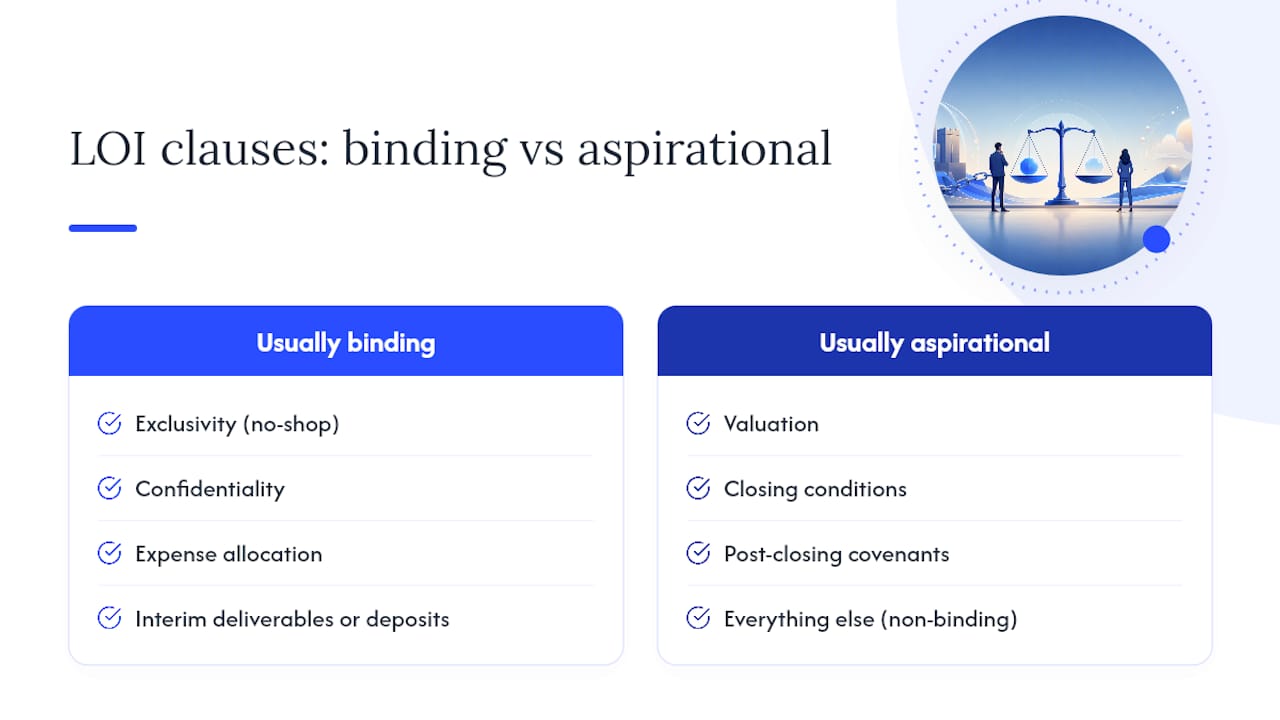
Exclusivity clauses get enforced because they create a concrete, time-bound restriction: the seller agrees not to shop the deal elsewhere for a set window. Courts can measure a breach easily (did the seller talk to someone else during the exclusivity period, yes or no), which makes it a natural candidate for binding treatment. Confidentiality works the same way. Once information changes hands, the harm from disclosure is real whether or not the underlying deal closes, so courts enforce the confidentiality obligation independent of the rest of the LOI.
Expense allocation clauses, who pays for due diligence, legal fees, or a broken deal, get similar treatment because they are self-contained obligations that do not depend on the transaction actually happening.
If you want a clause to bind, say so explicitly: "The parties agree that this Section 4 (Exclusivity) shall be binding and enforceable regardless of whether a definitive agreement is executed." If you want the rest to stay flexible, isolate that binding language in its own numbered section and open the remainder with "Except as set forth in Sections 4 through 6, this letter is non-binding and does not constitute an offer capable of acceptance."
When should you use an LOI instead of jumping to a contract?
An LOI earns its place in complex, high-stakes deals where both sides need to lock in direction before spending money on due diligence. It fits naturally in:
- M&A and asset purchases, where buyers need exclusivity before committing to expensive legal and financial review.
- Commercial lease negotiations, where landlords want to take a space off the market while terms get finalized.
- Vendor onboarding for large procurement, where a company wants to secure pricing before a full contract cycle.
- Pilot agreements, where both parties want to test a working relationship before a multi-year commitment.
Skip the LOI for straightforward, low-risk transactions. A standard purchase order or a one-page service agreement does not need a preliminary document; it just adds a negotiation cycle without adding protection. The same goes for deals where liability transfer needs to happen immediately, insurance binders, urgent asset transfers, anything where "non-binding for now" creates more risk than it solves.
For complex deals, exclusivity periods in LOIs typically run 60 to 120 days, giving both sides room to complete due diligence and negotiate the definitive agreement before that window closes.
What are the biggest risks of signing an LOI?
The most expensive mistakes are almost always drafting mistakes, not strategic ones. Ambiguous binding language sits at the top of the list: a document that never clearly states which sections bind and which do not leaves the door open for a court to find the whole thing enforceable based on conduct alone.
Common patterns worth flagging before you sign:
- Failing to segregate binding clauses. If exclusivity and confidentiality sit inside the same undifferentiated block as valuation and timeline, a court may treat the whole section the same way.
- Overly specific price language. "The purchase price shall be $4.2 million" reads like a final term, even in a document labeled non-binding.
- Exclusivity periods with no cap. An open-ended no-shop clause can trap a seller indefinitely if the buyer stalls.
- Starting performance too early. Sending deposits, sharing proprietary data, or beginning integration work before the definitive agreement signals that both sides already consider the deal done, which courts read as evidence of a binding contract by conduct.
Remedies differ sharply depending on what actually got breached. Breach a binding exclusivity clause and you are usually looking at damages tied to the cost of the breach itself, lost deal opportunities, wasted diligence spend. Breach a fully executed contract and the remedies expand to specific performance, broader consequential damages, and sometimes injunctive relief. That gap is exactly why sloppy LOI drafting is so costly: you can end up with contract-level exposure while thinking you only signed a non-binding formality.
Pro Tip: Cap every exclusivity clause at a fixed number of days with an explicit end date, not a vague "reasonable period." A specific date is nearly impossible to argue around later.

How do you draft an LOI to match your intent?
A good drafting checklist does one job: it forces you to decide, clause by clause, what you actually want enforced and then write language that matches that decision. Here is the sequence most experienced deal teams follow.
- Label every clause explicitly. Mark each section "binding" or "non-binding" in the heading itself, not buried in a general disclaimer at the end.
- Add a standalone "subject to contract" statement. Place it prominently, ideally right after the parties' names, stating that no obligation arises until a definitive agreement is signed.
- Set an explicit exclusivity window. Pick a number of days and a hard end date rather than an open-ended term.
- Define interim deliverables and expense responsibility. State who pays for due diligence, appraisals, or legal review if the deal falls apart.
- Include termination triggers. Spell out what happens if the parties fail to reach a definitive agreement by a set date, does the LOI simply expire, or does something survive it.
- Set a timeline to the definitive agreement. A target date for signing the final contract keeps both sides accountable.
A short non-binding paragraph might read: "This letter reflects the parties' current intentions and does not constitute a binding offer or acceptance, except as expressly stated in Sections 3, 4, and 7." An exclusivity clause might say: "For 90 days from the date of this letter, Seller shall not solicit, negotiate, or accept competing offers for the transaction described herein." These are illustrative starting points, not finished legal language, and every deal needs its own review.
Signing guidance matters more than people expect. Have the same signatories on the LOI who will ultimately sign the definitive agreement, date every version, and be careful about conduct in between. If your team starts acting like the deal is closed the week after signing, that behavior can outweigh even the most careful disclaimer language.
Pro Tip: Keep a signed, dated copy of every LOI draft, not just the final version. If a dispute ever turns on what the parties intended, the negotiation history often matters as much as the final text.
Templates and tools for drafting an LOI
Getting the binding language right is easier with a starting point built for the purpose rather than a blank page. Formable's letter of intent template includes clause guidance for exclusivity, confidentiality, and expense allocation, the exact provisions covered above that most often end up enforceable.
Formable's guided contract creator walks you through a structured form covering deal type, exclusivity terms, and binding preferences, pulling from a catalogue of standard templates built on Common Paper, a widely respected library of plain-language contract standards. The AI takes your answers and generates a full draft you can use as a starting point or send straight to e-signature.
That matters most for teams moving fast: instead of adapting a generic template and hoping the binding clauses are labeled correctly, you answer a set of guided questions and get a document already structured around the distinctions this article covers. When you are ready to move from LOI to a definitive agreement, the same platform handles redlining and negotiation so the transition does not require switching tools mid-deal.
What happens after you sign an LOI?
Signing an LOI starts a clock, not a closing. The path from there to a definitive agreement usually follows a predictable sequence, even though the timeline flexes with deal complexity.
- Due diligence window opens, typically 30 to 60 days for mid-size deals, longer for regulated industries or complex asset structures.
- Definitive agreement negotiation begins, often overlapping with diligence, running another 30 to 45 days.
- Third-party consents get requested, landlords, lenders, or key customers whose approval the deal depends on.
- Regulatory filings get submitted, if the transaction requires them.
- Closing and transition occur, once the definitive agreement is signed and conditions are satisfied.
Total time from LOI to closing typically runs 60 to 120 days for a straightforward middle-market deal, though regulatory complexity or contested diligence findings can extend that window considerably. Buyers usually own due diligence and financing, sellers own disclosure and consent-gathering, and counsel on both sides own drafting the definitive agreement itself.
How do enforcement remedies differ between an LOI and a contract?
Breach an LOI's binding provisions and the remedy is typically limited to the specific harm that clause was meant to prevent. Violate an exclusivity clause and the injured party can usually recover damages tied to lost opportunity cost or wasted diligence spend, but rarely the full value of the deal that never closed.
Breach a fully executed contract and the remedy landscape expands considerably. Courts can award consequential damages, order specific performance in deals involving unique assets like real estate, or grant injunctive relief to stop an ongoing violation. The difference comes down to what obligation actually existed: an LOI's non-binding sections create no enforceable duty to close the underlying transaction, so there is nothing to specifically perform. Only the narrow binding clauses, exclusivity, confidentiality, expense terms, carry consequences, and those consequences are sized to match the clause itself rather than the whole deal.
This is why sophisticated buyers and sellers negotiate LOI remedies almost as carefully as contract remedies. A well-drafted LOI often caps damages for a breach of exclusivity at documented out-of-pocket costs, capping exposure on both sides while still giving the exclusivity clause real teeth. Skip that negotiation and you are left arguing after the fact about what damages an LOI breach should even produce, a fight that is far more expensive than deciding it up front.
Do courts treat LOIs the same way in every jurisdiction?
The underlying legal test is remarkably consistent: courts across common-law systems ask about intention to create legal relations, certainty of terms, and conduct after signing. What varies is how aggressively courts in different jurisdictions are willing to find binding intent from ambiguous language.
Some jurisdictions lean toward presuming an LOI is non-binding unless the document says otherwise in clear terms, giving significant weight to a "subject to contract" clause. Others weigh conduct more heavily, meaning that even a document labeled non-binding can be found binding if the parties clearly acted as though a deal existed. Singapore courts, for example, apply the same objective test used broadly across common-law jurisdictions, but the presumption of non-bindingness can be overcome more easily when specific terms and performance both point toward a completed deal.
For cross-border transactions, this variation is not academic. A U.S.-based buyer and an overseas seller drafting an LOI need governing law and dispute resolution clauses that are explicit about which jurisdiction's rules apply, because the same ambiguous sentence could get read completely differently in Delaware than in Singapore or London. This is one more reason governing law clauses tend to be treated as binding even inside an otherwise non-binding LOI: without one, the parties cannot even agree on which rules decide the dispute.
An in-house counsel's quick checklist
Before I sign off on any LOI, I run through the same five checks: are binding clauses labeled clearly, is exclusivity capped with a real end date, are the signatories the same people who will sign the definitive agreement, is an NDA attached or incorporated by reference, and is there a stated timeline to the final contract.
Negotiation posture matters here too. Push back hard on vague exclusivity terms and soft on interim deliverables, since the deliverables rarely create real legal exposure while unclear exclusivity almost always does. A free guided template speeds up the first draft, but the checklist above is what actually protects you.
Draft your LOI with Formable
Formable gets deal teams from a blank page to a signed LOI without the usual back and forth of emailing redlines and hunting for the right template. Instead of starting from a generic Word document and hoping the binding clauses are worded correctly, you answer a guided set of questions and get a draft built around exclusivity, confidentiality, and expense terms already structured the right way.
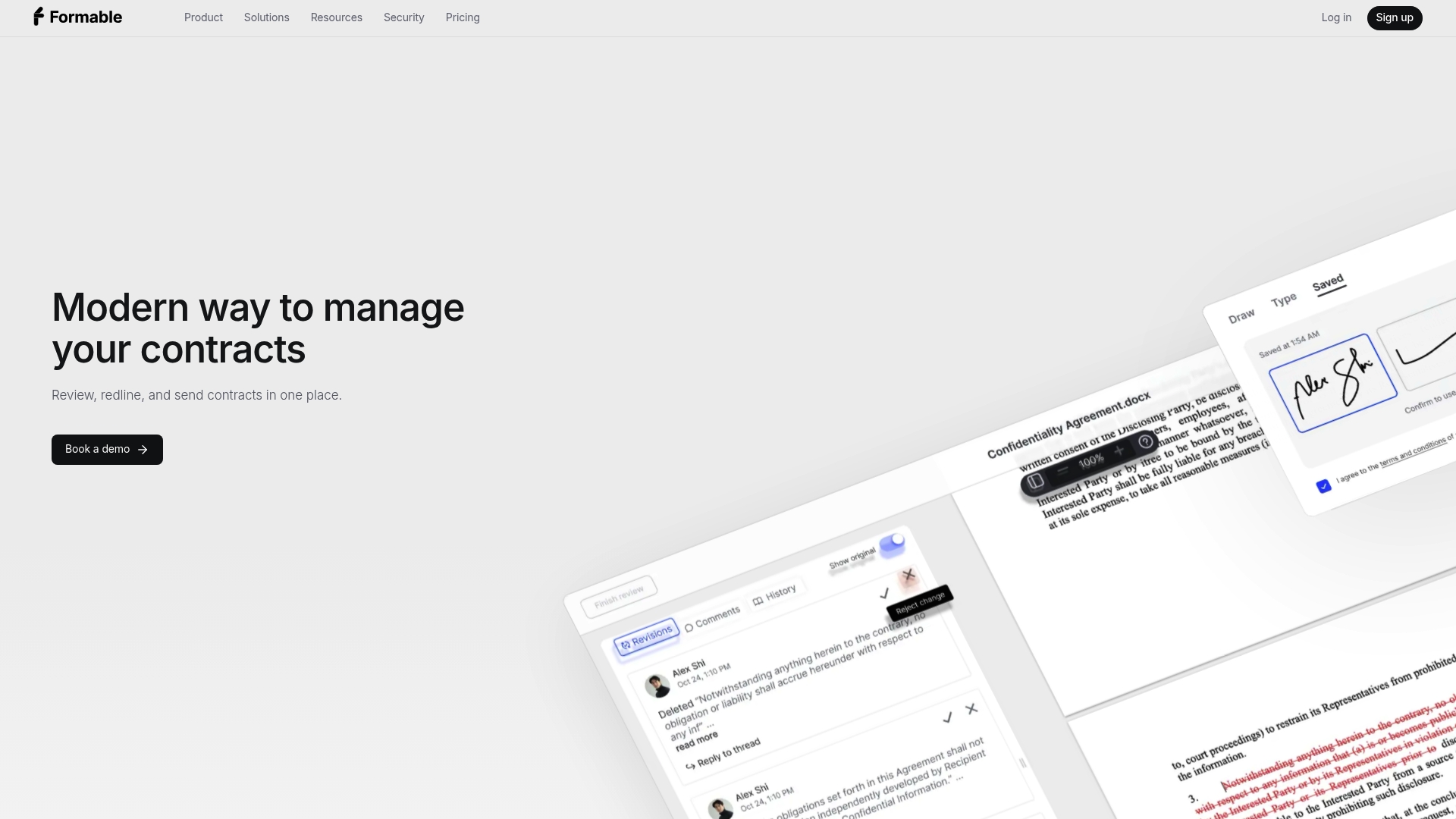
The guided contract creator pulls from a catalogue of templates based on Common Paper standards, then uses AI to turn your answers into a complete draft ready for redlining or straight to e-signature. Once both sides are aligned, Formable's redlining tool keeps negotiation in one place instead of scattered across email threads, and built-in audit trails document exactly when each clause was agreed to, useful if a binding provision ever gets disputed later.
If you are moving from LOI to a definitive agreement, the same platform handles that transition too, MSAs, SOWs, and order forms all live in the same workflow. Start with the free LOI template and see how much faster the first draft comes together.
Sources
For deeper background, see Cornell's Legal Information Institute on contracts, Investopedia's explainer on letters of intent, and George Washington University's overview of common contract documents. For M&A-specific timing, review Acquisition Stars' breakdown of LOI versus purchase agreements. Templates are useful for structure, but a lawyer should still review any LOI with meaningful deal value before signing.
This article is general information, not a substitute for advice from a qualified lawyer. Consult a qualified legal professional about your own circumstances before acting on anything here.
- Contract (Cornell Legal Information Institute)
- What is a letter of intent (Investopedia)
- LOI Agreement vs Purchase Agreement: Key Differences (Acquisition Stars)
- Letters of intent v MOU v contracts: which one do you actually need? (Conventus Law)
FAQ
Is a LOI considered a contract?
Not automatically. An LOI is generally treated as a preliminary, non-binding document, though specific clauses like exclusivity and confidentiality are often enforceable regardless of the document's overall status.
Is an LOI as good as a signed agreement?
No. An LOI records intent and headline terms but typically lacks the full remedies, representations, and enforceability of a definitive contract until that final agreement is signed.
Is it okay to back out of a LOI?
You can usually back out of the non-binding portions of an LOI, but backing out of binding clauses like exclusivity or confidentiality can expose you to damages for breach.
What are the risks of signing a LOI?
The biggest risks are ambiguous binding language, uncapped exclusivity periods, and starting performance too early, all of which can turn a document meant to be flexible into an enforceable obligation.
How is Formable different from a generic LOI template?
Formable's guided contract creator generates a draft based on your specific answers about deal type and binding preferences, pulling from standardized templates rather than a static form you edit manually.