A conference sponsorship contract needs eight non-negotiable elements: full legal names and event details, measurable deliverables in a scope of work, a payment schedule with deadlines, a defined exclusivity scope, an IP license with an approval process, termination and force majeure terms, insurance and indemnity language, and signatures from people authorized to bind each company. Draft a short SOW exhibit for the deliverables, then route the document for e-signature. That single step prevents most disputes before they start.
TL;DR:
- Clearly define measurable deliverables with specific specifications, deadlines, and platforms to prevent disputes over vague or absent scope details.
- Use detailed clauses for payment schedules, exclusivity scope, and termination rights, ensuring they align with actual deliverables and category specificity.
- Attach a numbered scope of work exhibit to keep deliverable standards consistent and easily adaptable for future sponsors without renegotiating the entire contract.
- Confirm signatory authority and include provisions for e-signatures and audit trails to ensure enforceability and proper documentation.
- Incorporate dispute resolution clauses such as mediation or arbitration, and include confidentiality and industry-specific compliance requirements to mitigate legal risks.
Quick checklist and sample clause block for a sponsorship agreement
Before you open a blank document, gather the facts that actually determine whether the contract holds up. Missing details here are the number one reason sponsorship deals stall in legal review.
Fill-in checklist: gather these before drafting
- Legal entity name and mailing address for both the event organizer and the sponsor (not just the brand name on their marketing site).
- Event name, exact dates, and physical or virtual venue.
- Total sponsorship fee, currency, and payment due dates.
- Deliverables with specs attached, not descriptions (see the SOW guidance below).
- Named approval contact at the sponsor's company, plus a response deadline.
- Minimum insurance coverage required, if the sponsor has an on-site presence.
- Names and titles of the people signing for each party.
- Renewal option, if any, and the deadline to exercise it.
Once you have those eight items, you can build the clause language. Here is a compact block you can adapt directly into a draft agreement or a negotiating email.
Sample clause block (fee, deliverables, exclusivity, termination, IP):
"Sponsor agrees to pay a sponsorship fee of $[amount], due as follows: 50% deposit within 10 business days of signing, and the remaining balance no later than 30 days before the event start date. Late payments accrue a fee of 1.5% per month. In exchange, Organizer will provide the deliverables listed in Exhibit A, including logo placement, booth space, and speaking opportunities, each with specifications and delivery deadlines. Sponsor receives exclusivity within the [specific product category] category only; Organizer retains the right to accept sponsors in unrelated categories. This agreement may be terminated by either party with 30 days' written notice, or immediately for material breach not cured within 10 days of notice. Organizer grants Sponsor a limited, non-exclusive license to use Organizer's event marks solely for promoting Sponsor's participation, subject to Organizer's prior written approval of any use."
Move the deliverable specs, logo files, and booth diagrams into a separate SOW exhibit rather than cramming them into the body text. That keeps the main contract clean and lets you swap the exhibit for repeat sponsors without renegotiating the whole document.
The 11 clauses every sponsorship agreement needs
Public sponsorship exhibits, including filings reviewed by the SEC, consistently include the same core building blocks: scope, deliverables, termination, indemnity, IP licenses, and signature blocks. Here is how to draft each one so it actually holds up.
1. Parties and definitions. Use the sponsor's registered legal entity name, not its trade name or the parent company's brand. If "Acme Coffee LLC" sponsors under the brand "Bean There," the contract needs the LLC name, its state of formation, and its mailing address. Confirm who has signing authority. A marketing coordinator often cannot bind a company; a VP or officer usually can.
2. Term and scope. Set the contract term to run from signing through a defined tail period after the event, typically 30 to 60 days, to cover post-event reporting and any dispute window. Don't let the term expire the day the conference ends. That leaves no enforcement mechanism if the sponsor never delivers a promised social post.
3. Deliverables and scope of work. This is where most sponsorship contracts fail. "Social media promotion" is not a deliverable. A measurable deliverable looks like: "Three Instagram posts and two LinkedIn posts featuring Sponsor's logo, published between [date] and [date], each tagged with the event handle." Vague deliverables are consistently cited as the top driver of sponsorship disputes, and the fix is straightforward: attach a measurable SOW listing exact quantities, platforms, and dimensions. Number each item and, where practical, assign it a dollar value. That number becomes useful later if you need to calculate a partial refund or a liquidated damages amount.
- Logo placement: specify pixel dimensions for digital use and physical size in inches for print or signage.
- Booth space: state square footage or linear footage, plus location tier (entrance, main hall, secondary hall).
- Speaking slots: name the session type, duration, and whether it is a solo slot or a panel seat.
- Social posts: specify platform, post count, format (story, feed post, reel), and whether FTC endorsement disclosure language is required.
Pro Tip: Treat every sponsorship like a small project with milestones. Write down each deliverable, its exact spec, and its approval deadline in one shared document both sides sign off on. Sponsors are far less likely to dispute a deliverable they helped define.
4. Payment. Spell out the total fee, deposit percentage, milestone payment dates, accepted payment methods, and a late fee (1% to 2% monthly is common). State who covers sales tax, if applicable, and whether the fee is refundable, partially refundable, or a straight credit toward a future event if something changes. Sample contracts from organizations like the Investment Company Institute tie payment to hard cutoff dates and treat unpaid slots as first-come, first-served, releasing the sponsorship if payment or a signed contract doesn't arrive by the deadline. That structure protects you from a sponsor who verbally commits and then stalls.
5. Exclusivity. If a sponsor pays for category exclusivity, define the category narrowly. "Exclusive cloud storage provider" is enforceable and specific. "Exclusive technology sponsor" is a blank check that could block a dozen unrelated deals later. Narrow, category-specific exclusivity language protects your ability to sell other sponsorships without breaching the agreement you already signed. Consider pricing exclusivity at a premium, typically well above your standard sponsorship tier, and reserve the right to accept sponsors outside the defined category.
6. IP and brand usage. Grant the sponsor a limited, non-exclusive license to use your event marks, and require them to submit their own logo and brand assets by a firm deadline, usually two to four weeks before the event. Reserve the right to reject or remove non-compliant assets. This cuts both ways: your team also needs sponsor approval before publishing anything using their logo.
7. Cancellation and force majeure. Define what counts as force majeure (severe weather, government order, venue closure) separately from ordinary cancellation. For force majeure, specify whether the sponsor gets a full refund, a credit toward next year's event, or a partial refund based on costs already incurred. For ordinary cancellation, tie the refund percentage to how close to the event date the cancellation happens, for example: full refund more than 90 days out, 50% refund 30 to 90 days out, no refund inside 30 days.
8. Liability and insurance. If the sponsor has physical presence (a booth, signage, demo equipment), require a certificate of general liability insurance, commonly $1 million per occurrence, naming the event organizer as an additional insured. Include mutual indemnification so each party covers claims arising from its own negligence.
9. Approval process. Set a firm approval window, 48 to 72 hours, for reviewing sponsor-submitted copy, logos, or booth designs. State what happens if approval is missed: does silence count as approval, or does the deliverable get pushed to a later date? Missing this clause is one of the most common reasons sponsors and organizers end up in a last-minute scramble the week of the event.

10. Post-event reporting. Commit to delivering proof of performance, attendance numbers, photos, social analytics, and a recap of completed deliverables, within a set window after the event. Thirty days is a widely used standard timeline and gives your team enough time to compile real numbers without letting the report slip indefinitely.
11. Signatures and authority. Confirm the signer's title matches someone with binding authority, and route the final document for e-signature rather than a scanned PDF and email chain. Set a deadline, typically five to seven business days for returning the signed contract before the sponsorship slot reverts to available.
Negotiation tips and red flags that sink sponsorship deals
Pricing exclusivity is more art than science, but there is a useful anchor point: charge a premium above your standard sponsorship fee, often in the range of 20% to 50% higher depending on how valuable the category lockout is to competitors. Document the premium explicitly in the contract so it doesn't get treated as a discount in a future renewal negotiation.
In-kind contributions, like a sponsor providing free software licenses or hotel rooms instead of cash, need a dollar value assigned in the contract itself. Without a stated value, you have no baseline for calculating a refund if the sponsor cancels, and no way to compare that deal against a cash sponsorship at renewal time.
- Use liquidated damages for specific, provable deliverables. A clause stating "Sponsor will pay $2,500 if the agreed booth space is not vacated within 24 hours of event close" is enforceable because it reflects a reasonable estimate of actual cost. A penalty untethered to real harm, like a flat $50,000 fee for any breach, risks being thrown out as punitive rather than compensatory.
- Watch for vague deliverable language. "Prominent branding" and "significant social media presence" are negotiating traps. Push for numbers.
- Flag overbroad exclusivity requests. A sponsor asking for "exclusive technology partner" status should be redirected to a specific product category.
- Confirm signing authority before you send the final draft. Ask directly: "Who at your company has authority to sign this agreement?" It's a normal question, and it saves you from a signed contract that a company later claims wasn't properly authorized.
Pro Tip: If a sponsor pushes back hard on measurable deliverables, that's usually a signal they plan to under deliver. Hold the line on specifics, even if it means a slightly longer negotiation.
Finalizing and executing the signed agreement
Once both sides agree on terms, confirm the signer's title and authority one more time before routing the document. Sending a contract to the wrong signatory, someone without binding authority, creates an enforceability gap that surfaces months later if a dispute arises.
E-signatures carry the same legal weight as ink signatures under the federal ESIGN Act, and platforms that generate a timestamped audit trail give you evidence of who signed, when, and from what device if enforcement ever becomes necessary. Keep that audit trail, along with the signed PDF and any exhibit revisions, in a single contract folder rather than scattered across email threads.
Build an asset intake checklist for the sponsor's marketing team:
- High-resolution logo files (vector format preferred, plus PNG with transparent background)
- Brand style guide, including approved colors and prohibited uses
- Any pre-approved copy or taglines for social posts
- Headshots and bios for speaking slot participants
- Deadline for all assets: typically two to three weeks before the event
The post-event report should include attendance figures, booth traffic or scan counts if you tracked them, photos of the sponsor's branded space, and screenshots or analytics from any social deliverables. Deliver it within 30 days of the event closing.
Contract workflow tools cut drafting time and reduce risk
Manually drafting each sponsorship contract from scratch invites the exact mistakes this guide has walked through: missed deadlines, inconsistent exclusivity language, deliverables that never made it into writing. A contract template library with built-in clause playbooks fixes the consistency problem. You draft the fee and deliverables once per sponsor, and the exclusivity, termination, and IP language stay standardized across every deal you sign that season.
Redlining tools matter more than most organizers expect. When a sponsor's legal team sends back a marked-up version with three changed clauses, tracking those edits by hand across email threads is where terms quietly get lost. A shared redlining view keeps both sides looking at the same document version with a visible change history, which shortens the back-and-forth from days to hours.
- Obligation tracking ties each SOW deliverable to a reminder, so nobody forgets the booth diagram was due last Tuesday.
- Version history on redlines shows exactly which party proposed which change, useful if a dispute ever surfaces months later.
- E-signature audit trails preserve proof of who signed and when, which matters if a sponsor later claims they never agreed to a term.
- Centralized storage means the signed contract, the SOW exhibit, and the asset intake checklist all live in one place instead of six email threads.
Pro Tip: Keep a standard sponsorship template with placeholder brackets for fee, dates, and deliverables. Reusing a vetted template instead of rebuilding language from scratch each time cuts your average drafting session down significantly and reduces the odds of accidentally dropping a clause you needed.
Dispute resolution: mediation, arbitration, or court
Every sponsorship contract needs a clause specifying how disputes get resolved, and skipping it means you default to whatever court process applies in your state, which can be slow and expensive for a disagreement over a $5,000 booth fee.
Mediation is the lightest-touch option: a neutral third party helps both sides negotiate a resolution, but neither party is bound to accept the outcome. It works well for relationship-preserving disputes, like disagreements over deliverable quality where both parties want to keep working together next year.
Arbitration is binding. Both parties agree in advance to accept an arbitrator's decision instead of going to court, which is typically faster and cheaper than litigation but limits your right to appeal. Many sponsorship agreements specify arbitration for disputes above a certain dollar threshold and mediation as a required first step below it.
If you skip both and rely on court, specify the jurisdiction and venue explicitly, usually the state where your organization is headquartered or where the event takes place. Without a named jurisdiction clause, a dispute with an out-of-state sponsor can turn into an argument about which state's courts even have authority to hear the case before anyone gets to the actual disagreement.
For most conference sponsorships under a few thousand dollars in fees, a simple mediation-then-arbitration ladder, paired with a named jurisdiction as backup, covers you without over-lawyering a routine deal.
Confidentiality and non-disclosure terms
Sponsorship contracts often expose sensitive information on both sides: attendee counts, other sponsors' fee levels, unreleased product details a sponsor plans to showcase at the booth. A confidentiality clause keeps that information from leaking to competitors or the press before either party wants it public.
Keep the clause mutual rather than one-sided. Sponsors sometimes push for a confidentiality term that only protects their information, but organizers share plenty of sensitive data too, like attendance projections or the pricing offered to other sponsors in the same category.
Define what counts as confidential explicitly: financial terms, attendee data, unreleased marketing plans, and anything marked "confidential" in writing. Carve out standard exceptions, information that becomes public through no fault of either party, or information already known before the contract was signed.
Set a duration. Two to three years past the event's end date is typical for sponsorship confidentiality terms, long enough to protect competitive information without locking both parties into a permanent obligation neither remembers agreeing to.
If the sponsorship involves a product launch or embargoed announcement, a standalone non-disclosure agreement signed before serious contract discussions begin is often the safer move. It lets both sides discuss specifics openly during negotiation without exposing sensitive plans if the deal falls through.
Measuring and reporting sponsorship ROI
Sponsors renew based on results, not goodwill, so the contract needs to define upfront what "results" actually means and who is responsible for measuring it.
Build measurable KPIs into the SOW itself rather than leaving ROI undefined until after the event. Common metrics include booth scan or lead counts, session attendance for a sponsored speaking slot, social media engagement on tagged posts, and website referral traffic if the sponsor's link appears in event materials.
Assign responsibility for tracking each metric. If the organizer's team scans badges at the sponsor's booth, that data collection method belongs in the contract so there's no argument later about whose numbers are accurate. If the sponsor wants access to a lead list, specify the format, timing, and any data privacy limits on what can be shared.
The post-event report mentioned earlier is where ROI actually gets delivered to the sponsor: attendance figures, photos, engagement screenshots, and lead counts compiled into a single document within 30 days. That report is also your best renewal tool. A sponsor who receives a clear, numbers-backed recap is far more likely to sign again next year than one who has to chase you for proof the deliverables happened at all.
Renewal and multi-year sponsorship terms
A single-event contract and a multi-year sponsorship agreement need different renewal language, and conflating the two is a common drafting mistake.
For a one-time sponsorship, include a right of first refusal clause: the sponsor gets the option to renew at the same or similar terms before you offer the slot to a competing brand, typically with a 30 to 60 day window to decide after the event ends. This rewards loyal sponsors without locking you into a bad deal if the relationship didn't work out.
For a true multi-year agreement, specify the term length upfront (two or three years is common for anchor sponsors), whether the fee escalates each year, and what triggers an early exit. Include a clause allowing either party to walk away if the event changes format significantly, moves to a different city, or shrinks below a stated attendance threshold the sponsor relied on when signing.
Whichever structure you use, put a firm deadline on the renewal decision. "Sponsor may renew by written notice no later than 45 days before the next event's on-sale date" is enforceable. "Sponsor may renew if interested" leaves you unable to sell that slot to anyone else while you wait for an answer that never comes. If sponsorship terms shift year over year, a formal contract amendment rather than a fresh full rewrite keeps the paper trail clean and the original terms intact where nothing changed.
Advertising and sponsorship compliance basics
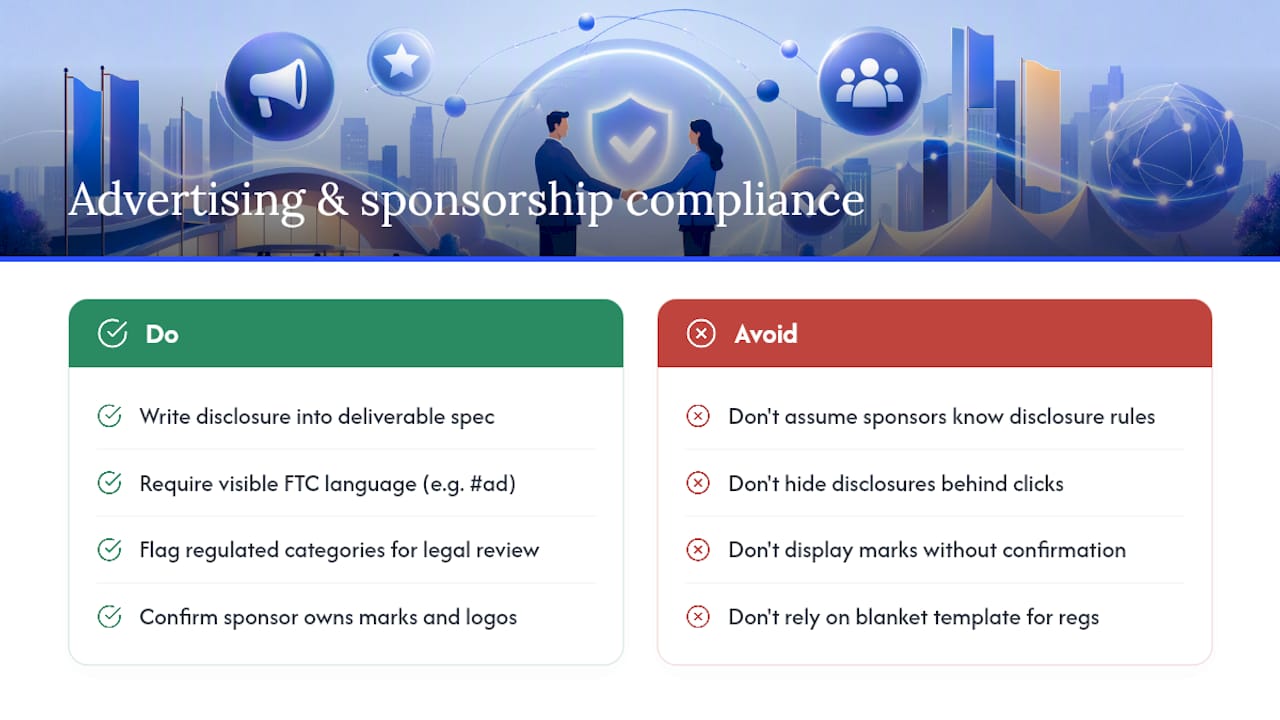
Sponsorship deliverables often cross into advertising law, and the most common gap organizers miss is endorsement disclosure. If a sponsor's product gets featured in a social post, a speaker testimonial, or influencer content tied to the event, the Federal Trade Commission's endorsement guidelines generally require clear disclosure of the paid relationship, language like "#ad" or "sponsored" visible without a click-through.
Build the disclosure requirement directly into the deliverable spec rather than assuming the sponsor's marketing team already knows the rules. A sample clause: "Any social media content referencing Sponsor's products, published by Organizer or Organizer's speakers, will include disclosure language identifying the post as sponsored content, in compliance with FTC guidelines."
If the event involves alcohol, financial products, healthcare, or other regulated categories, sponsor deliverables may also trigger industry-specific advertising rules beyond general FTC guidance, state alcohol advertising restrictions or financial services disclosure requirements, for example. Flag those categories early and route the specific deliverable language through legal review rather than relying on a general-purpose template clause.
Trademark use is the other compliance area worth double-checking. Confirm the sponsor actually owns the marks and logos they're asking you to display, and confirm your own event marks are cleared for the sponsor's proposed use before granting a license in the IP clause.
An editorial take on getting sponsorship contracts right
The biggest gap I see in sponsorship agreements isn't legal complexity. It's specificity. Organizers write contracts the way they'd write a partnership announcement, full of goodwill and short on the details that make an obligation enforceable.
Two things worth doing today: attach a numbered SOW exhibit to your next sponsorship contract instead of describing deliverables in the body text, and confirm your signatory's title and authority before you send the document out for signature. Both take fifteen minutes and prevent the two most common disputes I've seen described across sample agreements and legal guidance on this topic.
One more note. For anything unusual, a title sponsorship, a multi-year commitment, or a deal involving regulated industries like alcohol or financial services, get a lawyer to review the draft before you sign. The cost of an hour of legal review is nothing compared to the cost of a poorly drafted exclusivity clause you discover a year into a three-year deal.
— Alex
How Formable turns this checklist into a signed contract
Every clause covered here, the measurable SOW, the payment schedule, the exclusivity carve-out, still has to get drafted, negotiated, and signed before it protects anyone. Formable is built for exactly that gap between "we know what the contract should say" and "we have a signed copy in hand." Its contract creator combines templates with generative AI, so you can start from a sponsorship structure instead of a blank page, then drop your specific fee, dates, and deliverable specs directly into the exhibit.
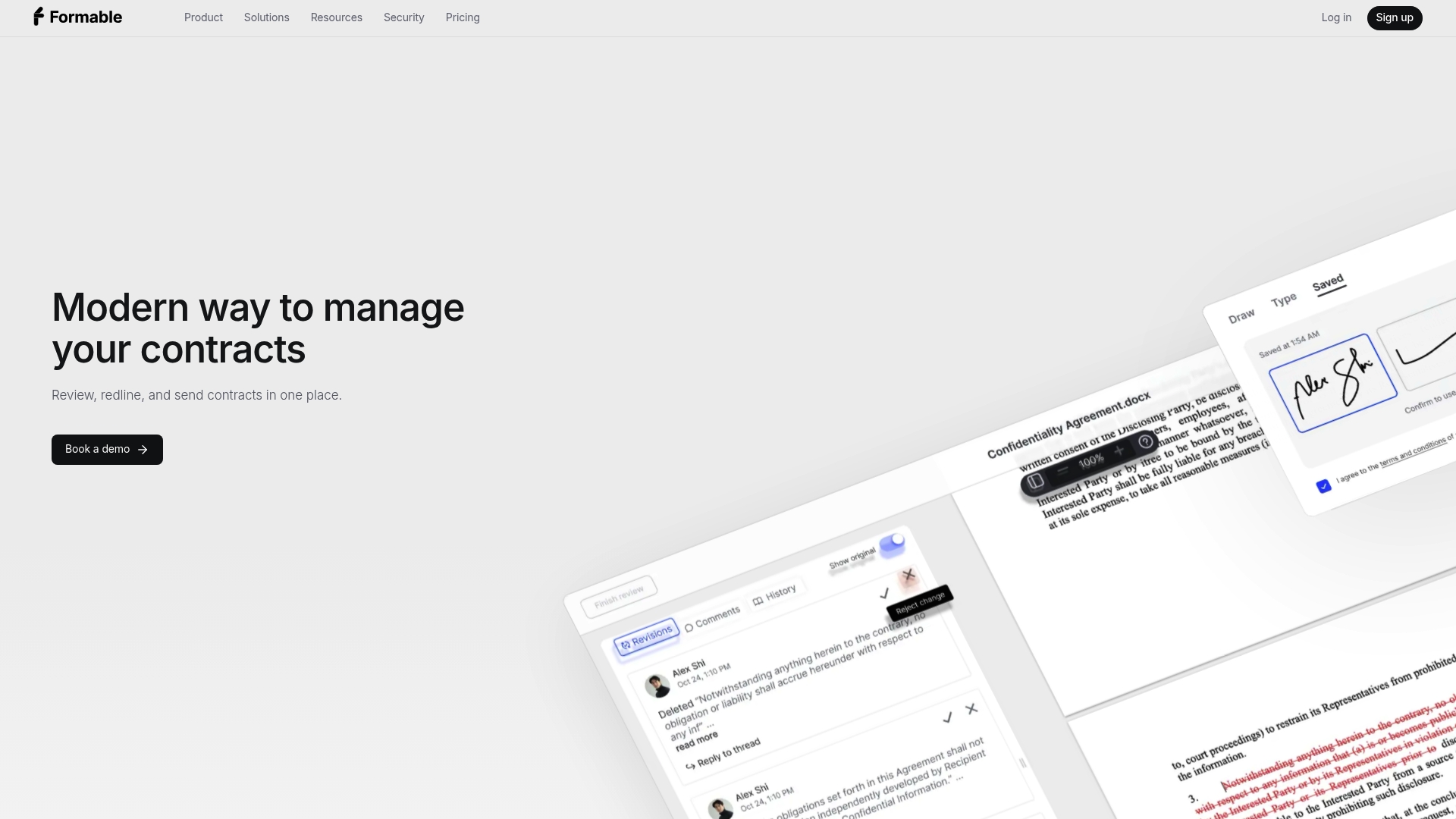
Redlining tools can let teams and sponsors mark up the same document in real time, so exclusivity language or payment terms don't get lost in email thread. Once terms are locked, e-signature with audit trail can close the loop to prove who signed what and when. If you're managing sponsorships alongside other recurring agreements, similar template logic applies to a services agreement for any deliverable-heavy partnership. Start a template on Formable's contract creator and run your next sponsor draft through redlining before it ever reaches the negotiating table.
Sources
- Key legal provisions in a sponsorship agreement | Kader Law
- ICI sponsor contract (2026) — sponsorship contract sample (Investment Company Institute)
- Event sponsorship agreement (SEC exhibit)
- How to fill out and execute a sponsorship agreement form | LegalClarity
FAQ
How do you get a brand to sponsor your event?
Build a sponsorship deck with measurable audience data (attendance, demographics, past sponsor results), then pitch a specific tier with clearly defined deliverables rather than a vague partnership request.
What are the four types of sponsorships?
Common categories include financial sponsorship (cash for benefits), in-kind sponsorship (goods or services instead of cash), media sponsorship (promotion in exchange for visibility), and exclusive or title sponsorship (premium category-locked branding rights).
What are the different types of sponsorship agreements?
Agreements range from single-event contracts to multi-year anchor sponsorships, and from cash-fee deals to in-kind exchanges, but nearly all should include the same core clauses covering deliverables, payment, exclusivity, and termination.
What are sponsorship contracts?
A sponsorship contract is a legally binding agreement where a brand pays or provides value in exchange for defined promotional benefits at an event, typically covering scope, deliverables, payment, exclusivity, IP use, and termination terms, similar to the structure shown in public SEC sponsorship exhibits.
Can I draft a sponsorship contract without a lawyer?
A standard template covers most single-event, low-dollar sponsorships, but any unusual structure, long-term commitment, or regulated industry involvement should get a lawyer's review before signing.