
A statement of work (SOW) is a contractual project document that records agreed scope, deliverables, acceptance criteria, timeline, payment terms, and change control in one place. According to ReqBrief's SOW guide, a well-structured SOW covers eleven core sections and fits into roughly two to three pages for standard projects. Before you draft a single clause, confirm you have these three things locked down:
- A one-sentence scope statement the client and delivery team both agree on
- At least one objective, measurable acceptance test per deliverable
- A milestone schedule with each milestone tied to a payment trigger
Miss any of these and you will spend the final week of the project arguing about what "done" means.
Key takeaways
A statement of work that includes objective acceptance criteria, a milestone-based payment schedule, and a written change-control clause is the single most effective way to prevent scope disputes and protect project revenue.
| Point | Details |
|---|---|
| Write scope in one sentence | If you cannot summarize the project in one sentence, narrow the scope before drafting anything else. |
| Use objective acceptance tests | Replace subjective language with measurable criteria: load times, word counts, error rates, or format specs. |
| Tie every milestone to a payment | Milestone-based invoicing protects cash flow and gives clients clear delivery checkpoints. |
| Add a deemed-accepted clause | A five-business-day review window with a deemed-accepted fallback prevents final-week stalemates. |
| Use Formable for faster drafting | Formable's SOW template, redlining, and e-sign tools take a project from draft to signed without email-thread confusion. |
What is a statement of work, and how does it differ from an MSA or proposal?
An SOW is a project-level contract. It records what will be delivered, by when, at what cost, and under what conditions a deliverable is accepted. Atlassian frames it as a blueprint for execution that gives every stakeholder a single reference for delivery expectations.
Three documents often get confused:
Proposal: A sales document. It describes what you could do and what it might cost. It is not binding on scope or acceptance.
Master Service Agreement (MSA): A framework contract covering liability, IP ownership, confidentiality, and governing law. It applies to every project between two parties. An MSA rarely specifies deliverables.
Statement of work: The project-specific layer. It sits under the MSA and fills in the details the MSA deliberately leaves blank: scope, deliverables, milestones, fees, and acceptance. PrimeBase recommends keeping the SOW focused on these project-level details when an MSA already covers broader legal terms.
Use a standalone SOW when there is no existing MSA, when the project is a one-time engagement, or when a client requires a self-contained document for procurement. Reference an existing MSA when the legal framework is already in place and you only need to specify the work.
Why a clear SOW protects your project and your revenue
A vague SOW is not just an administrative problem. It is a financial one. ProjectManager notes that the SOW is legally binding for the described work, and that clear deliverables, timelines, and acceptance criteria directly reduce the risk of cost overruns and missed deadlines.
The risks a weak SOW creates:
- Scope creep: Clients request work that was never agreed upon, and without an out-of-scope list, you have no written basis to push back.
- Unpaid work: Deliverables get revised indefinitely because there is no acceptance test or review window.
- Payment disputes: Milestone payments stall when the client and vendor disagree on whether a milestone was met.
- Missed deadlines: No client dependency list means the vendor waits on assets the client never knew they had to provide.
A well-drafted SOW prevents all of these. It gives the client objective criteria to approve work, gives the vendor a basis to invoice, and gives both parties a written record to resolve disputes quickly rather than through negotiation or litigation.
What every SOW must include: a component-by-component breakdown
TechnologyAdvice's SOW checklist covers objectives, scope, deliverables, tasks, milestones, schedule, payment, success criteria, standards, requirements, and signatures. Here is what to write in each section and why it matters.
Background and objective
State the business problem and the goal in two to four sentences. This section anchors every later decision about scope.
Conservative phrasing: "The client seeks to replace its legacy customer portal with a modern, mobile-responsive interface that reduces support ticket volume by improving self-service functionality."
Concise phrasing: "Objective: deliver a mobile-responsive customer portal that reduces support tickets by enabling self-service account management."
Scope: in and out
Write what is included and, critically, what is not. The out-of-scope list is where most disputes are prevented.
In scope: "Design and development of five core portal screens, integration with the client's existing CRM via REST API, and one round of usability testing."
Out of scope: "Data migration from the legacy system, third-party payment gateway integration, and ongoing maintenance after go-live."
Deliverables
List each deliverable with a verb, a quantity, and a format. "Website" is not a deliverable. "Five HTML/CSS page templates delivered as a GitHub repository" is.
Acceptance criteria
This is the most consequential section in the document. Every deliverable needs at least one objective test. Subjective language ("client satisfaction," "professional appearance") creates disputes. Objective language closes them.
Sample acceptance test: "The portal loads in under three seconds on a 4G connection as measured by Google Lighthouse, scoring 90 or above on performance."
Pro Tip: Add a deemed-accepted clause: "The client has five business days from delivery to provide written feedback. If no response is received within that window, the deliverable is deemed accepted." This single clause, recommended by ReqBrief, prevents the final-week stalemate where a client neither approves nor rejects completed work.
Timeline and milestones
List each milestone with a specific date, not a relative one ("Week 4" becomes ambiguous after a project slips). Tie each milestone to a payment trigger.
Client responsibilities and dependencies
List every asset, approval, or access the vendor needs from the client, with a required-by date. If the client misses a dependency, the milestone date shifts accordingly.
Example: "Client to provide brand guidelines, logo files, and CRM API credentials by March 7. Delays beyond this date extend the project timeline by an equivalent number of business days."
Fees and payment schedule
State the total fee, the payment schedule, the invoice method, and the payment terms (e.g., net 15). Specify whether the fee is fixed or time-and-materials, and what happens if scope changes.
Change control
Define the process for requesting and approving changes. A minimal clause: "Any change to scope, timeline, or budget requires a written change order signed by both parties before work begins. The vendor will provide a cost and timeline estimate within three business days of a change request."
Assumptions and constraints
List anything the SOW depends on that is outside the vendor's control. If an assumption proves false, the vendor has a written basis to renegotiate.
Example: "This SOW assumes the client's CRM API is stable and documented. If the API requires significant reverse-engineering, additional time and cost will be estimated via change order."
Termination and IP
State who owns the work product upon delivery and payment, what happens to work in progress if the contract is terminated, and how much notice each party must give.
Signatures
Include name, title, company, date, and signature line for both parties. Electronic signatures are fully enforceable under the U.S. Electronic Signatures in Global and National Commerce Act (E-SIGN Act).
How to write a statement of work: a step-by-step drafting workflow
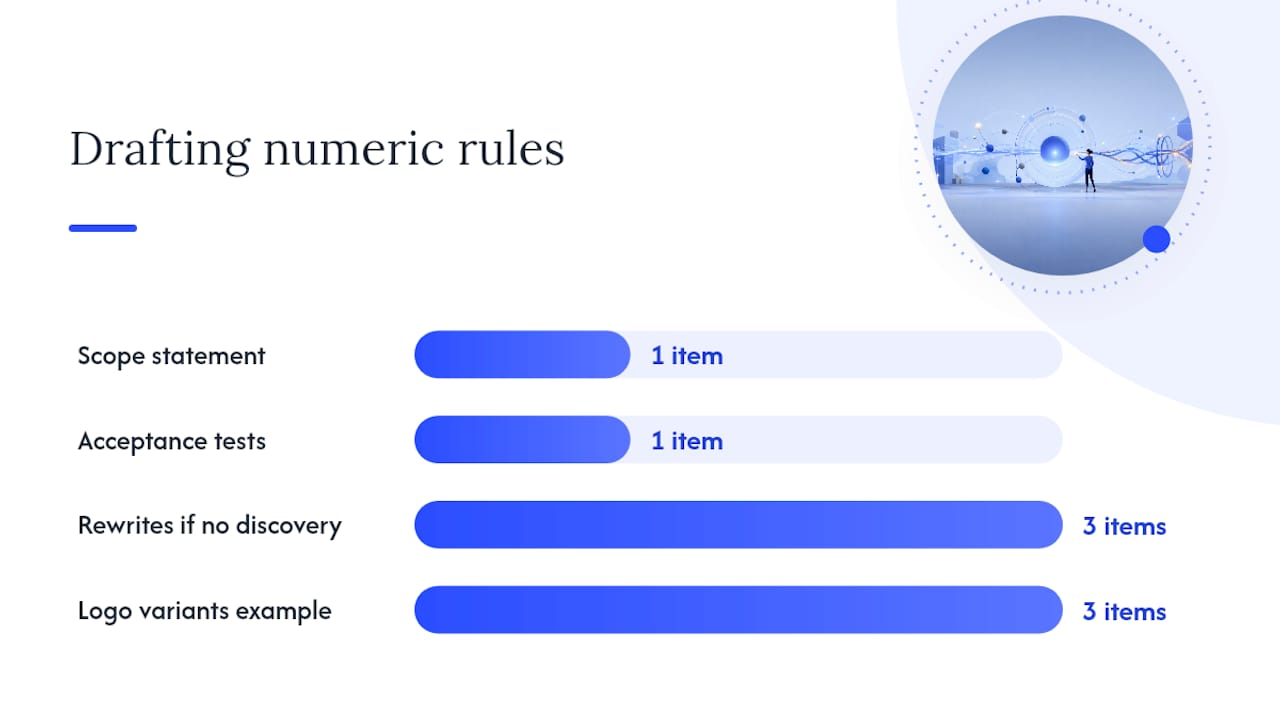
Writing a usable SOW in one pass requires a clear sequence. Skip discovery and you will rewrite the scope section three times.
- Run a discovery session. Interview the project sponsor and key stakeholders. Ask: What does success look like on day one after delivery? What would make you reject a deliverable? What do you need to provide us, and by when? Are there hard deadlines driven by external events?
- Write a one-sentence scope statement. If you cannot summarize the project in one sentence, the scope is too broad. Narrow it before writing anything else.
- List every deliverable with a verb and a format. Use the pattern: "[quantity] [deliverable] delivered as [format] by [date]." Three logo variants in SVG and PDF is a deliverable. "Logo work" is not.
- Write one acceptance test per deliverable. Objective, measurable, and agreed upon before work starts. If the client cannot articulate an acceptance test, that is a signal the requirement is not yet clear.
- Build the milestone schedule and map each milestone to an invoice. Milestone-based payments protect cash flow and give the client clear checkpoints. ReqBrief's drafting guidance specifically recommends tying milestones to invoice triggers for predictable revenue.
- Draft the change-control clause. Keep it short: written request, vendor estimate within three business days, signed change order before work begins.
- List client dependencies with required-by dates. Every item the vendor needs from the client goes here, with a date and a consequence clause for late delivery.
- Add the deemed-accepted clause to the acceptance section. Five business days is the standard review window.
- Run a pre-send validation check. Before sharing the draft, confirm:
- Every deliverable has a measurable acceptance test
- Every milestone has a specific date and a payment trigger
- The out-of-scope list covers the three most likely expansion requests
- Client dependencies are listed with required-by dates
- The change-control clause is present and unambiguous
For teams working on formal procurement submissions, the structure of a winning tender proposal follows a similar discipline: scope clarity, measurable outcomes, and explicit acceptance criteria are non-negotiable in both contexts.
Common SOW mistakes and how to fix them
TechnologyAdvice identifies vague objectives, undefined deliverables, unrealistic timelines, and missing acceptance criteria as the most common SOW failures. Each one has a direct fix.
| Mistake | Consequence | Fix |
|---|---|---|
| Vague deliverables ("website redesign") | Endless revisions, no basis to invoice | Use verb + quantity + format: "Five HTML page templates in a GitHub repo" |
| No out-of-scope list | Client requests work outside the budget | Add a three-item minimum out-of-scope list to every SOW |
| Subjective acceptance criteria | Final-week disputes, withheld payment | Replace "client satisfaction" with a measurable test (load time, error rate, word count) |
| No change-control clause | Scope grows without budget adjustment | Add a written change-order requirement before any new work begins |
| Unrealistic milestones | Missed dates, strained relationships | Build in buffer days; tie milestone dates to client dependency delivery |
| Missing client dependencies | Vendor waits; client blames vendor for delays | List every client-provided item with a required-by date and a delay-consequence clause |
| Incomplete payment terms | Late payments, cash flow gaps | State total fee, payment schedule, invoice method, and net payment terms explicitly |
Pro Tip: The fastest way to catch scope creep before it starts is to read your out-of-scope list aloud to the client during kickoff. If they push back on any item, that is a signal it belongs in a change order, not a verbal agreement.
A ready-to-use SOW template and filled sample
A standard SOW for most professional services projects fits comfortably in two to three pages. Use this structure and fill in the bracketed fields.
SOW template
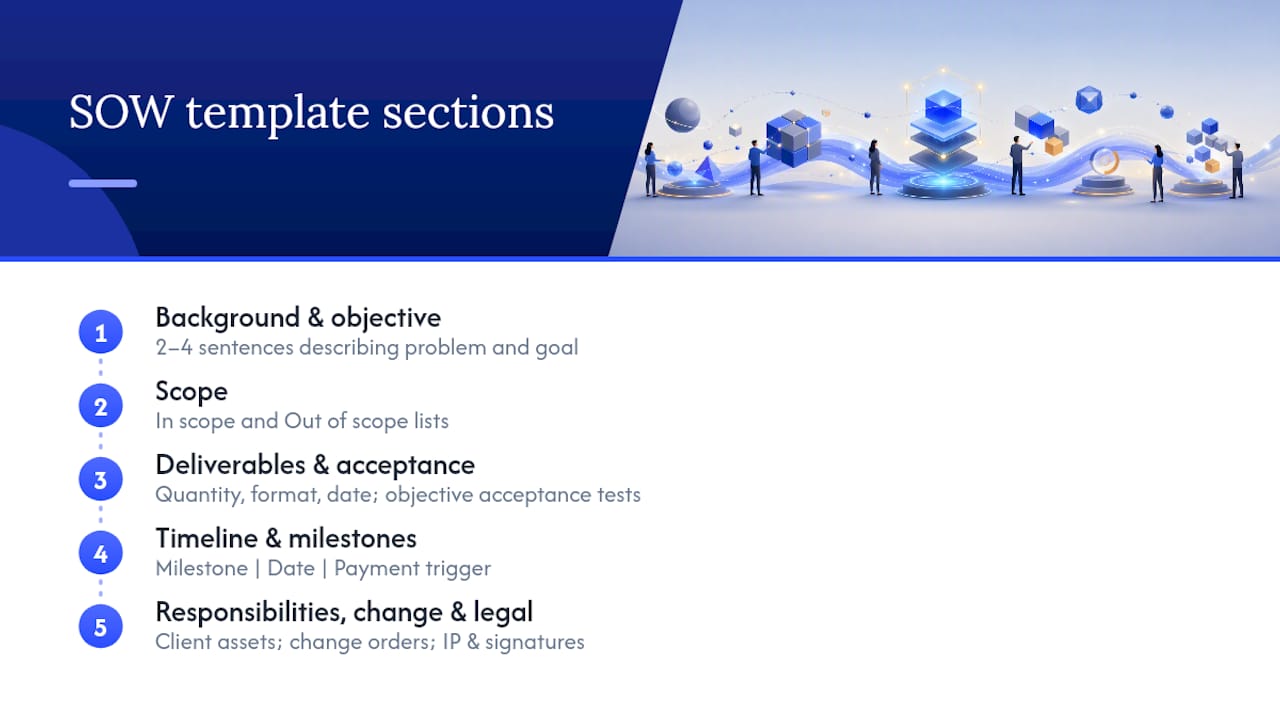
Statement of Work Version 1.0 | [Date] | [Client Name] and [Vendor Name]
1. Background and objective [Two to four sentences describing the business problem and the goal of this engagement.]
2. Scope In scope: [List of included work items.] Out of scope: [List of explicitly excluded items.]
3. Deliverables [Quantity] [Deliverable name] delivered as [format] by [date].
4. Acceptance criteria [Objective test for each deliverable. Include the deemed-accepted clause: "Client has a short review period from delivery to provide written feedback. No response within that window constitutes acceptance."]
5. Timeline and milestones [Milestone name] | [Date] | [Payment trigger]
6. Client responsibilities [List of assets, approvals, or access the vendor requires, each with a required-by date.]
7. Fees and payment Total fee: $[amount]. Payment schedule: [milestone-based or monthly]. Payment terms: net [15/30]. Invoice method: [email/platform].
8. Change control Written change orders required before any out-of-scope work begins. Vendor provides estimate within three business days.
9. Assumptions [List of conditions this SOW depends on.]
10. Termination and IP [Notice period, work-in-progress ownership, and final deliverable IP transfer upon full payment.]
11. Signatures [Name, title, company, date, signature for both parties.]
Filled sample: 8-week website build
Statement of Work Version 1.0 | March 1, 2026 | Meridian Retail Inc. and Calloway Digital LLC
Objective: Deliver a five-page marketing website for Meridian Retail's spring product line, live by April 25, 2026.
In scope: Information architecture, UX wireframes, visual design (two rounds of revisions), front-end development in Next.js, and QA across Chrome, Safari, and Firefox.
Out of scope: Back-end e-commerce functionality, SEO copywriting, and post-launch maintenance.
Deliverables: Production-ready Next.js page components delivered to the client's GitHub repository by a specified date.
Acceptance criteria: All pages score 90 or above on Google Lighthouse performance. Client has a short review period from delivery to provide written feedback. No response within that window constitutes acceptance.
Milestones:
- Wireframes approved on a specified date with an associated invoice payment.
- Design approved on a specified date with an associated invoice payment.
- Development complete on a specified date with an associated invoice payment.
- Go-live on a specified date with an associated invoice payment.
Client responsibilities: Brand guidelines and logo files by March 7; written copy for all five pages by March 14.
Total fee: $15,000. Net 15 payment terms.
Length guidance and final checklist
Keep the SOW to two to three pages for a single project with a defined scope. Expand into an annex or a second SOW when the project has distinct phases, multiple vendors, or regulatory requirements that need separate documentation.
Before sending to the client, confirm:
- Every deliverable has a measurable acceptance test
- The out-of-scope list covers the three most likely expansion requests
- Each milestone has a specific calendar date and a payment trigger
- Client dependencies are listed with required-by dates
- The change-control clause and deemed-accepted window are present
How to handle review, approvals, versioning, and change orders
Once the draft is complete, the review process needs as much structure as the document itself. Rework recommends storing the SOW in the project workspace so it is easy to find during change requests.
Review roles: The project manager reviews for completeness and milestone accuracy. Legal or general counsel reviews liability, IP, and termination clauses. The account executive or relationship owner reviews payment terms and client responsibilities.
Version control: Use a simple filename convention: SOW_ClientName_ProjectName_v1.0.docx. Increment the minor version (v1.1, v1.2) for pre-signature revisions and the major version (v2.0) for post-signature amendments. Store every version in a central workspace, not in email threads.
Signature options: Electronic signatures are valid under the E-SIGN Act. Collect signatures with a platform that timestamps the signing event and stores an immutable audit trail. Both parties should receive a countersigned copy immediately after execution.
Change orders: When scope changes after sign-off, issue a written change order that references the original SOW, describes the new work, states the additional fee and timeline impact, and requires signatures from both parties. A minimal change-order header:
Change Order #1 to SOW dated [original date] between [Client] and [Vendor]. Description of change: [one paragraph]. Additional fee: $[amount]. Revised milestone date: [date]. Signatures: [both parties].
The deemed-accepted clause applies to change-order deliverables as well. State this explicitly in the change order.
How contract tools speed SOW creation and reduce risk
Manual SOW drafting in a word processor creates version confusion, email-thread redlines, and signature delays. A purpose-built contract tool addresses each of these directly.
Core capabilities that matter for SOW work:
- Template library: Start from a pre-built SOW template with standard clauses already in place, including acceptance windows and change-control language.
- Collaborative redlining: Both parties mark up the same document in real time, with every change tracked and timestamped. No more "final_final_v3" email attachments.
- Version history: Every revision is stored automatically with a timestamp and the name of the editor. The audit trail is immutable.
- E-signing: Collect legally binding signatures without printing or scanning. The signing event is logged with a timestamp.
- Central storage: The executed SOW lives in a shared workspace, accessible during change requests without hunting through email.
A practical workflow: draft from a template, share for redline via a negotiation link, capture agreed acceptance criteria in the final version, collect e-signatures, and store the executed document with its full audit trail. That sequence removes the back-and-forth email chain and gives both parties a single source of truth from draft to signed.
A practitioner's perspective on what actually goes wrong
The most expensive phrase in project management is "that is not what I wanted," heard in the final week of delivery. It almost always traces back to one of two omissions: no objective acceptance test, or no out-of-scope list.
One pattern that comes up repeatedly: a vendor delivers a fully functional product, the client rejects it on aesthetic grounds that were never specified, and both parties spend two weeks negotiating what "professional" means. A single acceptance test tied to a measurable standard would have closed that gap before work began.
Three heuristics worth keeping on hand when reviewing any SOW:
- If you cannot write the scope in one sentence, the scope is not ready to be contracted.
- Every milestone should have a payment attached. A milestone with no payment trigger is just a date on a calendar.
- Every item the client must provide should have a required-by date and a consequence clause. Client delays are the leading cause of vendor-blamed missed deadlines.
The SOW is not an administrative formality. As Peter Landau notes at ProjectManager, it is arguably the most important project document because it is created at the outset. Getting it right early is the single highest-leverage action a project manager can take.
Formable makes SOW drafting faster, from template to signed
Drafting a clean SOW from scratch takes time. Drafting one that survives client redlines and gets signed without a week of email back-and-forth takes a repeatable process.
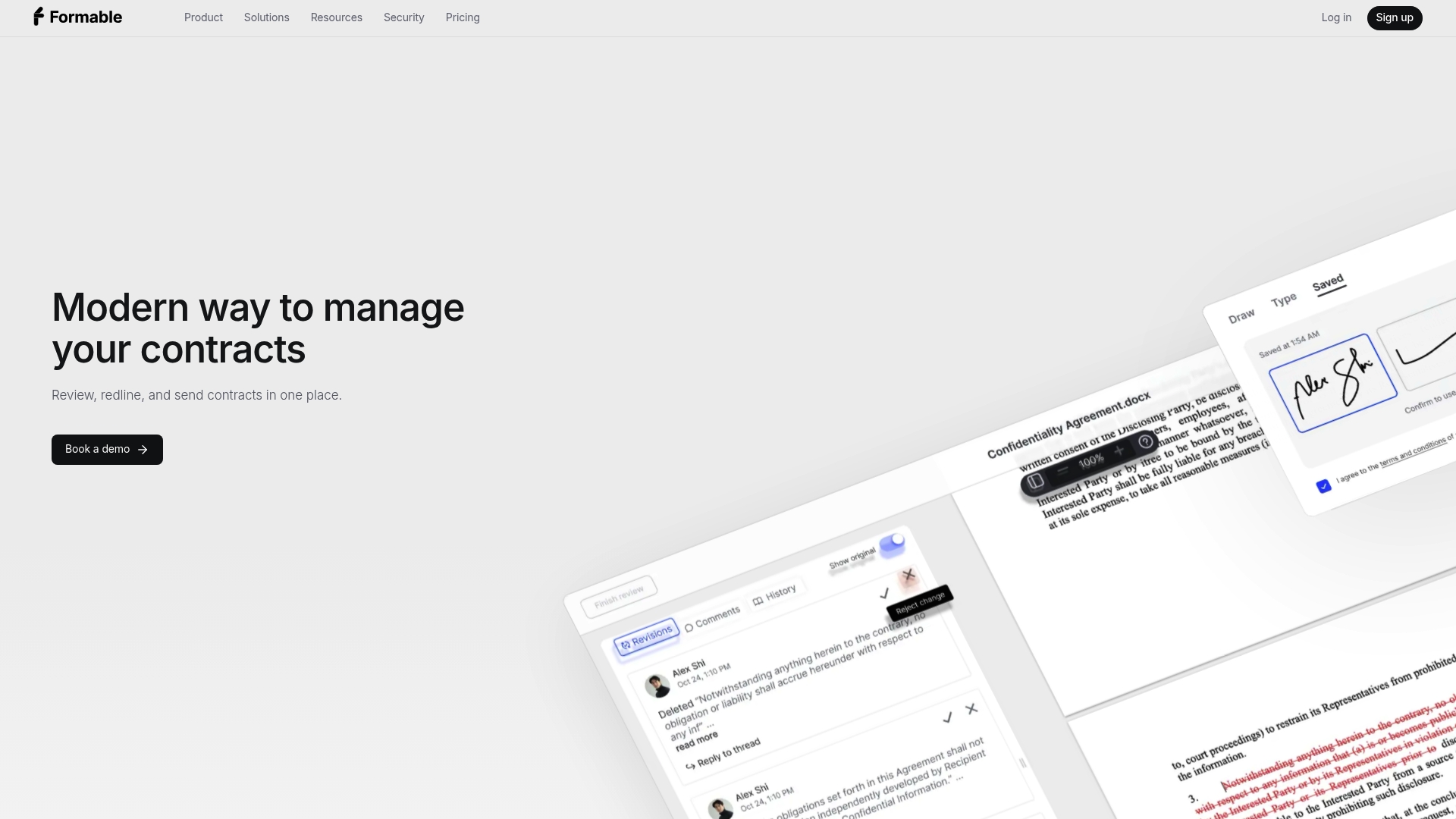
Formable gives you a pre-built SOW template with standard clauses already structured, including acceptance windows, change-control language, and milestone payment triggers. From there, you share the draft for negotiation using Formable's redlining tool, both parties align on terms in real time, and you collect e-signatures with a full audit trail, all in one platform. No version confusion, no email threads, no chasing signatures.
If you also need an MSA template to sit above the SOW, or a contract amendment for post-sign-off change orders, those are ready to use as well. Start with a template at Formabledocs or use the contract creator to generate a draft in minutes.
Sources
These sources provide templates, legal framing, and procurement-specific guidance for teams that want to go deeper.
- How to Write a Statement of Work (SOW): Template + Example | ReqBrief
- What is a Statement of Work (SOW) Definition + Template
- How to Write a Statement of Work + Free Template | TechnologyAdvice
- How to Write a Statement of Work (Free SOW Generator) | PrimeBase
- Statement of Work (SOW): Definition, Types & Examples | ProjectManager
FAQ
What is a statement of work?
A statement of work is a project-level contract that records agreed scope, deliverables, acceptance criteria, timeline, payment terms, and change control between a client and a vendor. It is legally binding for the described work.
How do you start writing a statement of work?
Start with a one-sentence scope statement that both parties agree on, then list every deliverable with a verb, a quantity, and a format before adding acceptance tests and milestones.
Who prepares a statement of work?
The vendor or service provider typically drafts the SOW based on requirements gathered during a discovery session with the client; both parties review, redline, and sign it before work begins.
What should an SOW include?
An SOW should include background and objective, in-scope and out-of-scope items, deliverables, acceptance criteria, a milestone timeline with payment triggers, client responsibilities, fees and payment terms, a change-control clause, assumptions, termination terms, and signatures.
How long should a statement of work be?
For most professional services projects, two to three pages covers all required sections; complex or multi-phase projects may need annexes or separate SOWs per phase.