Creating a mutual NDA: guide for business professionals

Alex Shi

A mutual NDA is a bilateral confidentiality contract where both parties agree to protect each other's disclosed information, and it must include, at minimum: named legal entities, a defined effective date, a scoped definition of confidential information, a stated permitted purpose, mutual use limitations, standard exclusions, a term with survival language, return or destruction obligations, a remedies clause, governing law, and a valid signature block.
Before you share anything sensitive, run through this checklist:
- Parties and effective date: Full legal entity names (LLC, Inc., Corp.) and the date the agreement takes effect
- Definition of confidential information: What categories of information are covered, and whether oral disclosures require written confirmation
- Permitted purpose: A narrow, specific statement of why information is being shared
- Use limitations and standard of care: Restrictions on how each party may use the information and the level of protection required
- Exclusions: Public domain, prior knowledge, independently developed information, and third-party disclosures without restriction
- Term and survival: How long the sharing period lasts and how long confidentiality obligations survive termination
- Return or destruction: What happens to materials after the relationship ends
- Remedies: Injunctive relief and damages provisions
- Governing law and venue: The state whose law governs and the courts with jurisdiction
- Signature block: Authorized signatories with titles and a method of execution (wet ink or e-sign)
Start from a vetted template, confirm each signatory has authority to bind their organization, and establish your marking and disclosure practices before the first document changes hands.
Table of Contents
- What does each clause in a mutual NDA actually do?
- How to draft and negotiate a mutual NDA step by step
- Annotated sample mutual NDA and clause bank
- When should you use a mutual NDA vs a unilateral NDA?
- Common pitfalls, US enforceability notes, and recordkeeping best practices
- What are the realistic timelines and costs for creating and signing a mutual NDA?
- What experienced practitioners wish you knew about mutual NDAs
- Key takeaways
- When to use a template vs when to call a lawyer
- Formable makes the full NDA workflow faster
- Authoritative sources and further reading
- FAQ
What does each clause in a mutual NDA actually do?
Every clause in a mutual non-disclosure agreement serves a specific protective function. Knowing what each one does helps you spot gaps in a template and make smart customization decisions.
Parties and effective date. This clause names the contracting legal entities, not individuals, and sets the date from which obligations run. Courts look at whether the correct legal entity signed; a signature by the wrong entity or a person without authority can void the agreement.
Definition of confidential information. This is the most consequential clause in the document. A balanced definition avoids two failure modes: too narrow leaves real secrets unprotected, and too broad risks being struck down as unenforceable. Most well-drafted definitions cover written, electronic, and oral disclosures, then carve out what is not covered.
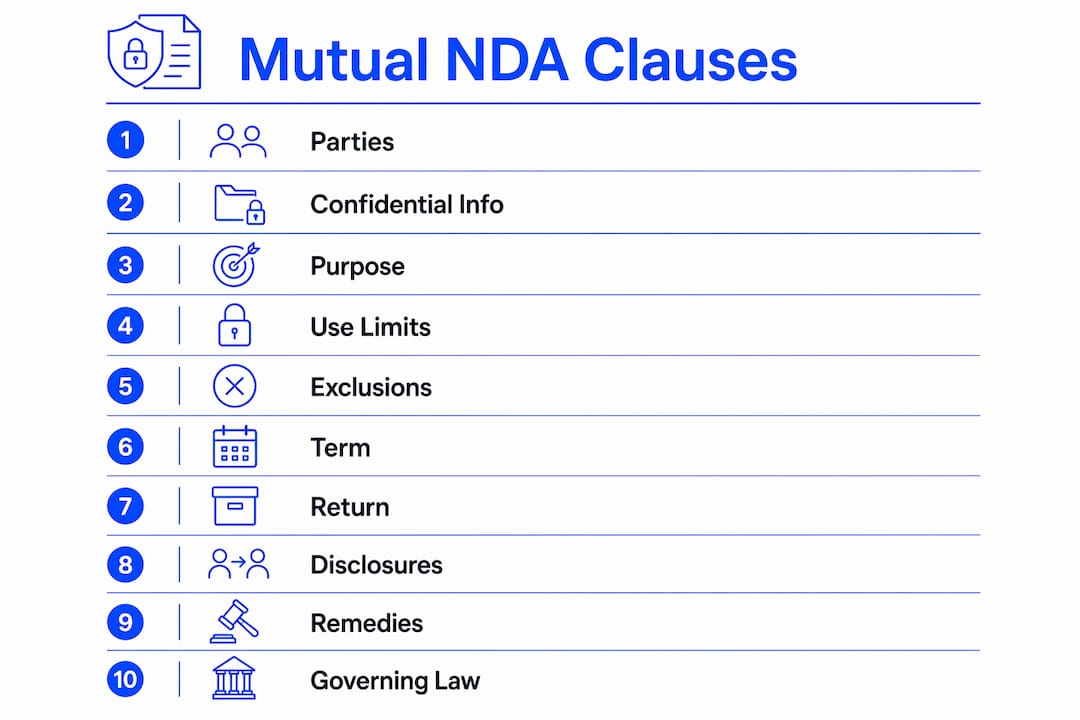
Purpose clause. The permitted purpose limits how each party may use what it receives. A narrow purpose ("evaluating a potential commercial partnership") is harder to abuse than a vague one ("business discussions"). The Common Paper MNDA defaults to "evaluating whether to enter into a business relationship," which is a reasonable starting point.
Use limitations and standard of care. This clause prohibits use outside the stated purpose and requires each party to protect the other's information with at least the same care it uses for its own confidential materials, typically no less than reasonable care.
Exclusions. Standard exclusions cover information that is already public, was known before disclosure, was independently developed, or was received from a third party without restriction. These are not optional; without them, the agreement overreaches and courts may limit its scope.
Term and survival. The term sets how long the parties may share information under the agreement. The survival clause sets how long confidentiality obligations persist after the term ends. Trade secrets often carry a longer or indefinite survival period; general business information typically survives one to three years post-termination.
Return or destruction. At the end of the relationship, each party must return or certify destruction of the other's materials. This clause often includes a carve-out for backup copies retained in ordinary IT processes, provided they remain subject to the confidentiality obligations.
Permitted disclosures. Employees, advisors, and contractors who need access on a need-to-know basis are typically allowed, provided they are bound by equivalent obligations. Compelled disclosures (court orders, regulatory demands) are permitted with notice to the disclosing party where legally possible.
Remedies. Most NDAs include a clause allowing the disclosing party to seek injunctive relief without posting a bond, because monetary damages rarely make a party whole after a trade secret is exposed. This clause also typically preserves all other available remedies.
Governing law and venue. This clause specifies which state's law governs and which courts have jurisdiction. Delaware is the Common Paper default; choose the state where your legal team operates or where disputes are most practical to resolve.
Assignment and no-license language. The agreement should state that it does not grant any license to intellectual property and that neither party may assign its rights without consent.
Signature block. Each signatory should be identified by name, title, and company. If you are using e-sign, the execution method should be noted.
Pro Tip: When drafting the definition of confidential information, list specific categories (source code, financial projections, customer lists, formulas) rather than relying solely on a catch-all phrase. Courts enforce specific definitions more reliably, and the list signals to both parties exactly what is protected.
How to draft and negotiate a mutual NDA step by step
Creating a mutual NDA follows a predictable sequence. Moving through each step in order reduces the risk of gaps and speeds up execution.
Step 1: Decide whether you need a mutual or unilateral NDA
If both parties will disclose substantive confidential information, use a mutual NDA. If only one party is disclosing, a unilateral NDA is simpler and faster to execute. Mutual NDAs are standard for partnerships, co-development discussions, M&A due diligence, and vendor relationships with two-way data flow.
Step 2: Gather the facts you need before you open a template
- Full legal names of both entities (check state registration records)
- The specific categories of information each party will share
- The purpose of the disclosure (be as narrow as the situation allows)
- The intended sharing period and desired survival period
- The state whose law should govern
- The names and titles of authorized signatories
Step 3: Choose a vetted template
Improvised language is the most common drafting mistake, and it is the one most likely to produce an unenforceable agreement. Start with the Common Paper MNDA standard, a reputable legal template provider, or counsel-drafted language. Map every placeholder before you begin customizing.

Step 4: Draft the key clauses
Work through the template systematically:
- Fill in party names and effective date
- Write the definition of confidential information using specific categories
- State the permitted purpose in one sentence
- Set the term (sharing period) and the survival period separately
- List permitted recipients (employees, advisors, contractors) and their obligations
- Specify the return or destruction procedure and timeline
- Confirm the governing law and venue
- Identify signatories by name and title
Step 5: Negotiate redlines strategically
When the other party returns a redlined draft, focus on three areas: the scope of the confidential information definition, the survival period, and any residuals clause. A residuals clause allows a party to use information retained in unaided memory, which can effectively gut the agreement. Push back on overbroad residuals or delete them entirely. Keep survival periods reasonable; three years is common for general business information, though trade secrets may warrant longer protection.
Use a redlining tool to track every change and maintain a clean version history. This matters if a dispute arises later.
Step 6: Verify signatory authority and execute
Confirm that each signatory has actual authority to bind their organization. For corporations and LLCs, this typically means an officer or a person with a written delegation of authority. E-sign is legally valid under the federal E-SIGN Act and UETA in all US states, and it produces a timestamped audit trail that is easier to produce in litigation than a scanned wet-ink signature.
Step 7: Operate the NDA after signature
- Label every document you share as "Confidential" before sending
- Confirm oral disclosures in writing within the window specified in the agreement (commonly 30 days)
- Keep a disclosure register listing what was shared, when, and with whom
- Limit access to need-to-know personnel only
- Require contractors and advisors who receive confidential information to sign flow-down NDAs or be named in the agreement
Annotated sample mutual NDA and clause bank
The template below uses bracketed placeholders. Replace each bracket with your specific information before circulating for signature. Annotations in italics explain what each section does and where you have room to negotiate.
MUTUAL NON-DISCLOSURE AGREEMENT
Effective Date: [DATE]
Party 1: [FULL LEGAL NAME OF ENTITY 1], a [STATE] [entity type, e.g., Delaware corporation] ("Party 1")
Party 2: [FULL LEGAL NAME OF ENTITY 2], a [STATE] [entity type] ("Party 2")
Annotation: Use the full registered legal name of each entity. Misidentifying a party is one of the most common execution errors.
1. Purpose. The parties wish to explore [DESCRIBE PURPOSE, e.g., "a potential commercial partnership in the field of enterprise software"] (the "Purpose"). Each party may disclose confidential information to the other solely in connection with the Purpose.
Annotation: Keep the purpose narrow. A broad purpose like "business discussions" gives the receiving party more latitude to use disclosed information.
2. Definition of confidential information. "Confidential Information" means any non-public information disclosed by one party (the "Disclosing Party") to the other (the "Receiving Party"), whether in written, electronic, oral, or visual form, that is designated as confidential or that reasonably should be understood to be confidential given the nature of the information and the circumstances of disclosure. Confidential Information includes, without limitation: [LIST CATEGORIES, e.g., source code, financial data, customer lists, product roadmaps, formulas].
Annotation: The category list is the most negotiable part of this clause. Balanced definitions that are specific but not exhaustive hold up better in court.
3. Exclusions. Confidential Information does not include information that: (a) is or becomes publicly available through no fault of the Receiving Party; (b) was known to the Receiving Party before disclosure; (c) is independently developed by the Receiving Party without use of the Disclosing Party's information; or (d) is received from a third party without restriction.
Annotation: These four standard exclusions are non-negotiable in practice. Any party that tries to remove them is a red flag.
4. Obligations. Each Receiving Party shall: (a) use Confidential Information solely for the Purpose; (b) protect it with at least the same degree of care it uses for its own confidential information, but no less than reasonable care; (c) disclose it only to employees, contractors, and advisors with a need to know who are bound by obligations at least as protective as those in this Agreement.
5. Oral disclosures. Oral disclosures qualify as Confidential Information only if the Disclosing Party identifies them as confidential at the time of disclosure and confirms them in writing within [30] days.
Annotation: Without this clause, oral disclosures may not be covered. Set the confirmation window at 30 days and actually use it.
6. Term and survival. This Agreement begins on the Effective Date and continues for [TERM, e.g., "2 years"] unless terminated earlier by either party on [30] days' written notice (the "Term"). Confidentiality obligations survive termination for [SURVIVAL PERIOD, e.g., "3 years"], except that obligations with respect to trade secrets survive until the information no longer qualifies as a trade secret.
Annotation: Separate the sharing term from the survival period. A trade-secret carve-out in the survival clause is worth including for high-value IP.
7. Return or destruction. Upon termination or request, each Receiving Party shall promptly return or certify destruction of all Confidential Information, except for copies retained in automated backup systems, which remain subject to this Agreement.
8. Remedies. Each party acknowledges that breach of this Agreement may cause irreparable harm for which monetary damages are an inadequate remedy. Each party is entitled to seek injunctive or other equitable relief without the requirement to post a bond, in addition to all other available remedies.
Annotation: The no-bond language is standard and worth keeping. Courts in most US states enforce it.
9. Governing law. This Agreement is governed by the laws of [STATE], without regard to conflict-of-law principles. Disputes shall be resolved in the courts of [COUNTY/STATE].
Annotation: Choose a state where your legal team has experience. Delaware is the Common Paper default; California and New York are also common.
10. General. This Agreement does not grant any license to intellectual property. Neither party may assign this Agreement without the other's written consent. This Agreement does not create any agency, partnership, or joint venture. This Agreement constitutes the entire agreement between the parties on confidentiality and supersedes all prior discussions on the subject.
Signatures:
| Party 1 | Party 2 | |
|---|---|---|
| Name | [NAME] | [NAME] |
| Title | [TITLE] | [TITLE] |
| Company | [COMPANY] | [COMPANY] |
| Date | [DATE] | [DATE] |
Alternative phrasings for common negotiation points:
| Clause | Standard language | Alternative (high-value IP) |
|---|---|---|
| Survival period | 3 years post-termination | Trade secrets survive until no longer secret |
| Oral disclosures | Confirmed in writing within 30 days | All disclosures deemed confidential regardless of form |
| Residuals | No residuals clause | Residuals permitted for information retained in unaided memory, excluding trade secrets |
| Return/destruction | Return or certify destruction within 30 days | Destruction with written certification; no retention of copies |
Pro Tip: Save the executed NDA and the redline history in the same folder or contract repository. If a dispute arises, the negotiation trail can clarify what each party understood a clause to mean.
When should you use a mutual NDA vs a unilateral NDA?
The choice turns on one question: will both parties disclose substantive confidential information? If yes, use a mutual NDA. If only one party is disclosing, a unilateral NDA is faster to negotiate and cleaner to enforce because obligations run in one direction only.
Mutual NDA scenarios:
- Two companies exploring a co-development or joint venture
- M&A due diligence where both buyer and seller share sensitive data
- A vendor relationship where the vendor receives customer data and the customer receives the vendor's proprietary methods
- Technology partnerships where both sides share source code, roadmaps, or pricing
Unilateral NDA scenarios:
- An employer asking a new employee to protect company information (the employee does not disclose confidential information to the employer)
- A startup sharing a pitch deck with an investor who is not disclosing proprietary fund strategy or portfolio data
- A company sharing a product prototype with a manufacturer for a quote
The practical decision tip: if both sides expect to disclose substantive confidential information, use mutual. Otherwise, use unilateral to speed execution. A mutual NDA used when only one party is disclosing is not wrong, but it adds unnecessary negotiation surface. For a deeper comparison, see unilateral vs mutual NDA.
| Factor | Mutual NDA | Unilateral NDA |
|---|---|---|
| Who discloses | Both parties | One party only |
| Typical use case | Partnerships, M&A, co-development | Employment, investor pitch, vendor quote |
| Negotiation complexity | Moderate (symmetric obligations) | Lower (one-directional) |
| Duration | Typically 1–3 years sharing; 2–5 years survival | Same range |
| Signing speed | Slightly slower | Faster |
| Enforceability considerations | Both parties must comply; courts examine both sides' obligations | Cleaner enforcement; one obligated party |
Common pitfalls, US enforceability notes, and recordkeeping best practices
A mutual NDA is only as useful as its enforceability. US courts examine several factors when deciding whether to enforce one.
What makes a mutual NDA enforceable in the US
For a mutual NDA to hold up, it needs:
- Voluntary agreement and mutual assent: Both parties must sign willingly and understand the terms
- Consideration: Mutual promises to protect each other's information constitute valid consideration; no separate payment is required
- Correctly named legal entities: Courts have dismissed claims where the wrong entity was named or the signatory lacked authority
- Legitimate business interest: The agreement must protect a real business interest, not simply restrict competition
- Reasonable scope and duration: Overbroad definitions or indefinite terms without a trade-secret carve-out invite judicial narrowing or invalidation
Common drafting pitfalls
- Overly broad definitions: Defining "all information shared between the parties" without categories or limits is the most litigated drafting error
- Missing exclusions: Omitting the four standard exclusions exposes the agreement to challenge
- No oral disclosure confirmation mechanism: Verbal conversations are common in early-stage discussions; without a written confirmation requirement, they may not be covered
- Signatory without authority: A manager who is not an officer and has no written delegation cannot bind a corporation
- Vague survival language: "Obligations survive termination" without a specified period creates ambiguity courts resolve against the drafter
- Overreliance on the NDA: An NDA does not prevent a breach; it creates a remedy after one occurs
Recordkeeping and security best practices
Marking documents "Confidential" and maintaining a disclosure register materially improve enforcement prospects. Specific steps:
- Label every document, file, and email attachment as "Confidential" before sending
- Keep a disclosure register: date, description of information shared, recipient, and format
- Confirm oral disclosures in writing within the agreed window
- Restrict access to need-to-know personnel; document who has access
- Require contractors and third parties who receive confidential information to sign flow-down NDAs or be named as permitted recipients in the agreement
For biotech and life sciences teams, security and confidentiality practices often go further, requiring data room controls and formal access logs as a baseline.
The Defend Trade Secrets Act (DTSA) provides federal protection for trade secrets, but it operates alongside, not instead of, your NDA. The NDA's governing law clause still controls contractual claims; the DTSA adds a federal cause of action for misappropriation.
What are the realistic timelines and costs for creating and signing a mutual NDA?
Getting a mutual NDA signed does not have to take weeks. With the right process, most standard agreements close in a few days.
Typical timeline:
- Template customization: 30–60 minutes for a standard mutual NDA using a vetted template
- Internal review: same day to 2 business days depending on your legal team's availability
- Negotiation: 1–7 business days; straightforward agreements between cooperative parties often close in 1–2 days
- Final execution with e-sign: same day once both parties approve the final draft
Typical costs:
- DIY using a free or low-cost template (Common Paper, Rocket Lawyer): free to minimal cost
- Online legal service review: $50–$300 for a standard review
- Attorney review or custom drafting: $350–$800 or more depending on region, complexity, and whether the attorney is drafting from scratch
E-sign best practices for faster execution:
- Confirm each signatory's authority before sending the document
- Collect a full audit trail (IP address, timestamp, email verification) from your e-sign provider
- Attach an exhibit listing the initial categories of information to be disclosed, if known
- Store the signed copy in a central contract repository immediately after execution
Checklist for fast execution:
- All placeholders filled in before sending
- Signatory names and titles confirmed
- Governing law and venue agreed in advance
- Redline-enabled workflow so the other party can comment without creating a new document version
- Signatories identified by capacity (officer, authorized representative)
What experienced practitioners wish you knew about mutual NDAs
The gap between a technically valid NDA and one that actually protects you is almost always operational, not legal.
Practitioners consistently recommend the same set of habits:
- Start with vetted language. The Common Paper MNDA and reputable template providers give you a reliable baseline. Customizing a vetted template is faster and safer than writing from scratch.
- Customize narrowly. Change only what the specific deal requires. Every deviation from standard language is a potential dispute point.
- Document disclosures contemporaneously. A disclosure register created at the time of sharing is far more credible in litigation than one reconstructed afterward.
- Verify signatory authority every time. This is the step most teams skip. A signature by someone without authority can void the entire agreement.
- Flow confidentiality obligations to contractors. If a contractor receives confidential information, they need to be bound, either through a flow-down clause in the NDA or a separate agreement.
Contract workflow tools address the operational side of this directly. Redlining features keep a clean version history, e-sign with audit trails produces timestamped execution records, and a central template library means your team always starts from approved language rather than last year's ad hoc draft. For teams managing multiple NDAs across deals, lessons from high-volume contract workflows show that the biggest enforceability risks come from inconsistent templates and missing disclosure logs, not from the legal language itself.
In biotech and life sciences, where outsourced research is common, NDA obligations in vendor selection often extend to subcontractors and CROs, making flow-down clauses and disclosure registers especially important.
Key takeaways
A mutual NDA protects both parties only when it is correctly drafted, properly executed by authorized signatories, and actively operated through disclosure logs and document labeling.
| Point | Details |
|---|---|
| Start with a vetted template | Use Common Paper MNDA or a reputable provider; improvised language weakens enforceability. |
| Scope the definition carefully | List specific categories of confidential information; balanced definitions hold up better in court. |
| Verify signatory authority | A signature by someone without authority can void the agreement entirely. |
| Operate the NDA after signing | Label disclosures, confirm oral exchanges in writing within 30 days, and keep a disclosure register. |
| Use Formable for the full workflow | Formable supports template creation, redlining, e-sign with audit trails, and central contract storage for mutual NDAs. |
When to use a template vs when to call a lawyer
Templates handle the majority of mutual NDA situations well. A standard two-party NDA for a commercial partnership, a vendor evaluation, or a co-development discussion is exactly what vetted templates are designed for. The Common Paper MNDA, Rocket Lawyer, and similar resources produce agreements that courts recognize and enforce.
The calculus shifts when the stakes change. If you are sharing genuine trade secrets, proprietary formulas, or clinical data, the definition clause and survival period need more precision than a generic template provides. Cross-border deals introduce choice-of-law complexity that a single-state template does not address. M&A due diligence NDAs often include standstill provisions and specific carve-outs that require counsel.
The practical rule: use a template for low-to-mid risk discussions, and bring in counsel when the information is irreplaceable, the counterparty is sophisticated, or the deal has cross-border dimensions. Either way, the operational hygiene matters as much as the document. Labeling, access controls, and disclosure logs are what make an NDA enforceable in practice, not just on paper.
Formable makes the full NDA workflow faster
Drafting a mutual NDA is only the beginning. The real friction comes from negotiating redlines, confirming signatory authority, collecting signatures, and keeping the executed document accessible when you need it.
Formable covers the entire workflow in one place. Use Formable's contract creator to generate a mutual NDA from a vetted template with AI assistance, then send it for negotiation using Formable's redlining feature so both parties can align on terms before signing. Formable's e-signing collects timestamped, auditable signatures and stores the executed agreement in a central repository your team can access immediately. For teams managing multiple NDAs across deals, Formable's template library means every agreement starts from approved language, not last quarter's ad hoc draft. Reach out and Formable will walk through your use case.
Authoritative sources and further reading
- Common Paper Mutual NDA standard: widely referenced baseline language for mutual NDAs, with downloadable DOCX and Markdown versions
- SEC mutual NDA exhibit: a real corporate mutual NDA filed as an exhibit, useful for seeing how large companies structure these agreements
- Rocket Lawyer mutual NDA template: practical US template with guidance on exclusions and standard clauses
- Promise Legal mutual NDA guide: startup-focused guidance covering signatory authority, oral disclosures, and remedies
- State-specific considerations: California, New York, and Delaware each have nuances in trade-secret law and enforceability standards; consult state bar resources or counsel for jurisdiction-specific advice
- Defend Trade Secrets Act (DTSA): Federal protection for trade secrets that operates alongside your NDA's contractual claims; relevant for any US company with valuable proprietary information
This article is general information, not legal advice. Confirm current rules and requirements with a qualified attorney for your specific situation.
FAQ
How do you create a mutual NDA?
Start with a vetted template (Common Paper MNDA or a reputable provider), fill in the parties' legal names, define the confidential information by category, state the permitted purpose, set the term and survival period, and have authorized signatories execute it via e-sign or wet ink.
Is there such a thing as a mutual NDA?
Yes. A mutual NDA (also called a bilateral NDA or MNDA) is a standard contract where both parties agree to protect each other's confidential disclosures, as opposed to a unilateral NDA where only one party's information is protected.
What is the difference between a mutual NDA and a standard NDA?
A standard NDA is typically unilateral: one party discloses and the other party is bound to protect that information. A mutual NDA creates symmetric obligations, so both parties are simultaneously disclosing parties and receiving parties.
Is it legal to write your own NDA?
Yes. US law does not require an attorney to draft an NDA. A self-drafted or template-based NDA is enforceable if it meets the basic contract requirements: mutual assent, consideration, correctly named parties, and reasonable scope. For high-value IP or complex deals, attorney review reduces the risk of unenforceable language.
How long does it take to get a mutual NDA signed?
Template customization typically takes 30–60 minutes. With e-sign and a cooperative counterparty, the full cycle from draft to executed agreement can close in one to two business days.