
What is a mutual NDA and why does it matter?
A mutual NDA, also called a bilateral NDA or two-way NDA, is a contract where both parties agree to keep each other's confidential information private. Unlike a standard one-way agreement, the obligations run in both directions. Neither side can disclose what the other shares without permission.
This structure fits any situation where both parties are exchanging sensitive information, not just receiving it. Common examples include:
- Partnership negotiations where both companies share financials or product roadmaps
- Vendor relationships involving proprietary processes on both sides
- Joint ventures where technical specifications and business strategies flow both ways
- Due diligence in mergers or acquisitions, where buyer and seller each reveal sensitive data
- Technology licensing discussions where both licensor and licensee share proprietary details
The practical benefit goes beyond legal protection. A mutual confidentiality agreement signals that both parties view the relationship as balanced. That perception alone can accelerate early-stage negotiations by removing the friction that comes when one side feels it is being asked to take on all the risk.
Key elements and typical clauses in a mutual NDA
Every enforceable mutual NDA rests on a handful of core provisions. Missing even one of them can leave a party exposed or make the agreement difficult to enforce in court.
Core components
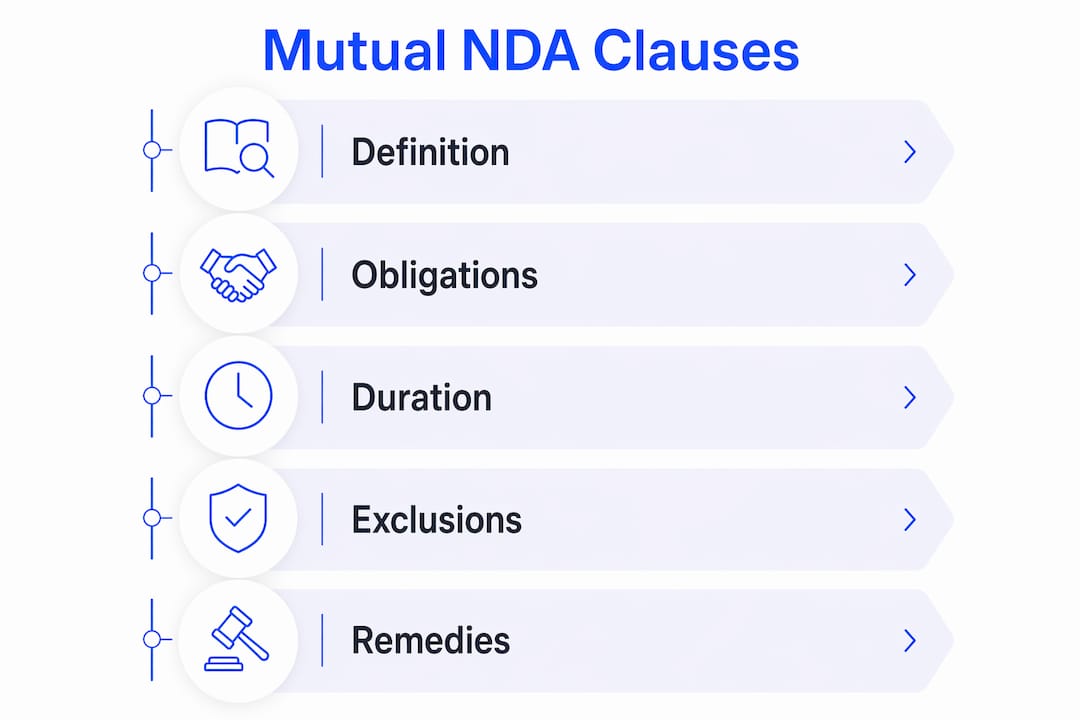
- Definition of confidential information: This clause specifies exactly what counts as protected. Broad definitions cover written, oral, and electronic disclosures; narrower ones limit protection to marked documents. The definition you choose shapes the entire agreement's scope.
- Obligations of the receiving party: Both parties must agree to hold the other's information in confidence, use it only for the stated purpose, and restrict internal access to those who need it.
- Exclusions from confidentiality: Standard carve-outs protect information that is already public, independently developed, received from a third party without restriction, or required to be disclosed by law or court order.
- Term and duration: US NDAs are enforceable when the confidentiality period is reasonable in scope and duration. Typical confidentiality periods run 2–5 years, though trade secrets can receive indefinite protection under the Defend Trade Secrets Act.
- Survival clause: Confidentiality obligations can survive the agreement's termination for a specified period, and sometimes indefinitely for trade secrets. The term of the NDA and the survival period are two distinct concepts.
- Permitted disclosures: Both parties should be allowed to share information with employees, contractors, and advisors who are bound by equivalent confidentiality duties.
- Return or destruction of information: Upon termination or request, each party should return or certify destruction of the other's confidential materials.
- Remedies for breach: Breach of a mutual NDA can lead to injunctive relief and monetary damages. Courts recognize that confidentiality breaches often cause harm that money alone cannot repair, which is why injunctions are a standard remedy.
- Governing law and dispute resolution: Specify which state's law governs the agreement and whether disputes go to arbitration or litigation. California, New York, and Delaware each have distinct rules that affect enforceability.
Quick reference: standard mutual NDA clauses
| Clause | What it covers | Why it matters |
|---|---|---|
| Confidential information definition | Scope of protected data | Determines what is actually protected |
| Exclusions | Public domain, independent development | Prevents overbroad restrictions |
| Term and duration | Length of confidentiality obligation | Sets the enforcement window |
| Survival | Post-termination obligations | Protects trade secrets after the deal ends |
| Remedies | Injunctions and damages | Gives teeth to the agreement |
| Governing law | Jurisdiction and applicable state law | Affects enforceability and court venue |
When to use a mutual NDA and how to deploy it correctly
The choice between a mutual NDA and a unilateral NDA comes down to one question: is only one party sharing sensitive information, or are both? If a vendor is pitching a client and only the vendor's proprietary process is at risk, a one-way agreement works. When both sides are disclosing, a mutual vs one-way NDA comparison almost always favors the bilateral form.

Choosing a mutual structure also signals a balanced partnership, which matters in early-stage relationships where trust has not yet been established. Asking a counterpart to sign a one-way NDA when they are also sharing sensitive data can create unnecessary friction before the real negotiation even begins.
Steps to execute a mutual NDA properly
- Identify what you are sharing before you sign. List the categories of confidential information each party will disclose. This exercise often reveals whether a mutual or unilateral form is actually appropriate.
- Use a written agreement, signed before any disclosure. Verbal NDAs are difficult to enforce. Sign the agreement before sharing anything sensitive, not after.
- Verify that signatories have authority. Both parties must be signed by individuals authorized to bind their respective organizations. An employee without signing authority cannot create a binding contract.
- Specify the permitted purpose. The agreement should state exactly why the parties are sharing information, such as evaluating a potential acquisition or developing a joint product. Vague purpose clauses invite disputes.
- Set a realistic duration. A five-year term is common for commercial deals. Trade secret provisions can run longer, but courts scrutinize unusually long terms.
Pro Tip: Symmetrical obligations in a mutual NDA tend to reduce negotiation time because neither party is fighting over who bears more risk. If you want to move quickly, propose a mutual form early and let the other side suggest edits rather than starting from a one-sided draft.
How to customize and draft a mutual NDA for your situation
A standard mutual NDA template gives you a solid starting point, but most real deals require at least some adjustment. Customization typically takes 30–60 minutes for straightforward situations; complex deals like major M&A transactions or technology transfers warrant a full legal review. For the full process, see our step-by-step guide to creating a mutual NDA.
Customization steps by use case
- Startups and early-stage partnerships: Keep the definition of confidential information broad enough to cover product concepts, code, and customer data. Add a clause confirming that the NDA does not create any obligation to proceed with a deal. Once the parties decide to formalize the relationship, a partnership agreement defines ownership, contributions, and decision-making.
- M&A due diligence: Include a standstill provision if appropriate, and specify that the existence of discussions is itself confidential. Limit the permitted purpose tightly to the evaluation of the potential transaction.
- Technology licensing and transfers: Address ownership of derivative works and improvements explicitly. If one party's engineers will be reviewing the other's source code, the permitted use clause needs to reflect that precisely.
- Vendor and supplier relationships: Consider adding a clause that restricts the vendor from soliciting the client's employees or customers during the confidentiality period.
- International parties: Even for US-governed agreements, note whether the counterpart is subject to export control regulations under the Export Administration Regulations (EAR) or International Traffic in Arms Regulations (ITAR), which can affect what information may legally be shared.
Specifying the governing state is not a formality. California courts, for example, apply stricter scrutiny to non-compete provisions sometimes bundled with NDAs, while Delaware courts tend to enforce commercial agreements as written. Choosing the wrong state can undermine clauses you thought were airtight.
Marking documents as confidential and keeping a disclosure log are practices that strengthen your position if a dispute ever reaches court. The log documents exactly what was shared and when, which is the kind of concrete evidence that wins injunction hearings.
Pro Tip: Store signed copies in a centralized contract management system with version control and audit trails. A signed PDF buried in someone's email is not a contract management strategy. Platforms like Formable's contract creator let you generate mutual NDAs from templates with AI, collect e-signatures, and store executed agreements with a full audit trail, all in one place.
Most NDAs do not require notarization or witnesses to be legally binding in the United States. Signatures from authorized representatives are sufficient. That said, for high-value deals, some parties add a witness line as a precaution, particularly when the agreement will be enforced in a jurisdiction with stricter formality requirements.
If you need to amend a mutual NDA after signing, do it in writing with a signed amendment that references the original agreement by date and title. Oral modifications are rarely enforceable and create ambiguity about which version governs.
Ready to draft and sign your mutual NDA faster?
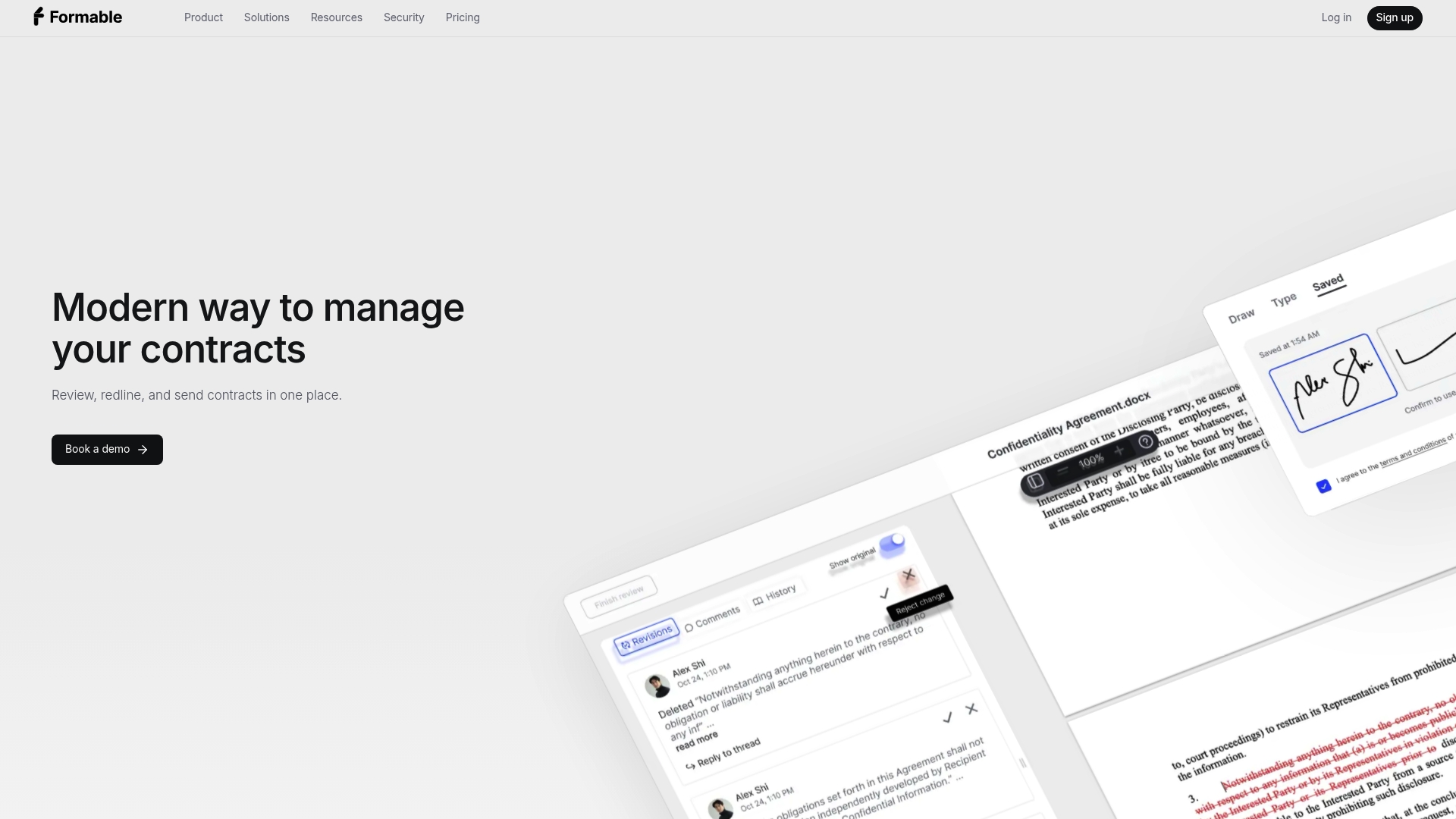
Formable's contract creation tool combines AI generation with professionally drafted templates, so you can produce a mutual NDA tailored to your deal in minutes. From there, Formable's redlining and negotiation tools let both parties align on terms without the back-and-forth of emailed Word documents. When you are ready to sign, built-in e-signing closes the loop with a timestamped, immutable audit trail.
Reach out and Formable will walk through your use case.
Key takeaways
A mutual NDA is the right choice whenever both parties are sharing sensitive information, and its enforceability depends on clearly defined scope, a reasonable duration, and proper execution.
| Point | Details |
|---|---|
| Bilateral obligations | Both parties are bound equally, which reduces negotiation friction and builds trust. |
| Duration and survival | Typical confidentiality periods run 2–5 years; trade secrets can be protected indefinitely even after the agreement ends. |
| Enforceability requirements | US courts require reasonable scope and duration; vague or overbroad terms risk being struck down. |
| Documentation practices | Mark disclosures as confidential and maintain a disclosure log to strengthen enforcement if a dispute arises. |
| Customization matters | Adjust the purpose clause, governing state, and industry-specific provisions before signing, especially for M&A or tech deals. |
FAQ
How can you tell if an NDA is mutual?
A mutual NDA explicitly states that both parties have confidentiality obligations toward each other. If the agreement defines "Disclosing Party" and "Receiving Party" as interchangeable roles that both signatories can occupy, it is mutual.
Are NDAs enforceable in the United States?
Yes. NDAs are enforceable across the US when they are reasonable in scope and duration, clearly define what counts as confidential, and are signed by parties with authority to bind their organizations. Courts in most states will enforce them as written, though California applies additional scrutiny to certain provisions.
What is the difference between a mutual and a standard NDA?
A standard NDA is unilateral: one party discloses and the other protects. A mutual NDA runs both ways, so each party is simultaneously a disclosing party and a receiving party with equal obligations.
Do mutual NDAs need to be notarized to be valid?
No. Notarization is not required for an NDA to be legally binding in the United States. Signatures from authorized representatives are sufficient in virtually every US jurisdiction.
What happens if someone breaches a mutual NDA?
The non-breaching party can seek injunctive relief to stop the disclosure immediately, as well as monetary damages for any harm caused. Courts treat confidentiality breaches seriously because the harm is often difficult to reverse once information is out.