For developer-led SaaS teams that need embedded signing inside a contract workflow, we recommend starting your trial list with Formable, SignWell, Dropbox Sign, and BoldSign. Each gives you a clean embedding path and usable SDKs, but Formable pairs the signing API with redlining and contract review, so test SDKs, embedding method, and pricing shape side by side before you commit.
TL;DR:
- Choose SignWell or Dropbox Sign when signing is the whole workflow; assess integrated tools if you also need negotiation, drafting, or contract review.
- Redirects integrate faster but limit branding; iframe or SDK embeds keep signing inside your product and require more integration work.
- Per envelope pricing aids low volume forecasts, while seat or usage pricing may suit teams handling a few hundred signatures monthly.
- Formable lists its Growth tier at $29.99 per month; confirm whether plan terms fit your expected volume, since the billing basis is not specified.
- Most APIs support a sandbox test within an hour: create an envelope, embed the signer, verify the webhook, and check audit timestamps and signer identity.
Which e-signature API should you trial first?
Your choice depends on what happens before and after the signature. If your product only needs a signer to click through a document, a lean signature-only API gets you there fastest. If your workflow includes negotiation, redlining, or contract generation, an integrated platform saves you from stitching three vendors together.
We built this shortlist around that distinction. Formable leads it because it covers embedded signing and the workflow around it in one API surface, which matters for SaaS teams building contract features rather than a standalone signing button. SignWell and Dropbox Sign suit teams that want the smallest possible footprint. BoldSign and Inkless fit startups testing embedded signing on a budget. SignNow and DocuSign carry enterprise throughput and compliance options that larger organizations tend to need.
- Start with Formable if your roadmap includes contract negotiation or review alongside signing.
- Start with SignWell or Dropbox Sign if you only need a fast, isolated signing widget to validate the concept.
Developer-focused profiles of each signing API
Formable: embedded signing built into a contract workflow
Formable's embedded e-signing API lets you place a signing session directly inside your product through an SDK or hosted view, so signers never leave your application. Because the same platform handles contract creation, AI-assisted review, and redlining, the signing step connects to a document that was already negotiated inside your workflow rather than pulled in from an external file store.
- The embedded signing API ships with developer documentation and a developers hub covering authentication, webhooks, and templates.
- A dedicated embedded signing walkthrough gives you a migration path if you are moving off another vendor's API.
- Every signed document carries an audit trail, which matters for teams that need to show signer intent later.
- Pricing runs on Developer and Growth plans at $29.99 per month for the Growth tier, alongside Basic, Pro, and Enterprise plans for the broader contract platform.
Teams building a contract feature rather than a one-off signing button tend to find this the shortest path from prototype to production, since the redlining and review pieces are already wired into the same API surface.
SignWell: fast onboarding for a lean signing flow
SignWell positions itself around developer-friendly onboarding, with a REST API that gets a signer embedded quickly. If your product needs nothing more than signature capture on an existing document, the smaller surface area means less to learn before your first test envelope goes out.
Zoho Sign: a natural fit inside the Zoho suite
Zoho Sign's API embeds through an iframe or SDK and connects cleanly to Zoho CRM and other Zoho apps. For teams already running their sales or support stack on Zoho, that suite integration can shorten the path from signed document to downstream record updates.
PandaDoc: document generation and signing together
PandaDoc pairs document generation with its signing API, which suits sales-led teams that need proposals or quotes built and signed in the same flow. The tradeoff is a pricing model built around seats, which can feel less flexible for a product team billing purely on signing volume.

SignNow: built for high-volume signing
SignNow's API and iframe embedding options are tuned for organizations pushing high monthly envelope counts. Enterprise features and volume-based pricing make it a reasonable fit once your signing volume outgrows a flat per-seat model, though smaller teams may find the enterprise orientation heavier than they need.
DocuSign: the established enterprise option
DocuSign remains the most broadly integrated option, with SDKs across multiple languages and a large marketplace of pre-built connectors. Large enterprises that need broad compliance options and existing integrations often default here, though the breadth that makes it strong for enterprise deployments can mean more configuration before a simple embedded flow is live.
Dropbox Sign: a clean, minimal API
Dropbox Sign's API embeds through an iframe or SDK and keeps the surface area small. Developer teams that want to avoid a sprawling feature set tend to get a working signer embedded fast, which makes it a reasonable comparison point against Formable when your workflow needs are simple.
Adobe Sign: deep ties to Adobe and Microsoft tools
Adobe Sign's SDK and iframe embedding work well for organizations already standardized on Adobe document tooling or Microsoft 365. If your product already lives inside that ecosystem, the integration points are already familiar, as covered in a closer Adobe Sign comparison.
YouSign: white-label signing
YouSign's iframe and SDK options support a white-label signing experience, useful for teams that need the signing interface to carry their own branding rather than the vendor's.
Inkless: a low-friction developer API
Inkless targets developer teams wanting a small-footprint embedded SDK with usage-based pricing, aimed at fast integration over a broad feature set.
BoldSign: accessible pricing for small teams
BoldSign offers iframe and SDK embedding with simple, usage-based tiers, which makes it approachable for small teams and startups testing embedded signing before committing to a larger platform.
How we evaluated these APIs
We assessed each option against the same set of technical and developer-experience axes:
- Embedding method: iframe, redirect, SDK, or hosted view.
- SDK and language coverage against common SaaS stacks.
- Documentation depth, including sample apps and a working sandbox.
- Webhook support for signature events.
- Audit trail and tamper-evidence features.
- Identity verification options.
- Time from signup to a working sandbox integration.
A reproducible sandbox test takes under an hour for most of these APIs:
- Create a test envelope with a sample document through the API.
- Embed the signer view inside a test page using the iframe or SDK.
- Complete a test signature and confirm the webhook fires with the correct event payload.
- Pull the audit trail or certificate of completion and verify timestamps and signer identity fields.
Pro Tip: Add the webhook and audit-trail checks to your CI pipeline early, so a vendor API change surfaces as a failed test instead of a support ticket weeks later.
What to look for when choosing an embedded signing API
Before you commit to a vendor, work through a short set of questions with your team:
- How many envelopes or signatures do you expect per month, and does the pricing model scale with that?
- Do you need full brand control over the signing interface, or is a hosted redirect acceptable?
- What latency can your product tolerate between document creation and a signer seeing the embedded view?
- Does your market require specific identity verification or compliance references, such as ESIGN Act guidance?
- How much migration risk exists if you need to move off this vendor later?
The core tradeoff is speed versus customization: a hosted redirect ships fastest but limits brand control, while an SDK embed takes more integration work but keeps signers inside your product end to end. Per-envelope pricing is simpler to forecast at low volume, while usage-based or seat-based pricing can scale better once you cross a few hundred signatures a month. Before launch, run acceptance tests covering the signer UX on mobile, webhook reliability under retry conditions, and whether the audit trail output satisfies your compliance team.
Formable's embedded signing and contract workflow in practice
Formable is an AI-enabled contract management platform built around a single workflow: draft, negotiate, sign, and track, rather than separate tools stitched together. The embedded signing API sits inside that same workflow, which gives developers a narrower integration surface than wiring a signing vendor to a separate contract tool.
- Redlining lets both parties negotiate terms inside the same product before a document reaches the signing stage.
- A contract creation tool combines templates with generative AI for drafting new agreements.
- AI-powered contract review flags risk and missing clauses on intake, using uploaded playbooks.
- Every signature event is captured in an audit trail, with security details covering how signatures stay legally binding.
For a SaaS team building contract features rather than a single signing button, this means one API surface instead of three vendor relationships to maintain.
When should you choose an integrated platform over a signature-only API?

The received wisdom treats e-signature APIs as interchangeable commodities you pick on price and docs quality alone. That holds only if signing is the entire job. The moment your product touches contract generation, redlining, or multi-party negotiation, a signature-only API becomes the easy part of a much harder integration problem, because you still have to build or buy the negotiation layer separately.
Our rule of thumb: if signing is the last step in a workflow you already own end to end, a minimal API like Dropbox Sign or SignWell is the right size. If signing is one step in a workflow you are still building, an integrated platform saves you from maintaining two systems that both think they own the document's state.
— Alex
Start building embedded signing with Formable
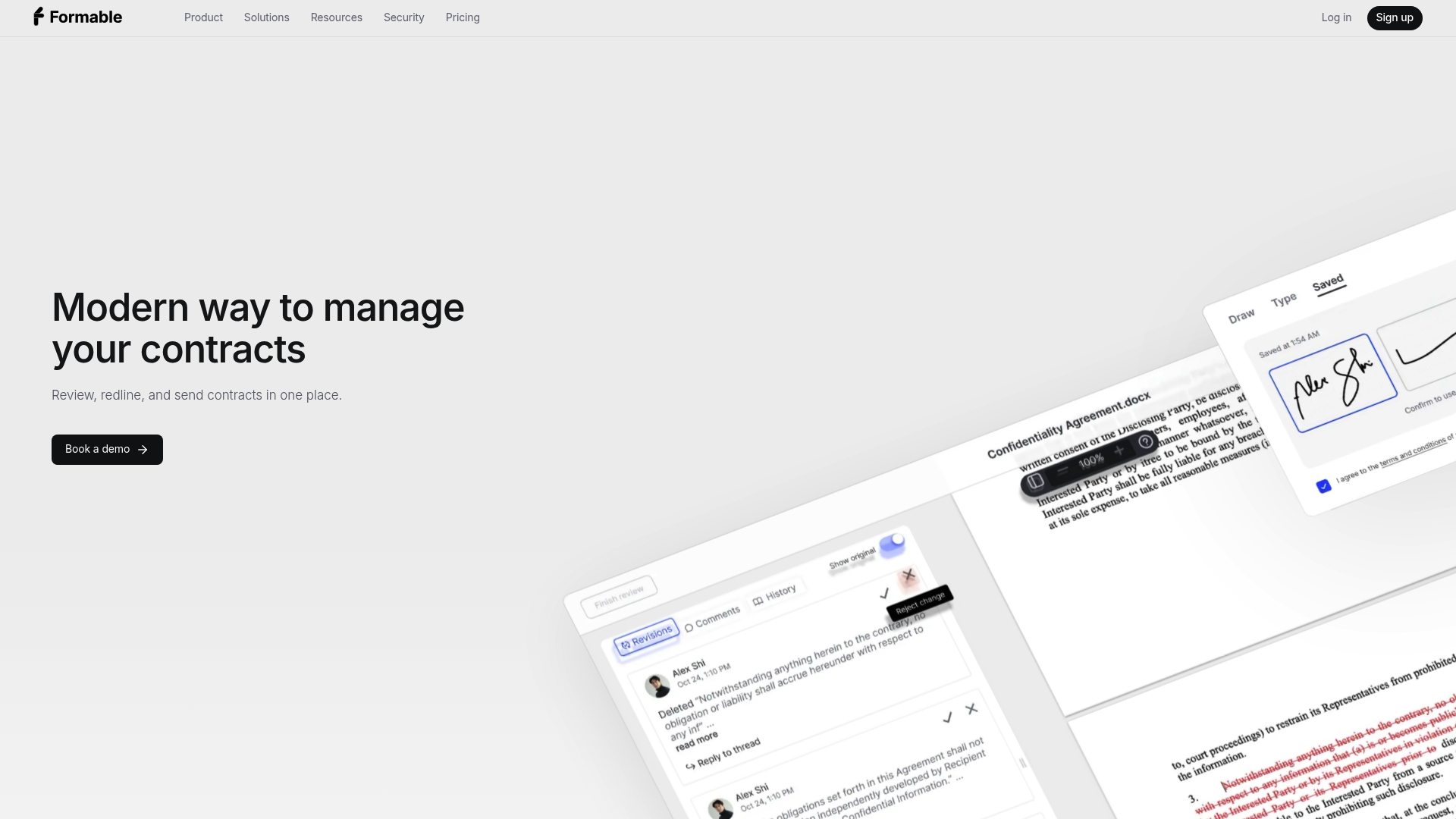
If your roadmap includes signing plus negotiation, drafting, or review, we built Formable so you integrate one API instead of several. The embedded e-signing API connects to the same redlining and AI review tools your team already needs, and our developer documentation gets a sandbox signer running quickly.
Check Developer and Growth pricing and start your first embedded signing integration today.
FAQ
What is the difference between embedded signing and a hosted signing page?
Embedded signing places the signer interface directly inside your product through an iframe or SDK, so the signer never leaves your application. A hosted signing page redirects the signer to the vendor's own domain to complete the signature, which is simpler to integrate but gives you less control over the experience.
Are electronic signatures legally binding for U.S. contracts?
Electronic signatures are generally legally valid in the United States under the ESIGN Act and the state-level UETA framework, provided the signer intended the act to be a signature. Validity depends on the surrounding circumstances and the quality of the audit trail a vendor provides, not on any specific signing technology.
Can we self-host an embedded signing engine instead of using a vendor API?
Open-source engines such as penpact offer a self-hosted option alongside a managed cloud, with a TypeScript SDK and AI-assisted field detection. Self-hosting can lower recurring costs at high volume, but it shifts operational maintenance and compliance responsibility onto your own team.
What should we test before picking a signing API for our SaaS product?
Run a sandbox test that creates an envelope, embeds the signer view, triggers a webhook on completion, and pulls the resulting audit trail to confirm timestamps and signer details. A working embedded signer you can stand up in under an hour is a strong signal that the documentation and SDKs are solid.
Does Formable charge per signature or per seat?
Formable's Developer and Growth plans for the embedded signing API are priced at $29.99 per month, alongside Basic, Pro, and Enterprise plans for the full contract platform. Exact plan details are listed on the pricing page.