Docusign is often recognized as the pioneer and industry standard in the e-signature space, known for its robust enterprise features and reliability. However, when evaluating needs for embedding signing, teams may find that Docusign's API and developer experience don’t always align with goals around seamless user experience, flexibility, or cost-effectiveness.
Docusign offers a few pricing plans. Docusign's cheapest API plan starts at $75 per month, with a limit of 40 envelopes each month ($1.88 per envelope). The next two tiers are $450 per month with limit of 100 envelopes for the intermediate plan ($4.50 per envelope), and $720 per month with same limit for the advanced plan ($7.20 per envelope).
Most teams don't leave Docusign because it doesn't work. They leave because pricing math stops working as they scale, frustrating user experience, or negligent customer support.
Fortunately, there are a few alternatives depending on your teams needs.
This guide compares six API-first options for embedded signing and sending inside your product. It focuses on how fast a team can onboard, customer and development support, white-label control, pricing structure, sandbox access.
Why We Chose These Alternatives
We looked at each option using criteria that matter to SaaS platforms, product teams, and developers:
- Embedded signing and email-link signing support
- Pricing transparency
- Webhook or event support for signing state management
- Sandbox or test mode for pre-production development
- White-label or custom branding support
- Redlining capabilities to allow signers to suggest changes before signing
- SDKs, documentation quality, and integration complexity
- Customer and development support
Docusign API alternatives compared
| Provider | Starting price | White-label / branding | Redlining | Sandbox | Docs / SDKs | Best fit |
|---|---|---|---|---|---|---|
| Formable | Free developer path; usage-based API | Full branding on the customer-facing embed | Yes, users can redline before signing | Yes, test mode | Easiest to onboard; Node.js, Python, Go, Ruby, Java, PHP, .NET | Fastest path to a working solution |
| Dropbox Sign API | $75/month (limited requests) | Branding available, plan-dependent | No | Yes, test mode | Strong docs and SDKs | Signature-only REST with a mature test mode |
| PandaDoc API | $40/month (40 documents) | Branding available, often tied to plan | No | Yes, sandbox | API docs and SDKs | Document generation plus signing |
| Documenso | Teams $40/month; Platform $250/month for white-label | Custom CSS and hide branding on Platform | No | Staging environment | REST/OpenAPI; TS, Python, Go; frontend embed SDKs | Open-source or self-hosted embed |
| Adobe Acrobat Sign API | Varies by agreement | Branding available, usually enterprise-dependent | No | Yes | Extensive Adobe developer docs | Adobe-heavy or regulated environments |
| Anvil | About $1.50 per completed e-sign packet | CSS, logo, and signer email; depth can vary by plan | No | Credits / dashboard | API-first; JS/React focus | PDF generation and signing in one pipeline |
Quick takeaways:
- Easiest API to onboard: Formable. One call returns a
SignatureRequestUrlyou can iframe. SDKs for most languages and a simple to understand OpenAPI spec. - Most friendly pricing: Formable offers the friendliest pricing at $20 a month for 50 envelopes.
- Best fit for document-heavy workflows: PandaDoc, when the product already needs proposals, templates, and generation before anyone signs.
- Redlining support: Formable. Allows users to request changes before signing.
- Highest enterprise-compliance fit: Adobe Acrobat Sign, especially when teams are already in the Adobe ecosystem.
- Best fit for PDF assembly plus signing: Anvil, when the hard problem is generating and filling the file, not the signer-facing UI.
- Best fit for open-source or self-hosted signing: Documenso. Cloud or self-host, with white-label embedding on the Platform plan.
All six APIs on this list can deliver a signature request two ways: an in-app embedded experience, or a regular email that contains a hosted signing link. However, how these experiences are surfaced to the user vary drastically.
1. Formable
The easiest e-signing API to onboard, with white-label control and negotiation in the same workflow.
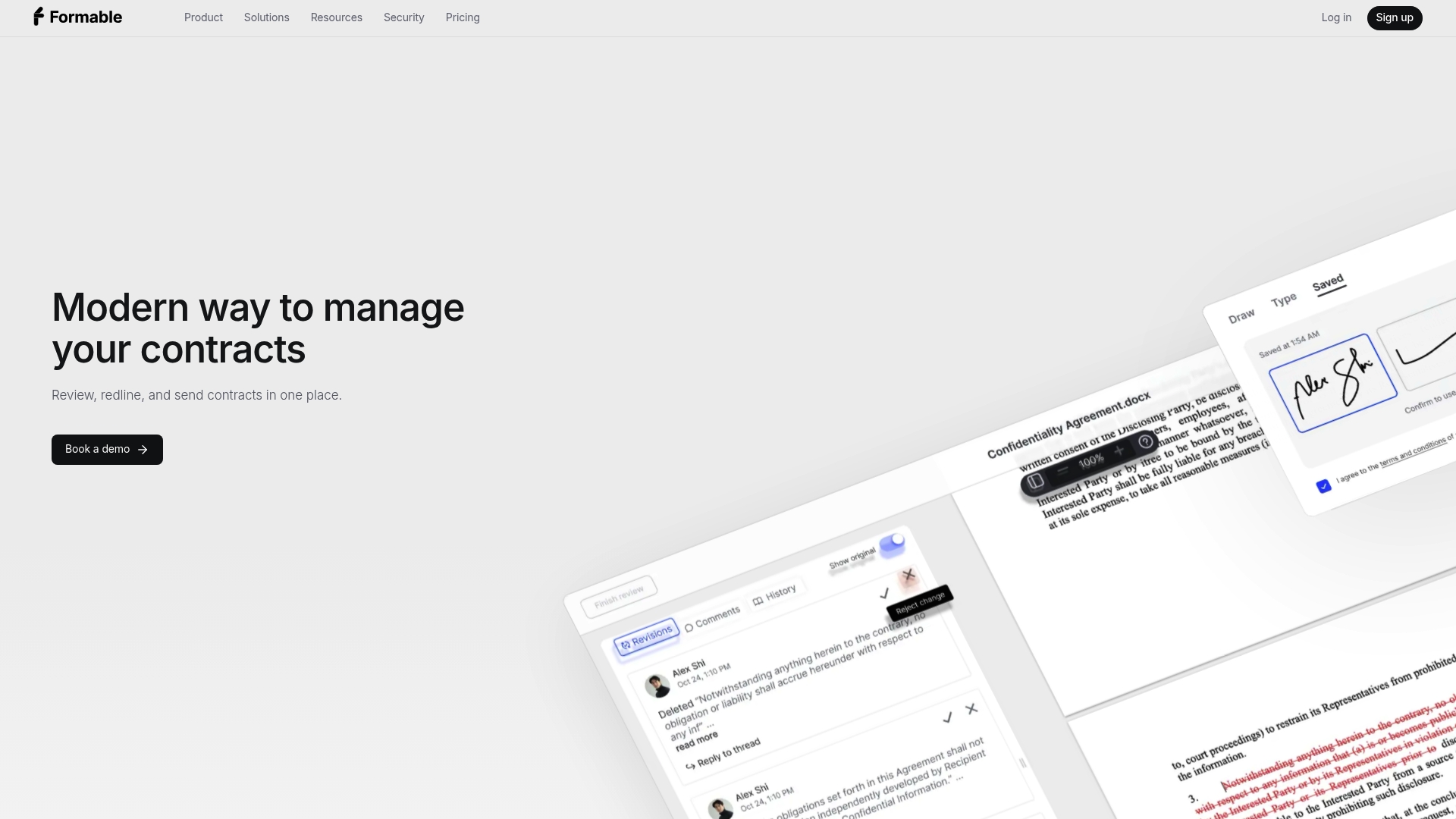
Formable is the easiest e-signature API on this list to onboard. You create a signature request, get back a SignatureRequestUrl, and load it in an iframe. It is often used by teams that want a clean developer experience, helpful documentation, and a quick path to a working integration.
Pricing overview:
- Developer / test mode: Free path to build and validate the integration
- API: $20 a month for 50 envelopes to start. Contact sales for higher limits with decreased costs.
Key features:
- Embedded redlining. Formable offers endpoints to allow users to request changes before signing. See here for more details.
- White-label and branding. Colors, email subject, and CTAs apply to the customer-facing experience so the flow stays under your brand.
- Docs, SDKs, and implementation. Official SDKs for Node.js, Python, Go, Ruby, Java, PHP, and .NET, plus a test mode so you can prove the integration before production volume. Teams coming from Docusign can follow the embedded signing migration guide.
- Customer support. Included on every paid plan, with a dedicated Slack channel for implementation help and bug fix requests.
Explore Formable's developer platform for SDKs, embedded signing, redlining, webhooks, and implementation examples.
Best fit for:
- SaaS teams embedding signing as a native product feature
- Products that need white-label control so users never leave your brand
- Teams whose need to support negotiation before signature
- Engineering teams that want the shortest path from API key to a signed document
- Teams that want great development support, pre and post integration
2. Dropbox Sign
Mature signature-only REST API
Dropbox Sign API, formerly HelloSign API, is recognized for its developer-friendly documentation and straightforward implementation. Since Dropbox’s acquisition of HelloSign in 2019, the platform has continued to deliver a stable, well-documented API, though there have been no notable new features or advancements to the core API or user experience.
Pricing overview:
- Test mode: Free for API testing
- Essentials: From about $75 per month for 50+ signature requests
- Standard: From about $250 per month for 100+ signature requests
- Premium: Custom
You can start on a simple API plan and move up when you need embedded workflows. Account for that upgrade when you model cost. Embedded signing, embedded requesting, and templates typically sit on higher tiers. The API is billed separately from the Dropbox Sign web app.
Key features:
- Embedded requesting. Embedded requesting is on Standard. Embedded templates usually require Premium. No native contract redlining.
- White-label and branding. Branding is available, but plan-dependent, and thinner on lower tiers.
- Docs, SDKs, and implementation. Clean docs, test mode that covers most endpoints, and SDKs in common languages.
- Compliance and audit trail. Audit trails plus common compliance claims (SOC 2, eIDAS, GDPR).
Best fit for:
- Teams that want a mature signature-only REST API
- Products that need embedded signing but not OEM-depth white-label economics
- SaaS teams building a straightforward, signature-only workflow
3. PandaDoc
Best for document generation, proposals, and signing in one workflow
PandaDoc API is a better match when signing is only one step in a larger document workflow. If your product generates proposals, quotes, or sales documents before collecting signatures, a signing-only API will leave you stitching an editor to a signature vendor.
Pricing overview:
- Sandbox: Free for testing
- API Developer Plan: About $40 per month for 40 documents, then per-document overages
- Enterprise: Custom
If the only requirement is embedded signing, a more focused API is usually cleaner and easier to develop and maintain.
Key features:
- Embedded requesting. API-driven document creation, templates, recipients, and send-for-signature flows.
- White-label and branding. Logo, colors, templates, and sender identity, with deeper control tied to higher plans.
- Docs, SDKs, and implementation. API docs and SDKs. Strongest when you treat PandaDoc as a document engine, not only a signature layer.
- Compliance and audit trail. Legally binding e-signatures and audit-related features. Confirm what your plan includes.
Best fit for:
- Sales proposal platforms
- Quote-to-cash workflows
- CRM-driven document generation
- Products that need templates, variables, generation, and signing together
4. Documenso
Open-source e-signature with an embeddable signing widget and a self-hosted path
Documenso is an open-source Docusign alternative you can run in their cloud or on your own infrastructure. The REST API creates documents and templates, and official embed SDKs drop the signing flow into React, Vue, Svelte, and similar frontends. It is a stronger fit when you want to own the stack, or when white-label embedded signing is the product requirement, than when you need contract redlining or backend SDKs across every language.
Pricing overview:
- Free: 5 documents per month, including API access
- Individual: About $25 per month billed yearly, with API access for personal use
- Teams: About $40 per month billed yearly. Embedded signing and API automation, under a fair-use policy
- Platform: $250 per month ($3,000 billed yearly). Unlimited documents and users, white-label embed, branded emails, Slack support
- Enterprise / self-hosted: Custom
Teams is priced for internal automation, not for powering a commercial product. If signing lives inside your app, budget for Platform. Volume is unlimited on paper, but fair use still applies.
Key features:
- Embedded requesting. The API can create documents, add recipients, and return a signing token for the embed. An embedded editor for preparing documents inside your product is an Enterprise feature, or a Platform add-on.
- White-label and branding. Custom CSS, CSS variables, and removal of Documenso branding sit on Platform. Teams can embed signing, but the vendor brand remains.
- Docs, SDKs, and implementation. REST API v2 with OpenAPI. Backend SDKs for TypeScript, Python, and Go. Frontend embed packages for React, Vue, Svelte, Angular, Solid, and Preact, or a plain iframe. Staging at
stg-app.documenso.com. - Compliance and audit trail. ESIGN, UETA, eIDAS SES, SOC 2, HIPAA, and 21 CFR Part 11 are listed as compliant. Self-hosting is the path if data residency is the constraint. No in-session redlining.
Best fit for:
- Teams that want an open-source or self-hosted signing stack
- Frontend teams that prefer a signing widget over a generic iframe URL
- Workflows that stay on unlimited-document pricing instead of per-envelope caps
5. Adobe Acrobat Sign
Adobe-heavy enterprises and regulated environments
Adobe Acrobat Sign API is a fit when the organization is already on Adobe Document Cloud, Acrobat, Microsoft integrations, or an Adobe enterprise agreement. It is less of a lightweight embed and more of an enterprise e-signature platform that happens to expose an API.
Pricing overview:
- Sandbox: Available with the appropriate account or plan
- Enterprise API: Custom pricing
For product teams, volume, authentication, branding, and advanced compliance are often tied to the agreement you negotiate. The question to ask is which embedded features are actually in scope, not whether Adobe has an API.
Key features:
- Embedded requesting. Send, agreement management, and workflow automation through the API.
- White-label and branding. Available, with deeper control usually at the enterprise level.
- Docs, SDKs, and implementation. Extensive Adobe developer documentation. Mature, and heavier to stand up than developer-first APIs if you are new to the stack.
- Compliance and audit trail. Commonly evaluated for regulated and compliance-sensitive programs, including certificate-based options.
Best fit for:
- Large enterprises
- Adobe-centric organizations
- Regulated document workflows
- Teams that need mature procurement and compliance support more than a one-sprint embed
6. Anvil
PDF fill, document generation, and signing as one pipeline
Anvil treats e-sign as a stage in a document workflow rather than a standalone signing product. That is useful when your application already has to generate or fill PDFs and then collect a signature on the same packet.
Pricing overview:
- Evaluation: Dashboard usage and credits to start
- E-sign packets: About $1.50 per completed packet over the API
- PDF fill / generation: Separate per-call pricing
More expensive than most e-signature APIs, but charging on completion rather than send is easier to forecast than Docusign-style envelopes that consume quota when a request goes out.
Key features:
- Embedded requesting. PDF fill, packet creation, and signing in one API surface.
- White-label and branding. Custom CSS, logos, and signer emails. Confirm which controls require a higher plan.
- Docs, SDKs, and implementation. API-first, with a stronger JavaScript and React story than a broad multi-language SDK set.
- Compliance and audit trail. Standard e-signature and audit support. The signer UI is PDF-native, which fits internal or form-heavy flows better than a consumer-facing branded modal. No contract redlining.
Best fit for:
- Onboarding and back-office pipelines
- Products that generate or fill PDFs before signature
- Teams that want completion-based e-sign billing
- Workflows where document assembly is the hard problem
How to choose the right Docusign API alternative
The best Docusign API alternative depends on what you are building. Use these questions to narrow the list.
1. Do you need embedded signing, embedded requesting, or both?
Some products only need the signer-side experience. Others need the full sender and signer workflow.
- Embedded signing lets users sign inside your product.
- Embedded requesting lets your users prepare documents, place fields, and send for signature from inside your product.
If your signer is the end user, embedded signing may be enough. If customers prepare and route documents from inside your platform, requesting matters just as much. Formable covers both, and adds redlining when the document is not frozen at send.
Also decide how signers who are not in your app will reach the document. All six vendors can email a hosted signing link. Formable, PandaDoc, Documenso, Adobe Acrobat Sign, and Anvil expose that path on the same API as the embed. On Dropbox Sign, email/hosted signing is the lower-tier default, and the iframe path is a separate request type that usually needs Standard or above.
2. How does pricing behave as usage grows?
Look past the monthly entry price. Ask how the vendor prices envelopes or documents, overages, templates, customer support, embedded workflows, and branding.
The questions that matter at scale are whether per-request cost improves with volume and whether overages are predictable.
3. How much white-label control do you need?
For internal workflows, branding may not matter. For an embedded product, it does.
If signing is part of your product experience, users should not feel handed off to another vendor. Ask whether you can use your own logo and colors, customize emails, hide the vendor brand, and whether those rights are included or custom-quoted.
4. How quickly can developers validate the API?
A useful API is one you can test before a long sales process. Look for clear docs, a sandbox or test mode, embedded signing examples, webhook documentation, SDKs in your language, and a path to production that does not require rewriting the integration.
Formable is built to integrate in a couple hours: credentials, a template or upload, one SignatureRequestUrl, and a webhook. A cheaper API that takes months to ship can cost more than the one your team can validate in a sprint. The sample path is on the implementation guide. For event handling, see the webhook guide.
5. What happens when the document still needs edits?
Most e-signature APIs treat the file as final when you send it. If your workflow includes MSAs, DPAs, or SOWs, void-and-resend becomes the hidden cost of the integration. Ask whether redlining lives in the same API or whether you will keep Word and email in the loop.
6. What compliance requirements do you actually need?
All providers on this list support legally binding e-signatures and audit trails. Advanced requirements vary by plan. Clarify ESIGN and UETA, eIDAS, GDPR, SOC 2, HIPAA, identity verification, and retention before you assume they are included.
The right alternative depends on what you are embedding
There is no single best Docusign API alternative for every team.
Sales tools may choose PandaDoc when document generation is the product. Adobe-focused enterprises may stay with Acrobat Sign. Teams that want open-source or self-hosted signing often shortlist Documenso. Dropbox Sign remains a signature-only REST option. Pipeline-heavy products may start with Anvil.
For SaaS platforms and product teams that want e-signature as a native feature, including contracts that still get negotiated, Formable is the place to start. It is the easiest API on this list to onboard, and it brings embedded signing, email-link signing, white-label control, and redlining together so you are not stitching a signing vendor to a separate contract tool.
If the goal is to add e-signature inside your product, start in test mode on docs.formabledocs.com and run the embed on your own domain before you commit.
Product comparisons are based on publicly available information as of August 2026 and may change. Confirm current plan gates, envelope rules, and embedded-signing eligibility with each vendor.
FAQ
What is an embedded e-signature API?
An embedded e-signature API lets you add signing workflows inside your own app or website. Instead of sending users to a separate portal, they sign through an in-app, branded, or iframe-based experience. For SaaS platforms, that makes e-signature feel like part of the product rather than a third-party handoff.
What is the difference between embedded signing and embedded requesting?
Embedded signing is the signer-side experience: a user opens and signs a document inside your product. Embedded requesting is the sender-side experience: your user prepares a document, places fields, adds recipients, and sends it for signature from inside your product. Some products only need signing. Others need both.
Do these APIs support email signing links as well as embeds?
Yes. Formable, Dropbox Sign, PandaDoc, Documenso, Adobe Acrobat Sign, and Anvil all support an in-app embed and a regular email that contains a hosted signing link. The differences are how you turn each mode on and whether it is gated. Dropbox Sign typically reserves embedded signing for Standard API and above, and does not let you mix embedded and email signers on one request. Documenso's embed starts on Teams, with white-label on Platform. Anvil's embedded signers do not get an Anvil-sent email; you notify them yourself.
Do all e-signature APIs support embedded signing?
No. Many APIs can send a document for signature by email, but the in-app embed may require a specific plan or implementation method. Embedded requesting, templates, and full white-label controls are also often plan-dependent. Confirm which workflows are included before you choose a provider.
What is the easiest Docusign API alternative to onboard?
Formable. The API is designed so a developer can go from an API key to a working signing session without learning an envelope and tab model. You create a request, load the SignatureRequestUrl, and subscribe to webhooks. Dropbox Sign and Documenso have usable docs, but they take more setup once you need an embed or mixed delivery.
What is the best Docusign API alternative for embedded signing?
For product teams that need the signing step to stay inside their app, Formable is the strongest default. It is the easiest API to onboard, and it supports embedded signing, email-link signing, white-label control, and redlining when terms still change. Dropbox Sign fits a signature-only proof of concept. Documenso fits open-source or self-hosted embeds. PandaDoc fits document generation. Adobe Acrobat Sign fits Adobe-heavy enterprises. Anvil fits PDF pipelines.
Which Docusign API alternative is best for SaaS companies?
It depends on how signing fits the product. Formable is the fit when you want the fastest developer onboarding and signing that feels like a native, branded feature, including agreements that still get negotiated. PandaDoc may fit products that also generate proposals. Dropbox Sign is usable for signature-only setups. Documenso may fit teams that want to self-host or white-label on Platform. Anvil may fit teams whose main problem is PDF assembly.
Are signatures from these APIs legally binding in the U.S.?
Providers on this list support ESIGN and UETA when they produce an attributable signature and a tamper-evident audit trail. Verify that your plan includes the audit log you will need in a dispute, and that signing tokens are generated server-side.