
For most product and engineering teams, buying an embedded e-signing API beats building one from scratch. The math rarely favors building: total cost of ownership runs higher than expected, compliance under the ESIGN Act demands ongoing legal attention, and in-house builds delay launch by months. Three levers decide the outcome every time: cost, audit evidence, and how fast your developers can ship.
TL;DR:
- A signed PDF alone is insufficient: retain a reproducible authoritative copy, capture consent, and link signer identity, timestamps, IP addresses, and lifecycle events.
- A production build takes months, then continues to consume engineering time for security patches, legal review, webhook monitoring, support, and incident response.
- Before choosing a vendor, test webhook retries during outages, retry limits, expired requests, declined multi signer flows, template changes, and resend behavior in a sandbox.
- Building in house chiefly suits teams with deep customization needs or legacy formats; otherwise, weigh engineering hours, vendor fees, and time to first signature.
What buy vs build actually covers: architectures and scope
Before comparing costs, it helps to define the three paths teams usually weigh. An embedded API lets your own interface call a vendor's signing infrastructure directly, so the signer never leaves your product. A standalone signing app is a hosted tool you send documents to and get signed copies back. Building in-house means your engineering team owns the entire signing stack, from cryptographic signature generation to legal recordkeeping.
Teams that choose to build still have to deliver the same pieces a vendor would normally hand you:
- A signing flow that handles multi-party sequencing and declined or expired requests
- Templating so repeat document types do not require manual setup each time
- Signer authentication strong enough to hold up to a legal challenge
- A webhook or event model that notifies your systems the moment a document is signed, viewed, or voided
- Audit-bundle generation that packages signer identity, timestamps, and IP data into one exportable record
- Storage and retention infrastructure that keeps authoritative copies accessible for years
Common architectures include an iframe-embedded signing widget inside your own app, a hosted-redirect flow where signers leave your product temporarily, and server-side envelope creation where your backend generates and tracks documents programmatically. Each one changes how much of the above list your team has to own directly.
Cost, timeline, and engineering effort: realistic estimates
A production-grade build is rarely a weekend project. Delivering authentication, a signing UI, webhook infrastructure, and audit-bundle packaging to a standard that holds up legally typically takes a dedicated engineering team months, not weeks, once you account for edge cases like expired links and multi-signer sequencing.
Ongoing costs stack on top of that initial build: security patching, legal review of your consent language, customer support for signing failures, and incident response when a webhook silently drops an event. None of these disappear after launch. They become permanent line items on your engineering roadmap.
Two timelines illustrate the gap clearly:
- Buy and run a proof of concept: days to a few weeks, from sandbox signup to a working embedded flow
- Build to production: months of engineering time before you have something legally defensible and reliable at scale
When you put this in front of stakeholders, frame the comparison around three questions: what does the build cost in engineering hours, what does the vendor cost per signature or per seat, and which option gets you to market faster.
Pro Tip: Budget for audit-bundle assembly and webhook monitoring as ongoing maintenance costs, not one-time build costs. Teams that build in-house consistently underestimate this line item.
Compliance and evidence: ESIGN and UETA requirements
Electronic signatures are legally binding for most commercial transactions under the ESIGN Act and UETA, provided the signer intended to sign and your organization retains records capable of being accurately reproduced later. Section 101(d) of the ESIGN Act specifically requires that records be retained and reproduced accurately to maintain enforceability. Skip that requirement and you risk an unenforceable agreement regardless of how clean the signature itself looks.
A signed PDF alone does not satisfy this bar. A defensible audit trail needs to link the signer to the action taken, record exact timestamps, capture IP addresses, and log every event in the document's lifecycle, from sent to viewed to signed. FTC advisory guidance confirms that the ESIGN Act gives legal force to electronic records only when consumer consent and demonstrable access to the record in its intended electronic form are properly obtained.

Consumer consent and retention aren't optional extras. FDIC compliance guidance recommends disclosing hardware and software requirements to signers and preserving an authoritative copy for the full retention period, a detail that's easy to overlook in a rushed build.
When evaluating any solution, check for:
- Bundled audit evidence that exports as a single, complete record
- Tamper-evident packaging that proves the record has not been altered after signing
- Retention controls that keep authoritative copies accessible for as long as the law requires
- Built-in consumer-consent capture that documents affirmative agreement to electronic delivery
Developer experience and integration durability
A signing API looks simple in a demo. The real test comes from webhook reliability, SDK quality, and how the system behaves under edge cases that only show up at scale.
Webhooks deserve particular scrutiny. If a vendor's webhook delivery silently fails during a network blip, your system never learns a document was signed unless retry logic exists on their end. Ask how retries are triggered, how many attempts are made, and what happens if your endpoint is briefly unavailable.
SDKs and example workflows matter just as much. A well-documented SDK for both embedded UI creation and server-side envelope generation saves your team weeks of trial and error. During a proof of concept, test these scenarios directly:
- Expired signing requests and how the system notifies both parties
- Multi-signer flows where one party declines or delays
- Template versioning when a document type changes mid-rollout
- Resend behavior after a signer loses access to the original link
Rate limits and polling can quietly become operational traps if your team relies on frequent status checks instead of trusting webhook delivery. Ask vendors for documented rate limits up front, along with fallback guidance if webhooks are delayed.
Pro Tip: Run webhook retries under simulated load in a sandbox environment before committing. This single test reveals more about production reliability than any sales conversation will.
Practical total cost of ownership checklist
Bringing a TCO breakdown to procurement keeps the buy versus build conversation grounded in numbers rather than assumptions. Include these line items:
- Initial build hours, if building, across auth, UI, webhooks, and audit packaging
- Hosting and infrastructure costs for signing and storage
- Security and compliance audit costs, including any outside legal review
- Ongoing maintenance: patching, monitoring, and incident response
- Customer support hours tied to signing failures or disputes
- Scaling costs as signature volume grows
Hidden costs tend to cluster around audit-bundle assembly and webhook monitoring, both of which require continuous engineering attention even after launch. A simple way to build an ROI case over time: compare time-to-first-signature under each path, track support tickets tied to signing issues, and measure engineering hours redirected to other projects once the signing stack is no longer your team's responsibility.
API and vendor evaluation checklist
Whatever path you lean toward, insist on documented answers to these items before signing a contract:
- Audit-bundle export that produces a complete, tamper-evident record on demand
- Documented webhook retry behavior, including attempt counts and failure handling
- Templating support for recurring document types
- Embedded signing UI that keeps signers inside your product
- Developer SDKs with working examples, not just API reference docs
- A sandbox environment for testing before committing to a contract
On the security side, ask for documented retention policies, encryption standards, and any compliance attestations the vendor can share. Commercially, verify SLA terms, data export guarantees if you ever need to migrate, and transparent pricing that scales predictably with volume.
Pro Tip: Run your proof of concept against real signing scenarios, not vendor demo data. Validate webhook delivery, audit-bundle export, and multi-signer flows before you commit engineering resources to a full integration.
A short take on how teams actually decide
Teams that lean toward building usually have deep customization needs or legacy format requirements that a standard API cannot meet. Most others get pulled toward buying once they tally engineering hours against a subscription cost. My recommendation: run a focused proof of concept against the compliance and webhook checklist above before committing either way, and get legal and security sign-off before anything reaches production.
— Alex
How Formable covers embedded signing, APIs, and the rest of the contract workflow
We built our embedded e-signing API for teams that want signing inside their own product. Our security page discusses our approach to security.
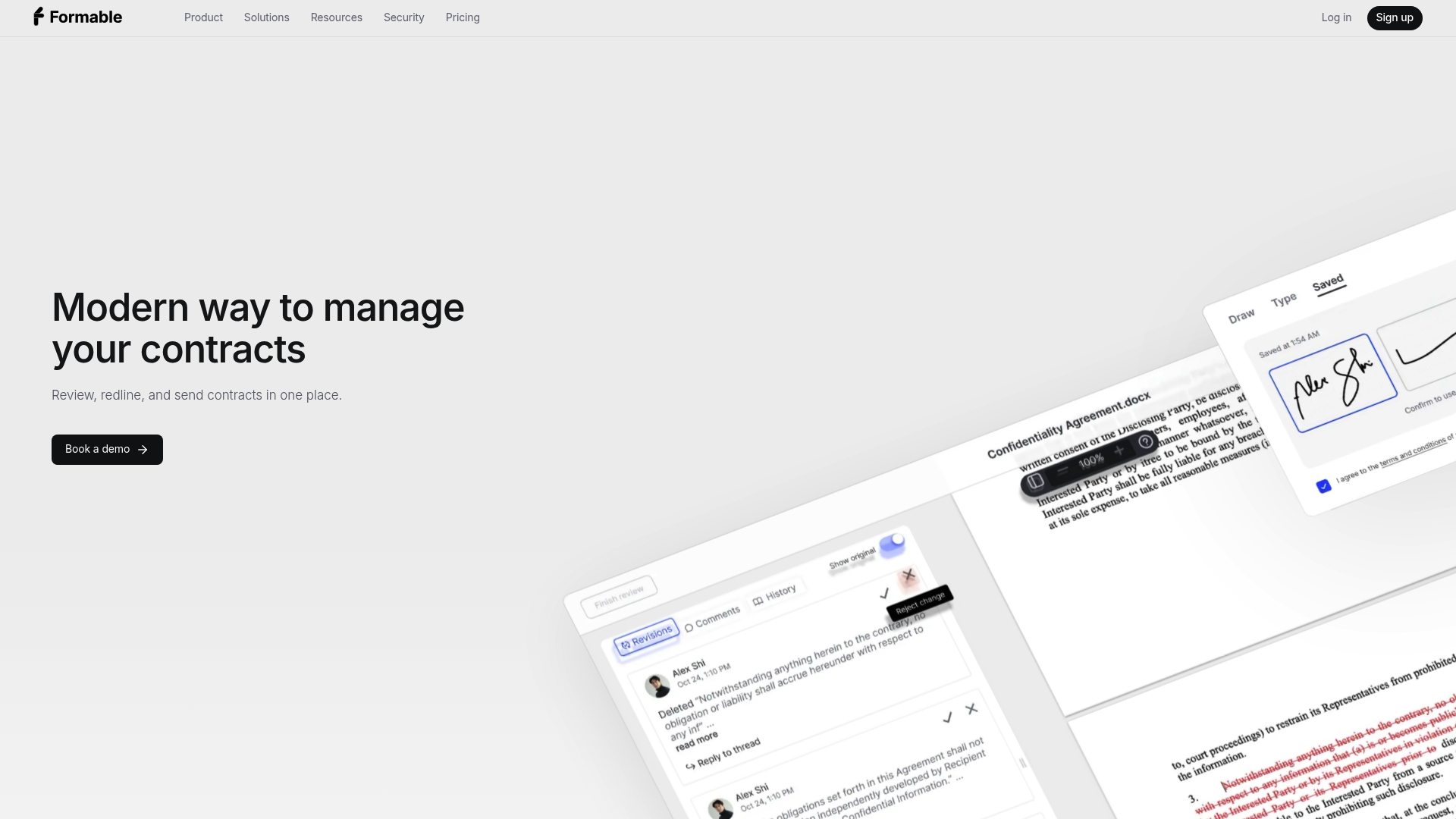
If you are weighing buy versus build, start with our developer sandbox, run a proof of concept against your own webhook and audit-bundle requirements, and check our API pricing for current prices.
FAQ
Is there an API available for digital signatures?
Yes, API-based digital signature options are widely available and let developers embed signing directly into their own products rather than redirecting users to a separate app. Most include webhook events, templating, and audit-trail export as standard features.
How much does an e-signing API typically cost?
Pricing varies by vendor and usually follows a subscription or usage-based model tied to signature volume or developer seats. Current prices for our Developer and Growth plans are on our API pricing page.
What is the best eSignature platform?
The right platform depends on whether you need deep customization, fast time-to-market, or a unified contract workflow alongside signing. Teams prioritizing an integrated flow that combines contract creation, redlining, and e-signing in one place often find that approach reduces the number of tools they manage.
How can I create my own electronic signature?
Creating a basic electronic signature typically involves typing, drawing, or uploading an image of your signature within a signing tool, then applying it to a document. For a signature to hold up legally, the platform also needs to capture consent and retain an audit trail as required under the ESIGN Act.
What makes an audit trail legally defensible?
A defensible audit trail links the signer's identity to the signing action, records exact timestamps and IP addresses, and logs every event from sending to completion. FDIC compliance guidance recommends preserving an authoritative copy for the full retention period to keep the record enforceable.