Prove electronic signature API ROI in 30-90 days for engineers and PMs

Alex Shi

Embedding an e-signature API into your app speeds contracts, cuts manual work, and enforces auditable compliance across every workflow it touches. It keeps signers inside your product, generates a tamper-evident record for every signature under the ESIGN Act and UETA, and gives engineering a SOC 2 friendly foundation to build on. Vendors like Formable offer this as a standalone API, so teams can evaluate the fit before committing.
TL;DR:
- Embedded e-signature APIs eliminate drop-off points and improve completion rates by keeping signing inside your product's branding.
- Webhook triggers from signed documents enable automations in your CRM, billing, and provisioning systems, saving manual effort and reducing errors.
- Proper implementation requires secure webhook verification, idempotency keys, sandbox testing, rate limit monitoring, and encryption standards compliant with NIST guidelines.
- Legal enforceability depends on the vendor satisfying the ESIGN Act and UETA, while security measures must include cryptographic hashes and tamper evidence.
- Running a pilot for 30 to 90 days on high-volume workflows helps justify scaling by measuring reductions in time to signature and manual workload.
Table of Contents
- Advantages of e-signature APIs your team will actually feel
- How an e-signature API actually moves a document
- What engineering needs to scope before the first sprint
- Security and compliance checkpoints before you sign a contract
- Measuring ROI: the numbers that justify the build
- Features that separate a real API from a checkbox feature
- A closer look at embedded signing in practice
- Should you build the integration or use a hosted portal?
- Where to start if you're ready to integrate
- Sources
- FAQ
Advantages of e-signature APIs your team will actually feel
The gap between "we added e-signatures" and "we integrated an e-signature API" shows up in the metrics that matter to both engineering and revenue teams.
Faster cycle times. Embedded, in-app signing removes the redirect to a third-party portal that causes signers to abandon the process or forget to come back. Automated reminders chase down slow signers without a human sending follow-up emails.
Higher completion rates. A white-labeled, embedded signing flow keeps the experience inside your product's own branding and navigation, which research on eSign API adoption ties directly to fewer drop-offs and fewer workflow bottlenecks.
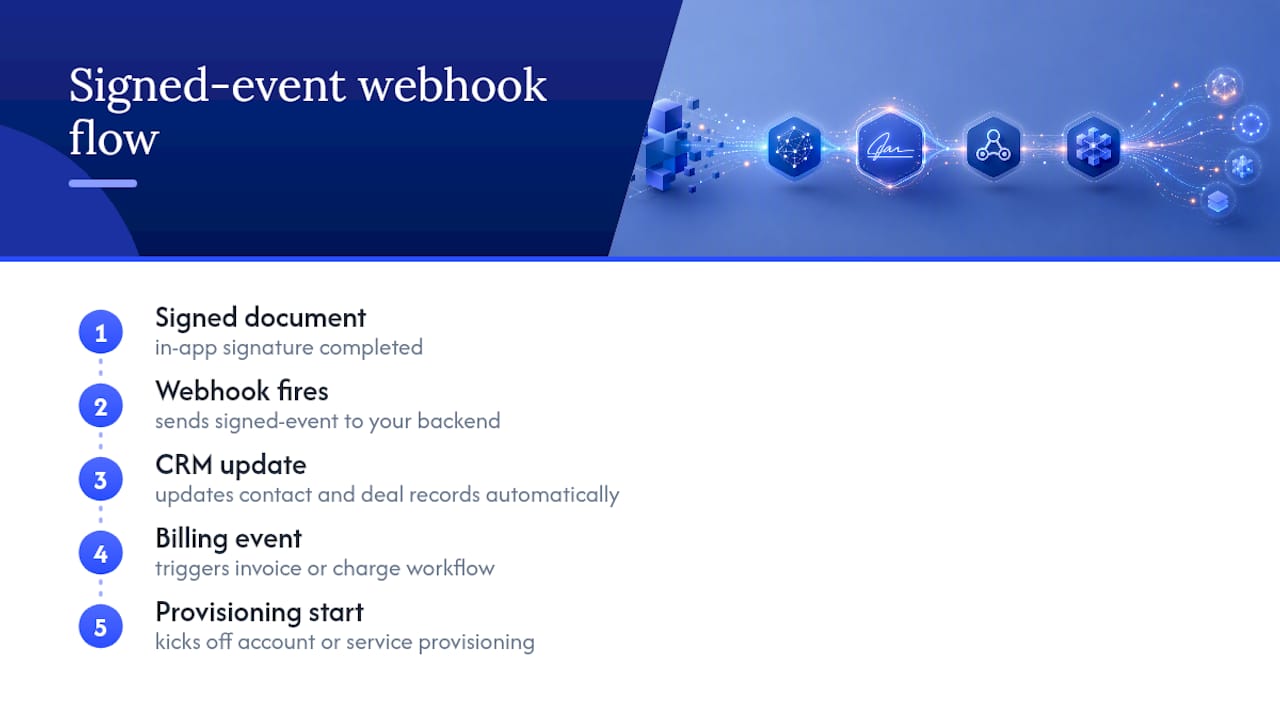
Automation that starts the moment ink hits pixel. A signed document fires a webhook. That webhook updates your CRM, triggers a billing event, or kicks off provisioning, turning what used to be a status check into an automatic handoff.
Fewer errors and less rework. Templates with locked fields and validation rules stop the classic problems: missing initials, wrong dates, an unsigned exhibit.
Compliance and auditability baked in. Every signature event lands in a centralized, immutable audit trail with consistent retention rules, instead of scattered PDFs in someone's inbox.
Predictable, scalable costs. Pricing models may vary based on usage or subscription structures.
Pro Tip: If you can only automate one thing this quarter, automate the webhook that updates your CRM on signature completion. It is the single highest-leverage integration point in the whole workflow.
How an e-signature API actually moves a document
The mechanics are simpler than most engineering teams expect, and understanding the flow helps you scope the integration honestly before you commit a sprint to it.
- Document creation. You generate the agreement from a template or upload a finished file through the API.
- Send request. The API creates a signature request, assigns signer roles, and routes the document, either by email or through an embedded link.
- Signer interaction. The signer completes fields inside an iframe embedded in your app, or gets redirected to a hosted signing page, depending on which flow you choose.
- Webhook event fires. The moment a signer signs, declines, or even just views the document, the API pushes an event to your endpoint rather than making you poll for status.
- Artifact retrieval. You pull the completed, tamper-evident document, along with its audit trail metadata, and store both.
Webhooks matter more than most integration guides admit. Polling an API every few minutes to check signature status wastes calls and adds latency. Treating the signature event as a trigger for downstream logic, not just a status update, is what separates a document workflow from a business workflow that unifies your system of record.
What engineering needs to scope before the first sprint
A few decisions early in the build save weeks of rework later.
- Choose an authentication approach with credential rotation built in, not an API key that lives in a config file forever.
- Use idempotency keys on create and send endpoints so a retried request never generates a duplicate signature request.
- Verify every incoming webhook with an HMAC signature check, and guard against replay attacks on top of that.
- Build against sandbox accounts with fixture contracts before touching production data, and run full test signer flows end to end.
- Watch rate limits closely if you plan to batch or bulk-sign, and put monitoring on webhook delivery failures from day one.
Pro Tip: Log every webhook payload before you process it, even the ones you plan to ignore. When a signature event mysteriously never fires, that raw log is the only way to tell whether the vendor never sent it or your endpoint silently dropped it. Formable's own developer guidance on webhook handling walks through this pattern in more detail, and third-party guides on API integrations for dashboards and reporting cover similar patterns for teams wiring signature data into analytics tools.
Security and compliance checkpoints before you sign a contract
Legal enforceability and security are separate questions, and vendors sometimes blur them. Confirm both.
- Verify the platform's signatures satisfy the ESIGN Act and UETA, the two federal and state frameworks that make electronic signatures legally binding in the United States.
- If any signed document could contain protected health information, confirm the vendor's HIPAA posture directly. HHS guidance is explicit that handling PHI carries specific obligations regardless of which tool touches it.
- Ask for SOC 2 Type II and ISO 27001 attestations, plus clear documentation on encryption at rest and in transit.
- Confirm the audit trail includes cryptographic hashes and tamper evidence, not just a timestamp and an IP address.
- Check retention policies and whether signed artifacts export cleanly for e-discovery or a regulator's request.
Cryptographic integrity is not a marketing checkbox. NIST's security guidance sets the baseline most serious vendors build against, and it's a reasonable framework to hold any provider to when you're evaluating how they store and verify signed records. Formable publishes its own security and compliance documentation covering these controls directly.
Measuring ROI: the numbers that justify the build
The business case for e-signature integration comes down to four numbers you can track from day one of a pilot.
- Time to signature. Measure from send to completed signature, not from send to "opened."
- Completion rate. What percentage of sent documents actually get signed without a manual nudge.
- Cost per signature. Usage-based API pricing divided by transaction volume, compared against the fully loaded cost of your current manual process.
- Manual hours saved. Hours your team previously spent chasing signatures, re-sending documents, or manually updating a CRM after the fact.
| Metric | What to track it against |
|---|---|
| Time to signature | Days from send to completion, current process vs. pilot |
| Completion rate | Percentage of documents signed without manual follow-up |
| Cost per signature | API cost per transaction vs. staff time per manual signature |
| Manual hours saved | Hours reclaimed per week from CRM updates and chasing signers |
Run the pilot for 30 to 90 days on one high-volume workflow, sales order forms or vendor NDAs work well, and set a rollout threshold before you start: a meaningful drop in time to signature plus a measurable cut in manual hours is a reasonable bar for expanding the integration further.
Features that separate a real API from a checkbox feature
Not every capability on a vendor's feature page carries the same weight. Sort them before you sign anything.
- Must-have: embedded signing, granular webhook events, exportable audit trails, a working sandbox, and SDKs in your team's actual language stack.
- Important: reusable templates with merge fields, bulk signing for high-volume batches, and pricing that scales predictably with volume.
- Nice-to-have: AI-assisted template generation, native redlining inside the signing flow, and advanced signer identity verification for higher-risk transactions.
Buyers researching vendor marketplaces consistently point to SDK quality and documentation as a deciding factor once initial demos are over, and reliable event granularity shows up again in reviews focused on scaling e-signature usage.
A closer look at embedded signing in practice
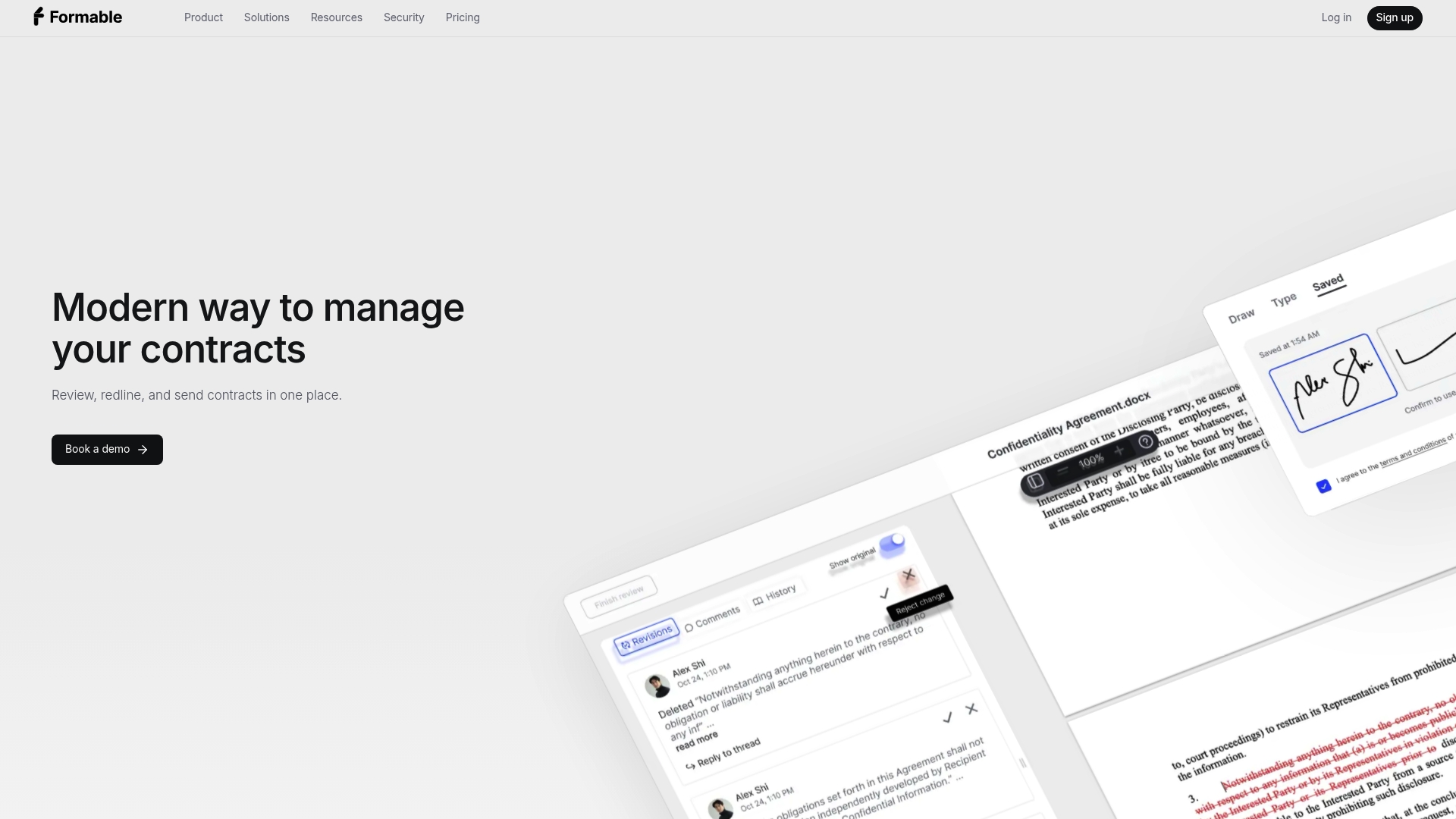
Formable runs its embedded signing API alongside a broader contract workflow: template based contract creation, AI-assisted drafting, collaborative redlining, and an AI contract review engine that flags risk before a document ever reaches signature.
Together, those pieces cut two kinds of friction at once:
- Manual reconciliation drops because signed data flows straight back into the same platform that created and negotiated the contract.
- Cycle time shrinks because redlining and signing happen in one continuous workflow instead of three disconnected tools.
Specific customer volume and time savings figures are not publicly listed for this integration.
Should you build the integration or use a hosted portal?
Integrate when volume is high, multiple teams touch contracts, and you need automation and an audit trail. A hosted portal works fine for occasional, low-volume signing needs.
— Alex
Where to start if you're ready to integrate
Embedded signing APIs can enable product teams to collect legally binding signatures without sending users to a separate portal, sometimes integrated within platforms that also handle contract creation, redlining, and AI-powered review. That combination matters if your team is currently stitching together a document generator, a separate e-signature tool, and a CRM update script held together with webhooks nobody fully trusts.
If you're evaluating whether to build against an API or keep patching your current setup, the fastest way to find out is to look at the embedded signing documentation and see how the signer flow maps onto your product. Teams further along in procurement can go straight to the Formable product overview to see how contract creation, negotiation, and signing fit together, or start building contracts from templates using the contract creator before wiring up the API itself.
Sources
- 5 ways an eSign API eliminates bottlenecks in your document workflows | CIO
- National Institute of Standards and Technology (NIST)
- Health Information Privacy | HHS
FAQ
What are the benefits of API integration for e-signatures specifically?
Faster time to signature, higher completion rates from embedded signing, automated CRM and billing updates through webhooks, and a centralized audit trail for compliance.
What are the benefits of using electronic signatures over wet-ink signing?
Electronic signatures cut turnaround from days to minutes, reduce printing and shipping costs, and create a digital audit trail that a paper signature never generates.
Is there an API available for digital signatures?
Yes. Several providers, including Formable, offer a standalone e-signature API that developers can integrate directly into their own product rather than redirecting users to a separate portal.
What are the stages of integrating an e-signature API?
Typical stages are document or template setup, sending the signature request, signer interaction, webhook event handling, and retrieving the signed artifact for storage.
Do e-signatures integrated through an API hold up legally?
Yes, provided the vendor's signatures comply with the ESIGN Act and UETA, the two frameworks that establish electronic signatures as legally binding across the United States.