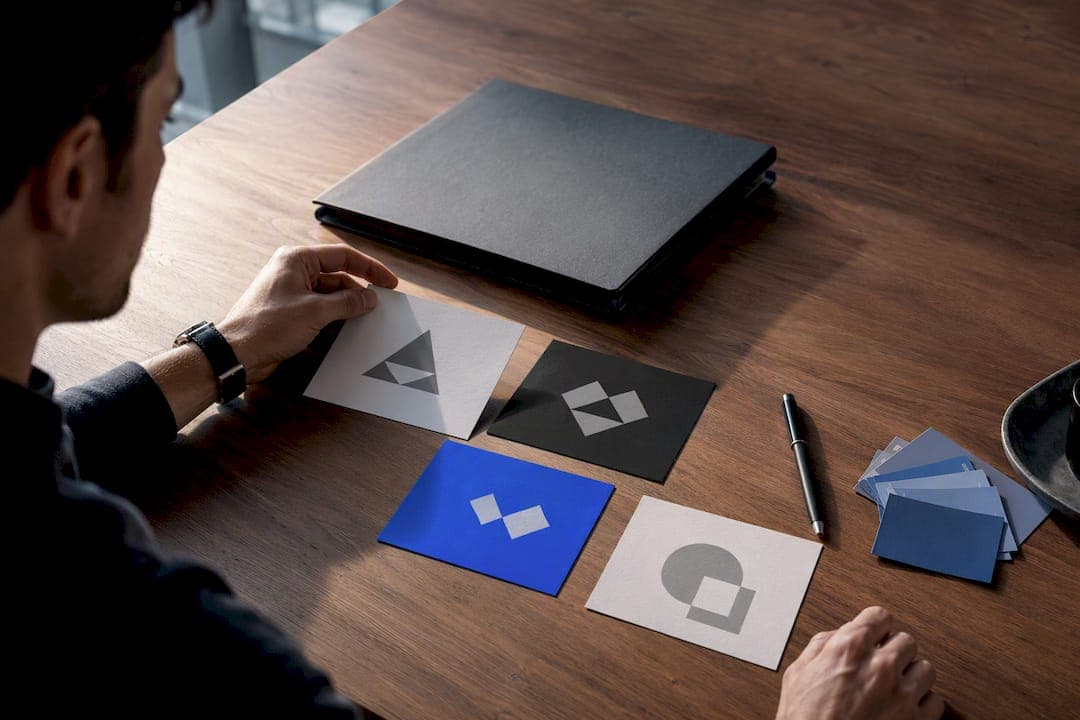
A freelance logo design contract needs eight things to hold up: a locked scope of work with exact deliverable counts and file formats, a defined revision limit, payment terms with a deposit and milestones, an IP clause that transfers ownership only on final payment, client responsibilities and feedback windows, a cancellation or kill fee structure, rules for third-party assets like fonts and stock art, and your portfolio rights. Sample clause language and a paste-ready checklist follow below.
TL;DR:
- Clearly define deliverables, including initial concepts, refinement rounds, final files in specified formats, and exclusions like brand guidelines or social media kits.
- Structure payment with a non-refundable deposit, milestone payments, and clear invoice terms to protect cash flow and prevent late payments.
- Limit revisions to a set number of rounds, with explicit definitions of a revision cycle, additional fees for extras, and response deadlines to avoid scope creep.
- Transfer ownership only upon full final payment, excluding pre-existing tools, third-party assets, and AI-generated elements, and clarify client responsibilities for trademark clearance.
- Use modular contracts with adaptable clauses to improve consistency, and implement digital tools for tracking versions, redlining, signatures, and avoiding delays or disputes.
What should I put in a freelance graphic design contract for logo work?
Most disputes between designers and clients trace back to one root cause: a scope of work written in general terms instead of specific ones. "A modern, professional logo" means nothing in a contract. "Three initial concepts, one round of refinement on the selected concept, delivered as AI, EPS, SVG, and PNG files" means everything.
The Plutio freelancer guide lists eight clauses every freelance contract needs: scope, payment, timeline, revision limits, IP rights, confidentiality, termination, and a signature block. This list holds up well for logo work specifically, but logos have their own failure points. Clients ask for "just one more version" indefinitely. They want the source file for free. They assume a flat fee includes brand guidelines, social media kits, and a business card set nobody mentioned in the proposal.
Here's a deliverable list that closes most of those gaps:
- A few initial logo concepts, presented as flat PDF or PNG mockups
- A limited number of refinement rounds on the client's selected concept
- Final files delivered in AI, EPS, SVG, and PNG formats, including color variants
- A basic color palette reference sheet with color values
- Editable source files may be made available for an additional fee
List your exclusions with the same precision. Brand guideline documents, social media kit resizing, trademark registration, and stationery design should appear as a short line: "The following are not included in this engagement and are available as separate add-ons: brand style guide, social media templates, trademark clearance search." That single sentence prevents the most common scope argument in the business.
A workable scope clause reads something like this: "Designer will deliver three (3) initial logo concepts based on the creative brief. Client will select one concept for refinement. Designer will provide one (1) round of refinement on the selected concept. Final deliverables include vector (AI, EPS, SVG) and raster (PNG, minimum 300 DPI) files in full color, single color, and white/reversed versions."
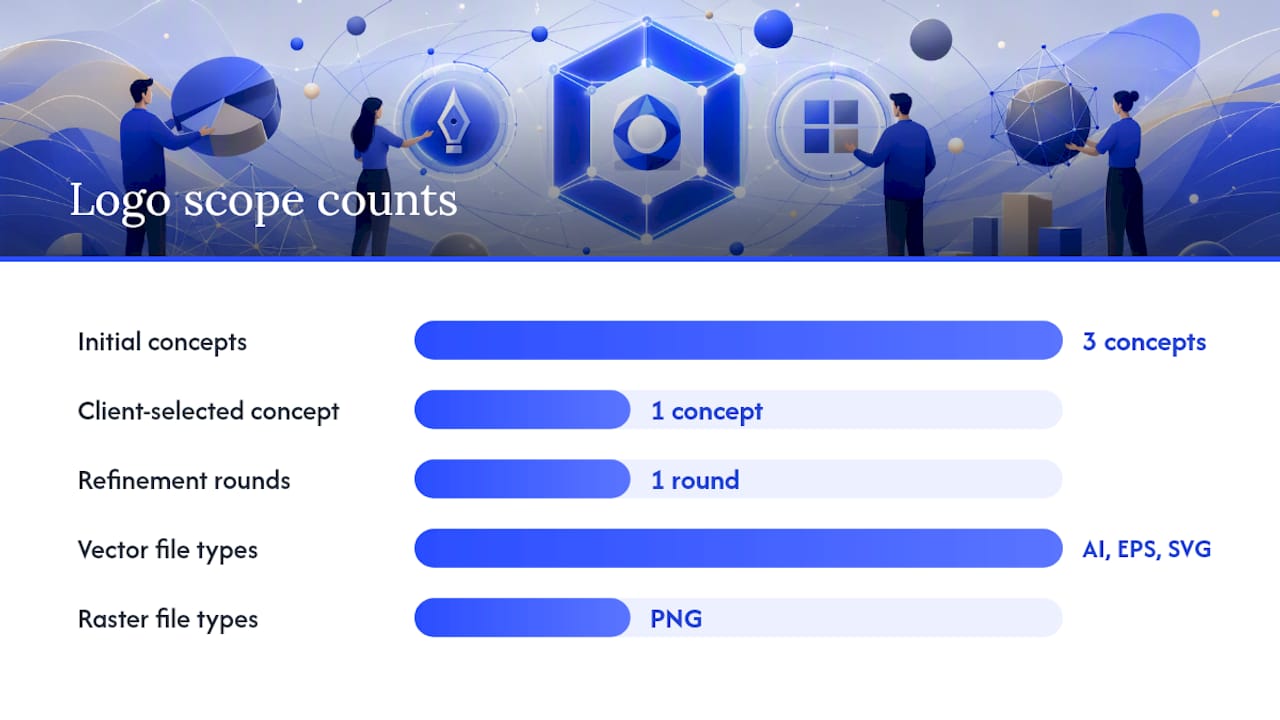
Pro Tip: Attach a one-page "what's included" sheet to your proposal before the contract even goes out. Clients who see the deliverable list clearly presented in both proposal and contract are less likely to claim misunderstanding about what they are purchasing.
How should payment terms protect your cash flow?
Payment structure is where designers lose leverage, usually by accident. A single invoice due "upon completion" gives the client every incentive to stall and none to pay promptly. Structuring payment around project phases keeps the incentive pointed the right way.
The standard pattern for logo work runs a nonrefundable deposit before any concepts are started, with the AIGA standard form of agreement noting that it is common industry practice to require a nonrefundable deposit to secure a project date. The remaining balance splits into a milestone payment (due when the client approves a concept for refinement) and a final payment (due before final files are released).
Your contract should specify:
- Deposit amount and whether it's nonrefundable ("This deposit is non-refundable and secures your position in Designer's production schedule")
- Milestone payment tied to a specific event, not a date ("50% due upon written approval of selected concept")
- Invoice terms: net 7 or net 14 from invoice date, not from project completion
- Accepted payment methods, stated plainly rather than assumed
- A late fee, commonly 1.5% per month on the overdue balance, or a flat fee after a stated grace period
Sample wording: "Client agrees to pay a non-refundable deposit of the agreed percentage of the total project fee upon signing. The remaining balance is due in installments per the milestone schedule. Invoices are due within the stated payment term; late payments may incur fees as specified in the contract."
For larger branding engagements with multiple phases, a structured term sheet can lay out approval triggers and payment milestones more clearly than a single paragraph buried in the main agreement.
How many revisions should a logo contract allow?
A small number of revision rounds is typical for logo work, and your contract should define clearly what constitutes "a round" of revision. Vague revision language is how one round of feedback turns into six weeks of incremental tweaks.
- Define a revision round operationally. One round means one consolidated document of feedback, submitted by the client within a set number of business days (five is typical), covering all requested changes at once. Feedback that trickles in over separate emails across two weeks does not reset the round count.
- Cap the included rounds. Two rounds for a straightforward logo, three for a more involved branding project. State the number in the contract, not in a follow-up email.
- Price additional rounds. Extra revisions beyond the included count bill at an hourly rate or a flat change-order fee, whichever you state up front.
- Set client response deadlines. If the client doesn't respond to a concept presentation within 10 business days, the project timeline shifts accordingly, and a hold fee may apply for projects paused longer than 30 days.
Sample clause: "Client is entitled to a limited number of rounds of revisions. Each round consists of one consolidated set of written feedback submitted within a set number of business days of concept delivery. Additional revisions beyond the included rounds will be billed according to terms stated in a written change order."
Who owns the logo, and when does ownership transfer?
Ownership hinges on one word most contracts get wrong: assignment versus license. Assignment transfers the copyright itself to the client. Licensing means you retain copyright and grant the client permission to use the work under specific terms. For logo work, full assignment on final payment is the standard client expectation, and it's the model most designers should default to.
Copyright law backs a critical detail here: ownership defaults to the creator, the designer, unless there's a written assignment saying otherwise, according to U.S. Copyright Office guidance. That means silence in your contract favors you, not the client, until you sign the rights away.
The practical fix is a transfer-on-payment clause. Ownership of the final logo design does not transfer to the client until the final invoice clears, in full. Until that point, the client is using the work under an implied license only, which gives you real recourse if a client tries to use unpaid work commercially.
A few things belong outside that assignment entirely:
- Pre-existing materials. Design systems, templates, or process tools you built before this project stay yours. Grant the client a license to use them only as incorporated into the final logo, not standalone.
- Third-party assets. Any licensed fonts or stock elements used in the design carry their own license terms, which you should disclose and pass through to the client rather than imply you're granting rights you don't have.
- AI-assisted elements. If you used a generative tool in concepting, disclose that use, since ownership and licensing questions around AI-generated content are still unsettled in several jurisdictions.
- Trademark clearance. You are not a trademark attorney, and your contract shouldn't imply otherwise. State plainly that the client is responsible for running trademark clearance searches or hiring counsel before using the logo commercially, an approach legal commentary on creative service agreements recommends as standard practice.
- Portfolio rights. Reserve the right to display the finished logo in your portfolio and marketing materials, even after full assignment.
Sample clause: "Upon receipt of full payment, Designer assigns all right, title, and interest in the final logo design to Client. This assignment excludes Designer's pre-existing tools, templates, and processes, which remain Designer's property. Designer retains the right to display the final work in its portfolio and promotional materials. Client is solely responsible for conducting trademark clearance searches prior to commercial use."
What termination and liability language protects you?
A kill fee tied to project phase keeps you from working for free if a client walks away mid-project. Common structure: the deposit is retained regardless of stage, and any completed milestone work bills at the agreed rate for that phase.
- Termination requires written notice, typically 7 to 14 days
- No ownership rights transfer to the client until payment for work completed is received in full
- Liability is capped at the total fees paid under the contract, protecting you from open-ended damages claims
- Disputes route to mediation first, then binding arbitration in your home state, before either party can go to court
Sample: "Either party may terminate this agreement with 14 days' written notice. Upon termination, Client agrees to pay for all work completed to date. Designer's total liability under this agreement is limited to the total fees paid by Client. Disputes will first be submitted to mediation before either party pursues arbitration."
Copy-paste clauses and a pre-signature checklist
Modular contracts work better than one dense legal document, which is exactly what the AIGA Standard Form of Agreement is built around: basic terms and IP provisions as the core, with supplemental modules added per project. Here's a compressed version you can adapt:
- Scope: "Designer will provide [X] initial concepts and [X] revision rounds, with final files delivered in AI, EPS, SVG, and PNG formats."
- Payment: "A non-refundable deposit of [X]% is due upon signing, with the balance due per the milestone schedule attached."
- IP transfer: "Full ownership transfers to Client upon receipt of final payment. Designer retains rights to pre-existing tools and portfolio display."
- Third-party assets: "Any licensed fonts or stock assets used in this project are subject to their own license terms, disclosed in Exhibit B."
- Kill fee: "In the event of early termination, Client agrees to pay for all work completed through the date of termination."
Before sending any contract, confirm: deliverable counts and formats are listed by name, the deposit amount and due date are stated, revision rounds are capped and defined, the IP transfer clause ties to final payment, exclusions are listed, and a termination clause exists. For enterprise clients or larger branding packages, you'll likely need to add modules covering brand guideline delivery, social kit variants, or multi-stakeholder approval chains. A services agreement template built for larger engagements handles that added complexity better than stretching a simple logo contract to cover it.
Pro Tip: Keep a "clause library" of your own past contract language, organized by category. Every project teaches you something a generic template doesn't cover, and the fastest way to improve your contracts is to fold real lessons back into the next one.
How do you actually get the contract signed?
Bring up contract terms during the proposal conversation, not after. If a client balks at a 40% deposit or a two-revision cap during the sales call, you want to know that before you've started concepting, not after you've sent the first round.
Once the client asks for changes to your standard terms, treat that as a redline, not a renegotiation of the whole document. Track what changed, keep the agreed scope and payment terms aligned with what you quoted in the proposal, and use a written change order for anything that shifts after signing.
- Electronic signatures are legally binding in the U.S. under the ESIGN Act and UETA, so there's no need to mail paper contracts
- Store every signed agreement somewhere retrievable, not buried in an email thread
- Never release final files before the last invoice clears, regardless of how the relationship has gone so far
The perspective on modular contracts and living clauses
Most designers write one contract early in their freelance career and never touch it again, which is backwards. Your best clause language comes from your worst projects, not a template you downloaded once. A client who tried to stretch one revision round into eight rounds taught you exactly how to write the revision clause. A client who disappeared for six weeks mid-project taught you the client-responsibility clause.
The modular approach AIGA promotes works precisely because it treats a contract as a set of interchangeable parts, not a monolithic document. Swap in a tighter revision clause after a bad experience. Add a hold fee module after a client goes silent. Walk clients through the IP and payment sections in plain language before they sign, not legalese they'll skim past, since a client who understands why the deposit is nonrefundable is far less likely to dispute it later.
— Alex
Store your templates and redline changes without losing track of versions
There are tools that help freelance designers manage the back and forth that comes with client contracts, avoiding the version-control mess of tracked changes in a Word document. You can store your logo contract templates and clause library in one place, send agreements out for redlining so both sides align on terms before signing, and collect e-signatures the moment a client is ready.
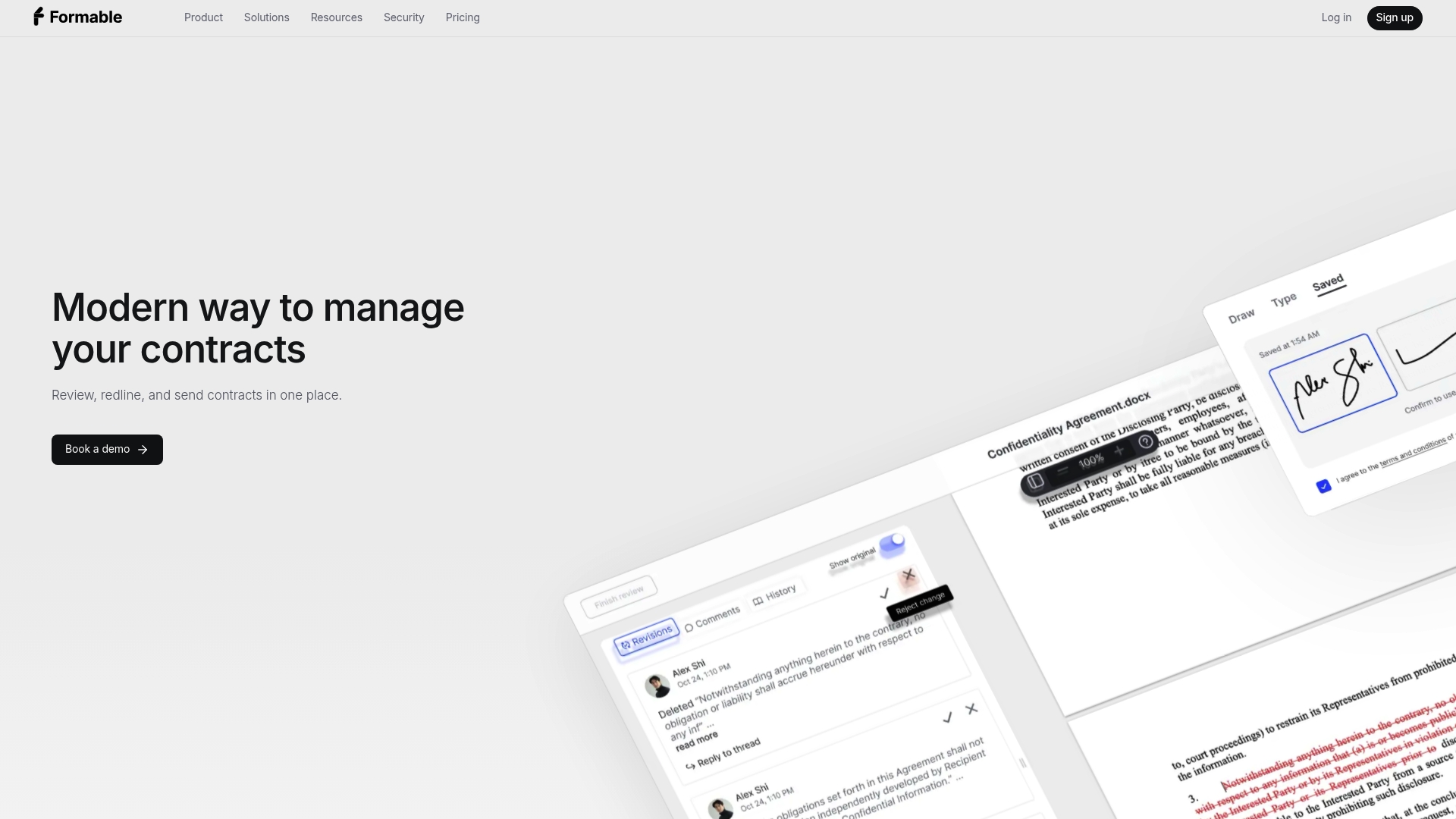
That matters most on the two moments where designers lose money: a client who "forgets" to sign before work starts, and a payment milestone that slips because nobody can find the current version of the agreement. Formable's contract creator lets you generate a logo contract from a template and adjust clauses without starting from scratch each time, and the platform's e-signing tools keep a record of exactly what was signed and when. If you're tired of chasing signatures over email, visit Formabledocs to see how the contract creator and signing workflow fit into your next logo project.
Sources
Review the AIGA standard agreement for modular clause structure, the U.S. Copyright Office's circular on ownership for assignment rules, and adjust any clause for your state or larger client contracts.
This article is general information, not a substitute for advice from a qualified lawyer. Consult a qualified legal professional about your own circumstances before acting on anything here.
- AIGA standard form of agreement for design services (PDF)
- How to create a freelance contract (Plutio)
- U.S. Copyright Office circular on works made for hire and copyright basics
FAQ
What should a graphic designer charge for a logo?
Logo pricing varies widely by experience and market, but the contract matters more than the number: whatever you charge, tie the fee to a deposit, a milestone, and a final payment so cash flow stays predictable regardless of your rate.
What should a freelance contract include?
At minimum, a freelance contract needs scope of work, payment terms, a timeline, revision limits, IP rights, confidentiality provisions, termination terms, and a signature block, so a dispute can be settled by reading the document rather than arguing about intent.
Do I always own the logo if I pay someone to design it?
Not automatically. Copyright ownership defaults to the designer as the creator unless the contract contains a written assignment clause transferring rights to the client, typically triggered by full payment.
How do I write a contract as a freelancer?
Start from a modular template covering basic terms and IP provisions, like the AIGA standard agreement, then add specific clauses for scope, payment milestones, and revision limits based on the actual project. A contract creator tool that combines templates with clause libraries can speed this up if you're building agreements from scratch each time.