
We recommend Formable as the strongest overall HelloSign API alternative for teams that want signing, redlining, and contract review in one workflow. BoldSign suits teams chasing the lowest per-request cost, SignWell fits straightforward bulk sending, and PandaDoc works well for sales teams that need document analytics alongside eSign. The right pick depends on how much of your contract process you want unified under one API.
TL;DR:
- Formable lists its Pro and Growth plans at $29.99 per month; compare per request, per signature, and extra feature fees against forecast volume.
- Teams that only need signing can choose BoldSign or SignWell, while sales teams may prefer PandaDoc for proposal open tracking and document analytics.
- Before switching, inventory templates, webhook events, and signer authentication rules, map endpoints through an adapter, and verify historical audit trails and signed document access.
- Test expected peak volume in a sandbox, checking rate limits and delayed webhooks; ask vendors for p95 response times, retry behavior, and contractual uptime terms.
- For international signers, test signing pages, emails, and audit certificates in each locale, then confirm date formats and verification methods meet local requirements.
Shortlist of HelloSign API alternatives worth evaluating
Dropbox Sign changed its pricing and developer terms after the HelloSign acquisition, and reviewers on G2 point to recurring frustration with documentation gaps and cost unpredictability. That is pushing engineering and product teams to shortlist replacements now rather than wait for the next price change.
Here is how the main contenders stack up on a first pass:
- Formable: unifies embedded e-signing, redlining, and AI contract review in one workflow, so teams skip the stitching work between separate tools.
- BoldSign: built for teams that want predictable per-request pricing and fast API response, according to developer reviews on G2.
- SignWell: keeps the signing experience simple, with bulk send and template reuse as its main draw.
- PandaDoc: pairs document generation with sales analytics, a fit for revenue teams who want more than a signature box, as reflected in G2 user feedback.
- Signeasy: lightweight signing with straightforward integrations, including SharePoint support.
- SignNow: a mature template and workflow library for teams with established document processes.
- Zoho Sign: the natural choice if your stack already runs on Zoho's suite of business apps.
- DocuSign: broad enterprise adoption and a deep compliance certification list, which matters for regulated buyers.
- Adobe Sign: strongest where PDF tooling and Adobe ecosystem integration already anchor your document process.
Each of these is available to U.S. buyers today, and none requires a long onboarding cycle just to test the API.
Comparing pricing, SDKs, and signing features side by side
Before you commit engineering time, it helps to see the technical and commercial shape of each option in one place. The dimensions that matter most for an embedded signing project are pricing model, SDK coverage, webhook depth, template support, identity verification, and how support is delivered once you are in production.
Formable's published pricing sits at the top of the table because it is the plan we can state with certainty: Pro and Growth both run $29.99 per month. Several competitors list plan tiers without public per-unit pricing, which is why "varies by plan" appears instead of a guessed figure.
What developers should expect from SDKs, webhooks, and docs
Integration time comes down to how much the provider's SDK and documentation do for you versus how much you build yourself. A well-documented API with official SDKs in your stack's language can cut weeks off a signing integration, since you are not hand-rolling HTTP clients or guessing at payload shapes.
- Official SDKs in common languages like JavaScript, Python, and Java reduce the boilerplate needed to call signing and template endpoints.
- Webhook coverage should include signature completion, decline, and expiration events, with retry logic so a dropped delivery does not silently lose a signed document.
- Quickstarts, copy-paste code samples, and sandbox API keys are the clearest signal that a provider treats developers as a primary audience rather than an afterthought.
- A clear separation between test and production credentials prevents accidental signature requests from reaching real signers during development.
Pro Tip: Keep sandbox and production API keys in separate environment variables from day one, so a single configuration mistake never sends a test document to a real signer.
Our own embedded signing API follows this pattern, with signing URLs generated through a dedicated endpoint so you can drop the signing experience directly into your application rather than redirecting users away from it.
How embedded signature APIs are priced and licensed
Vendors price embedded e-signature APIs a few different ways, and the labels matter less than what triggers a charge.
- Per-signature pricing charges for each completed signature, which is predictable at low volume but can climb fast as usage scales.
- Per-request pricing charges for API calls rather than completed signatures, which rewards efficient integrations.
- Flat monthly tiers bundle a set volume of sends or signatures into one price, which is easier to budget against.
- Per-endpoint or feature add-ons (identity verification, advanced templates) often sit on top of the base price and are the most common source of surprise overages.
Say a team sends 10,000 signature requests a month: under a flat tier, that volume either fits inside the plan or pushes you into the next tier, while under per-signature or per-request pricing, the monthly bill moves directly with usage. Modeling both scenarios against your expected volume before you integrate avoids a mid-year surprise on the invoice.
Migrating off HelloSign without breaking signed documents
A clean migration protects two things: continuity of your audit trail and uninterrupted signer access to documents already in flight.
- Inventory every template, webhook event, and signer authentication rule currently running through HelloSign.
- Map each HelloSign endpoint to its equivalent in the new provider's API, and build a thin adapter layer rather than rewriting every call site at once.
- Test that historical audit trails and previously signed documents remain accessible after the switch.
- Run a small pilot with a low-stakes document type before moving your full signing volume.
Our Dropbox Sign embedded signing migration guide and the non-embedded signing migration path both walk through the endpoint mapping step with code samples, which is usually the part that eats the most engineering time.
Verifying security, compliance, and uptime claims
Legal enforceability of a signature depends partly on how the signer was verified, and the EU's eIDAS regulation sets out tiered requirements for electronic signatures that illustrate why verification method matters even outside the EU.
- Check whether a provider offers email, SMS, knowledge-based authentication, or full ID verification, since stronger verification generally supports stronger enforceability.
- Ask procurement for the actual SLA language and historical uptime, not just a marketing claim of reliability.
- Look for a published security page detailing encryption standards and audit trail immutability. Our own security and compliance overview lays out how we handle signed-document encryption and audit logging.
Why Formable fits teams that want the full contract workflow
We built Formable around the idea that signing is one step in a longer contract process, not the whole job.
- A redlining and negotiation layer so both sides align on terms before a document ever reaches signature.
- An AI contract review engine that checks uploaded playbooks against incoming agreements and flags risk automatically.
How teams actually use these alternatives day to day
A startup closing MSAs and DPAs through a sales motion needs something different than an enterprise legal team processing high-volume vendor agreements, and the alternatives above split roughly along that line. Teams that chose BoldSign or SignWell typically describe the move as a pure cost and reliability swap: the signing experience looks similar to HelloSign, but the pricing is more predictable at scale, a pattern consistent with the developer sentiment captured in BoldSign's G2 reviews.
Sales-driven organizations lean toward PandaDoc when the goal is tracking how often a proposal gets opened before it gets signed, since the analytics layer sits on top of the same signing core, a point echoed across PandaDoc's G2 feedback.
Teams that came to us at Formable were usually trying to solve a different problem: the signature itself was never the bottleneck, the negotiation before it was. A founder closing a pilot agreement with a prospective customer often spends more time going back and forth on indemnification language than waiting on a signature, so folding redlining and AI review into the same workflow that handles signing removes a handoff rather than adding one. That is the use case where a unified platform earns its keep over a standalone signing API: not because signing is harder, but because the surrounding negotiation work was never covered by the signing tool in the first place.

What to expect from API speed and scale under load
Public, independently verified benchmark data comparing response times across these providers is not widely published, so treat any specific millisecond figure you see in marketing material with some skepticism. What you can reasonably ask a vendor for during evaluation is their own measured response time under your expected load, their rate limit structure, and whether their infrastructure scales automatically or requires a plan upgrade to raise ceilings.
A practical scalability check matters more than a raw speed number: send a batch of test signature requests through the sandbox environment at a volume close to your real monthly peak, and watch for rate limiting, queued webhook delivery, or degraded response times. Enterprise-oriented providers like DocuSign and Adobe Sign generally publish more detailed uptime and performance commitments as part of their enterprise contracts, since large customers negotiate those terms directly. Smaller or newer API providers may not have that level of published detail yet, which is itself useful information when you are deciding how much production risk you are comfortable taking on.
Ask every vendor on your shortlist the same three questions: what is your measured p95 response time for the signature creation endpoint, how do you handle webhook retries after a failed delivery, and what happens to your API rate limits as our volume grows. The answers tell you more about real-world performance than any number in a comparison chart.

Supporting signers and documents across languages and regions
If your signers are not all in the same country, localization support becomes a real integration requirement rather than a nice-to-have. The relevant factors are the signing interface's supported languages, whether date formats adapt to the signer's locale rather than defaulting to a single format, and whether currency references inside generated documents display correctly for the signer's region.
Enterprise providers like DocuSign and Adobe Sign generally offer the broadest language coverage in their signing interfaces, a reasonable expectation given their global enterprise customer base. Mid-market providers vary more: some support a handful of major languages in the signing UI while leaving document content itself in whatever language you generated it in. Date format handling is worth testing directly in a sandbox environment rather than trusting a feature list, since a signing page that silently defaults to a U.S. date format for an international signer can create real ambiguity in a legal document.
When you are evaluating for a global signer base, run a sandbox test with a signer locale set outside your home market and confirm the signing page, confirmation emails, and generated audit certificate all render correctly in that locale before you commit to a provider.
Where each alternative fits in your existing tool stack
The signing API you choose rarely lives in isolation. It usually needs to talk to a CRM, a document storage system, or an internal approval tool, and ecosystem fit often decides the real winner once you look past the signing feature list itself.
Zoho Sign's clearest advantage shows up for teams already running Zoho CRM or Zoho Books, since the integrations are native rather than bolted on through a generic webhook. PandaDoc leans into sales ecosystem integrations, which matches its analytics focus. Adobe Sign's strongest integration story is with other Adobe products, particularly for teams that already generate contract content in Adobe's document tools.
We built Formable's integration approach around the idea that most teams do not want another silo: the embedded signing API and redlining API are designed to sit inside an existing application rather than pull your team into a separate portal. For teams layering AI-driven document intelligence or workflow automation on top of contract processes, partners like Powitup's AI automation services offer a complementary path for connecting document workflows to broader business process automation, separate from the signing layer itself.
Choosing between a unified platform and a standalone signing API
If signing is genuinely your only problem, a focused API like BoldSign or SignWell will serve you well. If negotiation and review eat more engineering and legal time than the signature step itself, a unified platform earns its complexity. Pilot both with sandbox keys before deciding.
— Alex
Try Formable's sandbox before you commit
Switching signing providers is a real engineering cost, and we built our sandbox so you can test embedded signing, redlining, and AI contract review against your own documents before touching production.
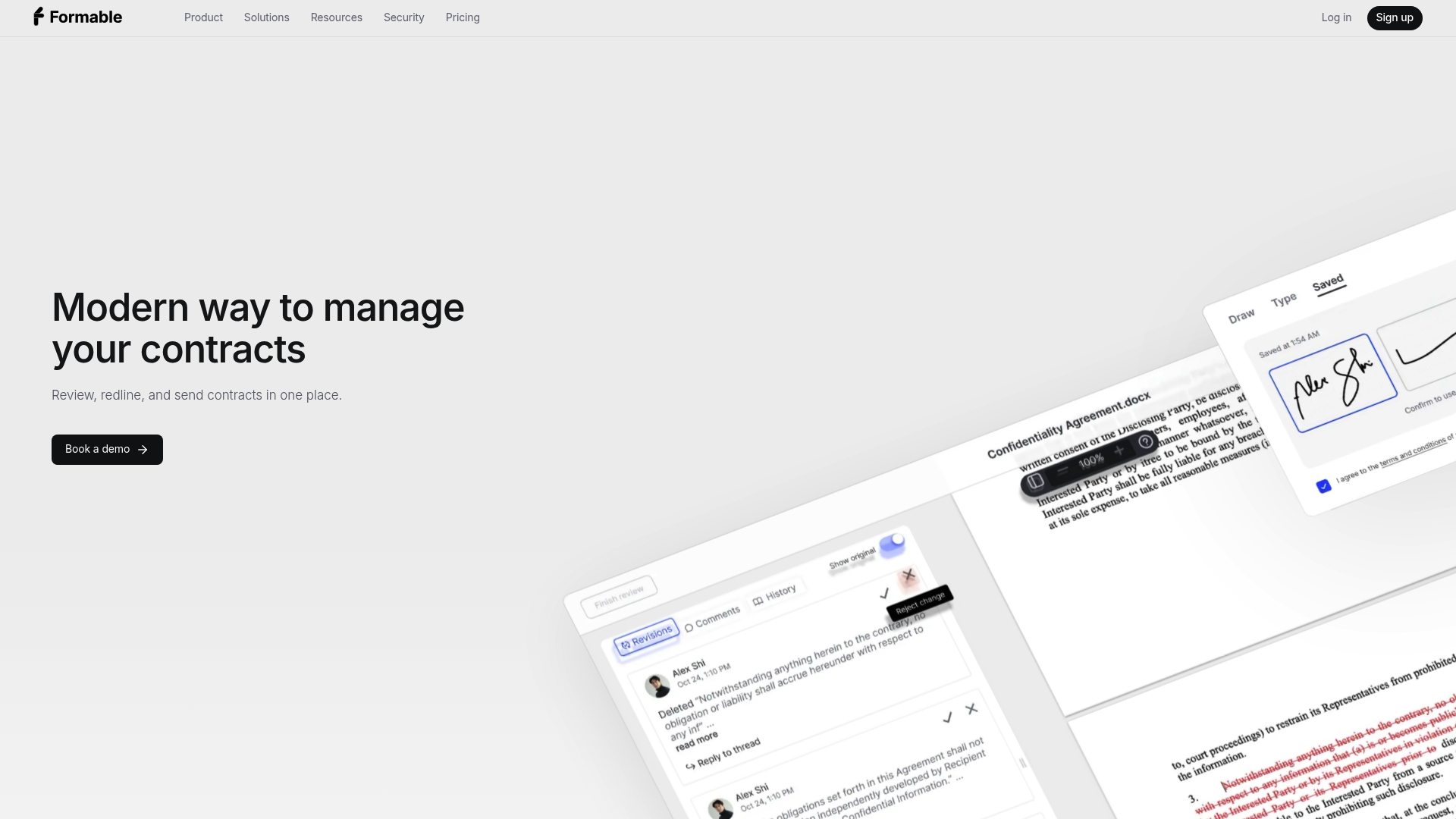
Our Growth plan runs $29.99 per month, the same price as our Pro plan, so the API and the full contract workflow cost the same whether your team starts with developers or with legal. Review the pricing details and start with the embedded signing API docs whenever you are ready to test a real integration.
FAQ
What happened to HelloSign?
HelloSign was acquired by Dropbox and rebranded as Dropbox Sign, and reviewers on G2 have noted pricing and documentation changes since the acquisition. That shift is a common reason teams start evaluating alternatives.
What are some alternatives to REST APIs?
Most eSignature providers, including Formable, BoldSign, and the others covered here, expose REST APIs as the standard integration method. GraphQL and webhook-driven event architectures exist as alternative API styles in software generally, but REST remains the dominant pattern for signature and document workflows.
Who is DocuSign's biggest competitor?
DocuSign competes with a broad field of eSignature providers, and no single source designates one official runner-up. Adobe Sign is frequently mentioned alongside DocuSign for enterprise deals due to similar compliance and ecosystem depth.
Is DocuSign the same as HelloSign?
No, DocuSign and HelloSign are separate companies with separate products. HelloSign was acquired by Dropbox and now operates as Dropbox Sign, distinct from DocuSign's platform and pricing.