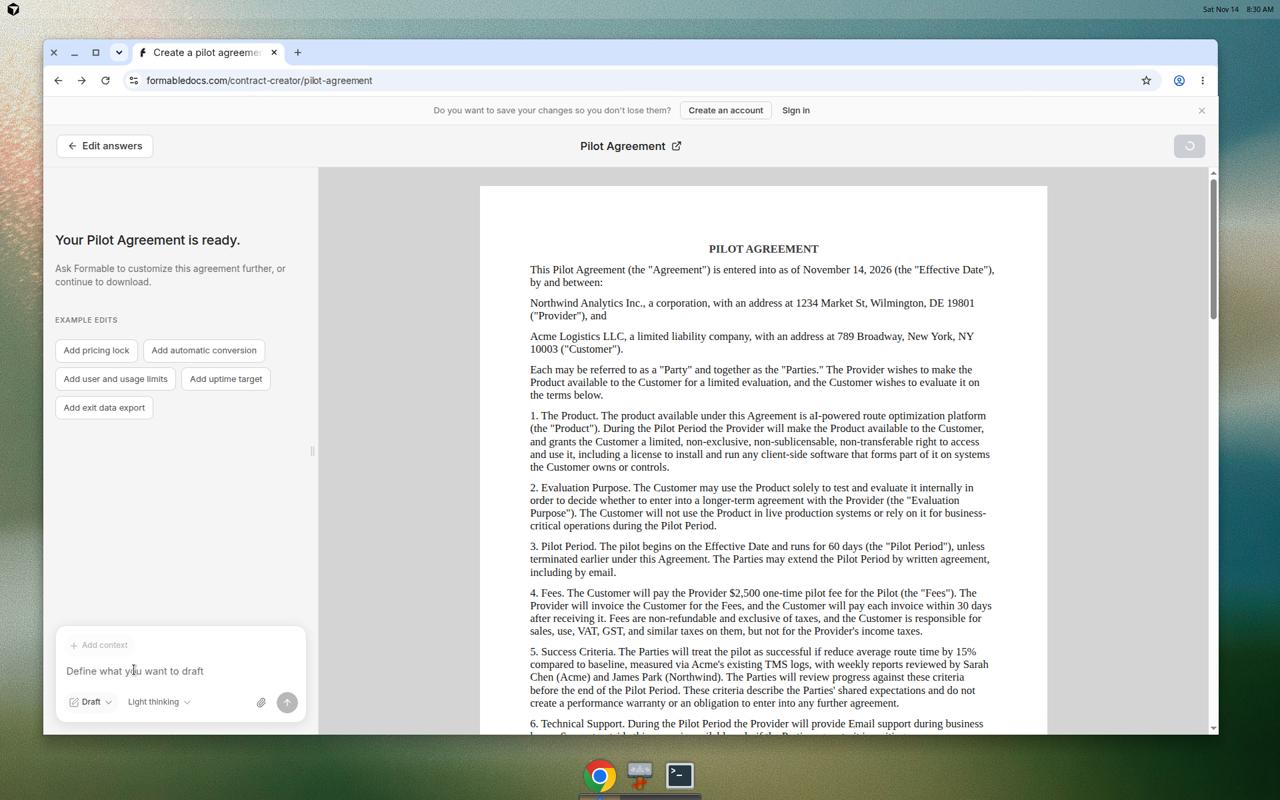
A proof of concept agreement is a short-term contract that governs a technical feasibility test. It answers the question "Can this work in our environment?" before either side commits to a longer operational pilot or a full commercial agreement. POC agreements are narrower, shorter, and cheaper than pilot agreements because they test technology in a sandbox, not business value in production.
The fastest path to a signed POC agreement is to use a pilot agreement template and adjust the scope, timeline, and success criteria to fit a technical test. Most POC agreements run two to eight weeks, use sandbox or test data only, and measure technical outcomes like integration success, latency, or accuracy rather than business metrics like cost savings or user adoption.
For a detailed comparison of when to run a POC versus a pilot, see pilot agreement vs POC.
Note: This article provides general information about POC agreements. It is not legal advice and does not create an attorney-client relationship.
What a POC agreement covers
A POC agreement covers the same legal structure as a pilot agreement but with narrower scope. Both agreements include product description, timeline, fees, success criteria, confidentiality, liability, and termination terms. The difference is what those clauses say.
A POC agreement limits the test to technical feasibility in a non-production environment. The product description names the specific integration or technical question being tested: "Test whether Vendor's API can ingest Customer's transaction data from the existing ERP system and return results within 500ms."
The evaluation purpose clause restricts use to sandbox or test environments only:
Customer may use the Product solely to test technical feasibility in a non-production sandbox environment. Customer agrees not to use the Product with live data, in production systems, or for any business-critical operations during the POC Period.
That language prevents the customer from treating the POC as a production license and prevents the vendor from claiming the customer is obligated to pay for production use.
A pilot agreement, by contrast, allows limited production use for operational testing. A POC agreement does not.
Technical success criteria for POC agreements
POC success criteria measure technical outcomes: integration success, data accuracy, latency, uptime, or feature completeness. They do not measure business outcomes like cost reduction, user adoption, or ROI. Business outcomes belong in a pilot agreement, not a POC agreement.
Strong POC success criteria are specific and technical:
Integration POC:
Successfully ingest and process 10,000 sample transactions from Customer's ERP system via API, with 100% data integrity and response times under 500ms for 95% of requests. Success will be measured via Vendor's API logs and confirmed by Customer's IT team.
Machine learning POC:
Achieve classification accuracy of 90% or higher on Customer's labeled test dataset of 5,000 records. Accuracy will be calculated using standard precision/recall metrics and reviewed by Customer's data science team.
Infrastructure POC:
Deploy Vendor's platform in Customer's AWS sandbox environment and achieve 99.5% uptime over a 30-day test period, measured via CloudWatch metrics. Demonstrate successful failover within 60 seconds during two simulated outage events.
Each criterion focuses on a technical question: Does the API work? Can the model hit the accuracy target? Does the infrastructure stay up? Those are the questions a POC answers. Business questions come later in a pilot.
Sandbox and no-production-data terms
POC agreements should prohibit use of live production data unless the technical test requires it. Most technical feasibility questions can be answered with synthetic data, test data, or anonymized samples. Using live data in a POC increases security and compliance risk without providing better answers to the feasibility question.
The POC agreement should state explicitly:
Customer will provide test data or anonymized sample data only. Customer agrees not to provide live production data, personal data covered by GDPR or CCPA, or any data classified as confidential or sensitive under Customer's data governance policies unless both parties agree in writing in advance.
If the POC must use live data to answer the technical question, attach a data processing agreement as an exhibit and reference it in the POC agreement. That DPA covers GDPR and CCPA requirements and states how the vendor will protect, process, and delete the data after the POC ends.
Most vendors prefer to avoid live data in a POC. It limits liability exposure and keeps the legal terms simpler.
Timeline: keep it short
POC agreements run shorter than pilot agreements. A typical POC runs two to eight weeks. Shorter than two weeks does not give the engineering team time to integrate and test. Longer than eight weeks starts to look like a pilot or a production trial disguised as a POC.
The POC period should be fixed: "The POC Period begins on the Effective Date and runs for 30 days." If the POC requires setup time before testing starts, account for it: "The POC Period begins on the date Vendor provides API credentials and runs for 30 days from that date."
POC agreements typically allow termination for convenience on shorter notice than pilot agreements. A POC might allow seven-day termination notice, while a pilot allows 30-day notice. The shorter notice reflects the lower stakes: if the technical feasibility is clearly impossible at day 10, both sides should be able to exit quickly.
Using the pilot template for a POC
The pilot agreement template works for POC agreements with a few adjustments. Use the same questionnaire, but adjust the answers to fit a technical test instead of an operational pilot.
Party details: Fill in the customer and vendor names exactly as you would for a pilot.
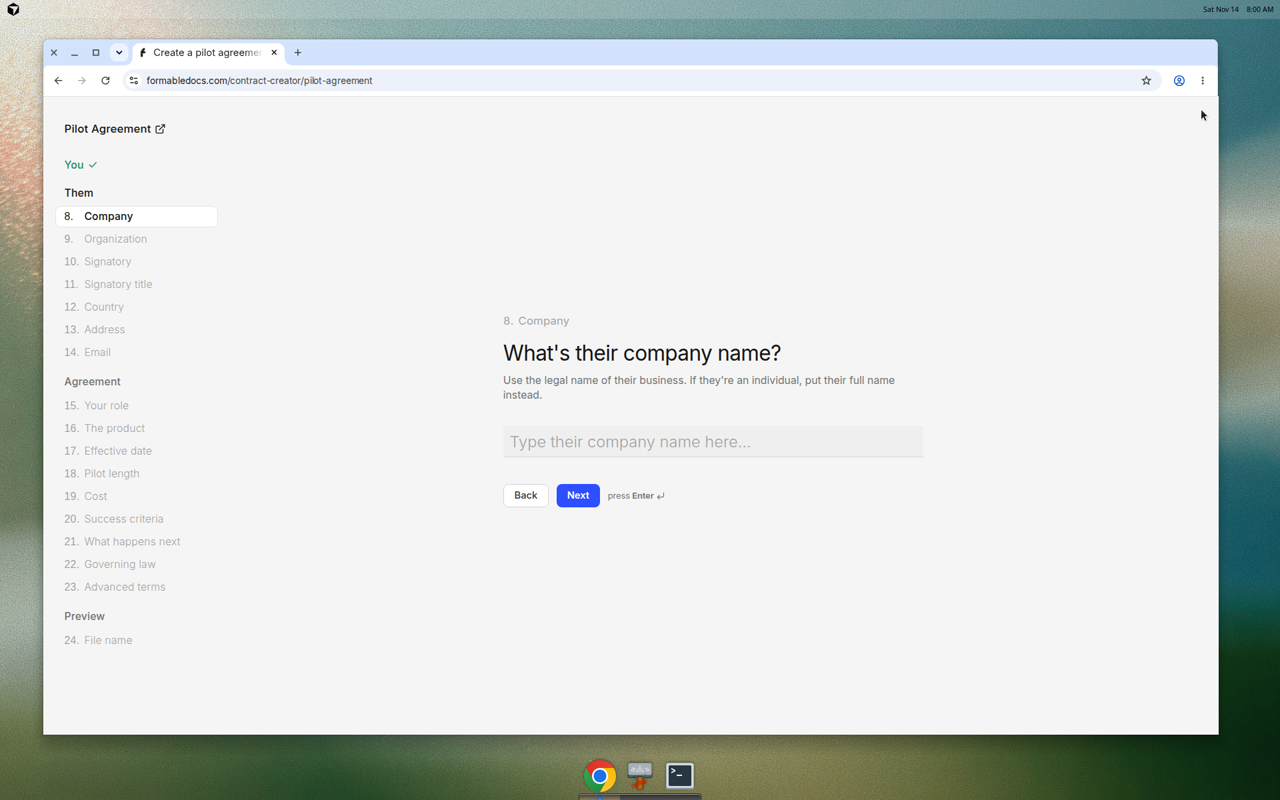
Product description: Focus on the technical capability being tested: "Vendor's API integration platform" or "Vendor's machine learning model for demand forecasting."
Evaluation purpose: Add explicit sandbox-only language. In the creator's evaluation purpose field, write: "Test technical feasibility in a sandbox environment. Customer agrees not to use the Product with live production data or in production systems during the POC Period."
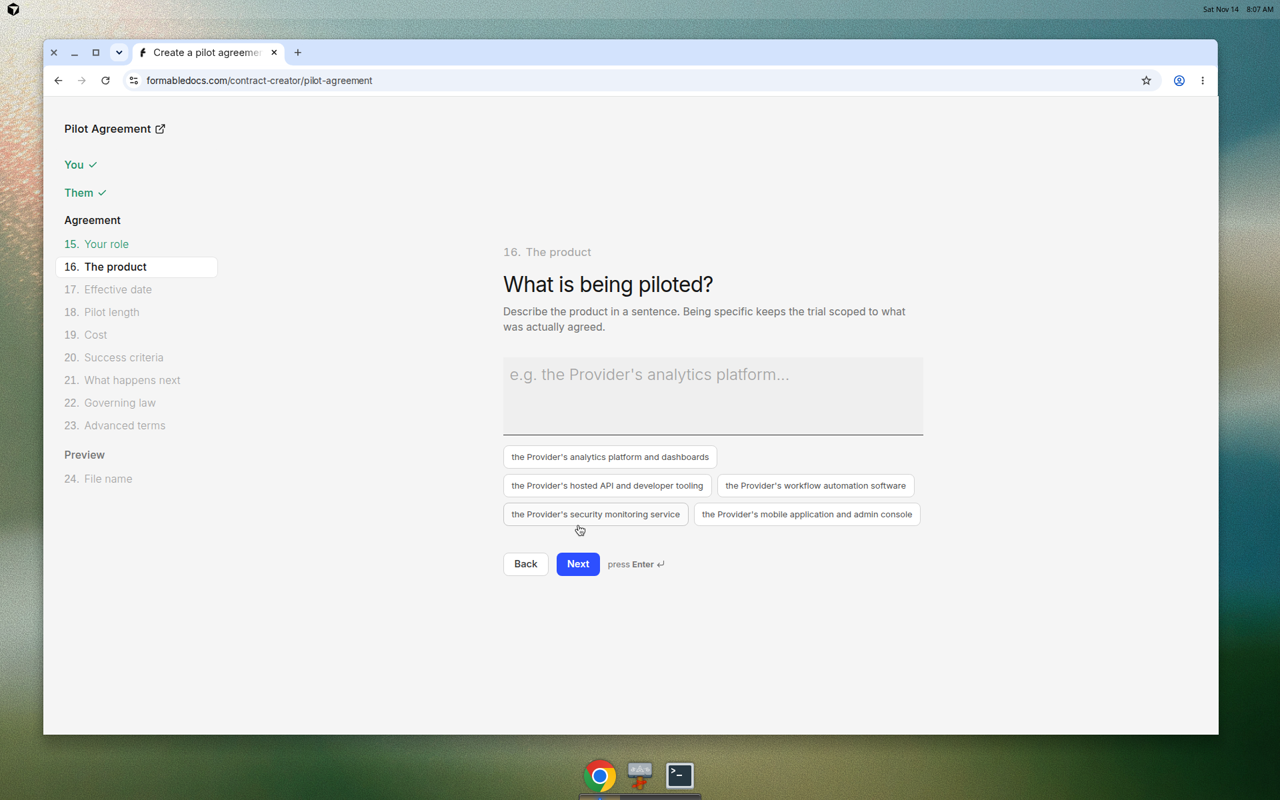
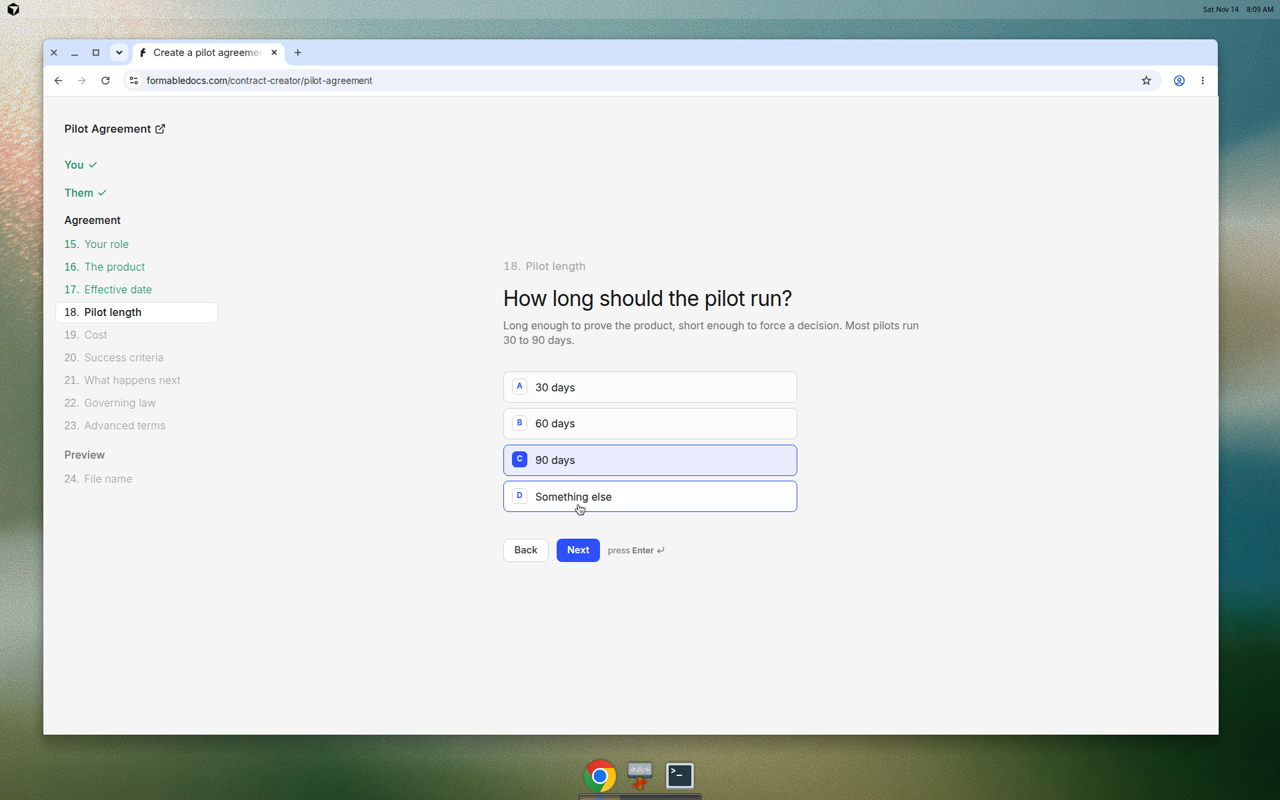
POC period: Set the timeline to 30, 45, or 60 days depending on the complexity of the technical test. Most POC periods are 30 to 45 days.
Fees: Many POCs are free. If the POC is paid, set a lower fee than you would charge for a pilot. A $1,000 to $2,500 POC fee is common for technical tests that require significant vendor engineering time.
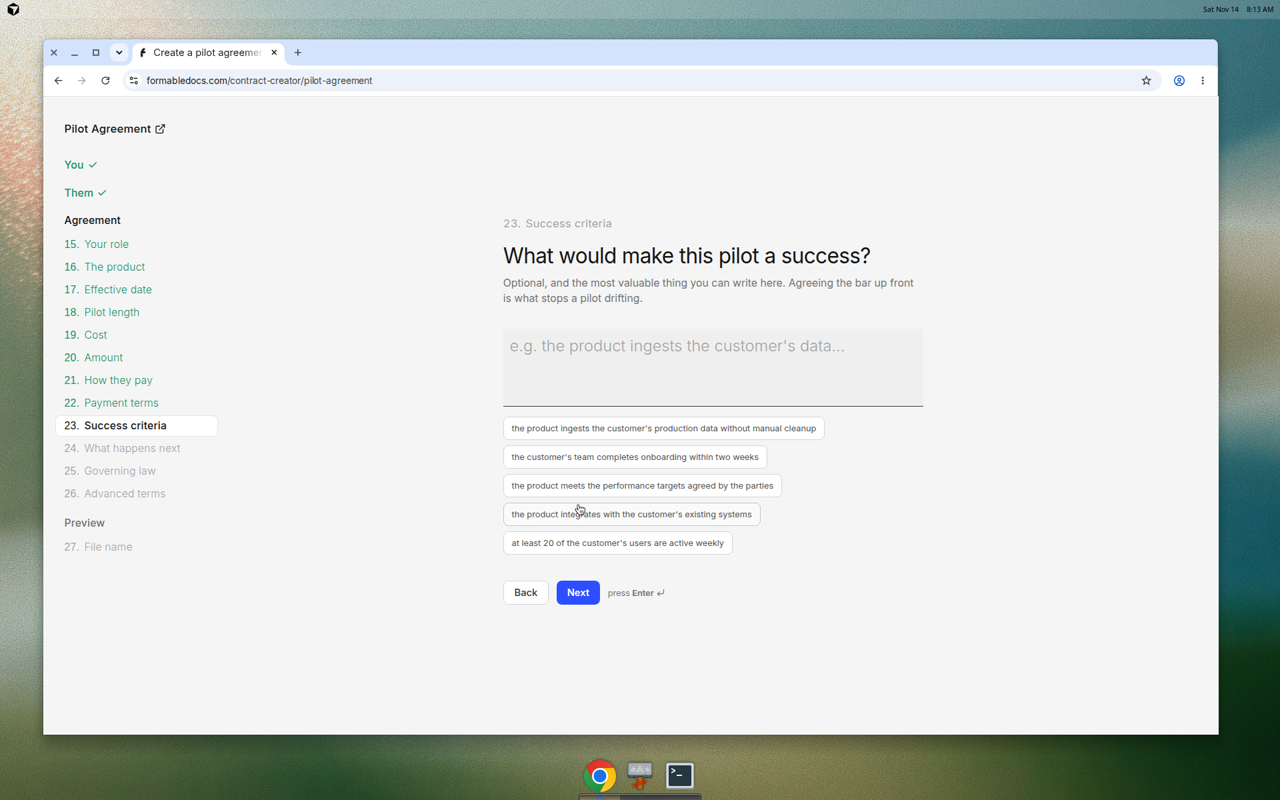
Success criteria: Write technical success criteria as described above. Focus on integration success, accuracy, latency, or uptime. Avoid business metrics.
Data deletion: Set a short data deletion window. For a POC using only test data, 7 to 14 days is sufficient. For a POC using live data, 30 days matches the standard for pilots.
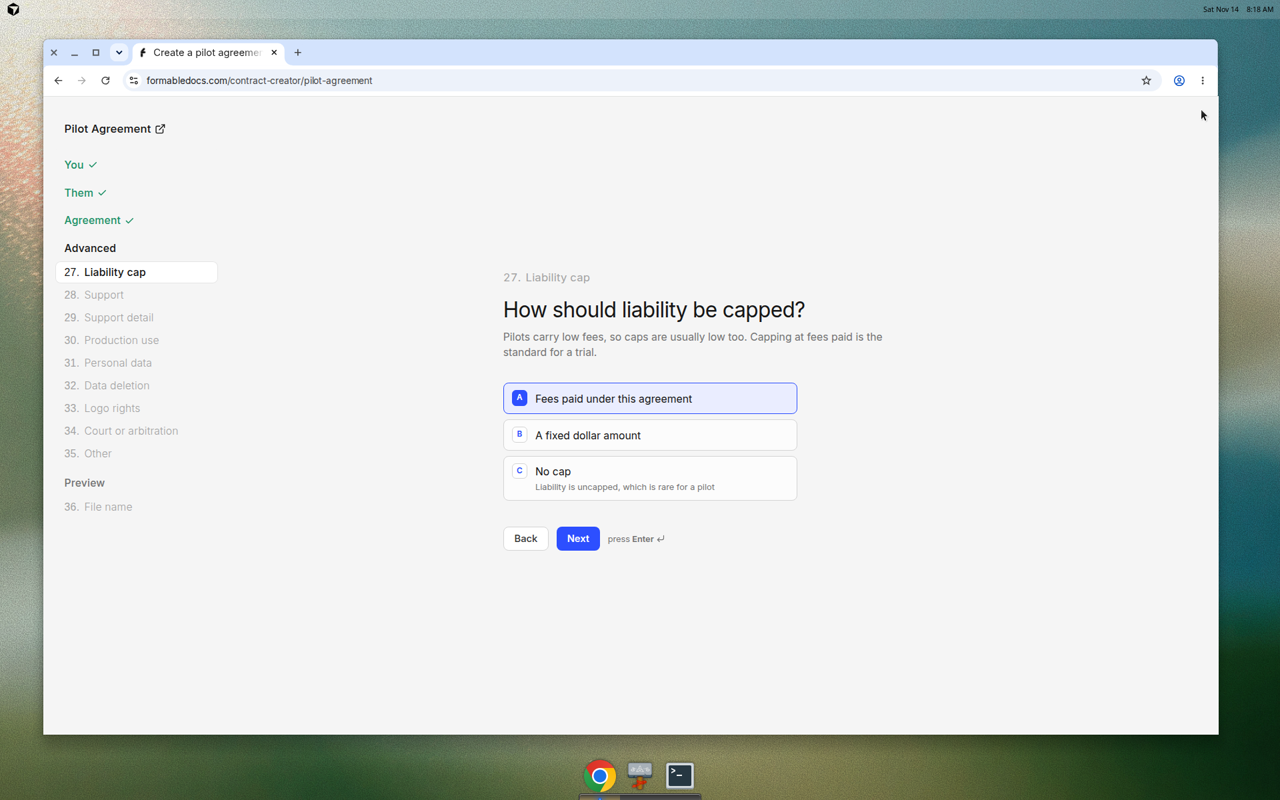
Liability: POC liability caps are typically lower than pilot caps because the exposure is limited to a sandbox test. A $5,000 to $10,000 cap is common for a free POC.
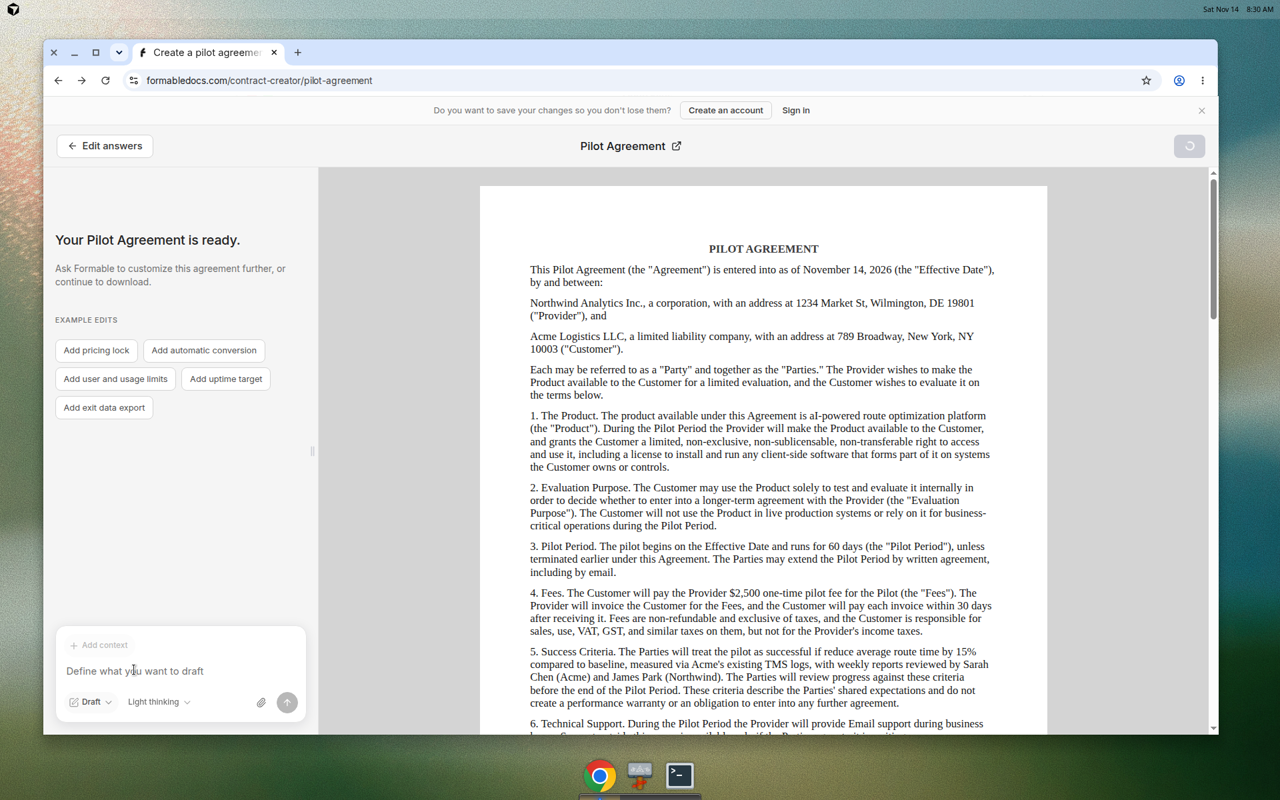
Once you complete the questionnaire, preview the agreement. The template generates a complete POC contract with all clauses adjusted to fit the technical test scope.
From POC to pilot to contract
The POC agreement should state what happens if the POC succeeds. Successful POCs typically move to a pilot, and successful pilots move to a full commercial agreement. Build that progression into the POC agreement to avoid restarting negotiation at each stage.
Include a clause like this:
If the POC meets the Success Criteria, Vendor will offer Customer a pilot agreement to test operational value in limited production use. The pilot agreement will include pre-agreed pricing terms as set forth in Exhibit A.
That clause gives the customer a clear path forward if the POC proves feasibility and gives the vendor a commitment that a successful POC leads to a paid pilot, not another round of free testing.
If the POC fails to prove feasibility, neither side is obligated to continue. The POC agreement terminates, and both sides walk away cleanly.
The progression looks like this:
- POC (2-8 weeks): Test technical feasibility in a sandbox with test data. Answer the question: "Can this work?"
- Pilot (30-90 days): Test operational value in limited production use with real workflows and real data. Answer the question: "Does this deliver business value?"
- Full commercial agreement (1-3 years): Deploy the product at scale under a subscription agreement, MSA, or enterprise license.
Each stage should reference the next stage in its contract, so a successful POC moves to a pilot with pre-agreed terms, and a successful pilot moves to a full agreement with pre-agreed pricing.
For guidance on full commercial agreements after a successful pilot, see the MSA template.
Use a free pilot agreement template to generate a POC agreement in minutes. Adjust the scope, timeline, and criteria to fit a technical test, then send it for e-signature.
For the full pilot drafting process, see how to write a pilot agreement.
FAQ
What is the difference between a POC and a pilot?
A POC tests technical feasibility in a sandbox over 2-8 weeks. A pilot tests operational value in limited production use over 30-90 days. POCs answer "Can this work?" Pilots answer "Does this deliver business value?"
Do I need a separate agreement for a POC and a pilot?
Yes. A POC agreement and a pilot agreement have different scope, timeline, and success criteria. Using one contract for both stages creates mismatched obligations. Draft them separately and reference the progression in each agreement.
Can a POC use live production data?
Only if the technical test requires it and both sides agree to a data processing agreement that covers GDPR and CCPA requirements. Most POCs use test data or anonymized samples to avoid the compliance overhead.
How much should a POC cost?
Many POCs are free. If the vendor incurs significant engineering effort to customize or integrate during the POC, a $1,000 to $5,000 fee is reasonable. Paid POCs signal seriousness and filter out customers who are not ready to buy.
What happens if the POC proves the product does not work?
Both sides walk away. The POC agreement should state explicitly that neither party is obligated to move forward if the POC fails to meet the success criteria. That protects the customer from being locked into a product that does not fit and protects the vendor from liability for a failed technical test.