Kill fees are how creatives stay protected when a client cancels mid-project. A kill fee is a pre-agreed payment the client owes after work has started. It only exists if the contract says so, and it only holds up if the clause is specific, proportionate and signed before the first draft. Founders, account executives, general counsel and talent teams who hire or manage creatives can settle the question in one document, before the work begins.
This guide covers what a kill fee is, what percentages are common, which terms the clause needs, how U.S. courts view the amount, and how to get the clause negotiated and signed without losing a week to email threads. Pair it with a clear freelance graphic design contract or web design contract so the cancellation terms are not left to a handshake.
TL;DR
- A kill fee compensates a creative for work done and income turned down when a client cancels. If the contract does not mention it, there is no guarantee one will be paid.
- Fees are commonly negotiated between 20% and 100% of the agreed fee, scaled to how far the project has progressed.
- A fee tied to work done and capped at the project fee is the safest to enforce. An oversized fee can be struck down as a penalty.
- The clause must define the trigger, the amount, the due date, expenses and who owns the work after cancellation.
- Draft, negotiate and sign the clause in one workflow so the terms are on the record before work begins.
What a kill fee is and when it applies
The Graphic Artists Guild's contract glossary describes a kill fee as money the client pays the artist when the client does not use the artwork. It covers two situations. A cancellation fee applies when the work met the requirements but the client decides not to use it, for example because the article it illustrated was dropped. A rejection fee applies when the work failed to meet the stated requirements.
The logic is simple. When a client cancels, the creative has already spent hours, held space on the calendar and often declined other jobs. A kill fee is not a penalty or a negotiating tactic. It is an estimate, agreed in advance, of what that cancellation costs.
For a founder or account executive commissioning a brand film, a logo, a website or a campaign, the clause is also protection. It sets a known cost for changing course, so a cancellation is a budget line and not a dispute.
What a kill fee is not
A kill fee differs from three other payments that often get mixed up with it:
- Payment for completed work. Work delivered and accepted is invoiced at its agreed price. A kill fee covers work that will not be used.
- Expenses. Stock licenses, travel, contractors and software are reimbursed separately unless the clause says the fee includes them. State which.
- A deposit. A deposit is paid up front against the project. A kill fee is owed on cancellation, and a deposit already paid is usually credited against it. Say so in the clause.
The clause should also say that the fee is in addition to payment for work finished and approved before the cancellation date. Without that sentence, the two get netted against each other and the creative is shorted.
How much a kill fee should be
There is no statutory number. The market sets it. The Graphic Artists Guild notes that fees are commonly negotiated from 20% to 100% of the agreed fee, depending on how far along the project was. The Guild's Code of Fair Practice says a kill fee should reflect time allotted, effort expended and expenses incurred, and that other work lost because of the commitment should be considered too.
In practice, the fee scales up in stages. One widely cited structure from Due is 25% if the project is cancelled before it starts, 50% after work begins, and 75% to 100% after substantial completion. On a $10,000 project, a 50% fee means $5,000.
A tiered structure from the UGC creator world shows the same principle with finer steps. Flare's sample clause sets 30% before the brief is delivered, 50% before filming, 75% once filming starts and 100% after final deliverables, payable within 14 days of written notice. The more work done, the more is owed.

A worked example
Say a startup hires a motion designer for a $12,000 product launch video. The contract includes this schedule:
| Stage when the client cancels | Fee owed | Amount |
|---|---|---|
| Before kickoff | 25% | $3,000 |
| After storyboard approved, before animation | 50% | $6,000 |
| During animation or first cut | 75% | $9,000 |
| After final delivery | 100% | $12,000 |
The client cancels after the storyboard is approved. The designer is owed $6,000 plus any pre-approved expenses already incurred, and invoices it within the window the contract sets. No one has to debate hours logged, because the schedule already answered the question.
Pick the number by role
The right percentage depends on how much income the cancellation puts at risk:
- Short, fast projects (a logo, a single illustration): higher early tiers, because the whole project fits in a few weeks and the slot is hard to refill.
- Long retainers and multi-phase campaigns: a fee based on a share of the remaining unpaid fees, or a set number of months, plus payment for all work done.
- Production work with third-party costs: a fee plus pass-through of non-recoverable costs such as crew or venue bookings.
Publishing contracts illustrate how much custom varies. Express Editeur's survey of publishing practice reports that magazine contracts have historically skewed toward 25%, while book-industry freelance agreements more often carry 50%. Treat any number you read online as a starting point and set yours against the effort at stake.
What the clause has to say
A vague clause is the most common reason a kill fee fails. "Client will pay a fair cancellation fee" invites a fight. A clause that works answers six questions.
- What triggers it? Cancellation is obvious, but creatives get hurt by quieter events too. Flare's guidance lists scope reduced after agreement, a brief changed beyond recognition and timeline delays past a set window as kill events. Any action by the client that nullifies the original agreement without the creative's consent should count. If you only list "cancellation," a client can shrink the job to nothing without owing a cent.
- How much is owed, and at which stage? Use a percentage schedule or fixed dollar amounts, tied to milestones both sides can verify.
- When is it due? Name a number of days from written notice. Fourteen to 30 days is common in the templates and model language reviewed here.
- How are expenses handled? Say whether expenses are reimbursed separately or included in the fee.
- What happens to the work? Rights are where creatives are most exposed. The Guild's glossary warns that on cancellation the client may still obtain the agreed usage rights once it pays the fee, unless the contract says rights revert to the artist. Write the outcome you intend: either all rights revert to the creator and preliminary materials are returned, or the client receives a defined license in exchange for the fee.
- How does notice work? Require written notice, and say which date fixes the stage of completion. A cancellation "in principle" over a call should not leave the stage open to argument.
Termination for cause versus for convenience
A kill fee is normally triggered when the client ends the deal for convenience, meaning without the creative having breached anything. If the client claims the creative breached the contract, the clause should require written notice and a cure period, commonly 15 to 30 days, before termination for cause takes effect. Otherwise a client can label a cancellation as "for cause" to avoid the fee. Spell this out so the label cannot be used as an exit.
The AIGA Standard Form of Agreement for Design Services handles it by letting either party terminate for convenience, paying the designer for work through the termination date, and adding an early termination fee of 25% of the total project fee when the client terminates for convenience. It is a useful reference point for how an industry body structures the two payments.
Will a U.S. court enforce the fee?
A kill fee is a form of liquidated damages: a sum fixed in advance as compensation for a breach or early exit. Under the Restatement (Second) of Contracts, section 356, the amount must be reasonable in light of the anticipated or actual loss and the difficulty of proving that loss. An amount that is unreasonably large is unenforceable as a penalty, as Freelance Atlas explains.
Enforcement is not perfectly predictable. A 2021 Southern California Law Review study finds that liquidated damages clauses are standard in commercial agreements but enforced unevenly across jurisdictions, and that courts find the line between compensation and penalty hard to draw.
That is why drafting matters more than the percentage. A defensible clause:
- anchors the fee to work performed or opportunity lost, and says so in the text;
- scales down for earlier cancellations and up as work advances;
- is capped at the total project fee, since a charge that can exceed the whole contract is hard to call compensation.
General counsel reviewing a vendor's kill fee should apply the same test from the other side: is the fee proportionate to a stage the client can verify? A reasonable schedule is easier to approve quickly and easier to defend later.
California and other state freelancer laws
Many founders in San Francisco hire freelancers directly, so state law belongs in the checklist. California's Freelance Worker Protection Act took effect on January 1, 2025, and requires a written contract when freelance services are valued at $250 or more, alone or combined with contracts between the same parties in the preceding 120 days. The contract must include:
- each party's name and mailing address;
- an itemized list of services and their value;
- the rate and method of compensation;
- the payment due date or a way to determine it;
- the date by which the freelancer submits a list of services rendered.
The hiring party must give the freelancer a signed copy and keep the contract for at least four years. Payment is due by the contract date, or within 30 days of completion if none is set. Waivers of the Act are void. A prevailing worker can recover attorney's fees and costs, and damages that include up to twice the unpaid amount for late payment, plus $1,000 if the worker asked for a written contract before starting and the hiring party refused.
The Act does not mandate a kill fee. It does make your payment terms, including any cancellation payment, matter in a way they did not before. Other states have comparable laws. New York's Freelance Isn't Free Act applies to $800 and above, and Illinois's law covers $500 and above, per Redline's state comparison. If your team contracts with creatives in several states, check the threshold and the retention rule for each. For a dispute or a specific fact pattern, talk to an employment or contracts attorney in the relevant state.

Why a kill fee usually fails in practice
Most kill fee disputes are not about the law. They come from process gaps:
- The clause was never in the contract, or lived in an email that nobody countersigned.
- The creative signed a client template that said nothing about cancellation.
- The scope changed three times through chat and the signed version no longer matched the work.
- The trigger was too narrow, so a quiet scope cut did not count as a kill event.
- No one could tell which version of the contract was final, or when each party agreed to it.
Every one of these is a document-control problem. It is solved by a clear template, a visible negotiation and a signed record, not by a larger percentage.
Getting the clause drafted, negotiated and signed
The fastest way to protect everyone is to bring the kill fee into the contract at the start, in the same workflow as the rest of the deal. Here is how that routine looks and where each step tends to go wrong.
- Start from the right agreement. An independent contractor agreement, a design services agreement or a consulting agreement each carry termination language. Formable's independent contractor agreement creator combines templates with generative AI to build the contract, and our design services agreement guide and consulting agreement guide show clause language for those engagements. For logo work, see our freelance graphic design contract guide, and for site projects our freelance web design contract guide.
- Check for what is missing. The most expensive gap is the one nobody noticed: no cancellation clause at all, or no rights-reversion language. Our guide on missing clauses in contracts walks through how to find and fix them. Formable's AI contract review detects risks and missing clauses automatically, and lets you upload a playbook so every agreement is checked against your own standards.
- Negotiate in one place. Kill fee percentages and triggers are the terms both sides want to adjust. Formable's redlining tool lets both parties align on terms before signing, so the discussion happens on the document and not across scattered emails.
- Tie the fee to milestones. The stage tiers only work if the stages are defined. Our guide on enforcing milestones in freelance developer contracts shows how to write milestones that can be verified, and the same approach applies to design and video work.
- Sign and keep the record. Formable provides e-signing with audit trails, so the executed version and the signing history are stored together. That matters in states that require you to retain the signed contract for years.
If you hire developers, the agreement for hiring a freelance developer covers termination terms for software work.
What a good kill fee clause looks like
The wording below is a model to adapt, not legal advice. Have your counsel review it for your state and the type of work.
If Client terminates this Agreement or cancels the Project for convenience, Client will pay Contractor (a) all fees for Services completed and approved through the date of written notice, (b) pre-approved expenses incurred through that date, and (c) a cancellation fee equal to the percentage of the Total Project Fee shown in the Schedule for the stage the Project had reached on that date. The cancellation fee is due within 30 days of written notice and will not exceed the Total Project Fee. Any deposit paid is credited against the cancellation fee. Upon payment, all rights in unused work revert to Contractor, and Contractor returns or destroys Client's confidential materials. Material reduction of scope, or changes to the brief that make the original deliverables unusable, without Contractor's written consent, are treated as cancellation for convenience.
Notice what it does. It separates payment for finished work, expenses and the fee. It caps the fee, which supports enforceability. It states what happens to rights. It treats a gutted scope as a cancellation. And it points to a schedule, so the percentages sit in one table that is easy to change during negotiation.
How to ask for a kill fee without losing the deal
The clause is easiest to win when it is presented as routine. Lead with the reason: the creative reserves time and turns away other work, and the fee covers that. Offer a scaled schedule rather than a flat number, because clients can see that they pay less if they decide early. Do not apologize for it. Make it part of the first draft, not a late addition after the client has approved everything else.
If the client pushes back, trade on the shape and not the principle. Lower the early tiers, move the due date, or exclude expenses from the fee. Keep the trigger language and the rights-reversion sentence, because those do the most work when things go wrong.
A kill fee also does double duty. It pays for unrecoverable time, and by making cancellation carry a cost it prompts clients to think before they cancel, as Redline's contract analysis points out.
Contract management for teams that commission creative work
One freelancer and one client can manage a clause by hand. A growing company cannot. If your team signs dozens of creative agreements a quarter, a missing cancellation clause becomes a recurring cost.
Formable is an AI-enabled contract management platform built for startups and go-to-market teams. It brings contract creation, AI review, negotiation, redlining and e-signing into a single workflow, so the kill fee you agreed to in a draft is the one that gets signed. The Pro plan is listed at $19.99 per month on our pricing page. You can see how the pieces fit on our AI contract review page and our e-signing page.
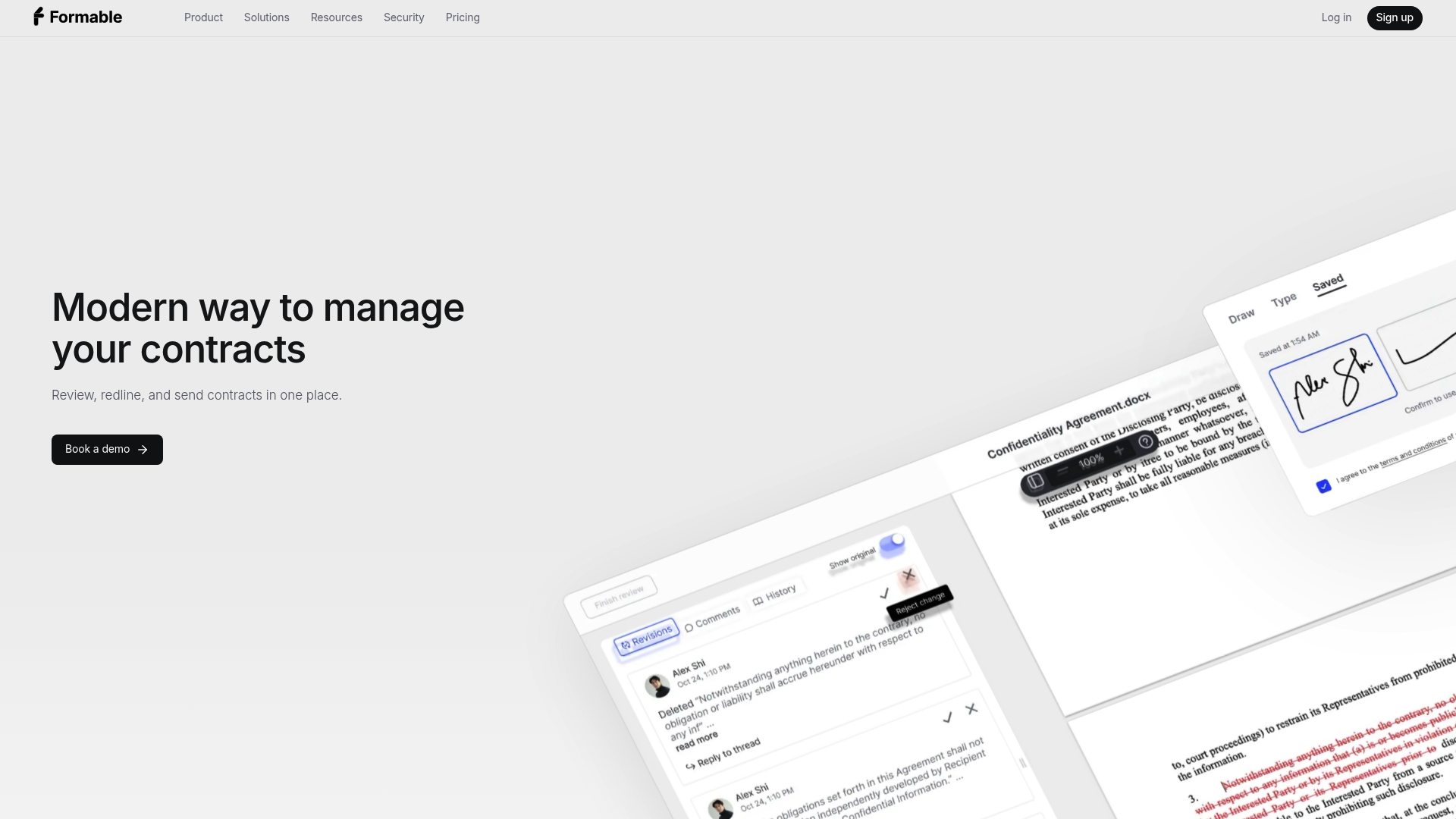
If you want to see the workflow applied to your own creative agreements, start from Formable's contract creator.
Our view on kill fees
Every cancelled creative project we hear about has the same shape. The work was real, the relationship was friendly, and the contract was silent on what happens when the plan changes. Nobody was acting in bad faith. The terms simply were not there.
We think a kill fee belongs in the first draft of any creative agreement, next to scope and payment terms. It is not adversarial. It tells both sides what a change of direction costs, and it lets a client cancel cleanly without a dispute.
The difficulty is rarely knowing that the clause is needed. It is getting the right wording into the document, spotting that it is missing when a counterparty's template arrives, negotiating the percentages without losing track of versions, and keeping the signed copy somewhere you can find it later. That is why we built Formable as one workflow: draft from a template, run AI review against your playbook, redline with the other side, sign, and keep the audit trail.
If you manage creative contracts at volume, make cancellation terms a standard line in your playbook, and let the software check every agreement against it.
Alex
FAQ
How much should I charge for a kill fee?
Base it on the stage of the project and the work you turned down. Fees are commonly negotiated between 20% and 100% of the agreed fee, with early cancellations at the low end and near-complete work at or near the full fee. A tiered schedule such as 25%, 50%, 75% and 100% is easy to explain and easy to verify.
Do I legally have to pay a cancellation fee?
Only if the contract provides for one. If the agreement does not mention a kill fee, there is no guarantee that one will be paid. If it does, the amount must be a reasonable estimate of loss, not a penalty. For a specific dispute, speak with a contracts attorney in your state.
Can a client refuse to pay a cancellation fee?
A client can dispute it, usually by arguing the amount is excessive, the trigger did not occur or the termination was for cause. A clear trigger, a capped and scaled amount, written notice and a signed contract make those arguments harder. Where California's Freelance Worker Protection Act applies, a prevailing freelancer can also recover attorney's fees and costs.
What does "kill fee" mean?
It is a pre-agreed payment owed to a creative when a client cancels a commissioned project or decides not to use the finished work. It compensates for time spent, schedule space reserved and other work declined. It is also called a cancellation fee.
Does the kill fee replace payment for work already done?
Not unless the contract says so. The cleanest approach is to list three separate items: payment for approved work, reimbursement of pre-approved expenses and the kill fee. Credit any deposit against the total owed.
Sources
- Contract Glossary, Graphic Artists Guild
- The Code of Fair Practice for the Graphic Communications Industry, Graphic Artists Guild
- Kill Fee, Due
- Kill fee for UGC creators, Flare
- How Kill Fees Work in Publishing Contracts, Express Editeur
- Kill Fee Clause: How to Write One Clients Will Sign, Freelance Atlas
- An Empirical Study of the Enforcement of Liquidated Damages, Southern California Law Review
- California Business and Professions Code, Freelance Worker Protection Act
- Freelance Contract Red Flags, Redline