
Contract obligation tracking is the process of capturing every enforceable duty in a signed agreement, assigning ownership, and monitoring fulfillment through to verified completion. The most reliable approach combines a centralized contract repository with AI-assisted extraction, normalized obligation records, clear ownership assignments, and automated alerts. Done right, it prevents missed deadlines, avoids penalties, and produces an auditable evidence trail that holds up during regulatory reviews or disputes.
Start with these five elements before anything else:
- Centralized repository: one searchable location for every executed contract
- AI extraction: automated identification of obligations from clause language
- Normalization: standardized fields (due date, owner, party, clause type, consequence)
- Ownership assignment: a named individual responsible for each obligation
- Automated alerts: layered reminders tied to due dates and renewal windows
Key takeaways
Reliable contract obligation tracking requires a centralized repository, AI-assisted extraction with human review, named ownership for every obligation, and layered automated alerts tied to due dates and renewal windows.
| Point | Details |
|---|---|
| Centralize first | A searchable repository with version control and audit logs is the prerequisite for every other step. |
| AI extraction needs a threshold | Set confidence at around 80%; route lower-confidence items to a human-review queue to maintain accuracy. |
| Every obligation needs a named owner | Assign a primary and backup owner before an obligation record is considered complete. |
| Layer your alerts | A 90/60/30/15/7-day alert sequence gives teams time to act, escalate, and document before a deadline passes. |
| Formable for fast pilots | Formable's AI review engine, audit trail, and APIs support a full obligation register deployment within 30 days. |
What contract obligation tracking means in practice
An obligation is a duty enforceable by law that requires a party to perform or refrain from performing a specific action. In contract management, that definition sets the scope: if a clause creates a legal duty or triggers a legal remedy when breached, it belongs in your obligation register.
Obligations split into two categories. Time-bound obligations have a fixed or calculable deadline: a payment due 30 days after invoice, a deliverable due at project milestone 3, a renewal notice required 60 days before contract expiration. Ongoing obligations have no single due date but require recurring evidence of fulfillment: maintaining a minimum insurance level, submitting quarterly compliance reports, or preserving data in accordance with a data processing agreement.
Common examples across both categories include payment terms, delivery milestones, service level agreements, regulatory reporting requirements, auto-renewal notice windows, confidentiality duties, and compliance certifications. What does NOT count as an obligation for tracking purposes: recitals, definitions, and boilerplate governing-law clauses that create no actionable duty.
Which contract obligations every team should track and how to prioritize them
Prioritize in this order when rolling out tracking across a portfolio:
- Payment milestones. Fields to normalize: invoice trigger date, payment due date, amount, payee, late-fee formula, evidence (remittance confirmation).
- Renewal notice windows. Fields: contract end date, notice-required period, notice method, responsible party, auto-renew consequence if notice is missed.
- SLAs and performance metrics. Fields: metric name, target threshold, measurement period, reporting party, penalty formula, evidence (performance report).
- Delivery milestones. Fields: milestone name, due date, deliverable description, accepting party, acceptance criteria, evidence (sign-off document).
- Compliance and certification requirements. Fields: regulation or standard name, certification due date, renewal frequency, responsible party, evidence (certificate copy). Note that contracts handling protected health information carry HIPAA-specific obligations that require stricter access controls and documented evidence of fulfillment.
Add these in a second phase once the priority items are stable:
- Audit rights. Trigger: counterparty request or annual schedule; evidence: audit completion letter.
- Indemnities with reporting triggers. Track the trigger event and the reporting deadline separately.
- Insurance obligations. Minimum coverage levels, certificate-of-insurance due dates, and named-insured requirements.
- Data protection duties. Breach notification windows, sub-processor approval requirements, and data deletion timelines.
Sales contracts also warrant a check for implied warranties of merchantability, which create obligations beyond the express contract terms and are frequently overlooked during initial extraction.
Why a centralized repository is the foundation for reliable tracking
A central repository is the single source of truth for obligations. Without it, obligation records fragment across email threads, shared drives, and individual spreadsheets, making it impossible to enforce ownership or produce a clean audit trail.
A repository built for obligation tracking must offer:
- Full-text search with OCR so obligations buried in scanned PDFs are discoverable
- Version control that preserves every amendment and redline alongside the executed original
- Structured metadata fields for obligation-level attributes (due date, owner, status, clause reference)
- Role-based access controls so sensitive contracts (PHI, financial terms) are visible only to authorized users
- API endpoints for syncing obligation data to ERP, CRM, and calendar systems
- Immutable audit logs that timestamp every view, edit, and status change
The business risks avoided by centralization are concrete: missed auto-renewals that lock teams into unwanted contracts, duplicate ownership assignments that leave obligations unclaimed, and lost evidence that creates liability during audits or litigation.
How AI and NLP discover obligations hidden in contract language
AI speeds obligation discovery significantly, but it requires human validation before records go live. The extraction process follows a predictable sequence: the system ingests the contract file, runs OCR if the document is a scanned image, classifies clauses by obligation type, resolves cross-references between sections, calculates deadline dates from relative triggers ("30 days after acceptance"), and normalizes the output into structured fields.
The limitations are real and worth setting expectations around. Ambiguous language ("reasonable efforts" obligations), conditional triggers ("if the counterparty exercises its option"), and relative-date math that depends on external events all produce lower-confidence extractions. A clause that says "within a commercially reasonable time" cannot be auto-dated without human judgment.
Enterprise platforms describe this staged workflow as discover, classify, track, automate, and monitor, with human review built into the classify step for low-confidence items.
Obligations extracted above that threshold move directly into the register for owner review. Anything below routes to a human-review queue with the raw clause text attached. A lightweight weekly review session of 30 minutes clears most queues and prevents backlog.
How to set alerts, reminders, and renewal logic that actually prevent misses
Layered alerts reduce misses more reliably than a single reminder. A single email 7 days before a deadline is easy to miss; a sequence starting 90 days out gives teams time to act, escalate, and document.
| Alert layer | Days before due date | Recipients | Channel |
|---|---|---|---|
| Early warning | 90 days | Contract owner, legal ops | Email + dashboard flag |
| Standard reminder | 60 days | Contract owner | |
| Action required | 30 days | Contract owner, manager | Email + calendar invite |
| Escalation | 15 days | Manager, legal ops | Email + Slack/Teams |
| Final notice | 7 days | Legal counsel, executive sponsor | Email + dashboard alert |
Renewal logic requires three distinct configurations. Fixed-date renewals trigger on a calendar date and need only a single anchor field. Auto-renew contracts need a notice-window calculation: contract end date minus the required notice period equals the alert trigger date. Relative triggers ("30 days after the counterparty delivers acceptance") require a secondary date field that gets populated when the triggering event is logged.
Calendar integration is not optional for this to work operationally. Obligation due dates must sync to the owner's calendar so reminders appear in the same system they use for every other deadline. Every alert sent should be logged as an immutable audit event with a timestamp, recipient list, and delivery confirmation.
How to assign an owner to every obligation and create escalation paths
Every obligation must be owned by a named individual and measurable against a defined status. Unowned obligations are the single most common cause of missed deadlines in obligation registers.
A practical status taxonomy:
- Assigned: obligation record created, owner notified, no action taken yet
- In progress: owner has begun fulfillment activity
- At risk: due date is within the alert window and fulfillment is incomplete
- Overdue: due date has passed without verified fulfillment
- Fulfilled: owner has completed the obligation and uploaded evidence
- Verified: a second reviewer (legal ops or manager) has confirmed the evidence
Escalation path with timing:
- Day 0 (assignment): owner receives obligation record with due date, evidence requirements, and SLA
- Day of "at risk" trigger: owner's manager receives an escalation notification
- Day of "overdue" status: legal ops receives an alert and opens a remediation ticket
- 48 hours overdue: legal counsel is notified and the record is flagged for executive review
Capture these fields for every owner record: owner ID, backup owner (for PTO coverage), SLA in days, evidence upload link, and last-update timestamp. A backup owner field prevents obligations from going dark when the primary owner is unavailable.
How to monitor SLA and performance obligations using dashboards and KPIs
A small set of KPIs gives the clearest operational signal across a contract portfolio. More metrics add noise without adding visibility.
- % of obligations fulfilled on time. The primary health metric. Track it by contract type, business unit, and owner.
- Overdue obligations by owner. Surfaces accountability gaps immediately and guides manager conversations.
- Renewal windows expiring by month. A rolling 90-day view prevents renewal surprises and supports budget planning.
- Obligation density per contract type. Identifies which agreement types (MSAs, SOWs, DPAs) carry the highest obligation load and need more review resources.
- Time-to-fulfillment. Average days from obligation assignment to verified completion; useful for SLA benchmarking and process improvement.
Different stakeholders need different views. Legal ops needs the full obligation register with status, owner, and evidence links. Finance needs a view filtered to payment milestones and SLA penalty exposure. Executives need a summary: total obligations, % on track, overdue count, and financial exposure from at-risk items.
Mapping obligation status to financial exposure is where dashboards become genuinely useful to leadership. An overdue SLA obligation with a $50,000 monthly penalty clause is not the same risk as a missed quarterly report with no financial consequence. Weight the dashboard accordingly.
Why spreadsheets and email-based tracking break at scale
Spreadsheets work for small, low-risk portfolios. They break when obligations scale across teams, contract types, or regulatory requirements. The failure mode is predictable: a shared spreadsheet has no audit log, no automated alerts, no role-based access, and no integration with the systems where work actually happens.
The specific gaps:
- Single source of truth: spreadsheets fork into multiple versions; there is no authoritative record
- Auditability: no immutable log of who changed what and when; unusable during regulatory inquiries
- Automation: reminders require manual calendar entries; no conditional logic for relative triggers
- Integrations: no native connection to ERP, CRM, or calendar systems
- Security: row-level access controls are not available in standard spreadsheet tools; sensitive terms are visible to everyone with file access
Migrate to a dedicated system when any of these conditions are true:
- Your active contract portfolio exceeds 50 agreements with tracked obligations
- You have experienced at least one missed renewal or deadline in the past 12 months
- An audit or regulatory review has required you to reconstruct obligation evidence manually
- You manage contracts subject to HIPAA, SOC 2, or other compliance frameworks that require documented controls
A step-by-step workflow playbook for obligation tracking
Follow these numbered steps to move from zero to an operational obligation register.
-
Intake and ingestion. Upload all executed contracts to a central repository. Actors: legal ops, contract administrator. Time: 1 to 2 weeks for an initial portfolio of up to 200 contracts. Output: complete contract inventory with metadata (counterparty, effective date, expiration date, contract type).
-
AI extraction and normalization. Run AI extraction across the ingested contracts. Review low-confidence items in the human-review queue. Normalize all records to standard fields: contract ID, obligation ID, clause excerpt, due date, trigger type, party, owner, consequence, evidence required. Time: 1 week per 100 contracts, with human review.
-
Ownership assignment. Assign a primary owner and backup owner to every obligation record. Send owner notifications with due dates, SLAs, and evidence requirements. Actors: legal ops manager, department heads. Time: 2 to 3 days.
-
Alert configuration. Configure the layered alert schedule (90/60/30/15/7 days) for each obligation. Enable calendar sync. Set escalation paths. Verify that audit logs capture every alert event. Time: 1 day with a configured CLM or contract management platform.
-
Verification and evidence capture. Owners upload fulfillment evidence (payment confirmations, delivery sign-offs, compliance certificates). A second reviewer verifies and closes the obligation. All evidence links are stored in the obligation record. Output: auditable fulfillment trail.
-
Reporting and continuous audit. Run monthly KPI reports against the five metrics above. Conduct a quarterly obligation audit: review all active obligations for accuracy, check for amendments that created new duties, and archive fulfilled records. Actors: legal ops, compliance. Output: obligation health report.
For teams that need external help building connectors between their obligation tracking system and existing business tools, an AI automation partner can accelerate the integration phase significantly.
Tool categories, templates, and fields every obligation tracker needs
Pick a tool category that matches your portfolio size and integration requirements. Spreadsheets serve portfolios under 30 contracts with low regulatory exposure. Lightweight trackers (purpose-built obligation apps) fit teams with 30 to 200 contracts who need basic automation and audit trails. Full CLM platforms with AI extraction are appropriate for portfolios above 200 contracts, multi-team environments, or regulated industries.
Evaluate any tool against this checklist:
- Extraction accuracy on your contract types (test with a sample set before committing)
- API and connector availability for your ERP, CRM, and calendar systems
- Calendar sync for obligation due dates and renewal windows
- Immutable audit trail with timestamps and user IDs
- Role-based access controls for sensitive contract categories
- Evidence capture and storage linked to obligation records
- Confidence scoring for AI-extracted obligations
Template fields for every obligation record:
- Contract ID and obligation ID
- Clause excerpt (verbatim text from the agreement)
- Normalized due date and trigger type (fixed, relative, event-based)
- Responsible party (counterparty or own-side)
- Owner and backup owner
- Status (from the taxonomy above)
- Evidence upload link
- Notes field for context or exceptions
- AI confidence score
Formable supports template-driven contract creation, AI extraction, collaborative redlining, e-signing, and APIs for embedding obligation workflows into existing platforms. Its contract creator produces agreements from standardized templates, which improves extraction accuracy because the clause structure is consistent and predictable.
Platforms that integrate with calendar, ERP, and CRM systems keep obligations visible in the systems where teams already work, which is a key factor in adoption. Regulatory mapping tools connect compliance obligations to operational processes using central legal databases and configurable workflows, which is particularly relevant for EHS and other regulated functions.
How Formable implements obligation tracking end to end
Formable supports the full obligation lifecycle: ingest, extract, assign, alert, verify, and audit. The feature set maps directly to the minimum requirements a repository must meet for obligation tracking to function reliably.

| Requirement | Formable capability |
|---|---|
| Full-text search and OCR | AI-powered contract review at intake |
| Version control and amendments | Redlining and negotiation history with audit trail |
| Structured metadata fields | Normalized obligation records with configurable fields |
| Role-based access controls | Team permissions and secure document access |
| API endpoints for integrations | E-sign API and embedding APIs for CLM workflows |
| Immutable audit logs | Timestamped audit events for every action |
| AI obligation extraction | AI review engine with confidence scoring and playbook support |
| Evidence capture | E-signing and document attachment linked to obligation records |
Implementation checklist for a 30-day pilot:
- Select a pilot scope of 20 to 30 contracts representing your highest-obligation-density types (MSAs, SOWs, DPAs)
- Upload contracts to Formable's review engine and run AI extraction
- Set confidence threshold at 80%; route lower-confidence items to a designated reviewer
- Assign owners to all extracted obligations and configure the 90/60/30/15/7-day alert schedule
- Enable calendar sync and verify that audit events are being logged
- At day 30, measure: % of obligations extracted with confidence above 80%, number of human corrections, and any missed-deadline incidents
Pro Tip: Run the pilot on contracts that already have a known obligation history. Compare what the AI extracts against what your team has been tracking manually. Discrepancies reveal both extraction gaps and obligations your team was missing. That comparison is the most honest accuracy benchmark you can produce.
Obligation tracking for third-party engagements, including CUECs, SOW duties, and shared-responsibility controls for audits like SOC 2, benefit from the same structured approach: capture the obligation, assign the owner, and link the evidence. The audit trail Formable produces is immutable and timestamped, which satisfies the documentation requirements for most compliance frameworks.
Data security and compliance when managing sensitive contract information
Contracts frequently contain the most sensitive information a company holds: financial terms, personal data, intellectual property, and regulated health information. The repository and tracking system that holds them must be treated as a high-security environment.
HIPAA obligations apply to any contract that involves protected health information. Business associate agreements (BAAs) create specific tracking duties: breach notification timelines, sub-processor restrictions, and data safeguard requirements all need to be captured as individual obligation records with evidence requirements. Failure to track and fulfill these obligations creates direct regulatory liability.
Minimum security requirements for any obligation tracking system:
- Encryption at rest and in transit for all contract documents and obligation records
- Role-based access controls that restrict sensitive contracts to authorized users only
- Audit logs that record every access, edit, and export event with a user ID and timestamp
- Data residency controls for contracts subject to state or international data protection laws
- Vendor security certifications (SOC 2 Type II is the standard baseline for SaaS platforms handling sensitive business data)
For contracts subject to regulatory frameworks, map each compliance obligation to the specific control it requires. A HIPAA BAA breach-notification clause maps to a 60-day notification window, a responsible party, a notification template, and an evidence requirement (documented notification). That level of specificity is what makes an obligation register useful during a regulatory inquiry rather than just a list of deadlines.
Practical pitfalls that slow obligation tracking rollouts
The most common adoption blockers are not technical. They are process and behavior gaps that no software can fix automatically.
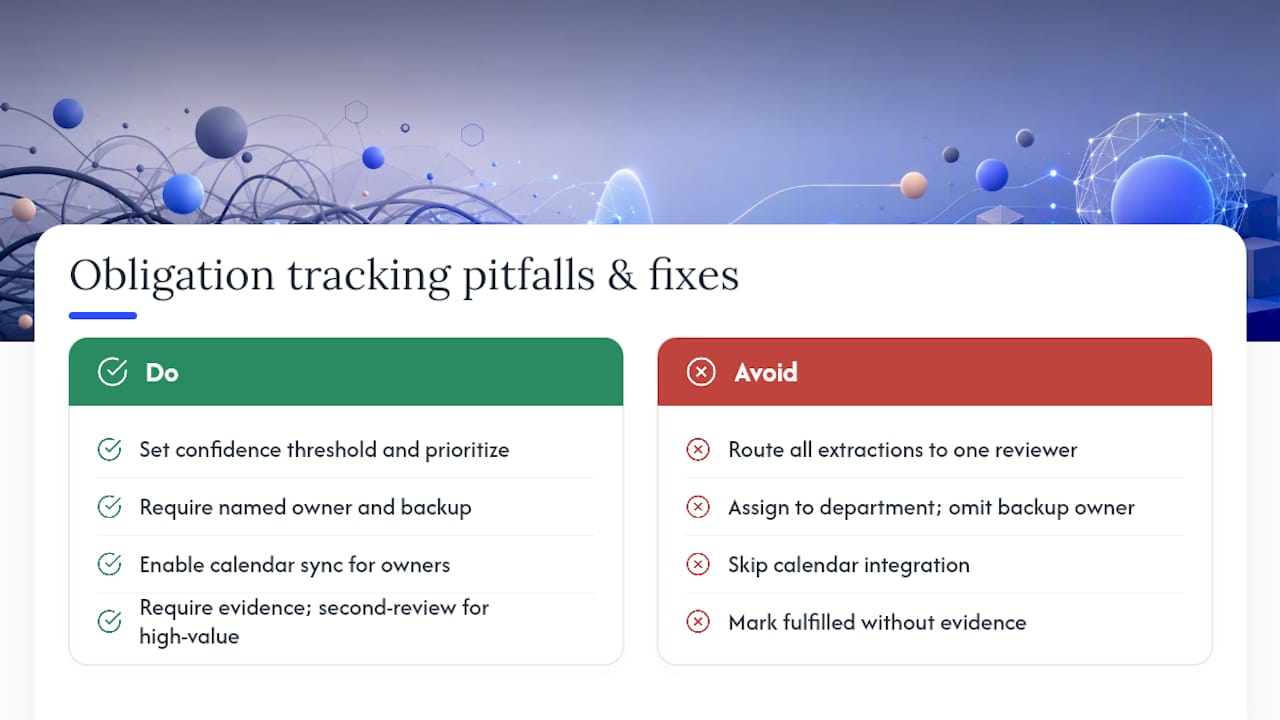
The first pitfall is noisy extractions without a review workflow. When AI extracts 400 obligations from 50 contracts and routes all of them to a single reviewer without prioritization, the queue becomes unmanageable. The fix: set a confidence threshold, prioritize by obligation type (payment and renewal first), and assign review tasks to the right people rather than a single inbox.
Unclear ownership is the second failure mode. Teams often assign obligations to a department rather than a named individual, which means no one is actually accountable. Require a specific person's name and a backup owner before an obligation record is considered complete.
Missing backup owners create gaps during PTO and turnover. An obligation due during a two-week absence with no backup assigned will go overdue. Enforce the backup owner field as a required attribute at the time of assignment.
Skipping calendar integration is a subtler problem. Owners who receive email reminders but do not see obligation due dates in their calendar treat them as lower priority than meetings and project deadlines. Calendar sync closes that gap with minimal effort.
Finally, teams that skip the verification step end up with obligations marked "fulfilled" that have no supporting evidence. When an audit or dispute arises, "fulfilled" without an evidence link is the same as no record at all. Make evidence upload a required step before status can change to fulfilled, and add a second-reviewer verification step for high-value obligations.
For a broader look at the operational and technical blockers that appear during contract management rollouts, the challenges in contract management guide covers the patterns most teams encounter and how to address them before they stall a deployment.
Formable gives your team a faster path to an operational obligation register
Most teams that come to Formable have the same starting point: a mix of spreadsheets, email reminders, and shared drives that worked fine at 30 contracts and broke somewhere around 80. The gap is not effort. It is infrastructure.
Formable's AI review engine extracts obligations at intake, flags risks, and routes low-confidence items for human review, all within the same platform where your team redlines, negotiates, and signs. There is no separate tool to integrate and no manual re-entry of obligation data after a contract closes. The audit trail is immutable and timestamped from the first upload through to verified fulfillment.
To start a pilot, bring 20 to 30 of your highest-obligation-density contracts (MSAs, SOWs, or DPAs work well), upload them to Formable, and run AI extraction. Within a week, you will have a working obligation register with owners assigned and alerts configured. After 30 days, you can expect measurable extraction accuracy, a reduction in missed-renewal incidents, and an auditable evidence trail for every fulfilled obligation. Reach out and the team will walk through your specific use case.
Sources
This article provides general informational guidance on contract obligation tracking practices and is not a substitute for legal advice. Confirm specific compliance requirements, regulatory deadlines, and data protection obligations with qualified legal counsel or the relevant primary source.
FAQ
What is contract obligation tracking?
Contract obligation tracking is the process of capturing every enforceable duty in a signed agreement, assigning a responsible owner, and monitoring fulfillment through to verified completion with an auditable evidence trail.
How does AI extract obligations from contract language?
AI systems ingest the contract, classify clauses by obligation type, calculate deadlines from relative triggers, and normalize the output into structured records. Low-confidence extractions route to a human-review queue before entering the live register.
When should a team move from spreadsheets to dedicated software?
Migrate when your active portfolio exceeds 50 contracts with tracked obligations, when you have experienced a missed renewal or deadline, or when a compliance framework such as HIPAA requires documented evidence of fulfillment.
What fields should every obligation record include?
At minimum: contract ID, obligation ID, clause excerpt, normalized due date, trigger type, responsible party, owner, backup owner, status, evidence upload link, and AI confidence score.
How does Formable support obligation tracking?
Formable's AI review engine extracts obligations at intake, supports playbook-based risk flagging, and produces an immutable timestamped audit trail. Its APIs allow teams to embed obligation workflows into existing ERP and CRM systems without manual re-entry.