7 contract renewal reminders with rollout templates for legal teams

Alex Shi

Protect the notice date, not the expiration date. Centralize every contract's key dates in one repository, assign a primary owner and backup for each agreement, and automate staged reminders that fire well before the action deadline arrives. This turns renewals into deliberate decisions instead of accidental defaults. A platform like Formable can handle the date extraction, ownership assignment, and cadence automation in one workflow.
TL;DR:
- Focusing on notice deadlines prevents missed opportunities, especially with auto-renewal clauses that can trigger renewal without explicit approval.
- AI-assisted tools that extract and allow editing of key dates streamline renewal management and reduce setup time in contract systems.
- Reminders should be set relative to notice deadlines, with a structured cadence beginning at 180 days for high-value contracts and compressing for smaller agreements.
- Assigning ownership to primary, backup, and escalation contacts ensures accountability and continuous renewal oversight, even during personnel changes.
- Running small pilot programs helps validate reminder effectiveness and establishes a repeatable process before scaling to entire contract portfolios.
Table of Contents
- Why notice deadlines matter more than expiry dates
- What to prioritize when evaluating reminder tools
- Recommended reminder cadence and renewal timeline
- Assigning ownership so nothing gets orphaned
- Copy-ready templates for renewal reminders
- Rolling out automated reminders: a pilot to scale checklist
- How Formable turns this checklist into a working system
- What actually goes wrong with renewal reminders
- Start protecting your renewal deadlines with Formable
- Sources
- FAQ
Why notice deadlines matter more than expiry dates
Most teams track the wrong date. The expiry date is when a contract technically ends. The notice-to-renew or notice-to-cancel deadline is the actual action window, the point by which you must notify the other party or lose your options entirely. Miss that window and the expiry date becomes irrelevant. You're locked in.
Auto-renew and evergreen clauses make this worse. A vendor contract might run for twelve months but require written cancellation notice a significant period before expiry. If your calendar only flags the expiry date, you'll discover the deadline has already passed.
Consider a mid-size SaaS buyer paying a substantial annual fee for a platform they wanted to drop. The notice clause required cancellation well in advance. Nobody flagged it. The contract auto-renewed for another full year.
That's not a rare story. It's why effective renewal systems fire reminders against the notice window rather than the expiry date, and why contract teams need to distinguish:
- Expiry date: when the current term ends
- Notice deadline: the last day you can act to change the outcome
- Auto-renewal trigger: the point at which silence becomes a binding decision
What to prioritize when evaluating reminder tools
Not every contract management tool handles renewals well. Before you sit through a demo or write an RFP, know what actually matters.
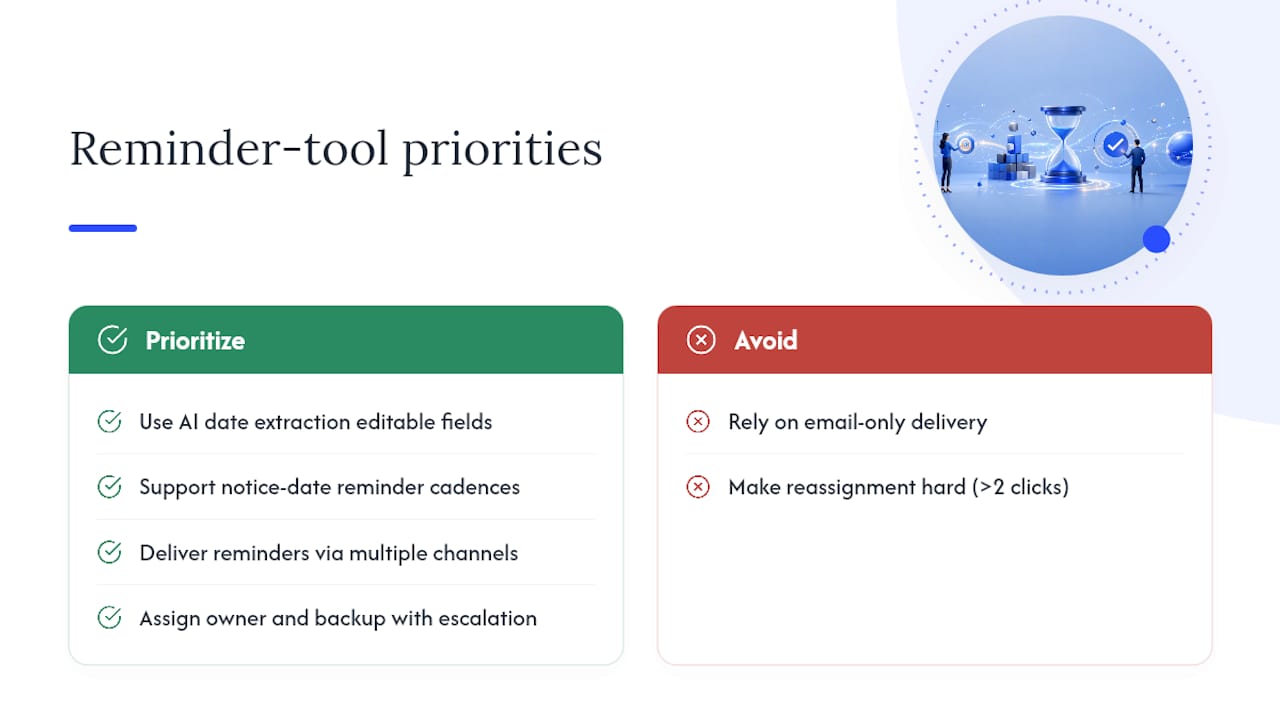
AI-assisted date extraction with editable fields. Manually keying in hundreds of expiry and notice dates from legacy PDFs is where most renewal programs die before they start. Tools that read uploaded contracts and suggest key dates for confirmation cut setup time dramatically, as long as you can still edit what the AI proposes.
Notice-date reminders with configurable cadences. The tool should let you set alerts relative to the notice deadline, not just the expiry date, and adjust the cadence per contract type.
Multi-channel delivery. Email alone gets buried. Look for tools that can reach recipients through multiple channels, including people who don't have a login to the system itself.
Owner and backup assignment with escalation rules. A reminder with no accountable human behind it is just noise.
Audit trails. Every reminder sent, every decision made (renew, renegotiate, cancel) should be logged and timestamped.
Attachment and integration support. The reminder should carry the actual contract PDF, and the tool should connect to your existing systems rather than becoming another silo.
Pro Tip: During a demo, ask the vendor to show you what happens when a reminder recipient leaves the company. If reassigning ownership takes more than two clicks, that's a signal the tool wasn't built for real turnover.
Recommended reminder cadence and renewal timeline
Start planning earlier than feels necessary. For high-value or complex agreements, begin the renewal process 120 to 180 days before expiry, which gives you room to assess performance, benchmark pricing, and negotiate before you're stuck accepting whatever terms land on your desk.
A reminder ladder that works for most contract portfolios:
- 180 days out: initial flag for high-value or strategic contracts only
- 120 days out: begin performance review and market comparison
- 90 days out: first formal reminder to the primary owner
- 60 days out: second reminder, decision should be forming
- 30 days out: decision deadline, escalate if undecided
- 14 days out: final warning before the notice window closes
- 7 days out: last-chance alert, treat as urgent
Low-risk contracts, like a $200 monthly software subscription, don't need all seven touchpoints. Reserve the full ladder for agreements above your organization's materiality threshold. For legacy contracts with notice windows shorter than 30 days, compress the cadence and flag them for immediate review rather than waiting for the standard sequence.
Assigning ownership so nothing gets orphaned
A reminder that reaches nobody accountable is a reminder that accomplishes nothing. Build the notification flow around three roles at minimum:
- Primary owner: the person responsible for the renewal decision, usually the contract requester or department lead
- Backup owner: someone who receives every reminder the primary owner does, so a vacation or a departure never creates a blind spot
- Manager or escalation contact: added into the loop automatically once a deadline crosses a risk threshold, such as 14 days out with no logged decision
Stage the recipient list by cadence. Early reminders (120 and 90 days) can go to the primary owner alone. Later reminders (30, 14, and 7 days) should copy the backup and, if still unresolved, the manager. When someone changes roles or leaves, reassign ownership in the system immediately and log the change. Reaching the actual decision-maker matters more than simply sending an alert, and staged escalation is how you guarantee that.
Copy-ready templates for renewal reminders
Good templates save you from writing the same email under deadline pressure every quarter. Adapt tone based on the relationship: firmer and more procedural for internal escalations, warmer and more collaborative when you're the one requesting renewal from a vendor or landlord.
- 90-day internal reminder — Subject: "Renewal decision needed: [Contract Name], due [date]." Body: "This agreement's notice deadline is [date]. Please review terms and confirm renew, renegotiate, or cancel by [internal deadline]."
- 30-day escalation — Subject: "Action required: [Contract Name] notice deadline in 30 days." Body: "No decision has been logged yet. Looping in [manager] to help finalize before [date]. Contract attached."
- Polite external renewal request — Subject: "Discussing our renewal for [Service/Lease Name]." Body: "Our current term ends [date], and we'd like to start a conversation about renewal terms ahead of the deadline. Are you available this week?"
- 7-day final alert — Subject: "Urgent: notice window closes in 7 days." Body: "This is the last reminder before the cancellation window closes on [date]. Please confirm your decision today."
Rolling out automated reminders: a pilot to scale checklist
Don't try to convert your entire contract portfolio in one pass. Run a pilot first.
- Inventory required fields. For each contract you'll pilot, capture expiry date, notice deadline, owner, backup, and a PDF attachment.
- Pick a pilot scope. Choose 20 to 50 contracts, ideally a mix of high-value and routine agreements, so you test both ends of the cadence ladder.
- Bulk import and validate. Upload contracts and let AI-suggested dates populate the fields, then manually confirm or correct each one rather than trusting extraction blindly.
- Run the pilot for one full cycle. Watch how reminders land, who responds, and where escalation triggers fire.
- Define KPIs before you scale. Track on-time decision rate, reduction in unwanted auto-renewals, and average days between first reminder and logged decision.
- Document a playbook and roll out. Turn what worked in the pilot into a standard operating procedure for the rest of the portfolio.
Pro Tip: Measure your baseline auto-renewal rate before the pilot starts. Without that number, you won't be able to prove the program worked when leadership asks.
How Formable turns this checklist into a working system
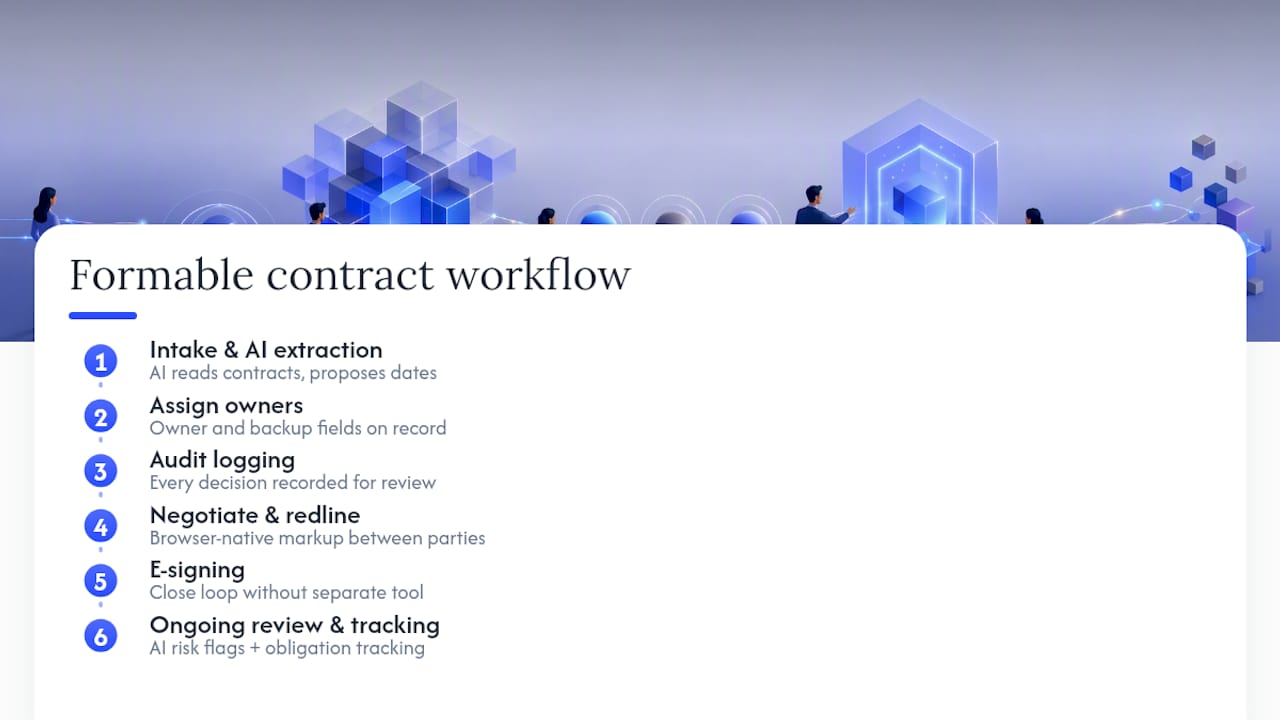
Formable brings the pieces of this checklist into one workflow instead of five disconnected tools. Its AI reads uploaded contracts and proposes renewal, notice, and expiration dates for you to confirm, which is the same AI-assisted extraction approach that speeds up pilot rollouts. Owner and backup fields sit alongside the contract record, and every decision gets logged in an audit trail you can pull up during a renewal dispute or an internal review.
Beyond reminders, Formable's browser-native negotiation and redlining tools let both sides mark up terms directly, so a renewal that turns into a renegotiation doesn't require switching platforms. Once terms are settled, e-signing closes the loop without a separate signature tool. For teams building their own workflows, Formable's AI contract review surfaces risk flags automatically during intake, which pairs naturally with contract obligation tracking once renewals are underway. Quick wins for a first pilot: bulk import a batch of contracts, let the AI suggest dates, and attach the source PDF directly to each reminder.
What actually goes wrong with renewal reminders
The biggest mistake I see teams make isn't a missing tool. It's alert fatigue. Set every cadence to the full seven-touchpoint ladder and your team starts ignoring every reminder, including the ones that matter.
Start with a pilot, not a full rollout. Extract the notice window for every contract before you extract anything else. Then pick two or three KPIs, on-time decision rate is usually the most telling one, and check them monthly.
Teams that skip straight to automating everything at once tend to abandon the system within a quarter. Teams that pilot, measure, and expand tend to keep it running for years.
— Alex
Start protecting your renewal deadlines with Formable
Formable replaces the spreadsheet-and-calendar patchwork most teams use for renewals with one workflow that extracts dates, assigns owners, and logs every decision automatically. Instead of stitching together a document tracker, a separate e-signature tool, and a manual reminder calendar, you get contract creation, AI review, redlining, and e-signing under one login.
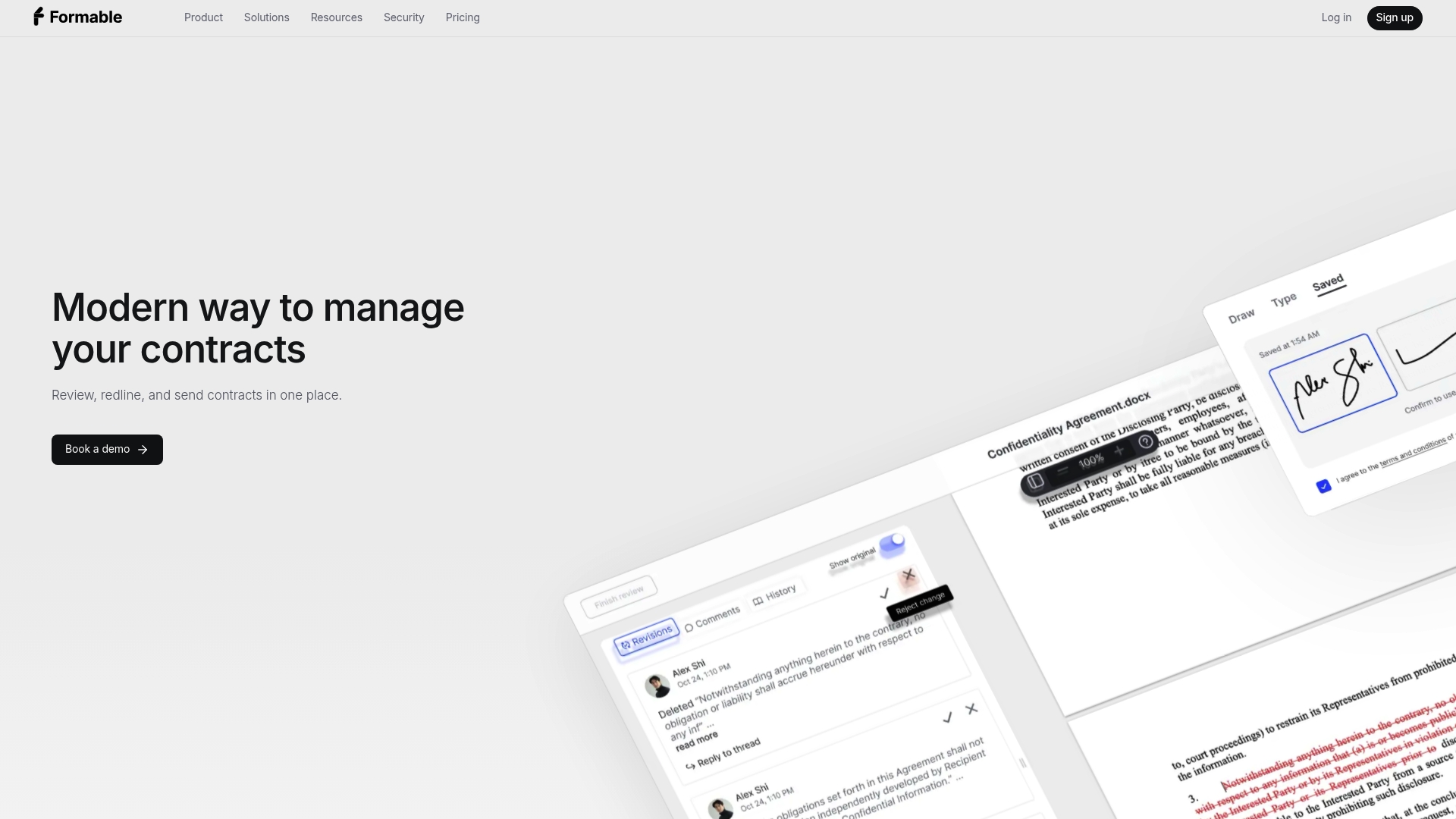
If you're managing a growing contract portfolio, start with the Contract creator to standardize your renewal-ready templates, then run a batch through AI contract review to surface missing notice clauses before they become a problem. Teams ready to commit can check the Pro plan at $29.99 per month or review Enterprise options for larger portfolios. Developers building renewal alerts into their own product can explore the Growth plan at $29.99 per month for API access. Import a sample batch of contracts today and see how many hidden notice deadlines the AI catches.
Sources
- Contract Renewal Reminder Software | Stop Auto-Renewal Lock-In | ExpiryEdge
- Contract Renewal Management Process Guide 2026 | ZiaSign | ZiaSign
FAQ
What is a good template for a renewal reminder message?
A strong template names the contract, states the exact notice deadline, and asks for a specific decision by a specific date. Keep the subject line direct, something like "Renewal decision needed: [Contract Name], due [date]," and attach the contract itself so the recipient doesn't have to search for it.
How do you politely ask for a contract renewal?
Reference the current term's end date, express interest in continuing the relationship, and propose a specific time to discuss terms. A line like "We'd like to start a conversation about renewal ahead of our [date] deadline" works for vendors, landlords, or service providers alike.
Can a company renew a contract without notice?
It depends entirely on the contract's own auto-renewal clause. Many agreements allow renewal to proceed automatically if neither party sends cancellation notice by the deadline, which is exactly why tracking the notice date rather than the expiry date matters so much.
What to say when your contract is not renewed?
Confirm the decision in writing, reference the final service or term date, and outline any transition steps, like data return or final invoicing. A short, professional note protects both parties if questions come up later, and logging that decision in your contract system keeps a record for future reference.