Close indemnity deadlocks: redlines, insurance steps, contract workflow

Alex Shi

Negotiate for narrowly tailored triggers, defense control tied to insurer-approved counsel, and a cap calibrated to fees or insurance limits rather than left open-ended. Push for mutuality wherever the risk actually runs both directions, and refuse to sign off on any indemnity your broker hasn't reviewed. The immediate move: propose folding the indemnity cap into the contract's general liability cap, carved out only for gross negligence, willful misconduct, and IP infringement.
TL;DR:
- Negotiate indemnity caps that are integrated into the general liability limit and exclude gross negligence, willful misconduct, and intellectual property claims.
- Ensure defense costs are included within the same cap as indemnity obligations to prevent double exposure and clarify who controls the legal defense process.
- Focus on mutual indemnity clauses with clearly defined triggers, timely notice, and explicit control of defense and settlement rights to avoid disputes.
- Be aware that some states restrict or void indemnity clauses that shift liability for sole negligence, especially in construction and certain sectors like oilfield services.
- Use automated contract review tools and real-time negotiation platforms to streamline drafting, flag gaps, and quickly finalize balanced indemnity language.
Table of Contents
- What is an indemnity clause, and how does duty to defend differ from duty to indemnify?
- Who, what, and how: the components you have to negotiate
- Negotiable levers: mutuality, caps, baskets, and carve-outs
- Notice, control of defense, and settlement: the mechanics that decide who actually pays
- Which state laws limit how far an indemnity clause can go?
- What does typical indemnity clause wording look like?
- How Formable helps legal teams turn negotiated indemnity language into a signed deal
- Where deadlocks actually break, and the compromise that works
- Turn your negotiated indemnity language into a closed deal, faster
- Where to dig deeper on indemnity law and clause drafting
- Sources
- FAQ
What is an indemnity clause, and how does duty to defend differ from duty to indemnify?
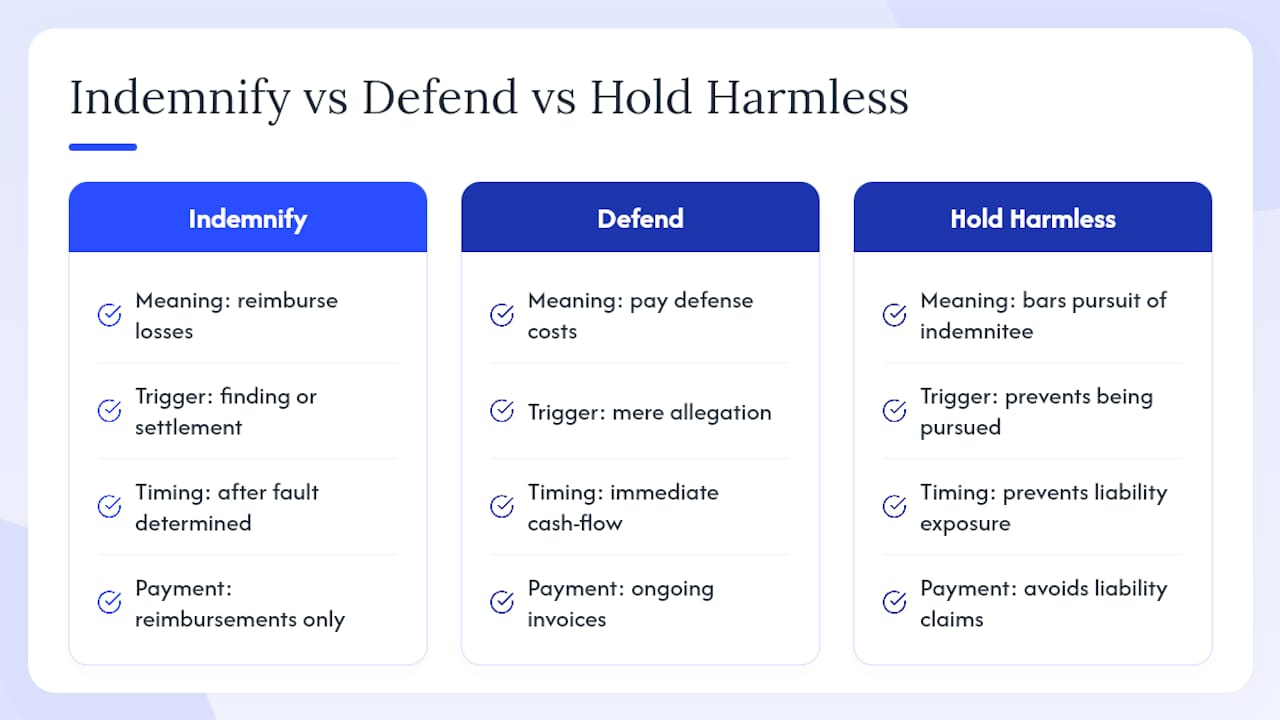
An indemnity clause shifts the financial consequences of a specific risk from one party to another. Three words tend to get bundled together in the same sentence, but they mean different things at the negotiating table: indemnify, defend, and hold harmless.
"Indemnify" means reimbursing the other party for losses. "Hold harmless" bars the indemnitee from being pursued for those losses in the first place. "Defend" is the one that catches negotiators off guard, because it creates a payment obligation that starts running immediately, not after a court decides who was at fault.
Picture a vendor agreement where the vendor has agreed to defend the customer against any claim that the vendor's software infringes a third party's patent. A patent troll sues. Under a "defend" obligation, the vendor's outside counsel starts billing that week, and the vendor pays those invoices as they land, regardless of whether the underlying infringement claim eventually fails. The duty to defend is legally distinct from the duty to indemnify: defend is a cash-flow obligation triggered by the mere allegation, while indemnify is a reimbursement obligation triggered by an actual finding or settlement.
That timing gap is where leverage lives. A party asked to accept a broad "defend" obligation is really agreeing to fund litigation on someone else's timeline. Negotiators who understand this ask, at minimum, that defense costs count against the same cap that governs indemnification, so the payer isn't exposed twice.
Who, what, and how: the components you have to negotiate
Every indemnity clause breaks into three drafting decisions, and sloppy language on any one of them creates exposure nobody intended.
Who is covered. Vendor-drafted templates routinely list the indemnitee plus its affiliates, officers, directors, employees, agents, successors, and assigns. If you're the indemnitor, that list is your negotiating target.
- Strike "affiliates" unless the affiliate is actually a party to the deal or receiving the product.
- Cap "successors and assigns" so the obligation doesn't silently transfer to an unrelated acquirer years later.
- Ask whether "employees" and "agents" need naming, or whether the corporate entity's coverage already reaches them through vicarious liability.
What is covered. Distinguish third-party claims (a customer's customer sues over a data breach) from first-party losses (the customer's own direct damages). Broad-form language often blurs the two, and sample indemnification clauses frequently combine "indemnify, defend, and hold harmless" with sweeping "all claims" phrasing that a careful redline narrows to claims "arising from a third party." IP infringement, data breach, and regulatory-fine triggers each deserve their own sentence rather than a shared bucket, because insurers underwrite them differently.
How it's triggered. Notice timing, proof requirements, survival period after termination, and named exclusions all belong in the same paragraph as the trigger itself. A clause that's silent on survival period is a clause that arguably survives forever, which almost never matches either party's intent.
Negotiable levers: mutuality, caps, baskets, and carve-outs
Mutuality is the first lever worth pulling, as explained in this SaaS implementation plan without IT that aligns risk and insurance considerations. If both parties can plausibly cause the other harm, say through a data breach or an IP claim, insist the indemnity runs both ways. Reciprocal language tends to produce more reasonable drafting on both sides, since mutual obligations force each party to imagine being on the receiving end of the exact clause it's proposing. Asymmetry is still justified in some deals, a landlord leasing space to a tenant, a manufacturer selling to a distributor, but the asymmetry should track who actually controls the risk, not just who drafted the contract first.
Caps come next, and there are two workable structures:
- Fold the indemnity into the general liability cap. This is the cleanest approach for most commercial deals, since it avoids stacking separate exposure ceilings.
- Set a standalone cap tied to fees or insurance. A common formula ties the cap to the greater of twelve months of fees under the agreement or the indemnitor's available insurance limit, which keeps the number grounded in something both sides can verify.
Baskets and thresholds shape when the obligation kicks in at all. A deductible means the indemnitor absorbs losses up to a set amount and pays only the excess. A retention shifts the entire loss to the indemnitor until the threshold is crossed, then indemnity applies from dollar one. De minimis carve-outs simply exclude trivial claims below a stated dollar figure so nobody is drafting demand letters over small amounts.
Carve-outs for gross negligence and willful misconduct almost always survive negotiation uncapped, and that's usually the right outcome. Best practice ties every other indemnity to a defined cap, basket, and survival period rather than leaving the obligation open-ended.
Pro Tip: Propose the cap-plus-carve-out structure before the other side proposes theirs. Whoever puts the first number on the table usually anchors where the final number lands.
Notice, control of defense, and settlement: the mechanics that decide who actually pays
A well-drafted indemnity is useless if the procedural mechanics underneath it are vague. Three things need explicit language.
- Notice windows. Require "prompt written notice," and define what late notice costs the indemnitee, typically a reduction in recoverable defense costs incurred during the delay, not a full forfeiture of the right to indemnification.
- Control of defense. Decide upfront who selects counsel. Payers generally want the right to choose insurer-approved counsel and to control settlement decisions that affect the cap.
- Reservation of rights and settlement consent. If the indemnitor controls defense, the indemnitee typically retains the right to approve any settlement that includes an admission of liability or that exceeds the negotiated cap.
Get these three elements wrong and you end up with a clause that looks protective on paper but produces disputes over who authorized which invoice. Clear procedural language is what turns a fair indemnity into a workable one.
Which state laws limit how far an indemnity clause can go?
Several states restrict or void indemnity language that shifts liability for a party's own sole negligence, and ignoring those statutes gets you a clause that looks enforceable but isn't. California Civil Code section 2782 is the one practitioners cite most often, and it specifically limits indemnification in construction contracts where the indemnitee's own sole negligence caused the loss. New York and Texas carry comparable restrictions, particularly in construction and, in Texas, in oilfield services agreements.
Insurance-related indemnities carry their own sector rules, since regulators generally don't allow an insurer to indemnify away statutory obligations owed to policyholders. Broad, uncapped indemnities pasted into standard-form contracts have also drawn court skepticism as against public policy in adhesion-contract settings, particularly where one party had no real ability to negotiate the term.
The fallback: choose governing law deliberately, and draft a severability provision so an unenforceable indemnity provision doesn't take the rest of the clause down with it.
What does typical indemnity clause wording look like?
Three variants, each drafted to favor a different party, show how much the same obligation can shift with a few words.
- Vendor-friendly: "Vendor shall indemnify Customer against third-party claims arising solely from Vendor's gross negligence, capped at fees paid in the prior twelve months." Narrow trigger, hard cap, fault threshold set high.
- Buyer-friendly: "Vendor shall indemnify, defend, and hold harmless Customer, its affiliates, and their respective officers and employees against any and all claims, losses, and expenses arising out of or related to this Agreement." Broad parties, broad triggers, no cap, no fault threshold. This is the template language worth redlining on sight.
- Balanced: "Each party shall indemnify the other against third-party claims arising from its breach of this Agreement or grossly negligent acts, subject to the liability cap in Section [X], excluding claims for willful misconduct."
Standard redlines to run every time: add a notice requirement if one is missing, tie the obligation to available insurance where the exposure is large, restrict scope to third-party claims unless first-party loss is genuinely intended, and insert a cap even when the other side resists.
How Formable helps legal teams turn negotiated indemnity language into a signed deal
Getting the language right is only half the job. Getting it into the actual document, tracked and applied consistently, is the other half. Formable's AI contract review engine lets legal teams upload a playbook with their preferred indemnity fallback positions, then flags any incoming draft that deviates, whether that's a missing cap, an unlisted carve-out, or an overbroad "affiliates" definition.
Once you've negotiated the language, browser-native negotiation tools let both sides redline the same document in real time instead of trading tracked-changes files by email. Save the final version as a reusable clause inside the contract creator, and the next MSA or DPA starts from your negotiated position instead of the counterparty's template.
Where deadlocks actually break, and the compromise that works
Most indemnity deadlocks aren't really about the words. They're about one side refusing to quantify its exposure. The compromise that consistently unsticks talks: mutual indemnity, capped at the greater of twelve months of fees or the indemnitor's insurance limit, with gross negligence and willful misconduct carved out uncapped.
Concede notice-window flexibility and counsel-selection input readily. Hold firm on the cap structure and on requiring insurer sign-off before final execution, since running the language past both brokers before signature catches coverage gaps nobody wants to discover after a claim arrives.
— Alex
Turn your negotiated indemnity language into a closed deal, faster
Formable is the alternative to juggling redlines across email threads and static Word documents when you're finalizing indemnity language under deadline. Instead of losing track of which version has the agreed cap and which still has the vendor's original broad-form draft, you negotiate inside one browser-native workspace where both sides see the same redline in real time.
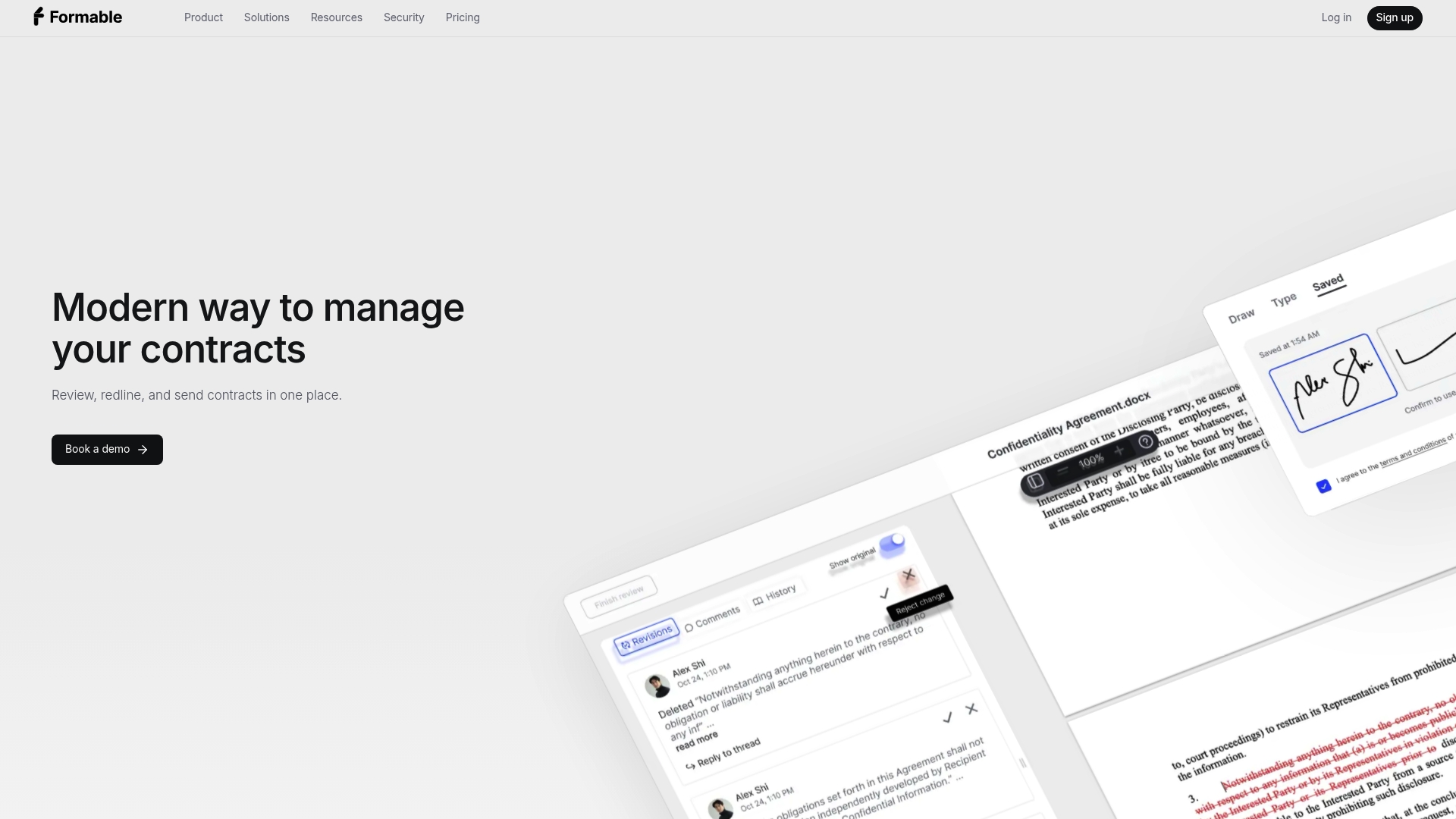
Upload a contract for AI contract review and Formable's engine flags missing caps, undefined survival periods, and overbroad indemnitee lists automatically, matched against a playbook you control. Once the language is settled, the contract creator turns it into a reusable template for your next MSA or DPA, and e-signing closes the deal without another platform switch. Pro plans start at $29.99 per month, with full details on the pricing page. Start by uploading your current indemnity template for a review pass and see what a playbook catches that a manual read misses.
Where to dig deeper on indemnity law and clause drafting
- California Civil Code section 2782: the statute most cited for construction-related sole-negligence limits.
- ABA's negotiating indemnity guide: practical mutuality tactics from practicing litigators.
- Justia's indemnity clause library: a reference set of real-world clause formulations.
Sources
- California Civil Code section 2782
- Negotiating indemnity (American Bar Association)
- Indemnification clauses in contracts (Bloomberg Law)
FAQ
How do you negotiate an indemnification clause effectively?
Start by narrowing the trigger to third-party claims, propose mutuality where risk runs both ways, and anchor the cap to either twelve months of fees or your available insurance limit before the other side proposes their own number.
What does an indemnity clause example actually look like?
A balanced version reads roughly: "Each party shall indemnify the other against third-party claims arising from its breach of this Agreement, subject to the cap in Section [X], excluding willful misconduct." Vendor-friendly and buyer-friendly versions swap the scope, cap, and covered-party list to favor one side.
Should you agree to an indemnification clause without a cap?
Generally no. An uncapped indemnity is a red flag most experienced negotiators refuse to accept, and a standalone cap tied to fees or insurance, with carve-outs for gross negligence and willful misconduct, is the standard workable compromise.
What is typical wording for the duty to defend versus indemnify?
Duty to defend language typically reads "shall defend" and obligates payment of defense costs as incurred, regardless of fault. Duty to indemnify language reads "shall indemnify against losses" and applies only once fault or settlement is established.
Can Formable help review indemnity clauses before signing?
Yes. Formable's AI contract review tool checks incoming drafts against your uploaded playbook and flags indemnity language that lacks a cap, survival period, or narrowed trigger before you sign.