Juro is a capable contract platform, but it is not the right fit for every team. The strongest alternatives depend on who owns your contracts. Sales-led teams usually land on PandaDoc or DealHub. Legal-led teams look at Ironclad, SpotDraft or Concord. Lean startups that want drafting, AI review, negotiation and signing in one place often choose Formable.
This guide compares the main options by what they do, who they suit and what to check before you switch. We build Formable, so we say where we sit. We have tried to keep the comparison fair, and we leave out figures we could not verify.
TL;DR
- No single tool wins for everyone. Match the tool to who owns contracts: sales, legal or operations.
- PandaDoc and DealHub lean toward sales documents. Ironclad, SpotDraft and Concord lean toward legal and lifecycle management. Contractbook leans toward automation after signature.
- Formable combines drafting, AI review, redlining, e-signing and APIs in one workflow, with Pro at $29.99 per month.
- Before switching, check implementation time, adoption by non-lawyers, integrations, security reports and how you will migrate existing contracts.
Why teams look beyond Juro
Teams rarely leave a contract platform over one missing feature. The reasons we hear most often are practical.
- Fit with the buyer. A platform designed around a legal team's workflow can feel heavy to a founder or an account executive who only needs an NDA out the door today.
- Price transparency. Many contract platforms ask you to book a demo before you see a number. Startups often want to start on a card and upgrade later.
- Scope. Some teams want negotiation and redlining built in rather than handled through email attachments and Word.
- Developer needs. Product teams sometimes want to embed e-signing or tracked changes into their own app, which calls for a real API.
The analyst firm MGI Research lists DealHub, Contractbook, DocuSign, Ironclad, PandaDoc and Juro among its rated CLM vendors, with Concord and SpotDraft as noteworthy additional suppliers. That is a useful map of the field, and it is the shortlist we work from below.
Juro alternatives at a glance
| Option | Best for | Main strength | Watch for |
|---|---|---|---|
| Formable | Startups and GTM teams that want one workflow | Drafting, AI review, redlining, e-signing and APIs together | Newer name than the enterprise incumbents |
| PandaDoc | Sales-led teams with proposal-to-contract flows | Sales documents and quotes | Lighter on legal review and negotiation depth |
| Contractbook | Lean teams automating work after signature | Operational workflows from signed agreements | Less focused on live negotiation |
| SpotDraft | Teams needing AI-assisted legal operations | Contract lifecycle management plus AI review | Plan scope, so confirm what is included |
| Ironclad | Larger legal departments | Mature enterprise CLM | Implementation effort and budget |
| Concord | Budget-conscious teams wanting end-to-end CLM | Full lifecycle at a modest scale | Confirm integrations for your stack |
| DocuSign | Teams already standardized on its signing | Signing familiarity and reach | Separate products for full lifecycle needs |
| DealHub | Sales teams tied to quoting and CPQ | Revenue-side deal workflow | Not a legal-first tool |
The table is a starting point. Each tool changes its plans often, so confirm current packaging on the vendor's own page before you decide.
Formable
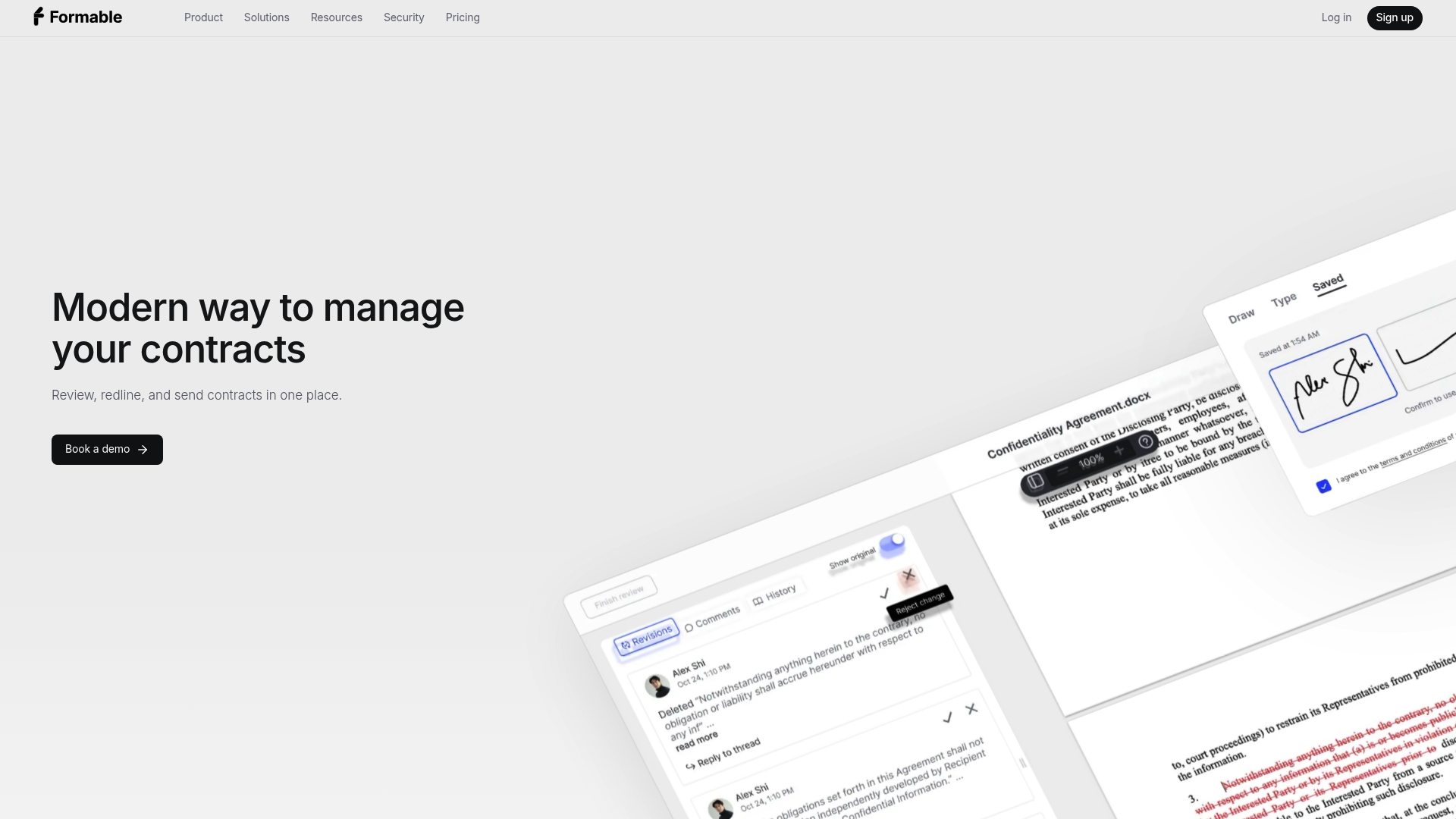
Formable is an AI-enabled contract management platform for startups and go-to-market teams. It covers the agreements those teams sign most: MSAs, DPAs, SOWs, LOIs, order forms, NDAs and pilot agreements.
What sits in one workflow:
- Creation. The contract creator combines templates with generative AI, so a first draft does not start from a blank page.
- AI review. AI contract review works from intake. You upload your playbook, and the engine flags risks and missing clauses automatically.
- Negotiation and redlining. Browser-native negotiation lets both parties align on terms before the signing stage, with no attachments going back and forth.
- E-signing. Formable is also a standalone e-signing provider, with audit trails for each agreement.
- APIs. A redlining API and an embedded e-signing API let developers put these features inside their own product.
On price, the Pro plan is $29.99 per month. The API Growth plan is also $29.99 per month. Basic, Enterprise and Developer are listed on the pricing page without a published figure, and there is a free tier for individuals and developers.
Formable is the strongest fit when the same small team drafts, reviews, negotiates and signs, and wants to stop moving files between four apps.
PandaDoc
PandaDoc grew out of proposals and quotes, and it still shows. It suits sales teams that move from a proposal to a signed contract inside a CRM-centered process. Comparative startup guides tend to place it first for sales-led companies with proposal-to-contract revenue workflows.
The tradeoff is depth on the legal side. If your contracts are heavily negotiated, with several rounds of redlines and fallback positions, you will want more than document assembly and signing. We cover that gap in detail in our PandaDoc alternative for contracts that need negotiation and on the PandaDoc alternative page.
Contractbook
Contractbook is built around contract data and automation. It fits lean teams that want signed agreements to trigger operational work: reminders, renewals, handoffs and structured data. If your pain starts after signature, it deserves a look.
If your pain is before signature, in drafting and negotiating, check how far its negotiation tooling goes for your use case.
SpotDraft
SpotDraft is a contract lifecycle management company with a notable AI angle. In January 2024 it released VerifAI, a Word add-in that checks contracts against user-specified guidelines and answers contextual questions. It launched with a two-week free trial and a $60 monthly subscription, and it works as a standalone product without any other SpotDraft subscription. Those were launch terms from 2024, so confirm current pricing with SpotDraft.
It suits teams that want AI-assisted legal operations and are comfortable working in Word.
Ironclad, Concord, DocuSign and DealHub
Ironclad is aimed at larger legal departments with complex approval chains. Expect a longer implementation and an enterprise-style sales process. It is a reasonable choice if you have in-house counsel and a dedicated owner for the system. Many startups find it more than they need.
Concord positions itself as end-to-end lifecycle management at a more approachable scale. It is worth a demo if budget is the main constraint and you need the whole lifecycle in one place.
DocuSign is the name most counterparties already know. Teams already signing in DocuSign sometimes keep it for signing and add a separate tool for drafting and review. That works, but it recreates the multi-app patchwork many teams are trying to leave.
DealHub is built for revenue teams, with quoting and deal rooms at the center. It makes sense when the contract is one step in a quote-to-cash process, and less so when legal owns the workflow.

Which alternative fits which team
Sales-led startups
Your priority is speed from proposal to signature. PandaDoc and DealHub are natural candidates. Formable fits if your deals involve negotiation on MSAs, DPAs or order forms, because redlining and e-signing sit in the same flow.
Legal-led teams
Your priority is control: playbooks, risk flags, audit trails and approvals. Ironclad, SpotDraft and Concord are built for this. Formable covers the review and playbook side with AI, and suits lean legal teams that do not want a long rollout. Our guide to the best legal AI contract management options goes deeper.
Operations-heavy teams
If you mainly need signed agreements to drive downstream workflows, Contractbook is a sensible place to start. Our contract workflow management guide for legal teams explains how to map those steps.
Product and developer teams
If you need to embed signing or redlining inside your own application, look at API quality before anything else. Ask each vendor about authentication, webhooks, sandbox access and how usage is billed. Formable offers both a redlining API and an embedded signing API, with usage-based pricing for API signing and negotiation events.
What to check before you switch
A feature list will not tell you how a migration goes. Work through these points with every vendor on your shortlist.
- Implementation time. Ask for a realistic timeline for a team your size, and who does the work on your side.
- Adoption by non-lawyers. If sales and finance will not use it, contracts will keep living in email. Have an account executive run a real NDA through the trial.
- Integrations. List the tools you rely on, such as your CRM, storage and chat, and ask which connections are native and which need an API.
- AI capabilities. Test with your own contracts and playbook. Ask whether the AI flags missing clauses as well as risky ones, and how your data is handled.
- Approval workflows. Check whether approvals can be conditional, for example routing only non-standard liability terms to counsel.
- Security. Ask for a SOC 2 or SOC 3 report. Enterprise buyers commonly require it: one large US software company, for example, requires cloud-service contractors to provide an SSAE 18 SOC 2 or SOC 3 report covering security, availability, processing integrity and confidentiality.
- Migration. Ask how existing contracts, templates and metadata are imported, and whether you can export everything if you leave.
- Pricing at scale. Get the price for your expected number of users and agreements, not just the entry plan.
If you are comparing AI review specifically, our roundup of AI contract review alternatives and the list of legal contract management software alternatives may help.
A quick worked example
Imagine Georgia, a founder at a 15-person SaaS company in San Francisco. She sends about 20 agreements a month: NDAs, order forms and the occasional DPA requested by a customer's security team. She has no full-time lawyer.
She needs three things: a fast first draft, a check against her standard positions before anything goes out, and a way to negotiate without email attachments. A sales-document tool covers the first and last of those partly. A heavy enterprise CLM covers all three but takes weeks to roll out. A unified tool like Formable covers them in one place, and she can start on Pro at $29.99 per month.
Now take Oleg, a general counsel at a 400-person company with a procurement process, multi-step approvals and thousands of legacy contracts. His priorities are repository search, approval routing and reporting. That points toward an enterprise CLM. The right answer changes with the team.

Our perspective
We see the same pattern again and again. Teams stitch together a template folder, a Word file, an email thread and a signing app. Each tool is fine alone. The cost shows up in the gaps: a version nobody can find, a clause nobody caught, a counterparty waiting on a file.
That is why we built Formable as one workflow. Drafting, review, negotiation, redlining, e-signing and tracking belong together, because the context from one step is what makes the next one faster. AI review is most useful at intake, before a bad clause is already in a draft. Negotiation is most useful when both sides see the same document and the same changes.
We also think buyers should be skeptical of any vendor, ours included. Run your own contract through each trial. Ask for current pricing in writing. If Juro or another platform fits your team better, that is a good outcome. If you want to test a lighter, unified alternative, we are happy to walk through your use case.
— Alex
Try Formable on a real contract
If you are replacing Juro or a patchwork of apps, the quickest test is to run one live agreement end to end. Draft it from a template, review it against your playbook, send it for negotiation and collect signatures.
Formable's Pro plan is $29.99 per month, and the free tier lets you try the basics. Compare plans on the pricing page, or start from the Formable home page.
Developers can look at the API pricing, where the Growth plan is $29.99 per month.
FAQ
What is the best Juro alternative for a startup?
It depends on who owns contracts. Sales-led startups often choose PandaDoc. Lean teams automating post-signature work look at Contractbook. Startups that want drafting, AI review, negotiation and signing in one tool should look at Formable, which starts at $29.99 per month on Pro.
Are there cheaper options than Juro?
Often, yes, especially for small teams. Several vendors offer entry plans, and Formable publishes its Pro price. Always compare total cost at your expected user and agreement volume, because entry plans can omit features such as API access or advanced review.
Which Juro alternative has the best AI contract review?
There is no single winner, so test with your own contracts. SpotDraft offers its VerifAI add-in for checking contracts in Word against your guidelines. Formable's AI review works from intake with your uploaded playbook and flags risks and missing clauses.
Can I embed e-signing or redlining in my own product?
Yes, with a vendor that offers APIs. Formable provides a redlining API and an embedded e-signing API, with usage-based pricing for signing and negotiation events. Ask any vendor about sandbox access, webhooks and billing before you commit.
What should I ask before migrating from Juro?
Ask how existing contracts and templates are imported, what the realistic implementation timeline is, and whether you can export your data. Also confirm security documentation such as a SOC 2 report and test adoption with non-legal users.