
A ready-to-use, editable master service agreement template is available for immediate download, and you can turn it into a signature-ready contract in minutes using Formable's guided contract creator. The tool builds on standard templates modeled after Common Paper, a widely respected library of startup-friendly contract language, then uses AI to draft a full agreement from your answers to a short questionnaire.
Here's what to do right now:
- Download the editable MSA template or launch the guided contract creator directly.
- Fill in both party names, pick your governing law, and confirm which services this MSA will cover.
- Decide whether this is a one-time engagement or the start of a longer vendor relationship before you lock in the term length.
Pro Tip: Set your payment terms, late fees, and acceptance windows as defaults inside the MSA itself rather than repeating them in every statement of work. Counterparties redline commercial terms far more often when they show up buried in a project-level SOW instead of the master. Fixing them once at the MSA level cuts an entire round of negotiation on future deals.
Key Takeaways
A well-built master service agreement separates negotiated legal terms from project-level statements of work, letting recurring vendor relationships move faster after the first signature.
| Point | Details |
|---|---|
| Pick the right variant | Match your template to your IP needs: assignment-heavy for agency work, license-based for SaaS. |
| Set commercial defaults early | Lock in payment terms, late fees, and liability caps in the MSA so SOWs stay short. |
| Never skip survival clauses | Confidentiality and indemnity obligations must explicitly outlive termination. |
| Confirm signatory authority | Verify whoever signs actually has the power to bind their organization before you sign. |
| Use guided tools to speed drafting | Formable's contract creator generates an editable MSA draft from a guided questionnaire, then supports redlining and e-signing in one flow. |
Which master service agreement template fits your business?
Not every MSA looks the same, and picking the wrong starting point costs you redline cycles later. Four variants cover most small business and startup scenarios: agency or consultant agreements, software or SaaS agreements, professional services agreements, and independent contractor masters.
The core difference between them is how they treat intellectual property and delivery risk. An agency or marketing MSA usually assigns work product outright to the client, since the client is paying for original creative or strategic output it needs to own outright. A SaaS or software MSA leans the other way. It grants a license to use a platform rather than transferring ownership of the underlying code, because the vendor needs to keep rights to its own product across every customer.
A few quick examples make the choice concrete. A startup hiring a marketing agency for ongoing campaigns wants an MSA with clean IP assignment and a services scope that flexes month to month. A software company selling access to its platform wants a SaaS MSA with license grants, uptime language, and data processing terms. A company bringing on an independent contractor for recurring technical work wants a contractor master that addresses worker classification and IP assignment carefully, since misclassification carries real legal exposure.
| Use case | Recommended template | Why it fits |
|---|---|---|
| Ongoing marketing or creative work | Agency/consultant MSA | Client typically needs full ownership of deliverables |
| Selling access to a software platform | SaaS MSA | License-based IP model protects the vendor's core product |
| Multi-phase professional services (consulting, implementation) | Professional services MSA | Built for milestone-based SOWs and change orders |
| Recurring freelance or contractor work | Independent contractor master | Addresses classification risk and IP assignment directly |
Formable's contract creator lets you select any of these variants at the start of the guided walkthrough, so you are not stuck editing a generic template to fit a use case it was never built for.
What is a master service agreement, and when do you need one?
A master service agreement is a framework contract. It sets the legal terms, meaning payment structure, liability, confidentiality, and IP ownership, once, then lets you attach individual statements of work for each project without renegotiating the whole deal. Thomson Reuters Practical Law describes this structure as standard practice for ongoing commercial relationships, and it's the reason MSAs dominate vendor contracting once a relationship moves past a single transaction.
You need an MSA when you expect more than one project with the same counterparty: a marketing agency retained for a year, a software vendor whose contract renews, a contractor doing recurring development sprints. You do not need one for a single small job with no expectation of repeat business. A basic services agreement covers that case more efficiently, since drafting a full framework contract for a one-off engagement adds negotiation overhead nobody needs.
Picture two scenarios. A design studio signs an MSA with a client planning quarterly rebrand projects, then issues a short SOW for each new phase. Compare that to a bookkeeper hired for a single year-end cleanup: a standalone services agreement gets the job done without the overhead of a master framework built for a relationship that may never repeat.
Which clauses does every MSA need, with sample language
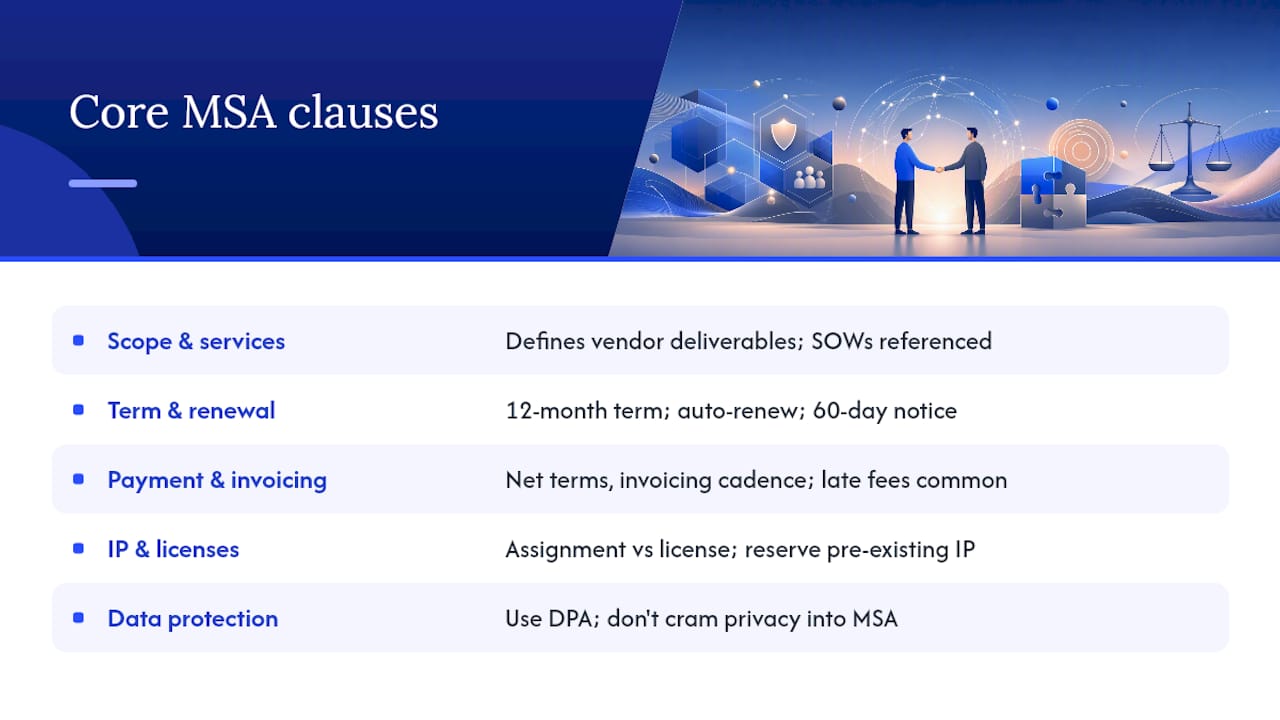
Every solid MSA covers the same core territory, even when the specific wording shifts by industry. Here's the checklist, clause by clause.
Scope and services. Defines what the vendor will actually do. Sample: "Vendor will perform the services described in one or more mutually executed statements of work incorporated by reference into this agreement." Counterparties often push to narrow scope language that feels too open-ended, so expect at least one round of tightening here.
Term and renewal. Sets how long the framework lasts and whether it auto-renews. Sample: "This agreement begins on the effective date and continues for twelve months, renewing automatically for successive one-year terms unless either party gives sixty days' notice." Watch for counterparties asking to shorten notice periods or remove auto-renewal entirely.
Termination for convenience and for cause. Lets either side exit, with different notice requirements depending on the reason. Vendors typically want longer notice for convenience terminations to protect revenue predictability; clients usually want the opposite.
Payment and invoicing, plus late fees. Sets Net terms, invoicing cadence, and consequences for late payment. A 1.5% monthly late fee is common and rarely gets negotiated away entirely, though the rate itself sometimes shifts.
Confidentiality. Protects both sides' non-public information. If you already have a standalone mutual NDA in place with this counterparty, coordinate the two so they don't conflict on survival periods.
IP ownership and license models. This is where agency-style "work made for hire" language and SaaS-style license grants diverge most sharply. Startups often push for broad assignment; established vendors push back to retain rights in pre-existing tools and frameworks.
Indemnification and limitation of liability. Indemnity covers third-party claims (IP infringement, data breach); limitation of liability caps total exposure. Counterparties routinely ask to cap indemnity obligations and exclude consequential damages.
Insurance requirements. Common for service providers touching client data or premises. Expect requests for certificates of insurance naming the client as additional insured.
Change control, acceptance criteria, and reporting. Governs how scope changes get approved mid-project and how deliverables get accepted or rejected.
Subcontracting, assignment, and non-solicitation. Controls who can perform the work and whether either side can poach the other's employees.
Audits. Gives clients the right to review vendor compliance, particularly relevant for data-heavy engagements.
Data protection. For any agreement touching personal data, note where a separate data processing addendum belongs rather than cramming privacy terms into the main body. The OMG's guide to cloud service agreements makes the case for keeping these modular, since data terms tend to change faster than the core commercial deal.
Dispute resolution and governing law. Pick a state whose courts and law both sides can live with, and decide upfront whether arbitration or litigation resolves disputes. Arbitration tends to be faster and more private; court litigation preserves broader discovery and appeal rights.
Pro Tip: A market-tested limitation of liability cap set at twelve months of fees paid is a structure that most corporate counsel accept without much friction, since it balances real risk against what the deal is actually worth. The Association of Corporate Counsel treats this as a standard benchmark rather than an aggressive ask, which makes it a useful anchor point when the other side opens with an uncapped liability position.
How do you customize and redline the template without slowing down?
Here's the workflow that gets an MSA from blank template to signed contract with the fewest surprises:
- Fill in both party legal names exactly as they appear on formation documents, not DBAs or brand names.
- Choose your governing law and venue, ideally the state where your business is incorporated or has its strongest connection to the deal.
- Set your commercial defaults: payment terms, late fees, and the liability cap you're comfortable defending.
- Select your IP model based on the template variant, assignment for agency work, license for SaaS.
- Attach insurance requirements if the engagement involves data access or on-site work.
- Build your first SOW using the fields already defined in the MSA, rather than restating terms that already live in the master.
- Send the draft to your counterparty for redlining and track every change through a single tool instead of email threads.
A few mistakes show up constantly in early-stage MSAs. Contradictory language between the MSA and its SOWs is the most common, usually because someone copies payment terms into a SOW that no longer match the master. Overbroad IP assignments trip up software vendors who accidentally sign away rights to their own core platform. Missing survival clauses mean confidentiality and indemnity obligations quietly expire the moment the agreement terminates, which defeats the entire point of including them.
When you manage redlines, work through structural issues first (term, termination, liability caps) before touching wording-level edits, since a change to one often cascades into the others. The American Bar Association recommends resolving business terms before legal language specifically because legal wording built around unsettled commercial terms usually needs a second pass anyway.
Loop in outside counsel when liability caps, indemnity, or IP assignment deviate meaningfully from your standard position. Skip it for routine renewals or SOWs that fit inside terms you've already negotiated once.
Pro Tip: Build your commercial defaults, Net 30 payment, a 1.5% late fee, a five-business-day acceptance window, directly into the MSA. Every SOW you issue afterward can then skip restating those terms entirely, which keeps future statements of work to a single page.
How do SOWs and SLAs connect to the master agreement?
Every SOW you sign incorporates the MSA by reference, meaning it inherits the liability caps, confidentiality terms, and dispute resolution language you already negotiated once. Change orders and purchase orders work the same way. This is the entire point of the two-layer structure: negotiate the hard legal terms a single time, then keep every subsequent project document short.
A well-built SOW covers:
- Deliverables and a clear description of what counts as complete
- Timeline and key milestones
- Acceptance criteria and the review window
- Fees and billing schedule
- Named contacts for both parties
- Any service level agreement terms specific to that engagement
SLAs matter most for SaaS and infrastructure deals, where uptime and response times carry real commercial weight. Teams managing complex technical acceptance criteria sometimes formalize this further with a requirements traceability matrix to track which deliverables map to which contractual obligations.
What should you confirm before you sign?
Run through this list before any signature goes on the document:
- Party legal names match formation documents exactly.
- Governing law and venue are both settled and acceptable to your business.
- Payment terms, late fees, and invoicing cadence are all stated once, in the MSA.
- The IP ownership model matches how you actually plan to use deliverables.
- Insurance requirements are met, with certificates on file if required.
- Whoever is signing actually has authority to bind their organization.
- Every referenced SOW is complete and consistent with the MSA's terms.
For a typical small-business deal, expect draft to first counter to run about a week, one to two redline rounds after that, and signature within two to four weeks total if neither side pushes for major structural changes. Legal review fees and any required insurance costs are the main expenses beyond your own time.
Watch for these red flags before signing: uncapped indemnity obligations, IP assignment language broad enough to cover work unrelated to the engagement, and missing survival clauses on confidentiality or payment obligations. Any one of these is worth pausing for a second look before you commit.
Sample table of contents and clause snippets you can reuse
A clean MSA table of contents typically runs: Definitions, Scope and Services, Term and Termination, Payment and Invoicing, Confidentiality, Intellectual Property, Indemnification, Limitation of Liability, Insurance, Data Protection, Change Control, Dispute Resolution and Governing Law, General Provisions, and Signature Block. LegalZoom's published MSA template follows this same general order, which reflects how most small-business contracts get structured in practice.
| Clause | Copy/paste snippet | Usage note |
|---|---|---|
| Termination for convenience | "Either party may terminate this agreement upon sixty days' written notice." | Adjust notice period based on how much lead time your business needs |
| Confidentiality survival | "Confidentiality obligations survive termination for three years." | Extend to five years for trade secrets or highly sensitive data |
| Payment terms | "Invoices are due within thirty days of receipt." | Pair with a stated late fee percentage |
| Assignment restriction | "Neither party may assign this agreement without prior written consent." | Carve out an exception for mergers or acquisitions |
Some clauses need more than a snippet before they're ready to sign. Indemnification usually requires defined terms and a cooperation obligation spelling out how the indemnified party must respond to a claim, so expand that section fully rather than relying on boilerplate. LawDepot's guidance flags this same expansion point as one of the most common places small businesses under-draft their agreements.
How Formable speeds up drafting, redlining, and signing
Formable's contract creator walks you through a guided form, asks about your services, IP model, and governing law preferences, then generates a full draft MSA built on templates modeled after Common Paper. You get an editable document, not a locked PDF, so it works as a real starting point rather than a rigid form.
Once the draft exists, a few features cut the negotiation timeline noticeably:
- Collaborative redlining lets both sides propose and accept changes in one place instead of trading marked-up Word files by email.
- Playbook-driven risk detection flags clauses that fall outside your standard positions before you send the draft out.
- Built-in e-signing and audit trails mean the signed version and its full history live in one system.
- APIs let engineering teams embed redlining or signature collection directly into their own product.
To try it, start the guided MSA flow, choose your governing law and IP model, generate the draft, invite your counterparty to redline, then finalize and sign.
Pro Tip: Keep modular add-ons, a data processing addendum, an insurance exhibit, an AI addendum, separate from your core MSA. It keeps the master reusable across deals that don't need those extra terms.
A few things I'd tell any founder drafting their first MSA
Set your SOW acceptance mechanics before you negotiate anything else. A vague "deliverables subject to client approval" clause causes more disputes than any liability cap ever will, because nobody agreed on what "approval" actually means. And resist assigning every scrap of IP to the client by default. I've watched a vendor lose the rights to reuse its own internal framework because a template defaulted to blanket assignment nobody bothered to narrow. One negotiation stalled for two weeks over an uncapped indemnity clause; switching to a twelve-month fee cap closed it the same afternoon.
Get your MSA signed faster with Formable
Formable turns a blank MSA into a negotiation-ready draft in one guided session, instead of the usual back-and-forth of a lawyer drafting from scratch or a static template you have to hand-edit clause by clause. The contract creator builds your draft from templates modeled after Common Paper, then hands you an editable document you can send straight into redlining and e-signing without switching tools. Teams managing recurring vendor relationships use it to standardize commercial defaults once, then generate SOWs against that master in minutes rather than renegotiating terms every time. Start a guided MSA now and see your first draft before you finish your coffee.
Sources
- Master service agreement: Templates and resources for ...
- American Bar Association guidance on practical contract drafting
- Master services agreement resource | Association of Corporate Counsel
FAQ
How do you create a master service agreement?
Start from an editable template, fill in party details and governing law, set commercial defaults like payment terms and liability caps, then attach a statement of work for the first project. Formable's guided contract creator walks through this process and generates a draft automatically.
What does a master service agreement include?
At minimum, scope of services, term and termination, payment terms, confidentiality, IP ownership, indemnification, limitation of liability, and governing law. Data protection and insurance requirements get added depending on the industry.
What are common MSA mistakes?
The most frequent ones are contradictory terms between the MSA and its SOWs, overbroad IP assignment that signs away more than intended, and missing survival clauses that let confidentiality or indemnity obligations lapse at termination.
Are an MSA and an SLA the same thing?
No. An MSA is the overall legal framework covering payment, liability, and IP; an SLA is a narrower set of performance commitments, like uptime or response times, usually attached to a specific SOW rather than the master agreement itself.