The most effective way to negotiate contracts online is to combine a written playbook, collaborative redlining on a single canonical draft, and a clear audit trail from first comment to final signature. That combination removes the two biggest friction points in remote negotiations: version confusion and unclear decision authority. Under the ESIGN Act and the Uniform Electronic Transactions Act (UETA), electronically negotiated and signed agreements carry the same legal weight as paper ones, so the workflow question is not whether online negotiation is valid. It is how to run it without losing control of the draft.
Three immediate actions to start correctly:
- Set your objective, nonnegotiables, and BATNA (Best Alternative to a Negotiated Agreement) in writing before opening the draft.
- Upload the canonical draft to a shared redline environment and lock all other copies.
- Schedule a synchronous video sync or set a firm asynchronous review deadline within 48 hours.
Platforms like Formable are built for exactly this sequence: intake, AI-assisted review, collaborative redlining, and e-signature in one place.
Key takeaways
Effective online contract negotiation depends on a single canonical draft, a written playbook, and a platform that keeps the audit trail intact from first redline to final signature.
| Point | Details |
|---|---|
| Start with a playbook | Document fallback positions and approved language before opening the first redline. |
| One draft, one channel | Lock a single canonical draft in a shared redline environment to prevent version conflicts. |
| Tag clause status | Label each clause Open, Agreed, or Escalated so asynchronous reviewers see a clear negotiation timeline. |
| Know the legal floor | ESIGN Act and UETA make electronically negotiated agreements enforceable; retain full negotiation records for the contract term plus applicable statute of limitations. |
| Use Formable | Formable connects AI-assisted review, collaborative redlining, and e-signing in one audit-ready platform for teams closing deals online. |
What tools and channels do you actually need to negotiate contracts online?
Choosing the right channel for each stage of an online negotiation prevents miscommunication and keeps the draft clean. Not every channel fits every task.
Channels and when to use them:
- Email works for initiating negotiations, transmitting the first draft, and confirming agreed positions in writing. It creates a timestamped record but is poor for real-time back-and-forth on clause language.
- Collaborative redline platforms (purpose-built tools or shared Word/Google Docs with tracked changes) are the primary working channel. All substantive edits belong here, not in email threads.
- Video calls are best for resolving impasses, building rapport early in the relationship, and walking through complex clause clusters. They are not a substitute for a written record.
- Secure file sharing (encrypted links, permission-controlled folders) handles exhibits, attachments, and signed copies. Never send sensitive drafts over unencrypted email attachments.
Must-have platform features:
- Real-time collaborative redlining with tracked changes and comment threads
- Version control with named, timestamped snapshots
- Immutable audit trail logging every edit, comment, and access event
- Clause playbook or precedent library for approved fallback language
- E-signature compatibility so the signed copy lives in the same system as the negotiated draft
- Granular access controls (view-only, comment, edit, sign)
Pro Tip: Pick one canonical draft and one negotiation channel before the first exchange. Two parties editing separate copies and reconciling by email is the single most common cause of rework in remote contract negotiations.
Preparation checklist before your first remote redline or negotiation call
Harvard Business School's contract negotiation guidance is clear: clarify unclear terms before advancing drafts. That principle applies with extra force online, where a misread comment can sit unresolved for days.
Work through this sequence before sending or receiving a single redline:
- Define your objectives and nonnegotiables. Write down the three outcomes you must achieve and the two positions you will not move from. Separate these from your preferred positions.
- Establish your BATNA. Know what you will do if this negotiation fails. A clear BATNA prevents you from making unnecessary concessions under time pressure.
- Identify all stakeholders and assign roles. Who can approve clause-level changes? Who has final signoff authority? Who owns the canonical draft? Ambiguity here causes delays.
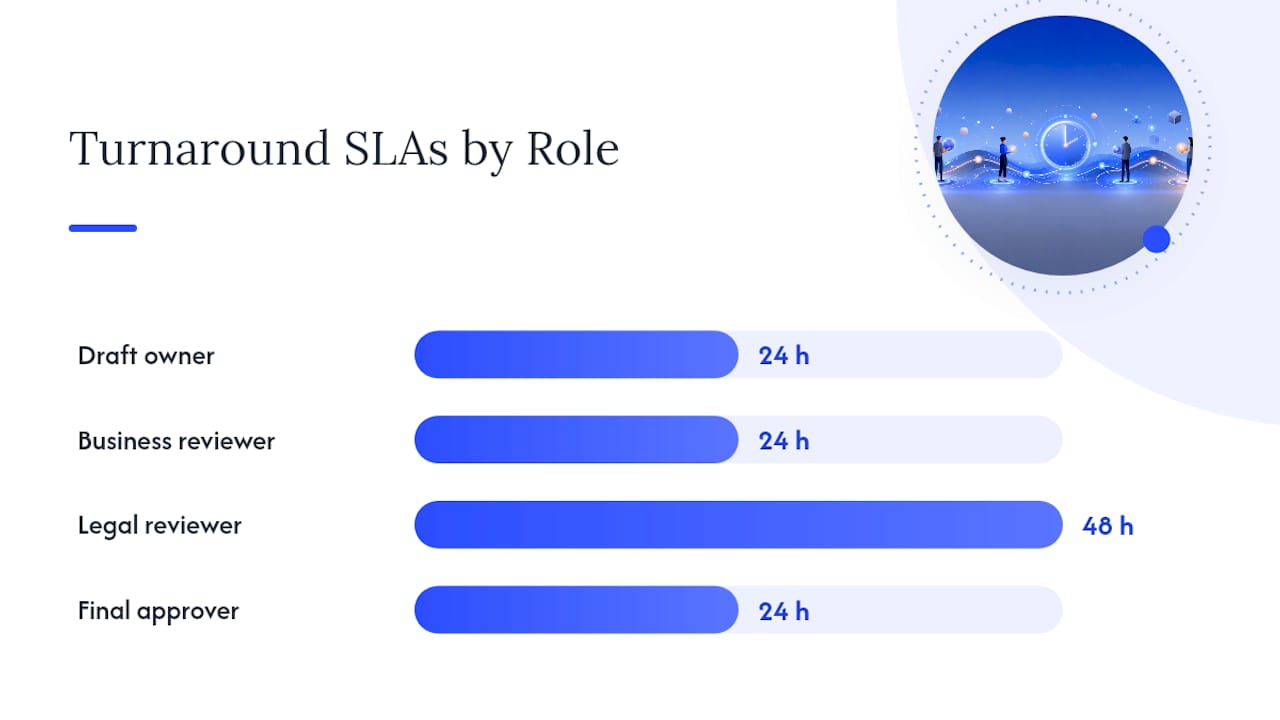
- Set turnaround SLAs. Agree internally on how quickly each reviewer must respond to a redline. A common standard for commercial agreements is to set turnaround SLAs within a few days.
- Prepare your playbook. Document fallback positions and approved language for the clauses most likely to be contested. This is your reference during asynchronous review.
- Run a document preflight. Confirm all exhibits are attached, defined variables are filled in, and the draft is in the agreed format before sharing.
Roles and responsibilities at a glance:
| Role | Responsibility | Approval threshold | Turnaround SLA |
|---|---|---|---|
| Draft owner | Maintains canonical version, applies accepted changes | All edits | 24 hours |
| Business reviewer | Reviews commercial terms (price, scope, SLAs) | Commercial positions | 24 hours |
| Legal reviewer | Reviews risk clauses (liability, IP, warranties) | Legal positions | 48 hours |
| Final approver | Signs off on agreed terms before e-signature | Full agreement | 24 hours |
Document preflight checklist:
- All exhibits and schedules attached and labeled
- Defined terms filled in (party names, dates, amounts)
- Governing law and jurisdiction fields completed
- Signature blocks formatted for e-signature
- Secure upload to the shared negotiation environment confirmed
Commonly negotiated terms and how to handle them in an online workflow
Harvard's Program on Negotiation recommends focusing negotiation energy on measurable items: deadlines, deliverables, and clear performance expectations. The eight clauses below are where most commercial negotiations spend the most time.
Scope Objective: define exactly what is and is not included. In the redline, add a comment: "Please confirm whether [specific deliverable] is in scope or add it to the exclusions list in Section 2.1." Typical concession: accept a broader scope statement if a change order mechanism is included.
Price and payment Objective: protect cash flow and reduce payment risk. Ask for net-30 terms and milestone-based payments. Fallback: accept net-45 if a late-payment interest clause is added.
Term and termination Objective: preserve flexibility. Push for termination for convenience with 30-day notice. Fallback: 60-day notice. Flag auto-renewal clauses for explicit review.
IP and ownership Objective: retain ownership of pre-existing IP and work product created outside the contract scope. Comment example: "Party A retains all rights to pre-existing IP as defined in Exhibit A; work product created under this SOW assigns to Party B."
Warranties Objective: limit implied warranties and cap warranty periods. Ask for a mutual disclaimer of consequential damages in the same clause.
Liability and indemnity Objective: cap total liability at a defined multiple of fees paid. Standard starting position: 12 months of fees. Fallback: 24 months. Flag uncapped indemnity obligations for legal review before accepting.
Performance metrics and SLAs Objective: make metrics measurable and tie remedies to specific thresholds.
Amendments and change orders Objective: require written amendments signed by both parties. Reject any clause that allows unilateral modification. For a ready-to-use amendment template, Formable's contract amendment guide covers standard clause language.
Workflow note: Tag each contested clause with a status label (Open, Agreed, Escalated) in your platform's comment thread. This gives asynchronous reviewers a negotiation timeline at a glance and prevents the same clause from being relitigated after it has been closed.
Negotiation tactics and communication practices that hold up in remote channels
Remote negotiations lose persuasive power when they rely on email alone. The tactics below are adapted for asynchronous and synchronous online channels.
Anchoring. Set the first number or position in the draft itself, not in a cover email. A concrete opening position in the redline is harder to ignore than a verbal suggestion on a call. PON's guidance on contract negotiation skills supports anchoring with clear, measurable terms from the start.
Staged concessions. Plan your concessions in advance and release them one at a time. Each concession should come with a condition or a reciprocal ask. Never give two concessions in the same message.
Deadline momentum. Set a firm response deadline on every redline you send. "Please respond by [date]" converts an open-ended thread into a decision event.
Asynchronous etiquette:
- Open each comment with the clause reference (e.g., "Section 4.2:") so reviewers can navigate without reading the full thread.
- End each comment with a clear ask: accept, reject, or propose alternative language.
- Post a thread-level summary after three or more exchanges on the same clause so new reviewers can catch up in one read.
- Avoid writing long explanatory paragraphs in comment threads. State the position, give one reason, and stop.
Synchronous meeting recipe (20-minute negotiation sync):
- Minutes 0–3: Confirm the agenda and the list of open issues.
- Minutes 3–15: Work through open issues in priority order. One issue at a time, one decision at a time.
- Minutes 15–18: Confirm agreed positions verbally and assign the draft owner to apply changes.
- Minutes 18–20: Set the next deadline or confirm the draft is ready for final review.
Follow every video call with a written summary email listing agreed positions, open items, and next steps. Send it within two hours of the call.
Pro Tip: Before escalating a stalled negotiation, score each unresolved issue on a 1–3 scale: 1 = minor, 2 = significant, 3 = deal-breaker. Share the scoring with the other side. It separates genuine impasses from noise and often resolves several issues without a call.
How AI-enabled contract platforms speed up online negotiation
AI features reduce the number of back-and-forth rounds on routine clauses. The practical gains come from a few specific capabilities, not from AI replacing human judgment.
Key AI features that reduce cycle time:
- Clause suggestion: the platform proposes approved language when a clause is flagged as missing or nonstandard, drawing from your playbook.
- Playbook automation: risk thresholds and fallback positions are applied automatically, so reviewers see a pre-screened draft rather than a raw counterparty markup.
- Precedent retrieval: the system surfaces how similar clauses were resolved in past agreements, giving negotiators a data point before they respond.
- Automated summaries: after a redline round, the platform generates a change summary so reviewers can focus on what changed, not on reading the full document again.
A repeatable AI-assisted negotiation workflow:
- Upload the counterparty draft to the platform.
- Run an automated risk scan to flag nonstandard clauses and missing provisions.
- Review AI-suggested markups against your playbook. Accept, modify, or reject each suggestion.
- Send the marked-up draft to the counterparty via the platform's shared redline environment.
- Receive their response, run a change summary, and repeat until all issues are resolved.
- Collect e-signatures in the same platform to close the audit trail.
Formable's contract review engine runs this intake-to-markup workflow automatically, catching risks and surfacing playbook-approved alternatives before a human reviewer opens the draft.
Pro Tip: Treat AI suggestions as a first draft of your position, not a final one. Review every suggested markup before sending. A clause that looks compliant in isolation can create a conflict with another section. Human review is the guardrail that keeps AI speed from creating new risk.
Auditability matters here. Every AI-suggested change should be logged as a distinct event in the audit trail, separate from human edits, so you can demonstrate the review process to counsel or a counterparty if the agreement is later disputed.
U.S. legal basics every online negotiator should know
Online contract negotiation in the U.S. operates under a clear legal framework. Understanding the basics protects you and tells you when to stop and call counsel.
The ESIGN Act (2000) and UETA establish that electronic signatures and electronically negotiated agreements are legally enforceable in the U.S., provided both parties consent to electronic transactions and the records are retained in a form that can be reproduced accurately. These laws do not validate every agreement automatically. Certain categories, including wills, family law matters, and some real estate transactions, are excluded.
Recordkeeping requirements for online negotiations:
- Retain the full negotiation history, including all drafts, redlines, comments, and version snapshots.
- Store the final signed copy in a format that cannot be altered after execution (PDF/A or a platform-locked record).
- Log access events, timestamps, and signer identity verification as part of the audit trail.
- Keep records for at least as long as the contract term plus any applicable statute of limitations (often 4–6 years for commercial contracts under state law, though this varies).
Jurisdiction and choice of law:
Remote agreements frequently involve parties in different states. The choice of law clause determines which state's law governs disputes. Specify it explicitly; do not leave it blank or rely on default rules.
Remote work agreements that span multiple states must address multi-state tax and employment law implications, equipment ownership, expense reimbursement, and data security obligations. These are not optional provisions.
When to pause and involve outside counsel:
- The agreement involves uncapped indemnity, cross-border IP rights, or regulatory compliance obligations.
- The counterparty's redline introduces terms your playbook does not cover.
- The deal value exceeds your internal approval threshold.
- The governing law is a state or jurisdiction your team has no experience with.
- The counterparty requests a waiver of jury trial, arbitration clause, or class action waiver.
Industry groups sometimes publish standardized remote contract forms as a starting point. The SDC Remote Work Contract is one example of a sector body setting practical defaults for remote arrangements, which illustrates that template standards exist beyond generic legal databases.
Remote agreements should also address the five core sections identified by workplace guides: work arrangement, compensation and benefits, equipment and software, connectivity, and travel and expense reimbursements.
This section provides general information, not legal advice. Confirm current rules with a qualified attorney before executing agreements with significant legal or financial exposure.
Ready-to-use templates and scripts for remote contract negotiations
Short, copyable templates save time and keep communications professional. Use these as starting points and adjust for your specific agreement type.
Email 1: Initiating the negotiation
Subject: [Agreement name] — Initial draft for review
Hi [Name],
Please find attached the initial draft of [Agreement name]. I have highlighted the sections most likely to require discussion in the comments. Our preferred positions are reflected in the current draft.
Please share your redline by [date]. I am available for a 20-minute call on [date/time] if you would like to walk through any sections before responding.
Best, [Your name]
Email 2: Proposing a compromise
Subject: [Agreement name] — Revised positions on open items
Hi [Name],
Following our last exchange, I have updated the draft with revised positions on Sections [X, Y, Z]. The key changes are: [one-line summary per clause]. I believe these address your concerns while preserving our core requirements.
Please review and confirm acceptance or propose alternative language by [date].
Best, [Your name]
Email 3: Closing the deal
Subject: [Agreement name] — Final draft ready for signature
Hi [Name],
All open items have been resolved. The final draft is attached and ready for e-signature. I will send the signature request via [platform] shortly.
Please confirm receipt and expected signature date.
Best, [Your name]
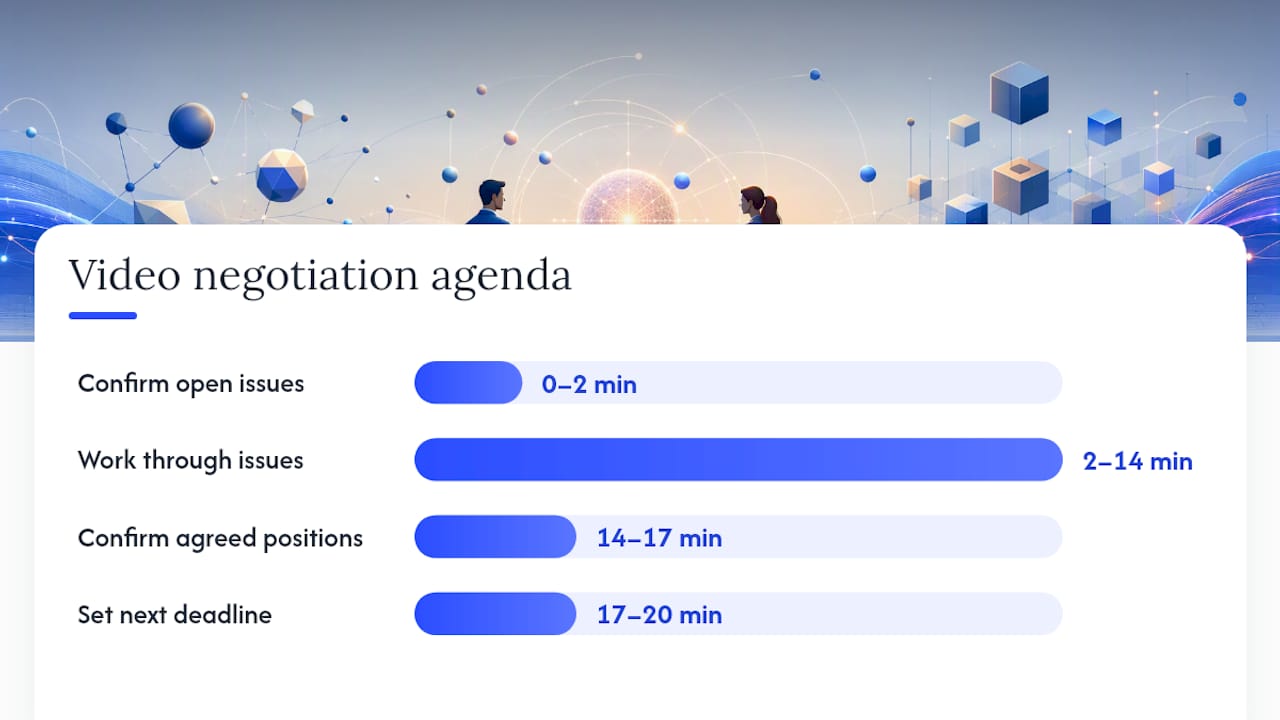
20-minute video negotiation agenda:
- (0–2 min) Confirm open issues list and agenda.
- (2–14 min) Work through issues in priority order: one issue, one decision, move on.
- (14–17 min) Confirm agreed positions and assign draft owner to apply changes.
- (17–20 min) Set next deadline or confirm readiness for final review.
Sample redline comments:
- Scope: "Section 2.1: Propose adding 'excluding [specific deliverable]' to the exclusions list. Please confirm or suggest alternative language."
- Payment: "Section 5.3: Propose net-30 from invoice date. Open to net-45 with 1.5% monthly interest on overdue amounts per Section 5.4."
- IP ownership: "Section 8.1: Party A retains all rights to pre-existing IP as defined in Exhibit A. Work product created solely under this SOW assigns to Party B upon full payment."
External reviewer checklist (attach to shared draft):
- Review deadline: [date]
- Required attachments confirmed: [ ]
- Defined variables completed: [ ]
- Governing law clause reviewed: [ ]
- Signature block formatted for e-signature: [ ]
- Playbook fallbacks applied to flagged clauses: [ ]
What experienced remote negotiators actually do differently
Most professionals treat online negotiation as a slower version of in-person negotiation. That framing causes the most common mistakes: too many channels, no single draft owner, and comment threads that grow without resolution.
The negotiators who close remote agreements quickly run a tight daily routine. Each morning, they open the active redline, scan for new comments, and triage by clause status: Agreed, Open, or Escalated. Anything Open with a response deadline in the next 24 hours gets handled first. Everything else gets a scheduled slot. The draft never sits idle for more than one business day.
The habit that makes the biggest difference is the thread summary. After three or more exchanges on a single clause, write a two-sentence summary at the top of the thread: what was proposed, what was agreed or rejected, and what the next step is. This takes 90 seconds and eliminates the most common source of rework in asynchronous negotiations, which is a reviewer re-reading a 12-message thread and reaching a different conclusion than the one already reached.
One pattern that consistently shortens cycles: when a clause is genuinely stuck, move it to a synchronous call with a pre-shared one-page issues list. Asynchronous channels are efficient for routine clauses. They are inefficient for impasses. Knowing which situation you are in and switching channels accordingly is the single most underused skill in remote negotiation.
Formable gives you the full negotiation workflow in one place
Closing deals faster online requires more than a shared Google Doc and an e-signature tool bolted on at the end. The gap between those two tools is where version confusion, missed playbook positions, and unsigned drafts accumulate.
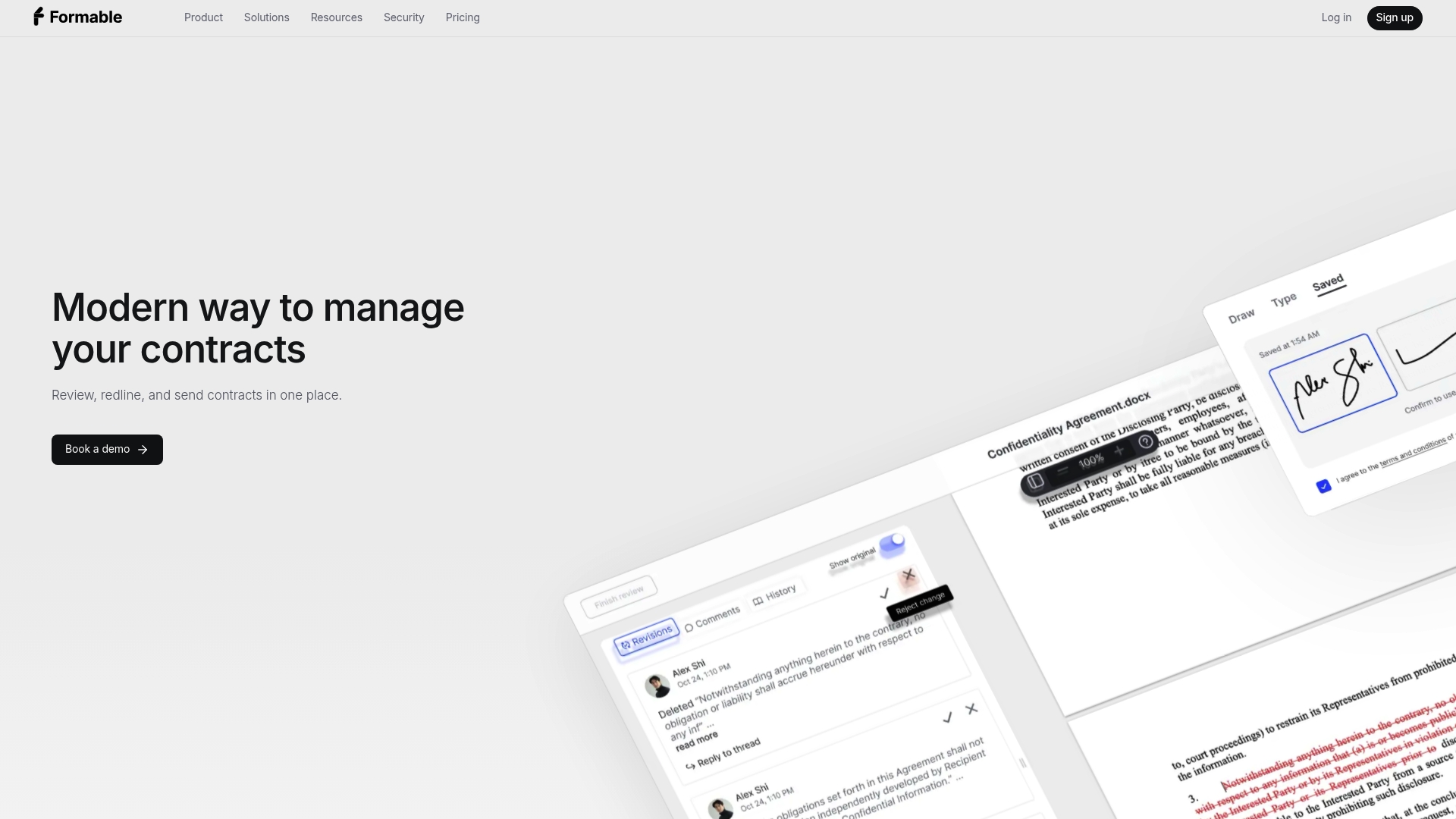
Formable connects the entire workflow: AI-assisted contract review at intake, collaborative redlining with playbook enforcement, and e-signing with a full audit trail in one platform. Teams using Formable work from a single canonical draft, apply approved fallback language automatically, and collect signatures without switching tools.
What Formable gives your team:
- Collaborative redlining with real-time tracked changes and comment threads
- AI-powered risk scan and clause suggestions tied to your uploaded playbook
- Immutable audit trail covering every edit, comment, access event, and signature
- E-signing API for teams that need to embed signing into their own platform
- Template library covering MSAs, NDAs, SOWs, DPAs, Order Forms, and more
If your team negotiates more than a handful of agreements per month, the manual workflow has a ceiling. Start with Formable's negotiate product to see how the redline-to-signature workflow runs in practice, or create your first agreement from a template to get a canonical draft ready in minutes.
Sources
Selected references that informed this guide, organized by type:
Conceptual and skills reading:
- How to Negotiate a Contract: 5 Things to Know
- Contract Negotiation Skills: Setting Yourself Up for Success
- Free Remote Work Employment Contract USA (2026) | PDF & Word
- What is a remote agreement contract?
- Work Contract - Stage Directors & Choreographers
Templates and remote agreement structure:
Legal reference and sector standards:
FAQ
What makes online contract negotiation different from in-person?
Remote negotiations rely on written records rather than verbal agreement, so version control and audit trails matter more. Clarifying unclear terms before advancing drafts is especially important when reviewers are working asynchronously across time zones.
Are electronically negotiated contracts legally enforceable in the U.S.?
Yes. The ESIGN Act and UETA establish that electronic signatures and electronically negotiated agreements are legally enforceable, provided both parties consent to electronic transactions and records are retained accurately. Certain categories such as wills and some real estate transactions are excluded.
What should a remote work contract always include?
A remote work contract should cover work arrangement, compensation and benefits, equipment and software, connectivity, and travel and expense reimbursements, plus multi-state tax and employment law provisions when parties are in different states.
How does Formable support online contract negotiation?
Formable provides collaborative redlining, AI-assisted risk review tied to uploaded playbooks, an immutable audit trail, and e-signing in one platform, so teams can take a contract from intake to signature without switching tools.
When should you involve outside counsel in an online negotiation?
Involve counsel when the agreement includes uncapped indemnity, cross-border IP rights, regulatory compliance obligations, or when the counterparty's redline introduces terms your playbook does not cover.