Deal teams: LOI vs term sheet, 9 point checklist to avoid binding traps

Alex Shi

A term sheet governs financings and sets valuation, securities, and governance terms in bullet form. A letter of intent, or LOI, governs acquisitions and lays out price, structure, and closing conditions in narrative letter form. Neither document is automatically binding or automatically safe. Whether a clause holds up in court depends on its wording and how the parties behave afterward, not on which title sits at the top of the page.
TL;DR:
- Most binding obligations in a term sheet or LOI relate to confidentiality, exclusivity, and expense allocation, rather than the deal's core terms.
- Clear naming of carve-outs and explicit language about non-binding provisions prevent future litigation risks.
- A typical term sheet is concise, about two to five pages, and used chiefly in venture financing, while an LOI is narrative, longer, and used in acquisitions.
- Courts assess enforceability based on language, conduct, and context, not just the document title, meaning even non-binding terms can become binding through actions.
- Using templates and precise language from the start reduces legal risk, especially for complex deals where mistakes could be costly.
Table of Contents
- Loi vs term sheet: what a term sheet actually is
- Loi vs term sheet: what a letter of intent covers
- Loi vs term sheet: the side-by-side comparison
- Which provisions in an loi or term sheet are actually binding
- When you need an LOI vs a term sheet, and how the sequence runs
- Negotiation traps that turn a preliminary document into a legal problem
- How courts decide whether your loi or term sheet is really binding
- A practical checklist before you sign an LOI or term sheet
- The gap between a good template and a good deal
- How Formable helps you draft and close these documents faster
- Sources
- FAQ
Loi vs term sheet: what a term sheet actually is
A term sheet is the financing world's shorthand document. Investors, founders, and their lawyers use it to lock in the economic and governance terms of a deal before anyone drafts the 40-page stock purchase agreement that follows. It reads like an outline, not a letter. Most run two to five pages, broken into bulleted sections rather than prose, which makes them fast to scan and fast to redline.
Inside a typical term sheet you will find valuation (pre-money and post-money), the type of security being issued (preferred stock, convertible notes, SAFEs), liquidation preferences, board composition, protective provisions, and pro rata rights. None of this is decorative. These are the mechanics that decide who controls the company later, and skipping detail here almost always means renegotiating it during the definitive-agreement stage, when leverage has shifted.
The audience is narrow and technical. Term sheets get read by venture investors, in house counsel, and deal operations staff who already speak the vocabulary of cap tables and drag along rights. That is part of why the format stays terse. Nobody expects a term sheet to persuade anyone; it exists to record what has already been agreed in a call or a meeting.
Startups raising a seed or Series A round almost always start here, often borrowing structure from NVCA's model legal documents, which have become the informal industry standard for venture financings. Using a recognized format shortens negotiation, because both sides already know what each clause means before they start marking it up.
Loi vs term sheet: what a letter of intent covers
A letter of intent is the acquisition world's version of the same idea, written in a completely different register. Where a term sheet reads like an outline, an LOI reads like a letter, addressed from one party to another, written in full sentences and paragraphs. That narrative format tends to run longer: LOIs typically span three to eight pages, compared with a term sheet's two to five.
The contents track the shape of an acquisition rather than a financing round. A well-built LOI states the purchase price or price range, the deal structure (asset purchase versus stock purchase versus merger), the conditions that must be satisfied before closing, and an exclusivity commitment that keeps the seller from shopping the deal elsewhere while due diligence runs.
That exclusivity clause is often the real point of the document. A seller negotiating a sale wants certainty that the buyer will not walk once confidential financials are on the table, and a buyer wants certainty that competitors will not swoop in mid diligence. The LOI is where both sides put that mutual insurance in writing, usually alongside confidentiality obligations and a commitment on who pays which expenses if the deal falls apart.
In smaller, owner-operated business sales, the LOI sometimes functions as the only preliminary document before the purchase agreement. There is no separate term sheet stage. The buyer and seller negotiate price and structure directly inside the LOI, then move straight to definitive drafting, which keeps the deal moving but raises the stakes on getting the LOI's language right the first time.
Loi vs term sheet: the side-by-side comparison
Deciding which document you need takes about ten seconds once you know the axis to check: is this a financing or an acquisition? Everything else, format, length, and where binding risk hides, follows from that one choice.
| Factor | Term sheet | Letter of intent |
|---|---|---|
| Typical use | Equity financings, venture rounds | M&A, business acquisitions |
| Format | Bullet or outline structure | Narrative business-letter format |
| Typical length | 2 to 5 pages | 3 to 8 pages |
| Primary audience | Investors, in house counsel, deal ops | Buyers, sellers, deal counsel |
| Core content | Valuation, securities, governance rights | Price, structure, closing conditions, exclusivity |
| Where binding risk concentrates | Confidentiality, information rights, expense terms | Confidentiality, exclusivity, expense allocation |
The format difference is not cosmetic. A bulleted term sheet is built for speed. It gets marked up in a shared document over a few calls, because each line item maps to a single deal term that either side can accept or push back on in isolation. An LOI's narrative style forces more context around each point, which slows negotiation slightly but gives sellers a clearer sense of the buyer's overall intent, not just the numbers.
Binding risk shows up in the same places on both documents. Confidentiality, exclusivity or no shop language, and expense allocation are the provisions most likely to survive a "this is non-binding" disclaimer, according to analysis of LOI enforceability. Courts look past the label on the cover page and ask whether the parties' language and conduct show they intended those specific clauses to stick, even while the economic terms stayed open for negotiation.
Which provisions in an loi or term sheet are actually binding
Most preliminary deal documents are a hybrid. The bulk of the page, valuation, price, structure, is meant to stay non-binding until a definitive agreement replaces it. But a handful of provisions are drafted, and enforced, as binding from the moment both sides sign, regardless of what the header says.
The clauses that routinely carry enforceable weight:
- Confidentiality obligations protecting shared financials, customer data, or trade secrets during diligence.
- Exclusivity or no shop commitments that block the seller from negotiating with other buyers for a set window.
- Expense allocation clauses stating who eats legal and advisory costs if the deal collapses.
- Governing law and dispute resolution provisions that determine which court or arbitration body handles any future disagreement.
Everything else, price, valuation ranges, board seats, earn out structures, is generally meant to remain non-binding and subject to change during definitive drafting. The trouble is that "generally meant to" is not a legal standard. Courts examine the totality of the document's language and the parties' subsequent conduct when they decide what actually binds, not the intent buried in someone's inbox.
That is why the safest LOIs and term sheets say the quiet part out loud. A clean disclaimer names its own exceptions instead of leaving them implied: "Except for the provisions captioned Confidentiality, Exclusivity, and Expenses, which shall be binding upon execution, this letter is non-binding and does not constitute an offer capable of acceptance." Naming the carve-outs explicitly, rather than trusting the word "non-binding" to do all the work, is the single biggest gap between a document that holds up and one that gets litigated.
When you need an LOI vs a term sheet, and how the sequence runs
Deal type decides the document before anything else does. Raising capital from investors means the term sheet is the standard opening move, almost without exception. Buying or selling a business means the LOI takes that role, particularly once negotiations move past a first conversation about price.
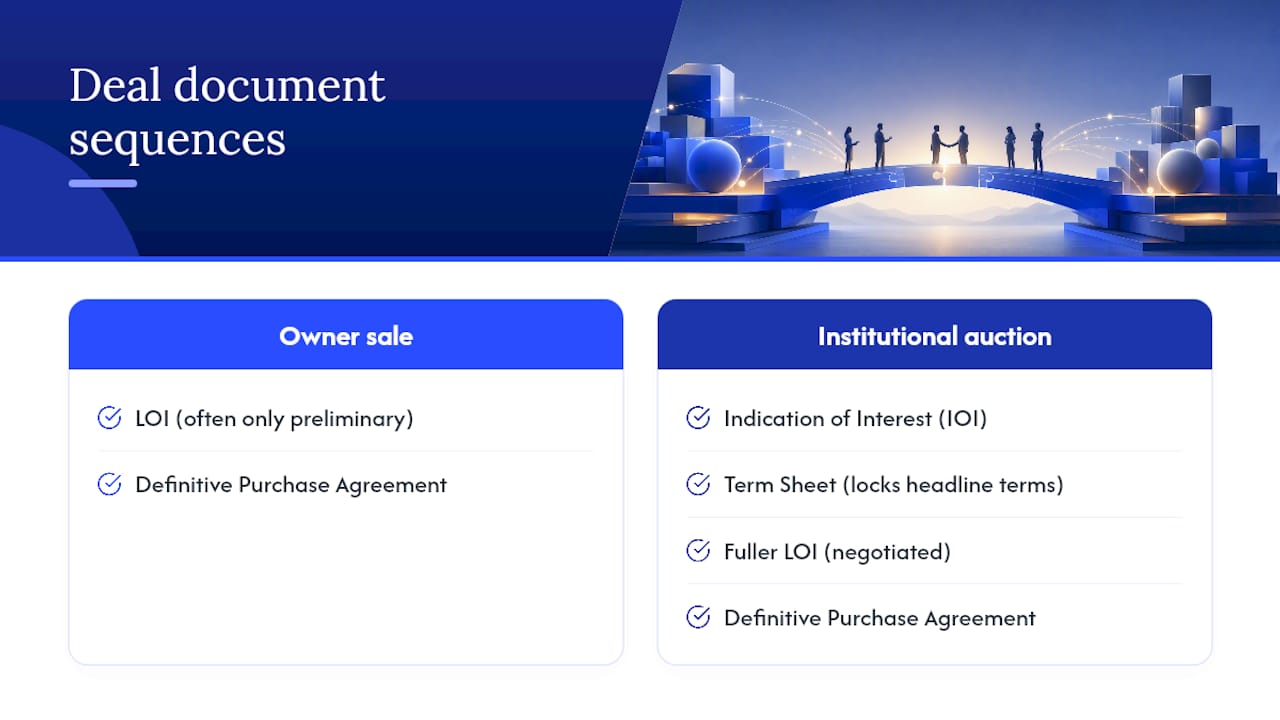
Deal size and sophistication shift the sequence further. In a lightly competitive, owner-operated sale, the LOI is often the only preliminary paper that exists before the purchase agreement gets drafted. In a formal, institutional auction process, the sequence gets longer: an indication of interest (IOI) narrows the buyer pool first, a term sheet locks headline terms with the finalist or finalists, and only then does a fuller LOI get negotiated before the parties move to a definitive purchase agreement. Skipping the IOI stage is common in smaller deals; skipping it in a competitive auction usually means losing negotiating leverage.
Exclusivity windows follow a similar pattern of scaling with complexity. Simpler deals often see 30 day exclusivity periods, while more complex transactions with heavier due diligence, multiple business lines, or regulatory approvals can run 60 to 90 days. Sellers should treat that window as a real cost, since it is 30 to 90 days where a competing buyer cannot make an offer, and push for a defined termination trigger rather than an open ended commitment.
Negotiation traps that turn a preliminary document into a legal problem
The traps that catch experienced founders are rarely about the big numbers. They show up in the boilerplate everyone skims past on the way to the valuation line.
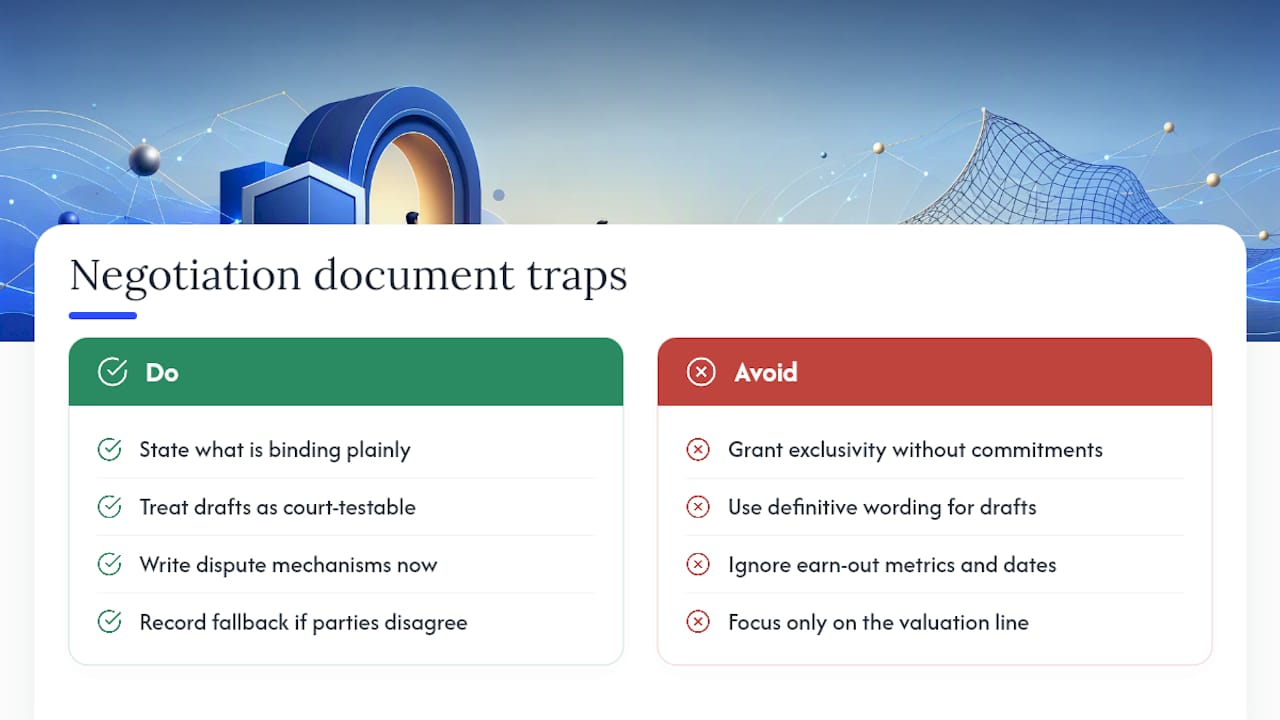
Premature exclusivity is the most common one. A seller grants a 90 day no shop window before the buyer has shown any real financing commitment, then discovers three months later that the buyer's capital fell through and the market has moved on. Unintentional binding language runs a close second: a founder writes "the parties agree" instead of "the parties intend" throughout a document meant to stay non-binding, and a court later reads that word choice as evidence of real commitment, not draft language.
Price tunnel vision causes its own damage. Negotiators spend three weeks fighting over a valuation number and sign off on vague earn-out language without a second thought, then spend the next eighteen months arguing over what "meeting projected revenue targets" actually meant. Open-ended earn-outs, ones without hard metrics, dates, and a dispute mechanism, are one of the most litigated provisions in mid-market M&A for exactly this reason.
The best drafting habit is treating every preliminary document as if the vague parts will get tested in court, because sometimes they will. State plainly what is binding, state plainly what is not, and never let silence on a point stand in for an agreement.
Pro Tip: If a clause matters enough to fight over now, write down what happens if you disagree about it later. A missing dispute mechanism on an earn-out or a working capital adjustment is the single most expensive gap in the deals that end up in litigation.
How courts decide whether your loi or term sheet is really binding
Judges do not start from the document's title. They start from four questions: what the language actually says, the context surrounding the negotiation, whether material terms were left open, and whether either party acted as if the deal were already done. That last factor, partial performance, is the one dealmakers underestimate most. Start integrating teams or announcing a deal internally before signing, and a court may treat that conduct as proof you considered the arrangement final.
Lawyers group the outcomes into two categories. A Type I agreement is treated as fully binding, essentially a completed deal that just needs formal paperwork. A Type II agreement binds the parties only to negotiate in good faith toward a final contract, which still creates real liability if one side walks away without a legitimate reason.
Real cases show the stakes: the Texaco-Pennzoil dispute remains the textbook example of a preliminary agreement triggering billions in liability. For public companies, a term sheet or LOI with sufficiently firm terms can also trip disclosure obligations well before signing, which is one more reason to get the language right the first time rather than fixing it after regulators or opposing counsel notice.
A practical checklist before you sign an LOI or term sheet
Before either document goes out for signature, run it against this list:
- Parties named correctly, with full legal entity names, not shorthand.
- Economic terms: price, valuation, or financing amount stated as a range or figure, with the currency and any adjustment mechanism spelled out.
- Deal structure: asset, stock, or merger; equity or debt instrument type.
- Due diligence scope and the timeline for completing it.
- Binding carve-outs listed by name, not implied.
- Exclusivity period, with a start date, end date, and termination trigger.
- Overall timeline to definitive agreement and expected closing.
- Expense allocation if the deal terminates before closing.
- Signature block for authorized representatives of each party.
Push back hard on any draft that leaves exclusivity open ended, that uses "agree" instead of "intend" in the non-binding sections, or that buries carve-outs in a single dense paragraph instead of naming them clearly.
The gap between a good template and a good deal
Templates get you 80 percent of the way there, and that last 20 percent is where most founders get hurt. A model LOI or term sheet will have the right sections in the right order. What it cannot do is tell you whether your specific exclusivity window is too generous, whether your earn-out metric is actually measurable, or whether the buyer across the table has a track record of using non-binding language as leverage before walking away.
My honest read after looking at how these disputes actually play out: the documents that cause the least damage are the ones that state their own limits out loud, in plain language, rather than relying on the word "non-binding" to carry the whole legal weight. That single habit, naming carve-outs instead of implying them, prevents more litigation than any clever valuation clause ever will.
Use a template to get moving fast. Hire counsel the moment the deal size, the earn-out structure, or the exclusivity terms get complicated enough that a mistake would actually cost you something.
— Alex
How Formable helps you draft and close these documents faster
Getting the language right on an LOI or term sheet used to mean bouncing between a template file, a redline thread, and a separate e-signature tool, with real risk of losing track of which carve-out language actually made it into the final version. Formable's contract creator combines templates with generative AI, so you can draft a term sheet or LOI from a standard structure and adjust the clauses that matter for your specific deal in minutes, not days.
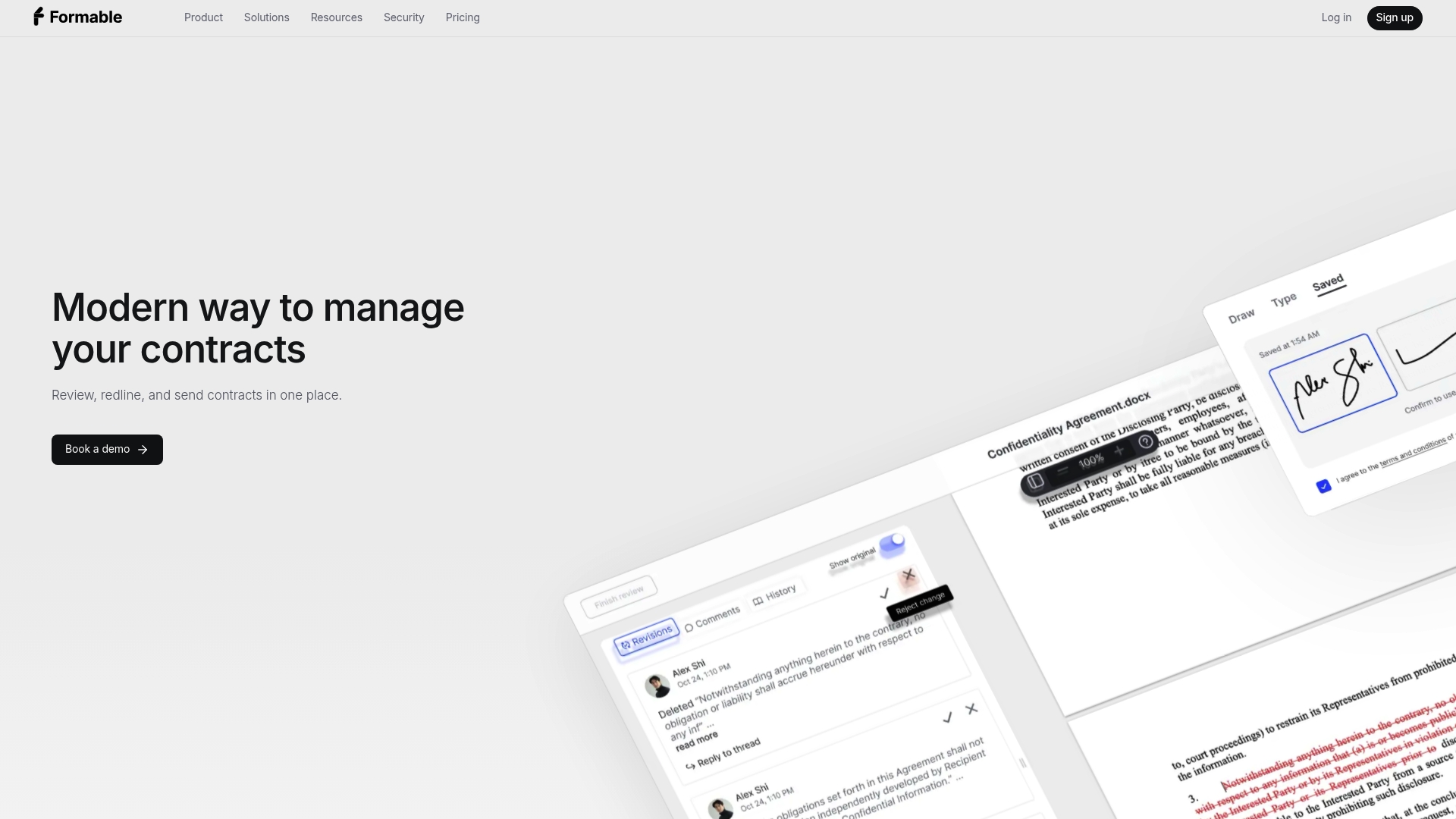
Once a draft exists, Formable's AI contract review engine can flag missing binding carve-outs, vague earn-out language, or exclusivity terms that leave a termination trigger undefined, catching the exact traps that turn a friendly negotiation into a legal dispute. When it is time to negotiate, browser-native redlining lets both sides mark up the same document in real time instead of emailing versions back and forth, and built-in e-signing closes the loop the moment terms are settled. Pro plans are available, with current pricing details on the Formable pricing page.
Sources
For venture financings, NVCA's model legal documents remain the closest thing the industry has to a standard term sheet. Nolo's guide to drafting an LOI or term sheet and LegalClarity's breakdown of binding LOI provisions both cover drafting mechanics in more depth than a single article can. Formable's own LOI and term sheet templates are built for readers who want to start drafting immediately.
This article is general information, not a substitute for advice from a qualified lawyer. Consult a qualified legal professional about your own circumstances before acting on anything here.
- What is an LOI contract and which provisions are binding?
- US Letter of Intent / Term Sheet handbook (Chaindoc)
FAQ
Is a term sheet a letter of intent?
No. Both are preliminary deal documents, but they serve different transaction types and look different on the page. A term sheet is a bulleted outline used mainly in financings, while an LOI is a narrative letter used mainly in acquisitions.
Are term sheets enforceable?
Parts of them usually are, even when the header says "non-binding." Courts have consistently found that confidentiality, exclusivity, and expense provisions hold up as binding obligations, regardless of what the rest of the document says about the deal's economic terms.
Is an LOI as good as a definitive agreement?
No, and it should not be treated that way. An LOI records intent and locks in a handful of binding procedural terms, but the full legal protections, representations, warranties, and closing mechanics only exist in the definitive purchase agreement that follows.
What is a term sheet?
A term sheet is a short, bulleted document, typically two to five pages, that records the economic and governance terms of a financing before the parties draft full legal contracts. Formable's term sheet template gives founders and investors a starting structure that follows this same standard format.