Remote online notarization (RON) lets a commissioned notary witness your signature over live audio-video instead of in the same room. The document, signature and notary seal are all electronic. The notary checks your identity, watches you sign and records the session. If your agreement needs a notarial act, the smooth path is to finish drafting, review and negotiation first, so the notary only sees a final document. We built Formable to run that earlier stretch in one workflow, from AI contract review to e-signing.
TL;DR
- RON is notarization for a signer in a different location, done over two-way audio-video with electronic documents, seals and identity checks.
- It differs from a plain e-signature: a notary verifies who you are and witnesses the act. It also differs from in-person electronic notarization, where you sit with the notary.
- Rules are set state by state. Identity methods, recording rules and eligible documents vary.
- A valid RON act is not always accepted by the recipient. County recorders, lenders and courts can add their own requirements, so confirm first.
- Get the contract final before the session. Edits after notarization can mean starting over.
What remote online notarization is
The National Notary Association describes RON as notarization for a remotely located signer who appears before the notary using two-way audio-video technology. It generally uses electronic documents, signatures and seals, multifactor identification, an audio-video recording and tamper-evident technology (NNA).
Three terms get mixed up, so here is the difference.
| Term | Who verifies identity | Where the signer is | Notary involved |
|---|---|---|---|
| Electronic signature | Usually the sender or the signing platform | Anywhere | No |
| In-person electronic notarization (IPEN) | The notary, face to face | Physically with the notary | Yes |
| Remote online notarization (RON) | The notary, over video plus ID checks | Anywhere the state allows | Yes |
An e-signature shows that someone agreed to a document. A notarization adds a trained, commissioned official who confirms the signer is who they claim to be. IPEN notarizes an electronic document with the signer in the room. RON removes the room.
Do you need a notary at all?
Most commercial agreements do not need one. MSAs, SOWs, NDAs, order forms and pilot agreements are normally enforceable with a properly captured e-signature and a clean record of who signed and when. A notary enters when a statute, a lender, a court, a recorder or the counterparty asks for a notarial act.
Common examples include affidavits, powers of attorney, corporate resolutions, deeds, title documents and mortgage closing packages. Colorado's official notary handbook lists the kinds of electronic documents a remote notary may handle under that state's law (Colorado notary handbook). If you are not sure whether your document needs notarization, ask the party who will rely on it, or your lawyer, before you book anything.
How a RON session works, step by step
Platforms differ, but the sequence is consistent. The signer appears before the notary in real time over audio-video. The notary verifies identity, then completes the notarization with an electronic signature and seal using tamper-evident technology. In most states the act is also logged in an electronic journal (NNA).

1. Finalize the document
Everything that can change must be settled before the session. A notary does not negotiate your terms, and a notarized file that is edited afterward is no longer the notarized file. This is where teams lose time: legal sends a redline, a counterparty adds a clause, and the notary appointment is already booked.
This step is the one we handle. In Formable you can generate the agreement from templates with generative AI, run AI contract review against your playbook to catch risks and missing clauses, and negotiate in the browser with collaborative redlining until both sides align. Only then is the document ready for a notary.
2. Upload and prepare the file
The signer or the sender uploads the final document to the RON platform the notary uses. Check names, dates, signature blocks and any notarial wording the receiving party requires. A wrong name on the signature line is the most common reason a session ends early.
3. Prove who you are
The platform checks your identity before the notary ever sees you. Oregon's real estate agency says the signer generally needs reliable internet, a laptop or desktop with a camera and microphone, and current government-issued identification. The platform verifies identity with measures that include knowledge-based authentication (KBA) questions and credential analysis (Oregon Real Estate Agency).
4. Meet the notary on video
The notary and signer must be able to see, hear and understand one another in real time, and the notarized document must state that communication technology was used, according to the same Oregon guidance. The notary confirms your identity, confirms you understand the document and are signing willingly, and watches you sign.
5. Sign, seal and receive the file
You sign electronically while the notary watches. The notary applies an electronic signature and seal with tamper-evident technology. You receive the notarized file, and the session recording and journal entry are retained by the notary under state rules.
Identity checks in detail
The NNA says most states require two or more identity-check methods, which may include KBA, credential analysis or other multifactor identification (NNA).
Ohio gives a concrete example. When the notary does not personally know the signer, Ohio's rule requires an unexpired government ID, credential analysis and identity proofing. Its KBA standard requires at least five personal-history questions, at least 80% correct answers and completion within two minutes (Ohio Administrative Code 111:6-1-05).
Two practical points follow:
- Have your ID ready and unexpired. A lapsed license can end the session before it starts.
- Watch for limited U.S. credit history. Oregon's real estate agency warns that KBA questions may draw on U.S. credit, banking and residence history, so a signer without enough of it may not be able to finish that method (Oregon Real Estate Agency). This matters for newly arrived founders and international hires. Ask the notary platform which alternative identity methods the state allows.
Security, recording and privacy
RON is built around a record. NASS principles say audio-video communications should be reasonably secure from interception, and session recordings should be securely captured, archived and stored (NASS).
Retention periods are set by state. Colorado's handbook says each remote transaction's recording must be securely stored for 10 years, and a notary cannot proceed if the remotely located individual does not agree to being recorded (Colorado notary handbook). Oregon's Secretary of State says an electronic journal is required for remote notarizations and, under the rule described there, must be kept for 10 years from the last transaction (Oregon Secretary of State).
For you as a signer, that means your face, your ID details and the content of the document sit in a recording for years. Sign from a private room, and think about what is visible on your screen and behind you. If the document contains commercial terms or personal data, make sure only the people who need to be on the call are on it.

Is RON legal in every state?
No single national rule governs it. NASS notes that state enactments differ on remote paper transactions, permitted notarial duties, jurisdiction, identity methods, technology standards and security requirements. Its examples show Virginia, Texas and Nevada authorizing electronic remote notarization, while Montana also allowed certain remotely performed wet-ink acts (NASS). That paper dates from 2017, so many states have acted since. Check the current statute or the Secretary of State's page for the state of the notary.
The notary's commissioning state matters most. Colorado's handbook states that a remote notary must be physically located in Colorado, while the remotely located individual may be in another state or country, subject to special conditions for signers outside the United States (Colorado notary handbook). So a founder in San Francisco can usually be notarized by a notary commissioned in a state that allows RON, if that state's rules and the receiving party agree.
What can and cannot be notarized remotely
Common eligible categories include affidavits, powers of attorney, business contracts, corporate resolutions, deeds, title documents and mortgage packages, where the governing state permits them.
Exclusions exist too. Federal ESIGN exclusions and state carve-outs can reach wills, codicils, testamentary trusts, family-law matters and election records. Colorado's handbook, for instance, excludes election-related records and generally excludes wills and codicils except as its electronic-wills law provides (Colorado notary handbook).
Real estate adds another layer. Deeds and closing documents also need the approval of the lender, the title company and the county recorder. If you build products around these documents, our developer playbook on embedding e-signable Iowa estate affidavits with RON shows how a state-specific document and a remote notarization step fit together.
Will the other side accept it?
Legal validity and practical acceptance are different questions. A properly performed act is generally governed by the law of the notary's commissioning state and can receive interstate recognition even when the signer and recipient are elsewhere. Acceptance is not guaranteed: county recorders, lenders, courts, agencies and private counterparties may apply their own rules, so confirm before the session, especially for real estate recording and loan closings (Colorado notary handbook).
A short pre-session checklist:
- Ask the receiving party in writing whether it accepts remotely notarized documents.
- Ask whether it requires a particular notarial certificate wording.
- For recording, confirm the county accepts electronic documents, or whether a hybrid closing is needed.
- Confirm the notary's commissioning state and that RON is authorized there.
- Confirm the document is final and every signer will attend.
That last step is where a contract workflow helps. Notarization is the last mile. Most of the delay is upstream, in review cycles and version confusion.
Where RON fits in a contract workflow
A typical growth-stage deal might look like this (a hypothetical example). A startup closes a pilot with a regional customer. The customer's legal team wants a corporate resolution notarized to prove the signer has authority. The pilot agreement itself needs only signatures.
The efficient sequence:
- Draft the pilot agreement and the supporting documents from templates.
- Review incoming paper against your playbook for risky or missing clauses.
- Negotiate the redlines in one shared place.
- E-sign the commercial agreement with an audit trail.
- Book the notary session only for the document that needs it, after its text is locked.
Separating the two keeps notarization small and predictable. It also keeps a notary appointment from becoming the bottleneck for the whole deal.
Our view on RON and deal speed
We talk to teams who treat notarization as the hard part of closing a deal. Usually it is not. The slow part is everything before it: a contract that sits in someone's inbox, a clause nobody caught, a redline in a PDF that no one can reconcile with the last version.
Formable puts drafting, review, negotiation, redlining, e-signing and tracking in one workflow, so the document reaches its final state faster. When a deal does need a notarial act, you arrive at the session with a locked document and a clear record of what was agreed and who signed.
Our approach is to keep the agreement moving in one place. Our AI contract review checks incoming documents against your playbook and flags risks and missing clauses. Our audit trails record the signing history, and our APIs let developer teams embed redlining and e-signing in their own product.
Alex
Getting your agreements ready for notarization
If your team handles high volumes of contracts, the first gain is usually not in the notary session at all. Formable's E-Signing is a standalone signing product with audit trails, and browser-native negotiation lets both parties align on terms before signing. The Pro plan is listed at $19.99 per month on our pricing page.
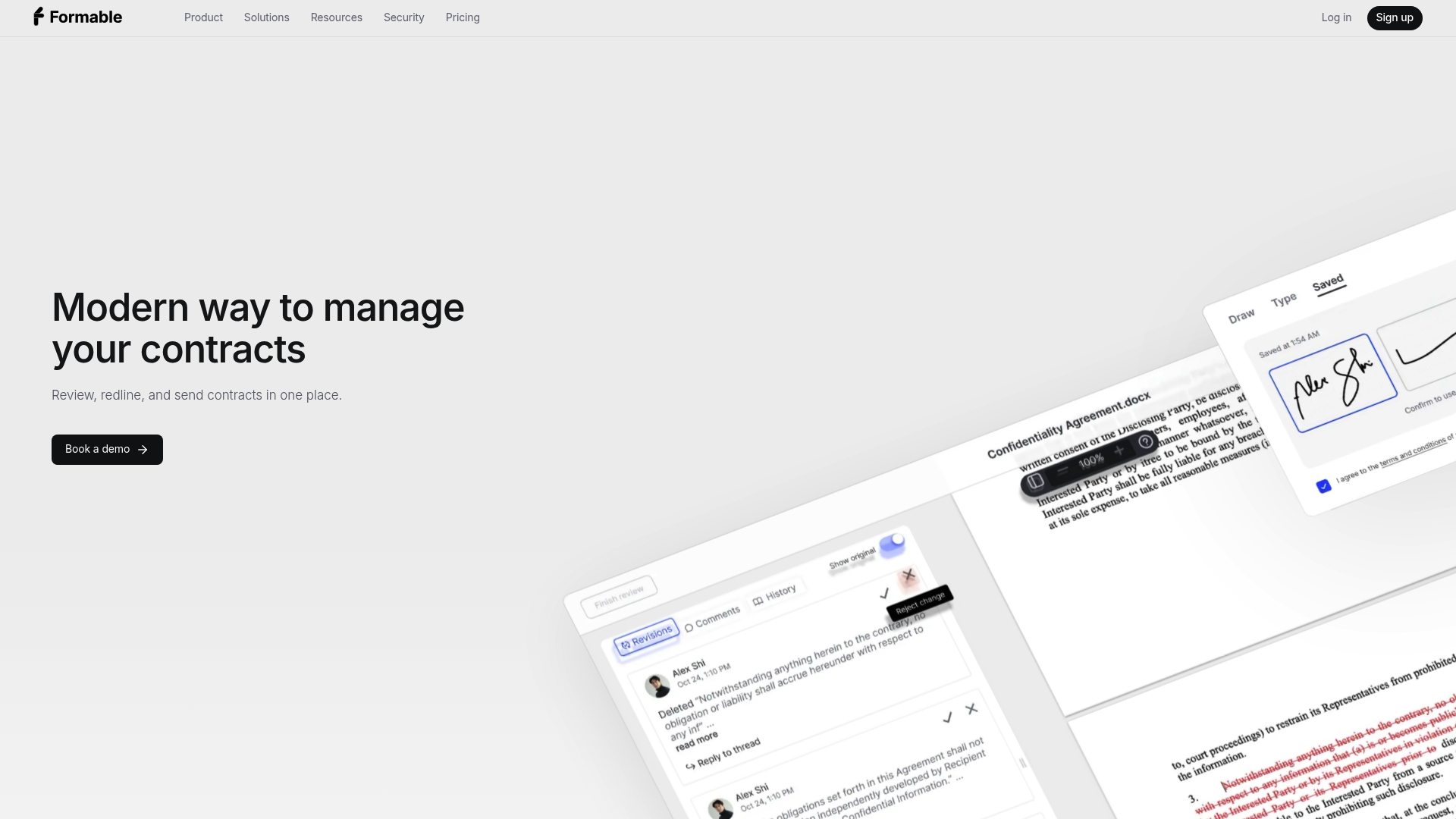
Developers building signing into a product can look at the embedded e-signing API and the Redlining API. The Growth API plan is listed at $29.99 per month on the API pricing page. Our security and legally binding e-signatures page explains how signing is handled.
Common mistakes to avoid
- Booking before the document is final. Any text change after the session usually means repeating it.
- Assuming the state of the signer sets the rules. The notary's commissioning state is the starting point.
- Skipping the recipient check. A recorder or lender may refuse a document that is legally fine.
- Poor camera or connection. The notary must be able to see, hear and understand you in real time.
- Expired ID. Credential analysis fails on an unexpired-ID requirement.
- Declining the recording. In Colorado, for example, a notary cannot proceed without consent to be recorded.
FAQ
Is remote online notarization the same as an e-signature?
No. An e-signature records agreement to a document. RON adds a commissioned notary who verifies your identity over audio-video, witnesses the act and applies an electronic seal. Many agreements need only the e-signature.
What do I need for a RON session?
Oregon's guidance lists reliable internet, a laptop or desktop with a camera and microphone, and current government-issued ID. You will also go through identity checks such as KBA questions and credential analysis, which vary by state.
Can I be notarized remotely if I am in a different state from the notary?
Often yes. The notary generally must be located in their commissioning state, while the signer may be elsewhere, subject to that state's conditions. Confirm that the notary's state allows RON and that the receiving party accepts it.
Can any document be notarized online?
Not every one. Wills, codicils, testamentary trusts, family-law matters and election records are commonly excluded or restricted, and real estate documents need lender, title and county approval. Check the governing state's rules for your document.
How long does a notarial recording have to be kept?
It depends on the state. Colorado requires secure storage of each remote transaction's recording for 10 years, and Oregon requires its electronic journal be kept 10 years from the last transaction.