Developer playbook: embed e-signable Iowa estate affidavits with RON

Alex Shi

Yes, you can use an e-signable sworn affidavit in a commercial contract workflow, and it holds up legally when 15 U.S.C. § 7001 (E-SIGN) and state UETA rules are satisfied. Start with a compliant template that captures affiant identity, factual assertions, and perjury language, as detailed in this practical guide to document digitization. Then confirm whether the recipient requires notarization, and capture a tamper evident audit trail before you send it out for signature.
TL;DR:
- An e-signable sworn affidavit is legally valid when compliant with federal and state requirements, including proper templates, notarization, and tamper-proof audit trails.
- The affidavit must contain specific elements such as detailed factual statements, affiant's role, entity name, competency language, and a notary or unsworn declaration, to ensure enforceability.
- Notarization, including remote online notarization, provides essential third-party verification; ensure jurisdictional rules and foreign authentication needs are addressed beforehand.
- Legally, federal law and UETA affirm electronic signatures’ validity when consent, retention, and identity verification are met; jurisdiction-specific exceptions require careful review.
- Implementation involves creating standardized templates with conditional notarization, verifying authority before signing, capturing session metadata, and integrating automation into contract workflows.
Table of Contents
- When a sworn affidavit belongs in a commercial closing or contract pack
- Checklist: required elements for a business affidavit template
- Notarization and RON: when a sworn affidavit needs a notary
- What E-SIGN and UETA require before you rely on an e-signed affidavit
- How to implement an e-signable affidavit in your contract workflow
- Integration notes for developers embedding affidavits
- Best practices and red flags legal teams should watch for
- Iowa estate affidavit requirements and standard forms
- How Iowa uses estate affidavits in probate administration
- Who qualifies to use an Iowa estate affidavit and where it falls short
- Estate affidavits versus other Iowa probate documents
- Why template discipline beats improvisation on every affidavit
- Put affidavit workflows on the same rails as your other contracts
- Sources
- FAQ
When a sworn affidavit belongs in a commercial closing or contract pack
Affidavits show up whenever a counterparty needs a factual statement backed by legal weight rather than a simple representation buried in contract boilerplate. They differ from officer certificates, which confirm corporate authority, and from ordinary reps and warranties, which live inside the agreement itself and carry contract remedies instead of perjury exposure.
Commercial teams reach for a sworn affidavit in a handful of recurring situations:
- Confirming a signer's authority to bind an entity when a board resolution is missing or stale
- Attesting to the accuracy of business records during due diligence or an acquisition
- Making factual statements about ownership, liens, or prior agreements during a closing
- Satisfying a lender, title company, or foreign registry that demands a sworn statement over a simple representation
Watch for recipients who specifically ask for "sworn" or "notarized" language in a closing checklist. That request signals they want evidentiary weight a standard signature block cannot provide.
Checklist: required elements for a business affidavit template
A weak affidavit template is the single biggest source of enforceability disputes. According to LegalClarity's drafting guidance, a properly built business affidavit needs six components working together, not just a signature line at the bottom.
- Affiant identity and title. Full legal name, role, and relationship to the matter at hand.
- Exact entity name and jurisdiction. Match the corporate name character for character against formation documents, including the state of organization.
- Competency language. State whether the affiant speaks from personal knowledge or from a review of business records, since the two carry different evidentiary weight.
- Specific factual statements. Dates, dollar amounts, account numbers, and exhibit references, never vague summaries.
- Perjury or unsworn declaration language. Use formal notary wording, or 28 U.S.C. § 1746 unsworn declaration language where a notary is not required.
- Signature and notary block. Space for the affiant's signature, date, and a notary acknowledgment section if applicable.
Pro Tip: Build one master template with conditional fields for notarization, then let your workflow tool suppress or require the notary block based on the deal type. That single decision eliminates most last-minute redrafts.
Notarization and RON: when a sworn affidavit needs a notary
Notarization matters because it adds an independent witness who confirms identity and willingness to sign under oath. That third-party confirmation is often what a lender, court, or foreign registry is actually asking for when they say "sworn statement," not just a signature.
Remote online notarization (RON) preserves that evidentiary value without an in-person meeting. According to practitioner guidance on RON operations, a compliant RON session needs several pieces working together:
- A recorded audio-video session showing the notary and signer in real time
- Multi-factor identity verification tied to a government issued ID
- Confirmation that the notary's commission state permits RON for this document type
- A tamper-evident electronic seal applied to the finished document
- A journal entry logging the session for later audit
Statistical Insight: State RON rules vary meaningfully. Florida's statute on electronic notary journals and seals is a useful example of how granular state-level operational requirements can get, right down to how the electronic journal must be secured and retained.
Before you rely on RON for a cross-border deal, check whether the receiving party needs an apostille or authentication chain. A notary seal alone rarely satisfies a foreign registry, so plan that extra authentication step into your timeline rather than discovering it at the closing table.
What E-SIGN and UETA require before you rely on an e-signed affidavit
The federal rule is straightforward: 15 U.S.C. § 7001 says a signature or record cannot be denied legal effect solely because it exists in electronic form, and that includes notarization and acknowledgment requirements when the electronic signature is logically associated with the record. The govinfo mirror of §7001 restates the same consent and retention requirements for anyone who needs a citation-ready reference.
State UETA statutes generally align with this federal framework, but American Bar Association commentary points out that counsel still needs to check jurisdiction-specific exceptions and UCC interactions before treating e-signature acceptance as automatic.
Before you launch an e-signable affidavit flow, confirm you have covered the practical side of the statute, not just the legal theory:
- Documented consent from the signer to conduct the transaction electronically
- Clear notice of the hardware and software needed to access and retain the record
- A retention format that lets any party reproduce the signed document later
- Logical association between the electronic signature and the document it authenticates
Formable's security and e-sign compliance page walks through how these consent and retention pieces get built into a signing flow rather than bolted on afterward.
How to implement an e-signable affidavit in your contract workflow
Building this into a repeatable workflow means treating the affidavit like any other contract artifact, not a one-off legal exception.
- Map the template. Define required fields, mark which ones trigger a notarization requirement, and attach exhibit slots for supporting documents.
- Verify identity and authority. Confirm the affiant's role against an officer certificate or board resolution before the document goes anywhere near a signature request.
- Route for notarization if required. Schedule a RON session or in-person notary appointment, and capture the session recording and journal entry as part of the record.
- Send for electronic signature. Use an e-sign flow that logs consent, timestamps, and device information alongside the signature itself.
- Finalize and store. Generate a tamper-evident, sealed PDF and file it with full audit metadata so it can be retrieved and verified months or years later.
Pro Tip: Treat notarization as a conditional branch in your workflow rather than a separate manual process. If the field logic in your template already knows which affidavits need a notary, nobody on your deal team has to remember it.
Formable's step-by-step signature collection checklist covers the same sequence in more operational detail for teams building this out for the first time.
Integration notes for developers embedding affidavits
Engineering teams building affidavits into a contract platform generally follow the same pattern used for any embedded signing flow: generate a template, populate the fields programmatically, create a signature request URL, embed the signing interface, then finalize and store the completed record.
The metadata that matters most for defensibility later includes:
- The identity verification method used for the signer (knowledge-based, ID scan, or RON)
- A precise timestamp for each signing event
- IP address and device fingerprint at the moment of signature
- A cryptographic hash of the final document
- The notarization certificate or RON session ID, when notarization applied
According to Formable's embedded signing documentation, capturing signer proof, consent records, document hash, and notarization metadata as structured fields, rather than free text, lets automated review and any later discovery process reproduce the record exactly as it was signed.
Pro Tip: If your platform already runs AI contract review, point it at the affidavit template before it goes out. It can flag a missing exhibit reference or an inconsistent entity name faster than a human reviewer scanning a closing pack at midnight.
Best practices and red flags legal teams should watch for
The gap between a defensible affidavit and a disputed one usually comes down to a handful of habits.
Do this:
- Require documented proof of the affiant's authority before routing for signature
- Include perjury or unsworn declaration language on every version, no exceptions
- Capture a complete audit trail, including consent, timestamps, and device data
- Store the final document in a format any party can reproduce years later
Don't do this:
- Accept vague factual statements that lack dates, amounts, or specific identifiers
- Rely on weak identity verification when a recipient expects notarization
- Skip notarization because it feels like an extra step, if the recipient asked for it
Pro Tip: A mismatched entity name between the affidavit and the underlying contract is the single most common defect counsel catches on review. Cross-check the legal name against formation documents every single time, not just on the first draft.
Iowa estate affidavit requirements and standard forms
Iowa's small estate affidavit process runs through Iowa Code chapter 635, and it uses a specific court-approved form rather than a generic sworn statement drafted from scratch. The affidavit has to identify the decedent, list the personal property being collected, name the successor entitled to that property, and confirm no formal probate proceeding is pending.
Iowa courts expect the affidavit to include a statement that debts, funeral expenses, and any Medicaid recovery claims have been addressed or accounted for. Filers typically attach a death certificate and, in some cases, a will if one exists, even though the small estate procedure exists specifically to avoid full probate.
Because the form has to be filed with the clerk of the district court in the county where the decedent lived, accuracy on entity and property descriptions matters as much as it does in a commercial affidavit. A missing account number or an imprecise property description can send the filing back for correction, adding weeks to what is supposed to be a fast process.
Anyone drafting or reviewing one of these forms for a client should treat the required statements the same way a commercial affidavit treats its factual assertions section: specific, dated, and tied to identifiable exhibits like a death certificate or an account statement, rather than general summaries of what the estate contains.
How Iowa uses estate affidavits in probate administration
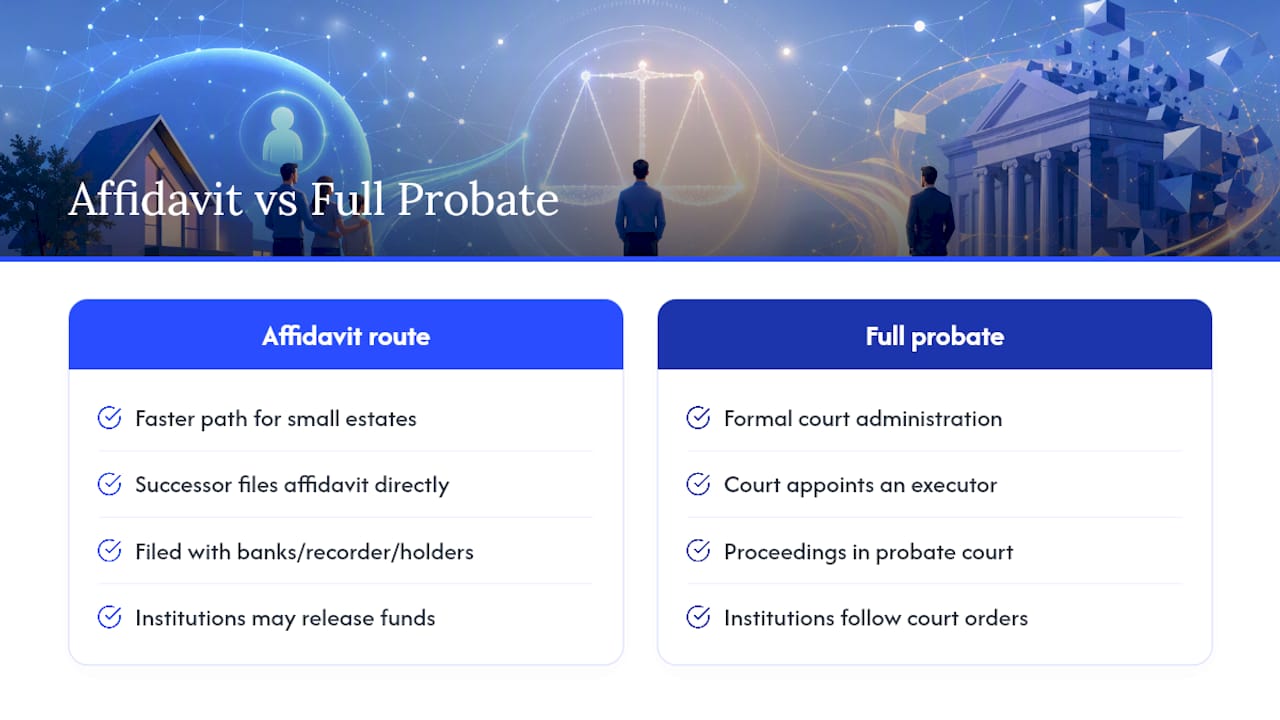
Iowa's estate affidavit exists to give families a faster path through estate administration when a full probate case would be disproportionate to what is actually in the estate. Instead of opening a formal case with a court-appointed executor, the successor files the affidavit directly with financial institutions, the county recorder, or other parties holding the decedent's property.
Banks and other institutions holding accounts in the decedent's name will generally release funds once they receive a properly executed affidavit, since Iowa law protects institutions that rely on the sworn statement in good faith. That protection is part of why the form has such specific statutory requirements. It shifts risk away from the institution and onto the accuracy of what the affiant swears to.
The affidavit does not substitute for probate in every case. If the estate includes real property with a disputed title, active creditor claims, or family disagreement over who is entitled to the property, a court will often require the full probate process regardless of the estate's size. The affidavit route works best for straightforward estates: a bank account, a vehicle title, maybe a small retirement account, with a clear, uncontested successor.
For estates that fall outside the simplified path, Iowa's probate court process still applies, and the estate affidavit becomes irrelevant once formal administration begins. Understanding which category an estate falls into before drafting anything saves considerable time.
Who qualifies to use an Iowa estate affidavit and where it falls short
Iowa limits the small estate affidavit process by the total value of the estate, and that dollar threshold is the first thing anyone should check before drafting the form. Estates that exceed the statutory cap have to go through formal probate administration instead, regardless of how simple the underlying assets look.
Even estates under the value threshold can run into limitations that push them back toward full probate:
- Real estate with an unclear or disputed title generally cannot be transferred cleanly through the affidavit process alone
- Outstanding creditor claims or unresolved debts complicate the good-faith reliance institutions need before releasing assets
- Disputes among heirs over who qualifies as the rightful successor often require a judge to resolve, which the affidavit process was never designed to do
- Certain asset types, particularly those requiring a formal title transfer through a state agency, may need additional documentation beyond the affidavit itself
The affidavit process also assumes there is no will contest and no pending probate case already open for the same decedent. If a formal case exists, the affidavit route is no longer available, and the estate has to proceed through whatever probate case is already underway.
Anyone unsure whether an estate qualifies should treat the value threshold as a starting checkpoint, not a final answer. The combination of asset type, title status, and family agreement determines whether the simplified process actually works, or whether it just delays the inevitable move to full probate.
Estate affidavits versus other Iowa probate documents
An Iowa estate affidavit is not interchangeable with the other documents that show up in probate administration, and confusing them causes real delays.
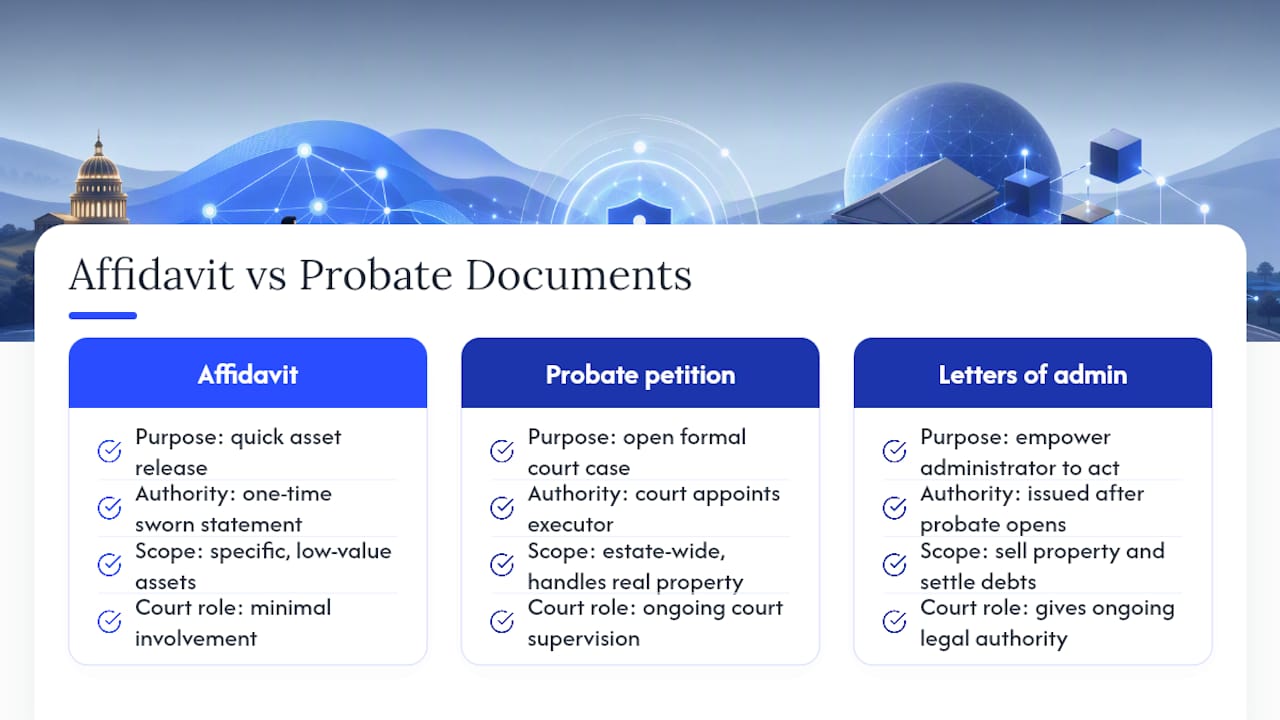
A full probate petition opens a formal court case, appoints an executor or administrator, and puts the estate under ongoing court supervision until the case closes. That process handles creditor claims, contested assets, and real property transfers that the affidavit process was never built to manage. It takes longer and costs more, but it produces a court order that resolves disputes definitively.
Letters of administration, issued once a probate case is open, give the appointed administrator legal authority to act on the estate's behalf, including selling property or settling debts. The affidavit grants no comparable ongoing authority. It is a one-time sworn statement used to unlock specific assets, not a standing legal appointment.
A will, if one exists, still needs to be filed with the court in most cases even when the estate qualifies for the simplified affidavit process, since the affidavit does not replace probate of the will itself if the will needs to be formally admitted. The two documents often move in parallel rather than one substituting for the other.
The practical distinction that matters most: the affidavit is a tool for unlocking specific, low-value assets quickly with minimal court involvement, while probate petitions and letters of administration exist for estates that need ongoing court oversight, dispute resolution, or authority broader than a single asset release.
Why template discipline beats improvisation on every affidavit
Most enforceability disputes trace back to a template problem, not a signature problem. Teams draft an affidavit from a prior deal, forget to update the entity name or the competency language, and end up with a document that looks sworn but has a factual gap a counterparty's counsel will catch immediately. Templates plus RON and a documented audit trail close most of that gap before it becomes a fight.
Template libraries, embedded signing APIs, redlining, and AI contract review tools exist precisely because that discipline is hard to maintain by hand across dozens of deals a quarter.
— Alex
Put affidavit workflows on the same rails as your other contracts
Affidavit drafting can be turned into a repeatable step in your contract process instead of a special legal exception someone handles manually every time. Template libraries cover the required fields a business affidavit needs, embedded e-sign APIs generate signature request URLs you can drop straight into your own product, and audit trails capture the timestamp, device data, and document hash a defensible record needs.
For teams that also need notarization built into the flow, Formable's e-sign security and compliance features explain how consent disclosures and retention formats map to E-SIGN and UETA requirements without extra manual tracking. Developers can start with the embedded signing documentation to see exactly how the signatureRequestUrl pattern fits into an existing product. If your team is manually rebuilding affidavit templates for every deal, that is the first workflow worth automating. Start with a template in Formable or reach out to talk through your specific integration needs.
Sources
Confirm the statutory basis directly rather than taking any summary at face value. The federal text lives at 15 U.S.C. § 7001 and its govinfo mirror. The ABA's commentary on electronic signatures covers practical opinion-letter issues, and operational RON guidance explains notary journal and apostille steps.
- 15 U.S.C. § 7001: General rule of validity
- USCODE-2024-title15-chap96-subchapI-sec7001
- Comment Concerning Use of Electronic Signatures and Third-Party Opinion Letters
FAQ
Can you sign a sworn affidavit electronically?
Yes, under 15 U.S.C. § 7001, an electronic signature on an affidavit cannot be denied legal effect solely because it is electronic, provided consent and retention requirements are met.
Does an e-signed affidavit still need a notary?
It depends on the recipient and jurisdiction. Many commercial affidavits still require notarization or RON to carry evidentiary weight, even when the signature itself is electronic.
What is the difference between UETA and E-SIGN?
UETA is state-level legislation and E-SIGN is the federal statute; both generally validate electronic signatures, but counsel should confirm any state-specific exceptions before relying on either alone.
What fields does a business affidavit template need?
At minimum: affiant identity and title, exact entity name and jurisdiction, competency language, specific factual statements, perjury or unsworn declaration wording, and a signature and notary block.
Can Formable help embed affidavits into a contract workflow?
Yes. Formable's template library and embedded e-sign API let teams generate, populate, and route affidavits for signature with audit metadata captured automatically.