
The E-SIGN Act is a federal law and UETA is a state-level model law. Together they say that a signature or contract cannot be denied legal effect only because it is electronic. E-SIGN sets the national baseline. Most states have adopted UETA or a consistent alternative, so for ordinary business contracts such as MSAs, SOWs, NDAs and order forms, an electronic signature carries the same weight as ink when the basic conditions are met.
This guide explains how the two laws fit together, what makes an e-signature effective, which documents are excluded, and what to do operationally so your signed agreements hold up.
TL;DR
- E-SIGN (federal, signed June 30, 2000) and UETA (state law) both prevent a signature or record from being rejected solely because it is electronic.
- E-SIGN is the baseline. A state's UETA or consistent alternative generally governs state-law transactions, and E-SIGN controls where no qualifying state law applies.
- Validity turns on intent to sign, a link between the signature and the record, and consent to transact electronically, which in business deals can be implied.
- Wills, testamentary trusts, most UCC matters, court documents and certain notices are excluded, and consumers get extra consent protections.
- Keep an audit trail and a reproducible copy of every signed record.
What the E-SIGN Act does
Congress signed the Electronic Signatures in Global and National Commerce Act on June 30, 2000. It gives a general rule of validity for electronic records and signatures in transactions in or affecting interstate or foreign commerce, and its substantive provisions took effect October 1, 2000.
The core principle is simple. A signature, contract or record may not be denied legal effect, validity or enforceability solely because it is in electronic form. Both E-SIGN and UETA carry this rule.
Because it reaches commerce that crosses state lines, E-SIGN covers most B2B and SaaS deals. A contract between a startup in San Francisco and a customer in Texas is a typical example.
What UETA does
UETA, the Uniform Electronic Transactions Act, is a uniform framework that states adopt as their own law. It covers electronic records and signatures in business, commercial and governmental transactions, and it applies only where the parties have agreed to conduct the transaction electronically.
That agreement does not need to be a separate signed document. Under Connecticut's version, for example, agreement may be determined from context, surrounding circumstances and the parties' conduct. If both sides negotiate by email and sign through a platform, that conduct usually shows the agreement.
How E-SIGN and UETA fit together
The two laws are not rivals. E-SIGN supplies the federal baseline and lets states use UETA or another consistent, technology-neutral alternative. Under the ABA's explanation, a state UETA or alternative generally governs state-law transactions unless it is inconsistent with E-SIGN. Where no qualifying state law applies, E-SIGN controls.
The statute itself sets the conditions. States may modify or supersede E-SIGN for state-law matters by adopting UETA or consistent procedures that do not mandate a particular technology. A qualifying enactment after June 30, 2000 must refer specifically to E-SIGN.
| E-SIGN Act | UETA | |
|---|---|---|
| Level | Federal statute | Uniform law adopted state by state |
| Reach | Transactions in or affecting interstate or foreign commerce | Business, commercial and governmental transactions under state law |
| Core rule | No denial of effect solely because electronic | Same |
| Role | National baseline and consumer consent rules | Primary state-law rule where adopted |
| Consent to e-transact | Required for consumers receiving legally required writings | Parties must have agreed, which can be shown by context and conduct |
Where states differ
Most U.S. jurisdictions have adopted UETA or a consistent alternative. New York uses its own Electronic Signatures and Records Act. E-SIGN preserves qualifying variations that are consistent and technology-neutral. The ABA describes the practical result as substantially similar rules nationwide.

In practice, a business usually faces one broadly consistent outcome. The statutory route differs depending on whether the state adopted UETA or its own alternative, so a contract with a specific governing-law clause should be checked against that state's version.
What makes an electronic signature valid
The laws define an electronic signature broadly: an electronic sound, symbol or process attached to or logically associated with a record, and executed or adopted with intent to sign. Examples include a typed or scanned signature, a click-to-accept action, and a mouse or touchscreen signature.
That leaves four practical elements.
- Intent to sign. The signer must mean to be bound. A clear signing step, such as a button labeled to sign and a visible agreement, supports this.
- Association with the record. The signature must be tied to the specific document. A signature floating in a separate system does not help.
- Consent to transact electronically. For a business contract, the parties' agreement to use an electronic signature may be implicit.
- Evidence of adoption. Counsel at Haynes Boone note that the main enforceability facts are intent, linkage and proof the signer adopted the process. A platform alone does not guarantee validity if authenticity or intent cannot be shown.
E-signature is not the same as a digital signature
E-SIGN does not require digital signatures. A digital signature is one type of electronic signature, typically one based on cryptography. Neither law requires you to use it. Both are technology-neutral by design.
For a deeper comparison with ink, see our guide to wet signatures versus electronic signatures. If you are new to the basics, start with what electronic signatures are.
What the laws do not do
E-SIGN and UETA are procedural statutes. They remove paper and signature-form barriers, but they do not eliminate other substantive legal requirements, defenses or elements of contract formation. A contract still needs offer, acceptance, consideration and capacity. A signer who lacked authority is still a problem.
The laws also do not force anyone to go electronic. Neither statute generally requires a person to use or accept electronic records or signatures, and UETA expressly preserves a party's ability to refuse later electronic transactions, subject to applicable law.
Consumer consent rules
Most startup contracts are B2B, but if your product sends consumers information that a law requires to be in writing, E-SIGN adds a formal consent process. The statute requires affirmative electronic consent that has not been withdrawn, preceded by clear and conspicuous disclosures covering:
- the consumer's right to paper records and to withdraw consent;
- the scope of the consent;
- how to update contact information;
- how to get a paper copy and whether a fee applies;
- the hardware and software needed to access the records.
Consent must reasonably demonstrate that the consumer can access the electronic form that will be used. If the technology requirements change materially, revised disclosures and renewed confirmation are required. The FDIC summarizes the effect: an electronic record can satisfy a writing requirement when the consumer affirmatively consented and has not withdrawn.
Withdrawal works going forward. Records properly provided before withdrawal remain legally effective, and withdrawal takes effect within a reasonable period after the provider receives it.
If you are deciding between a signature and a simple acceptance flow for large user bases, our piece on clickwrap versus e-signature for policy updates covers the tradeoffs.
Documents the laws exclude
Not everything can be signed electronically under these statutes. Both exclude laws governing wills, codicils and testamentary trusts, and the UCC except for Articles 2 and 2A. E-SIGN also excludes, among others, specified family-law records, court documents and orders, utility cancellation notices, residential default, foreclosure and eviction notices, health or life insurance cancellation notices, product recalls and hazardous-substance transportation documents.
Specialized law may still authorize electronic handling of some of these. Before you automate a document type outside the usual commercial agreements, confirm the rule for that category with counsel.
Real estate teams should pay particular attention here, since some documents in the property world fall in or near these categories and others do not. For an overview of how these laws apply to a related use case, read about the legal validity of online lease signatures. Our own guide to defensible signing for construction and real estate looks at the workflow side.

Record retention and access
When a law requires a record to be retained, an electronic version must satisfy three tests. It must accurately reflect the original information, remain accessible to all legally entitled persons for the required period, and be capable of accurate reproduction for later reference. The underlying law, not E-SIGN or UETA alone, sets the retention period.
The OCC adds a caution: E-SIGN's retention rule does not automatically resolve evidentiary admissibility, integrity or every regulatory issue. Systems should preserve accuracy, prevent unauthorized alteration and support later production. In other words, the record has to be trustworthy, not merely stored.
A practical compliance workflow
Haynes Boone describes a workable sequence. We have adapted it for contract teams:
- Identify the governing state and federal law for the agreement.
- Confirm the transaction type is in scope and not excluded.
- Capture intent and consent, including consumer disclosures where they apply.
- Link the signature to the final version of the record.
- Preserve an audit trail and a reproducible copy.
In day-to-day terms, that means every signature event should carry a timestamp, the signer's identity details, the exact document version and a log of actions. If a signature is ever challenged, that record is your evidence. Our six-step checklist for collecting signatures digitally turns this into a task list for legal and dev teams.
Our perspective
Most signing disputes we see discussed are not about whether e-signatures are legal. They are about whether a team can prove what happened: who agreed, to which version, and when.
That is why we treat e-signing as one step in a single contract workflow, not a standalone tool. When drafting, review, negotiation, redlining and signing live in one place, the final record is tied to the negotiation that produced it. Intent and linkage are easier to show, and the audit trail is not stitched together from several apps.
Formable is designed so that signature events, timestamps and document versions stay connected. You can read how we approach this on our security and legally binding e-signatures page. For developers, the same signing flow is available through an e-signature API, so the legal evidence is captured inside your own product.
Alex
Putting this into practice with Formable
Formable is an AI-enabled contract management platform for startups and GTM teams. You can draft agreements with templates and generative AI, review incoming paper against your playbook, negotiate in the browser with redlining, and collect signatures in the same workflow. That covers MSAs, DPAs, SOWs, LOIs, order forms, NDAs and pilot agreements.
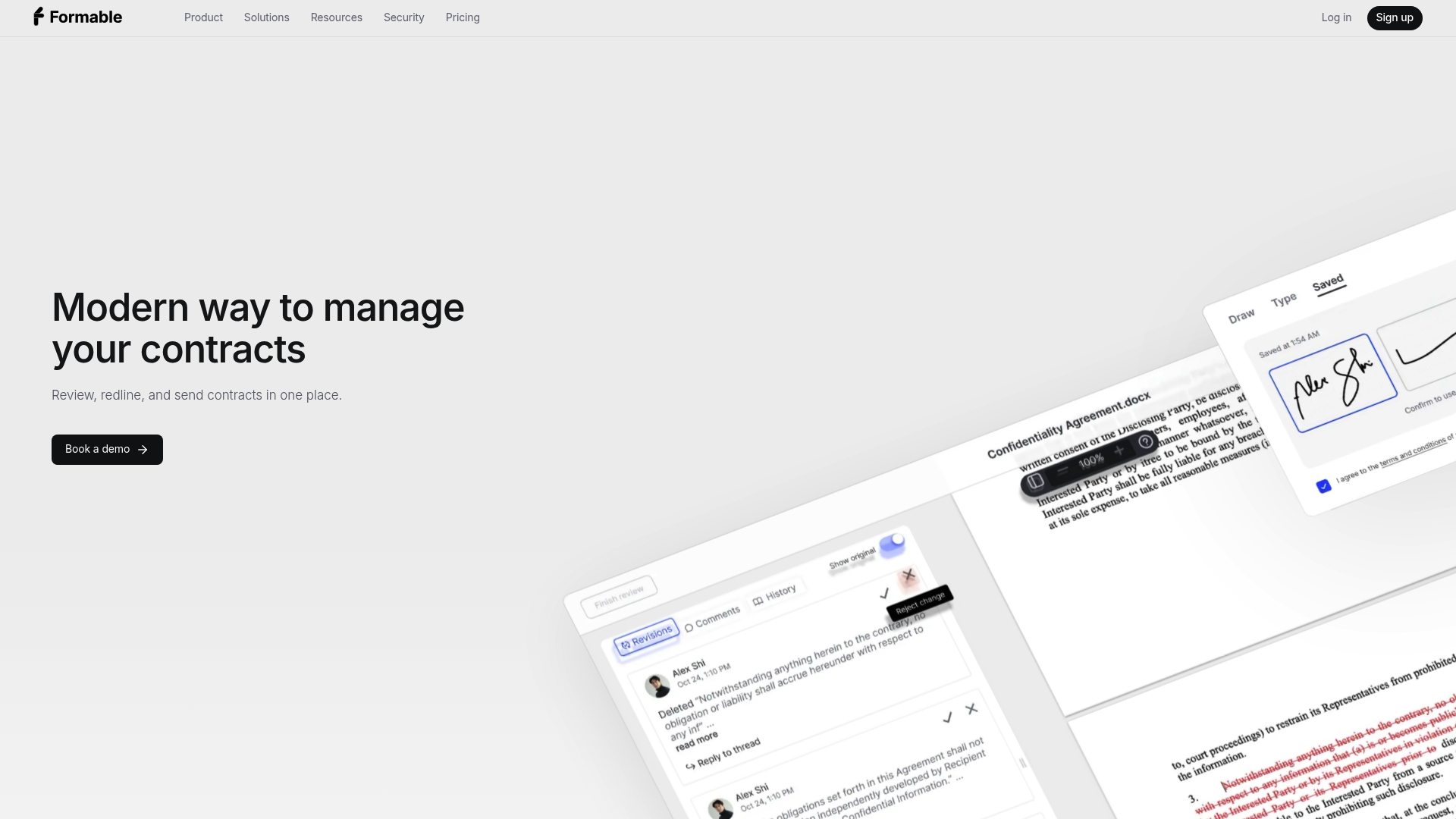
If you only need signatures, Formable E-Signing works as a standalone option. If you are building signing into your own product, the embedded e-signing API and the redlining API are built for that. The Pro plan is $29.99 per month, and the Growth API plan is also $29.99 per month. See the pricing page for plan details, or reach out and we will walk through your use case.
FAQ
Is an electronic signature as legally binding as a handwritten one in the US?
Generally yes. Both E-SIGN and UETA provide that a signature cannot be denied legal effect solely because it is electronic. The signature still needs intent to sign, a link to the record and, where required, consent to transact electronically.
Do I need both E-SIGN and UETA compliance?
You do not follow them separately. E-SIGN is the federal baseline, and a state's UETA or consistent alternative generally governs state-law transactions. Where no qualifying state law applies, E-SIGN controls. In practice, one sound signing process satisfies both.
Does a digital signature have to be used under these laws?
No. E-SIGN does not require digital signatures, which are one type of electronic signature. A typed name, a click-to-accept action or a drawn signature can all qualify when made with intent to sign and associated with the record.
Which documents cannot be signed electronically under E-SIGN and UETA?
Wills, codicils and testamentary trusts are excluded from both, as are most UCC matters outside Articles 2 and 2A. E-SIGN also excludes certain court documents, family-law records and specified notices such as eviction or foreclosure notices. Ask counsel about any document type outside ordinary commercial agreements.
Do I need a consumer's consent before sending electronic records?
When a law requires information to be provided to a consumer in writing, yes. E-SIGN requires affirmative electronic consent after clear disclosures about paper rights, withdrawal, scope and technology requirements. B2B contracts between businesses can usually rely on implied agreement from the parties' conduct.
Sources
- FDIC: Electronic Signatures in Global and National Commerce Act
- Connecticut General Assembly: Uniform Electronic Transactions Act summary
- Nebraska Bankers: Electronic signatures, records and contracts
- American Bar Association: Comment concerning use of electronic signatures
- 15 U.S.C. § 7002: Exemption to preemption
- Overview of the U.S. E-Sign Act and the Uniform Electronic Transactions Act
- Michigan Bar Journal: Electronic records and signatures
- Haynes Boone: Approaching electronic signature platforms
- E-SIGN Act, Title I: Electronic records and signatures in commerce
- OCC advisory letter on electronic records