What is a one-way non-disclosure agreement?

Alex Shi

A one-way non-disclosure agreement, also called a unilateral NDA, is a legal contract where only the recipient is bound to keep disclosed information confidential and use it solely for a defined purpose. The disclosing party shares sensitive information freely, while the receiving party carries all confidentiality obligations. No reciprocal duties exist. This structure is the standard choice in U.S. business contexts whenever information flows in one direction only.
Every enforceable one-way NDA contains these core elements:
- Parties: Full legal names of the disclosing party and the receiving party
- Confidential information definition: A precise description of what qualifies as protected information
- Purpose clause: The specific, limited reason the recipient may use the information
- Exclusions: Categories of information the agreement does not cover
- Term and survival: How long obligations last, and which clauses survive termination
- Return or destruction duties: What the recipient must do with materials when the agreement ends
- Remedies: Legal relief available if the recipient breaches the agreement
- Signatures: Executed by both parties to create a binding contract
Table of Contents
- Key features and legal implications of a one-way NDA
- When does a one-way NDA make sense for your business?
- How one-way NDAs differ from mutual NDAs
- How to draft a one-way NDA that actually holds up
- Sample one-way NDA templates and where to find them
- Key takeaways
- FAQ
Key features and legal implications of a one-way NDA
The defining characteristic of a one-way NDA is asymmetrical obligation. The receiving party bears full compliance responsibility; the disclosing party does not. Because obligations fall only on one party, the agreement is simpler to draft, requires less negotiation, and can be executed faster than a mutual NDA.
Under U.S. law, enforceability depends on several conditions being met:
- Adequate consideration: At-will employment often serves as sufficient consideration in many jurisdictions, though adding a signing bonus or equity grant strengthens the agreement's legal standing.
- Specificity: Vague definitions of confidential information invite court challenges. Courts consistently favor agreements that identify protected information with precision.
- Mutual assent: Both parties must sign, even though only one carries confidentiality duties.
- Lawful purpose: The agreement cannot be used to suppress legally protected disclosures or whistleblower activity.
Standard exclusions in one-way NDAs protect the recipient from liability in legitimate situations:
- Information already in the public domain (through no fault of the recipient)
- Information the recipient already knew before disclosure
- Information received independently from a third party without restriction
- Disclosures required by law, court order, or a regulatory authority
One drafting gap that frequently undermines enforceability: many one-way NDA templates omit-a-complete-guide) the federal Defend Trade Secrets Act (DTSA) whistleblower-immunity notice. Without it, a company cannot recover exemplary damages or attorney's fees in a trade secret misappropriation lawsuit against an employee or contractor.
When does a one-way NDA make sense for your business?
One-way NDAs are commonly used in employer-employee relationships, contractor agreements, vendor disclosures, and investor pitches across U.S. businesses. The common thread in each scenario is that sensitive information flows in one direction only.

Employer to employee. A company onboarding a new hire shares proprietary processes, client lists, or product roadmaps. The employee receives that information; the employer does not receive equivalent confidential information in return. A one-way NDA fits cleanly here.
Contractor and vendor agreements. When a startup engages a freelance developer or a third-party vendor, it often needs to share source code, pricing models, or customer data to get the work done. The contractor has no equivalent confidential information to protect, so a mutual NDA would create unnecessary obligations on both sides.
Investor pitches. A founder sharing a pitch deck, financial projections, or proprietary technology with a potential investor is disclosing in one direction. The investor is not sharing confidential information back. A one-way NDA protects the founder's IP without complicating the conversation with reciprocal obligations the investor would likely push back on anyway.
Vendor due diligence. A company evaluating a new software vendor may share internal workflow data or security requirements to get a proper assessment. The vendor receives that information; the company does not receive the vendor's trade secrets in return.
In each case, the one-way structure avoids the negotiation friction that a mutual NDA introduces. When time matters and the information flow is clearly asymmetrical, a one-way NDA closes faster.
How one-way NDAs differ from mutual NDAs
The core difference is straightforward: a mutual NDA binds both parties to confidentiality, while a one-way NDA binds only the recipient. That distinction has real consequences for drafting complexity, negotiation time, and risk allocation.
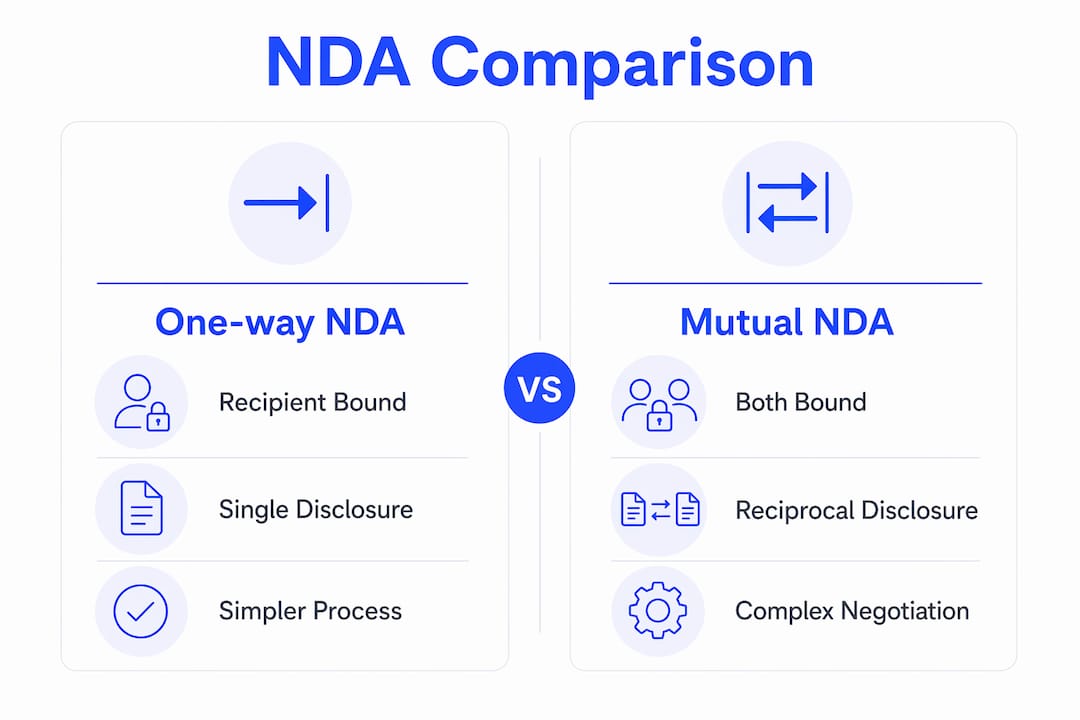
| Factor | One-way NDA | Mutual NDA |
|---|---|---|
| Who is bound | Recipient only | Both parties equally |
| Information flow | One direction | Bidirectional |
| Drafting complexity | Lower | Higher |
| Negotiation time | Shorter | Longer |
| Best suited for | Employee onboarding, investor pitches, vendor disclosures | Joint ventures, partnerships, co-development |
| Risk allocation | All compliance risk on recipient | Shared between parties |
Choosing between the two comes down to how information actually moves. If only one party is sharing sensitive material, a one-way NDA is the cleaner, faster choice. If both parties are exchanging proprietary information, a mutual NDA is more appropriate and more fair. Legal experts advise reviewing confidentiality risk allocation carefully before accepting generic NDA terms, particularly for founders protecting intellectual property in life sciences or technology deals.
For a deeper comparison of these two agreement types, Formable's guide on unilateral vs mutual NDAs walks through the decision criteria in detail.
How to draft a one-way NDA that actually holds up
A one-way NDA is only as strong as its drafting. Courts will not enforce an agreement that is too vague to define what it protects or too broad to be reasonable. Here is what every enforceable one-way NDA needs:
- Precise confidential information definition. Name the categories of information explicitly: financial data, customer lists, source code, product specifications. A clear, specific definition-a-complete-guide) is the single most important factor for enforceability in U.S. courts. Broad, catch-all language like "any information shared" is a liability.
- Explicit purpose clause. State exactly why the recipient is receiving the information. "For the purpose of evaluating a potential acquisition" is enforceable. "For business purposes" is not.
- Defined exclusions. Include the standard carve-outs: public domain, prior knowledge, independent development, and legal compulsion. These protect the recipient from unreasonable liability.
- Term and survival clause. Specify how long the obligations last. Two to five years is common for commercial agreements; trade secrets may warrant indefinite protection. Identify which clauses survive termination.
- Remedies clause. State that breach may cause irreparable harm and that the disclosing party is entitled to seek injunctive relief without posting a bond. This matters in court.
- Return or destruction of materials. Require the recipient to return or certify destruction of all confidential materials upon request or termination.
- Governing law and jurisdiction. Name the state whose law governs the agreement and where disputes will be resolved.
Pro Tip: Add the DTSA whistleblower-immunity notice to every NDA that covers employees or contractors. Without it, you cannot recover exemplary damages or attorney's fees under the federal Defend Trade Secrets Act, even if you win the lawsuit. Most template NDAs omit this clause entirely.
On consideration: at-will employment is generally sufficient in most U.S. states, but supplementing with a signing bonus or stock options creates a stronger contractual foundation, particularly if the agreement is signed after the employment relationship has already begun.
Avoid these common drafting mistakes:
- Signing an NDA with no defined term (obligations that never expire create compliance risk for the recipient)
- Using a template governed by another state's law without reviewing whether it applies to your jurisdiction
- Omitting the purpose clause, which leaves the recipient's permitted use undefined and unenforceable
- Accepting a one-way NDA when the information exchange is actually bidirectional
For founders and GTM teams who want AI-assisted drafting without starting from scratch, Formable's contract creator combines customizable NDA templates with generative AI to produce agreements tailored to your specific business context.
Sample one-way NDA templates and where to find them
Several reliable sources publish free one-way NDA templates that cover the standard clauses. The table below outlines the key clauses present in a well-structured one-way NDA template.
| Clause | Purpose |
|---|---|
| Parties | Identifies the disclosing party and the recipient by full legal name |
| Confidential information definition | Specifies what information is protected under the agreement |
| Purpose of use | Limits how the recipient may use the disclosed information |
| Exclusions | Lists categories of information not covered by confidentiality obligations |
| Term and survival | States how long obligations last and which clauses remain after termination |
| Return or destruction | Requires the recipient to return or destroy materials when the agreement ends |
| Remedies | Describes legal relief available for breach, including injunctive relief |
| Governing law | Names the state law and jurisdiction governing disputes |
| Signatures | Execution block for both parties |
Sample templates typically cover all of these clauses, though the DTSA whistleblower notice is frequently absent and should be added manually.
Publicly available templates from sources like Cooley GO and LegalTemplates provide solid starting points for standard commercial agreements. For more complex deals, such as those involving proprietary technology, clinical data, or multi-party vendor arrangements, a template is a starting point, not a finished product. Customization for your specific business context, jurisdiction, and risk profile is always necessary.
Formable supports the full NDA workflow: draft with AI-assisted templates, negotiate terms using collaborative contract redlining, and collect signatures with built-in e-signing. Founders and legal teams using Formable can also upload playbooks and catch missing clauses, including the DTSA notice, automatically during contract review. AI tools are increasingly central to how legal and GTM teams handle this kind of contract work, and AI productivity for founders is one area where the efficiency gains are most visible.
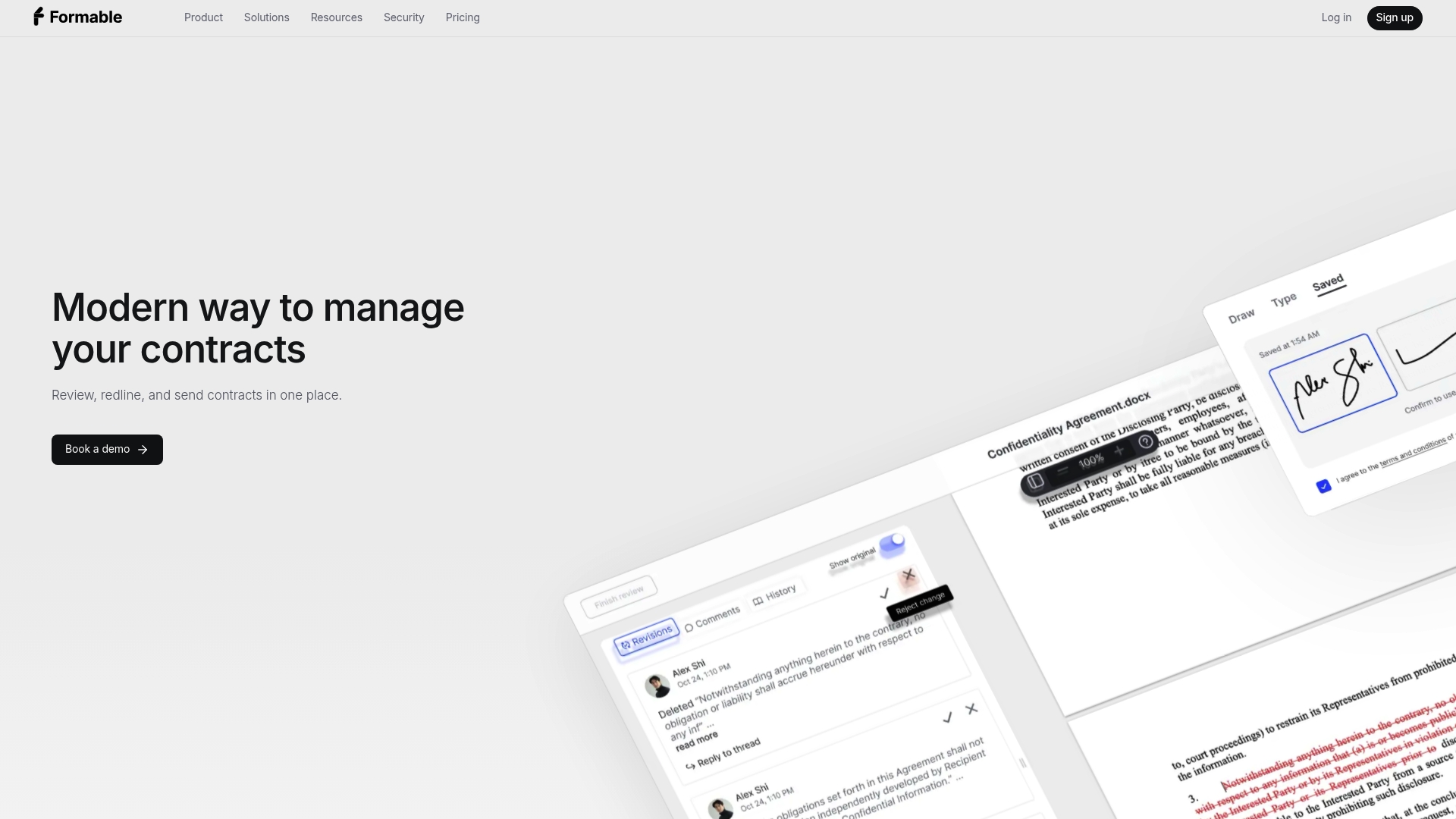
Formable is built for teams that need to move fast without cutting corners on compliance. Whether you are drafting your first NDA or managing a high volume of agreements across a GTM motion, Formable's contract platform handles creation, negotiation, review, and signing in one place.
Key takeaways
A one-way NDA binds only the recipient to confidentiality, making it the right choice whenever information flows in one direction and speed of execution matters.
| Point | Details |
|---|---|
| Only the recipient is bound | The disclosing party has no reciprocal confidentiality obligations under a one-way NDA. |
| Specificity drives enforceability | Vague confidential information definitions risk invalidation; name categories explicitly. |
| DTSA notice is often missing | Omitting the whistleblower-immunity notice blocks recovery of exemplary damages and attorney's fees. |
| One-way vs mutual depends on information flow | Use a one-way NDA when only one party shares sensitive information; use mutual when both do. |
| At-will employment can be sufficient consideration | Adding a bonus or equity grant strengthens enforceability, especially for post-hire agreements. |
FAQ
Can an NDA be one-sided?
Yes. A one-way or unilateral NDA is specifically designed to bind only the recipient to confidentiality while the disclosing party has no reciprocal obligations. This structure is standard in employer-employee agreements, investor pitches, and vendor disclosures.
How serious is a non-disclosure agreement?
An NDA is a legally binding contract. Breach can result in injunctive relief, monetary damages, and, in cases involving trade secrets under the DTSA, exemplary damages and attorney's fees if the agreement includes the required whistleblower-immunity notice.
What are the three types of NDA?
The three common types are unilateral (one-way), mutual (bilateral), and multilateral. A unilateral NDA binds only the recipient; a mutual NDA binds both parties; a multilateral NDA covers three or more parties where at least one discloses confidential information to the others.
What are common NDA red flags?
Watch for agreements with no defined term, overly broad confidential information definitions that cover publicly known material, missing exclusion clauses, no governing law provision, and the absence of a DTSA whistleblower-immunity notice in agreements covering employees or contractors.