Yes, e-signatures are legal in Canada, both federally and in the provinces and territories. A signature on a commercial contract such as an MSA, NDA, SOW or order form can be made electronically, provided the other party consents and the signature reliably identifies the signer and ties them to the document. A short list of documents, including wills, negotiable instruments and certain land transfers, still calls for wet ink or extra formalities.
This guide explains which laws apply, what makes a signature valid, which documents are excluded, and what a U.S. business should check before sending an agreement to a Canadian counterparty.
TL;DR
- Canada recognizes e-signatures under Part 2 of PIPEDA at the federal level and under provincial and territorial electronic commerce laws.
- A valid e-signature must reliably identify the signer and be reliably linked to the document. Consent of the parties matters.
- Wills, powers of attorney, negotiable instruments such as promissory notes, and certain land documents are commonly excluded or need extra steps.
- Quebec has its own framework, with its own tests for linking a person to a document.
- For U.S.-Canada deals, add an e-signing clause, name a governing law, and check each document type against the province's rules.
Are e-signatures legal in Canada? The short answer
Canada does not have one single e-signature statute that covers everything. It has a federal regime and a set of provincial and territorial laws. According to the Government of Canada's guidance on using electronic signatures, Part 2 of the Personal Information Protection and Electronic Documents Act (PIPEDA) establishes electronic equivalents at the federal level, and most provinces and territories have enacted their own electronic commerce laws.
For a U.S. reader, the closest comparison is the pairing of the federal ESIGN Act and state-level UETA. If you want that background first, see our explainer on the E-SIGN Act and UETA. The Canadian structure is similar in spirit, though the details differ by province.
In practice, for ordinary B2B contracts, the main questions are not whether e-signing is allowed. They are:
- Did both parties agree to sign electronically?
- Can you show who signed and that they meant to sign?
- Does the document fall into an excluded category?
- Which province's law governs?
How federal law treats e-signatures
Part 2 of PIPEDA defines an electronic signature as a signature made of one or more letters, characters, numbers or other symbols in digital form, incorporated in, attached to or associated with an electronic document. That is a broad, technology-neutral definition. A typed name, a drawn signature or a click-to-sign action can all fit it, depending on how the signing is recorded.
The federal rules apply narrowly, though. Under section 43 of PIPEDA, a signature requirement in a federal law is satisfied by an e-signature only if that law or provision is listed in Schedule 2 or 3 of PIPEDA, and any regulations for that provision have been followed. Per Dentons' guidelines on electronic signatures, Schedule 2 lists the Federal Real Property and Federal Immovables Act (ss. 3, 5 to 7, 11 and 16) and the Canada Labour Code (s. 254(1)), while Schedule 3 lists the Federal Real Property Regulations (ss. 9 and 11).
The same Dentons guidance notes that the federal requirements are less permissive than the provincial ones. Most private commercial contracts are governed by provincial law, so this federal layer matters mostly for dealings under specific federal statutes.

When a signature must be "secure"
Dentons also explains that when a document is a statement made under oath or affirmation, a statement declaring the truth of its contents, or a document that must be witnessed, the e-signature must be "secure." That means using encryption, hash functions and other security features. A basic click-to-sign is not designed for those cases. If your workflow touches sworn statements or witnessed documents, plan for this at the start, and speak with Canadian counsel about the right method.
Provincial and territorial laws
Most everyday contracts fall under provincial or territorial electronic commerce legislation. Ontario's Electronic Commerce Act, 2000 and equivalent laws in the other common law provinces are, according to an ABA Business Law Today article by Tracy Springer, generally permissive about e-signatures so long as the technology is reliable. The article names two basic characteristics of an enforceable e-signature: the signature is reliable for identifying the person, and its association with the electronic document is reliable.
A Venable presentation on online contracts describes the Uniform Electronic Commerce Act (UECA) model as saying that information should not be denied legal effect solely because it is electronic. It adds that nobody is required to use or accept electronic information, but consent can be inferred from conduct. Consent is a recurring theme, so build it into your contract.
What the statutes ask for
The wording differs between statutes. Three examples show the range:
| Law | What it requires |
|---|---|
| Canada Business Corporations Act, s. 252.7 | The signature must come from a technology or process that can prove it is unique to the person, that it is attached to or associated with the document, and that it can identify the person. Prescribed requirements must also be met. Statutory declarations and affidavits are excluded. |
| Manitoba's Electronic Commerce and Information Act (s. 13(1)) | For prescribed classes of documents, the signature must be reliable for identifying the person and associating the signature with the document. For documents given to a person other than a public body, that person must consent. |
| Quebec's Act to establish a legal framework for information technology (ss. 38 and 39) | The link between a person and a document can be shown by any process that confirms identity and the link to the document. The signature can be set up against the signer if the document's integrity is ensured and the link was established at signing and has been maintained since. |
The common thread is evidence. Identity, linkage to the document, integrity over time and consent are the four things a court or counterparty will want to see. A good e-signing workflow records each of them automatically.
Documents that still need ink or extra formalities
The exclusions are where mistakes happen. Electronic commerce laws generally carve out the same categories, though each province words them differently.
The CSIO eSignatures Advisory Report says electronic commerce legislation generally does not apply to:
- wills and codicils
- trusts created by wills or codicils
- powers of attorney for financial affairs or personal care
- documents that create or transfer interests in land and must be registered to be effective against third parties
- negotiable instruments
The same report notes that Manitoba, New Brunswick and Quebec do not specifically exclude wills, testamentary trusts or powers of attorney. So the answer can depend on the province, and you should not assume one rule fits all of Canada.
Provincial examples confirm the pattern. The Nova Scotia Electronic Commerce Act in s. 3(3) excludes wills, testamentary trusts, certain powers of attorney, and land documents requiring registration, and s. 3(4) excludes negotiable instruments. In Alberta, per the Alberta Municipalities legal explainer, section 7 of the Electronic Transactions Act excludes wills, enduring powers of attorney, personal directives, guarantees and negotiable instruments such as cheques, and a Transfer of Land document must be physically signed in ink.
Insurance adds another layer
The CSIO report describes a patchwork of federal and provincial rules for insurance, with extra exclusions such as a notice of cancellation of an insurance contract and certain changes an insurer makes to a policy. If you sell into insurance, check those rules separately.
What this means for a typical startup
MSAs, DPAs, SOWs, LOIs, order forms, NDAs and pilot agreements are not on these exclusion lists. They are ordinary commercial agreements. Where startups hit trouble is at the edges: a personal guarantee attached to a lease, a promissory note in a financing, or a real estate document that must be registered. Treat those as separate steps with their own signing method.

For a broader view of how wet ink and electronic signatures compare, see our guide on wet signature vs electronic signature.
What U.S. businesses should check before signing with a Canadian party
A cross-border deal brings two legal systems into one document. Dentons recommends specifying that the laws of a particular province govern the execution of the agreement, regardless of where the parties are when they sign. It also suggests an e-signing clause, and the same guidelines offer sample wording that allows signing electronically, including through DocuSign and similar applications, and in counterparts, each deemed an original.
A practical checklist:
- Confirm consent. Make sure every party agrees to sign electronically. Put it in the contract.
- Name the governing province. Pick one and state that its law governs execution and the agreement.
- Add an e-signing and counterparts clause. Use language along the lines Dentons suggests, adapted by your counsel.
- Screen the document type. Check it against the exclusions above for the relevant province.
- Capture the evidence. Keep timestamps, signer identity details and the final document with its audit trail.
- Escalate special cases. Lending, guarantees and registered land documents need counsel.
On lending, the ABA article advises that wet ink should be required for certain Canadian documents, including promissory notes, personal guarantees, notarized mortgage documents and security registered with the Bank of Canada. It also stresses weighing the governing law and the place of formation of each borrower and guarantor to avoid enforceability challenges. Dentons likewise says promissory notes across Canada fall under the Bills of Exchange Act and an e-signature would not satisfy its signature requirement.
If you are earlier in the process and want a step-by-step workflow, our checklist for collecting signatures digitally covers the process for legal and dev teams.
Are DocuSign and similar services valid in Canada?
Signatures made through an e-signature service are expected to be effective. Dentons says DocuSign signatures likely fall within the broad statutory definition of an electronic signature, though it adds that this has not been judicially considered. The same holds for other platforms. The law looks at the signature and the evidence behind it, not the brand.
That is why the platform's records matter. A signing tool should log who signed, when, and what version, and it should keep the finished document unaltered. You can read how we approach this on our security and legally binding e-signatures page.
Is forging an e-signature illegal in Canada?
Yes. Under section 368 of the Criminal Code, it is an offence to use, deal with or act on a document as if genuine while knowing or believing it is forged, and the penalty can be up to 10 years' imprisonment for an indictable offence. The 2009 identity theft amendments define identity information to include written, electronic and digital signatures. Section 402.2 makes it an offence to obtain or possess someone else's identity information where the circumstances support a reasonable inference it is meant for an indictable fraud-related offence.
For a business, the lesson is operational: use signer authentication and keep audit records so you can show a signature is genuine if it is ever questioned.
Our perspective
Cross-border contracts slow down for a simple reason. The paperwork is split across tools. Drafting happens in one place, review in another, negotiation in email, and signing in a fourth app. When a Canadian counterparty enters the picture, every handoff adds a chance to lose the version history that proves what was agreed.
We built Formable to keep drafting, AI review, redlining, e-signing and tracking in a single workflow. That matters for the evidence Canadian law looks for: who signed, what they signed, and that the document did not change afterward. An audit trail that runs from the first draft to the final signature is easier to defend than one stitched together from five systems.
Our advice to founders and account executives is practical. Treat the standard commercial agreements as fast, fully electronic work. Flag the few exceptions early, such as guarantees and registered land documents, and handle those with counsel. Then the rest of your pipeline never waits on a courier.
Alex
Close Canadian deals faster with Formable
If your team regularly signs with Canadian customers, you need a signing process that records identity, timestamps and document integrity every time. Formable's e-signing lets you collect signatures as part of the same workflow where you draft, review and negotiate. Our AI contract review helps you catch risks and missing clauses at intake, and our browser-native negotiation lets both sides align on terms before signing.
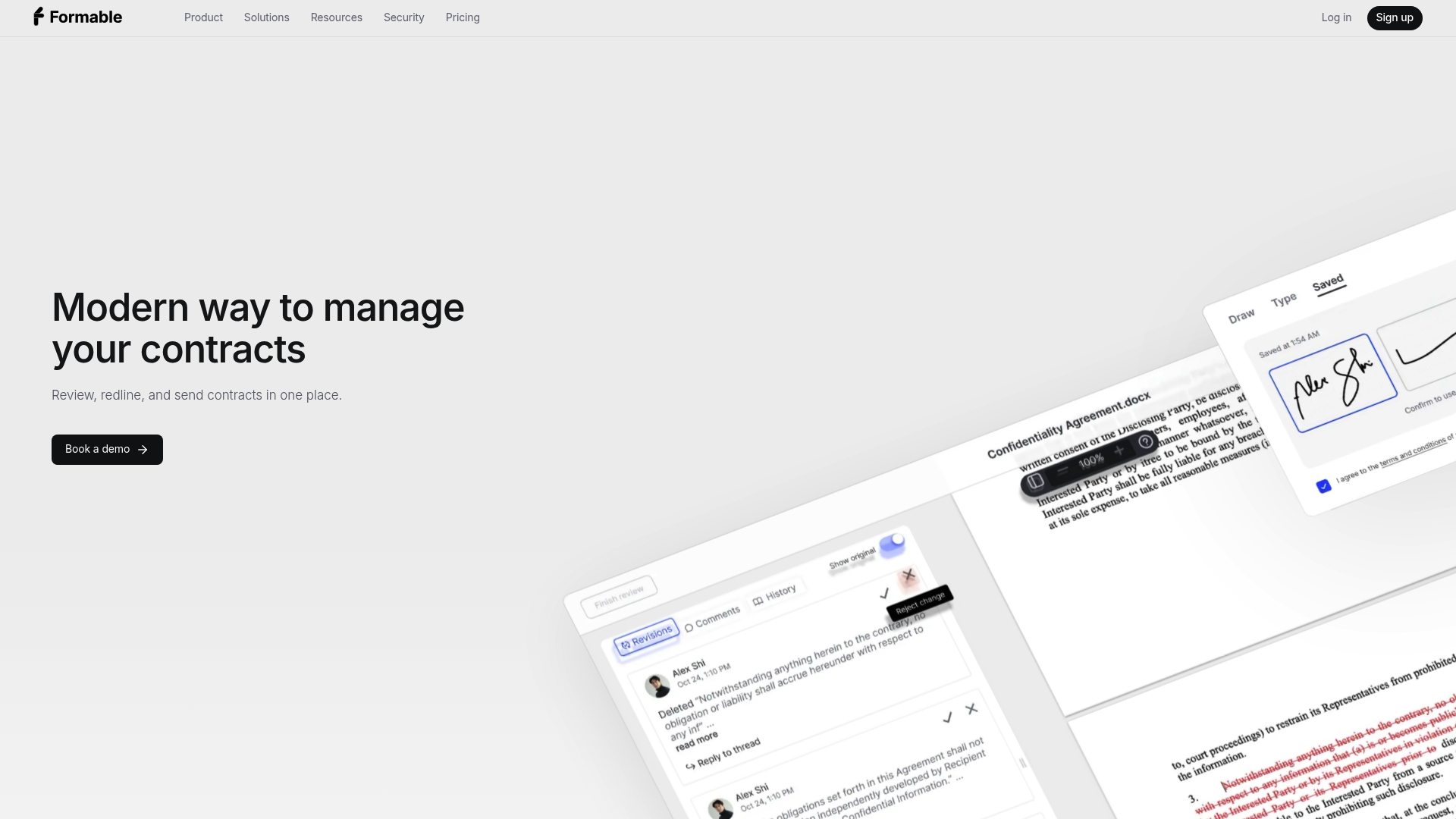
The Pro plan is $19.99 per month, and you can see all plans on our pricing page. Developers who want signing inside their own product can look at our embedded e-signing API. Reach out and we will walk through your use case.
A quick reference by document type
Use this as a first screen only. It reflects the sources above, and the rules for your province and facts still govern.
| Document | Typical e-signing position |
|---|---|
| NDA, MSA, SOW, order form, pilot agreement | Ordinary commercial agreements, generally not on the exclusion lists, where parties consent |
| Sworn statements, witnessed documents | Federal rules call for a "secure" signature |
| Wills, codicils, testamentary trusts | Generally excluded, with different treatment in Manitoba, New Brunswick and Quebec |
| Powers of attorney (financial or personal care) | Often excluded, varies by province |
| Promissory notes and other negotiable instruments | Wet ink, per Dentons and the provincial exclusions |
| Land transfers requiring registration | Often excluded, as in Alberta and Nova Scotia |
| Insurance cancellation notices | Additional insurance-specific rules |
FAQ
Is DocuSign valid in Canada?
Generally yes for ordinary commercial agreements. Dentons says DocuSign signatures likely meet the broad definition of an electronic signature, though no court has directly ruled on this. Documents on the exclusion lists still need other methods.
What documents cannot be electronically signed in Canada?
The usual exclusions are wills and codicils, testamentary trusts, certain powers of attorney, negotiable instruments such as promissory notes, and land documents that require registration. The exact list varies by province, so check the statute for the province that applies.
Is an e-signature as binding as a handwritten one?
For most commercial contracts, yes, as long as the signature reliably identifies the signer, is reliably linked to the document, and the parties consent to signing electronically. Some federal and provincial rules add conditions, such as a secure signature for sworn or witnessed documents.
Is it illegal to forge a signature in Canada?
Yes. The Criminal Code makes it an offence to use or deal with a document you know or believe is forged, with up to 10 years' imprisonment for an indictable offence. Identity theft provisions also cover electronic signatures as identity information.
Can a U.S. company sign electronically with a Canadian company?
Yes. Get consent from both sides, include an e-signing and counterparts clause, and name the province whose law governs. Screen the document against the exclusions and get Canadian counsel for lending or registered documents.
Sources
- Government of Canada guidance on using electronic signatures
- Personal Information Protection and Electronic Documents Act
- Dentons, Law and Practice of Electronic Signatures
- ABA Business Law Today, enforceability of e-signatures in commercial lending
- Venable, Contracts 2.0
- Canada Business Corporations Act, section 252.7
- Manitoba Electronic Commerce and Information Act
- Quebec Act to establish a legal framework for information technology
- CSIO eSignatures Advisory Report
- Nova Scotia Electronic Commerce Act
- Alberta Municipalities, Casual Legal: electronic document signing
- Criminal Code, section 368
- An Act to amend the Criminal Code (identity theft), 2009