eIDAS is the EU regulation that sets the rules for electronic signatures and other trust services across all 27 member states. It defines three signature levels (simple, advanced and qualified) and guarantees that no electronic signature can be rejected in court just because it is electronic. If you are a US company signing with a European customer, vendor or investor, a simple or advanced signature is enough for most commercial contracts. A qualified signature matters only in narrow cases.
This guide explains what each level requires, what the law actually says, how it compares to US rules, and how to run a cross-border signing workflow without slowing the deal.
TL;DR
- eIDAS (Regulation (EU) No 910/2014) has applied directly in every EU member state since 1 July 2016 and recognizes three signature levels: simple, advanced and qualified.
- No electronic signature may be denied legal effect or admissibility as evidence solely because it is electronic. Only a qualified signature automatically equals a handwritten one.
- In the US, the ESIGN Act and state UETA laws give electronic signatures a similar baseline, so one workflow can often serve both sides of the Atlantic.
- Choose the signature level by contract risk and by any form requirement in the counterparty's national law, not by habit.
- Keep an audit trail for every signature. It is your evidence if a signature is ever challenged.
What eIDAS is and where it applies
eIDAS stands for electronic identification, authentication and trust services. It is a regulation, not a directive, so it is directly applicable across Europe without national transposition. It came into full effect on 1 July 2016 and repealed the 1999 eSignature Directive.
That change mattered. Under the old directive, each country interpreted the rules in its own way, which produced a patchwork of laws that did not recognize one another. eIDAS replaced the patchwork with one framework. According to the European Commission, it also introduced time stamping, electronic seals for legal entities and national Trusted Lists of qualified providers.
The regulation was later amended. Regulation (EU) 2024/1183, often called eIDAS 2.0, entered into force on 20 May 2024 and amends the original text, adding the European Digital Identity Wallet. The Commission confirms that the distinction between simple, advanced and qualified signatures is maintained, with qualified signatures keeping the same legal effect as handwritten ones across the Union.

Does eIDAS apply to a US company?
eIDAS is EU law. It governs trust services offered in the EU and how EU courts and authorities treat signatures. A US company is not "certified" under eIDAS just by using an e-signing tool. But when you sign with a party in the EU, a European court or regulator may look at your signature through the eIDAS lens. That is why you want to know which level you are producing.
The three types of electronic signature under eIDAS
The levels build on one another. According to the European Commission's eSignature FAQ, each level includes the requirements of the one below it.
| Level | What it requires | Legal effect |
|---|---|---|
| Simple electronic signature (SES) | Data in electronic form attached to or logically associated with other data, used by the signatory to sign | Cannot be denied effect or admissibility only because it is electronic |
| Advanced electronic signature (AdES) | Uniquely linked to the signatory, able to identify them, created under their sole control, and tamper-evident | Same baseline as SES, with stronger evidence value |
| Qualified electronic signature (QES) | An AdES created by a qualified signature creation device and based on a qualified certificate | Equivalent legal effect to a handwritten signature, recognized in all member states |
The definitions come from the EUR-Lex text of the regulation. Here is what they mean in practice.
Simple electronic signature
A typed name, a drawn signature on a screen or a click-to-sign action can all qualify, as long as the data is linked to the document and used by the signatory to sign. Most day-to-day business agreements are signed at this level.
Advanced electronic signature
An advanced signature adds four conditions: it is uniquely linked to the signatory, it can identify them, it is created with data the signatory can use under their sole control with a high level of confidence, and any later change to the signed data is detectable. In practice that means stronger identity checks, such as verified email plus an additional factor, and a cryptographic seal on the document. Hardware keys are one way to support signer control, and security key resellers explain how that maps to eIDAS requirements.

Qualified electronic signature
A qualified signature needs two extra ingredients. The signature must be created on a qualified signature creation device (QSCD), and it must rest on a qualified certificate issued by a qualified trust service provider. QSCDs must meet Annex II of the regulation and be certified by an independent body appointed by a member state before they appear on the EU list.
To issue a qualified certificate, the provider must verify the signer's identity, either in person, remotely through electronic identification at "substantial" or "high" assurance, or by other nationally recognized methods. The Czech Ministry of Interior sets out those identity verification options in its requirements document. Qualified providers are published in national trusted lists under Article 22.
What the law says about legal effect
Three short provisions in Article 25 carry most of the weight, as shown in the official regulation text:
- Article 25(1): an electronic signature shall not be denied legal effect and admissibility as evidence in legal proceedings solely because it is electronic or because it does not meet the requirements for qualified signatures.
- Article 25(2): a qualified electronic signature has the equivalent legal effect of a handwritten signature.
- Article 25(3): a qualified signature based on a qualified certificate issued in one member state is recognized as a qualified signature in all others.
Read the first point carefully. It does not say a simple signature always wins a dispute. It says a court cannot dismiss it merely for being electronic. Whether it persuades a judge depends on the evidence behind it: who signed, when, from where and whether the document changed afterward.
eIDAS and US law: how they line up
US law takes a more uniform approach. The federal ESIGN Act provides that a signature or contract in interstate or foreign commerce may not be denied legal effect, validity or enforceability solely because it is in electronic form. For consumer transactions where the law requires written information, consumers must affirmatively consent to electronic records and receive the required disclosures. Most states also have their own version of UETA, which adds the same baseline at state level.
The key differences for a business team:
- Tiers. eIDAS ranks signatures. ESIGN and UETA do not: a compliant electronic signature has the same underlying validity whatever the technology.
- Presumption of equivalence. Under eIDAS, only a qualified signature is automatically equal to a handwritten one. In the US, intent to sign and consent to do business electronically carry the analysis.
- Evidence. In both systems, the strength of your record decides how easily you defend a signature. Timestamps, signer identity and a tamper-evident audit trail help in either court.
For a deeper look at how electronic and handwritten signatures compare, see our guide on wet signature vs electronic signature. If you are new to the topic, start with what electronic signatures are.
Which signature level should you use?
The right level follows the contract, not the other way round. Use this decision path.
- Identify the contract type. NDAs, order forms, SOWs, MSAs, DPAs and pilot agreements between businesses are ordinary commercial documents. A simple or advanced signature typically fits.
- Check for form requirements. Some documents in some EU countries need a particular form, such as notarization or a qualified signature. Real estate transfers, certain employment or family documents and some public-sector filings are common examples. Ask counsel in the relevant country.
- Weigh the risk. The higher the value, the longer the term and the more likely a dispute, the more you gain from stronger identity verification and an advanced signature.
- Ask what the counterparty requires. Some EU customers, especially in regulated sectors or public procurement, state their required level in their procurement terms.
- Record your choice. Note the level in your contract playbook so sales and legal teams stop asking the same question every deal.
When a counterparty or national rule asks for a qualified signature, use a qualified trust service provider from the relevant national trusted list. A general e-signing workflow can then handle the surrounding negotiation, review and filing.
A practical workflow for US teams signing with EU counterparties
Most cross-border delays do not come from the signature itself. They come from the steps around it: version confusion, unclear risk, and a signature request that arrives after weeks of email. A cleaner workflow looks like this.
1. Draft from an approved template
Start from a template that your legal team has already cleared, with governing law, data protection terms and jurisdiction set correctly for EU deals. When the deal includes personal data, a DPA is usually part of the package.
2. Review for risk on intake
Run the incoming paper against your playbook. Missing clauses, unusual liability caps and non-standard governing law are easier to fix before negotiation starts than after both sides think they have agreed.
3. Negotiate in one place
Redlines in a shared document let both parties align on terms before signing. It also avoids the risk of someone signing a stale version.
4. Sign with a verifiable record
Collect signatures in a way that records who signed, when and on which exact version. If your counterparty requires a higher level, agree it before you send the document, not after.
5. Store the executed copy and the audit trail together
If a signature is ever questioned, you will want the signed document, timestamps and event history in one place. Our checklist to collect signatures digitally walks through this for legal and dev teams.
Special cases to watch
- Consumers. ESIGN adds consent and disclosure requirements in US consumer transactions. EU consumer rules add their own layer. Business-to-business deals are simpler.
- Employment and HR documents. National labor law in EU countries can impose form rules. Check locally before sending offer letters or amendments to European staff.
- Real estate. Transfers and certain leases often need notarial or registry formalities that a signature level alone will not satisfy.
- Data protection. Signing involves personal data such as names, emails and IP addresses. If you handle EU residents' data, work with your counsel on GDPR obligations and where signing data is stored.
- Building trust with signers. Clear sender identity, a recognizable domain and plain explanations reduce hesitation. These principles are covered in this overview of how to build trust online.
Our perspective
Most teams treat eIDAS as a wall between them and European revenue. We see it as a checklist you can plan for once and reuse.
The legal baseline is encouraging. Both EU and US law say an electronic signature cannot be refused just for being electronic. That leaves a practical question: can you show who signed, what they signed and when? A signature is only as useful as the record behind it.
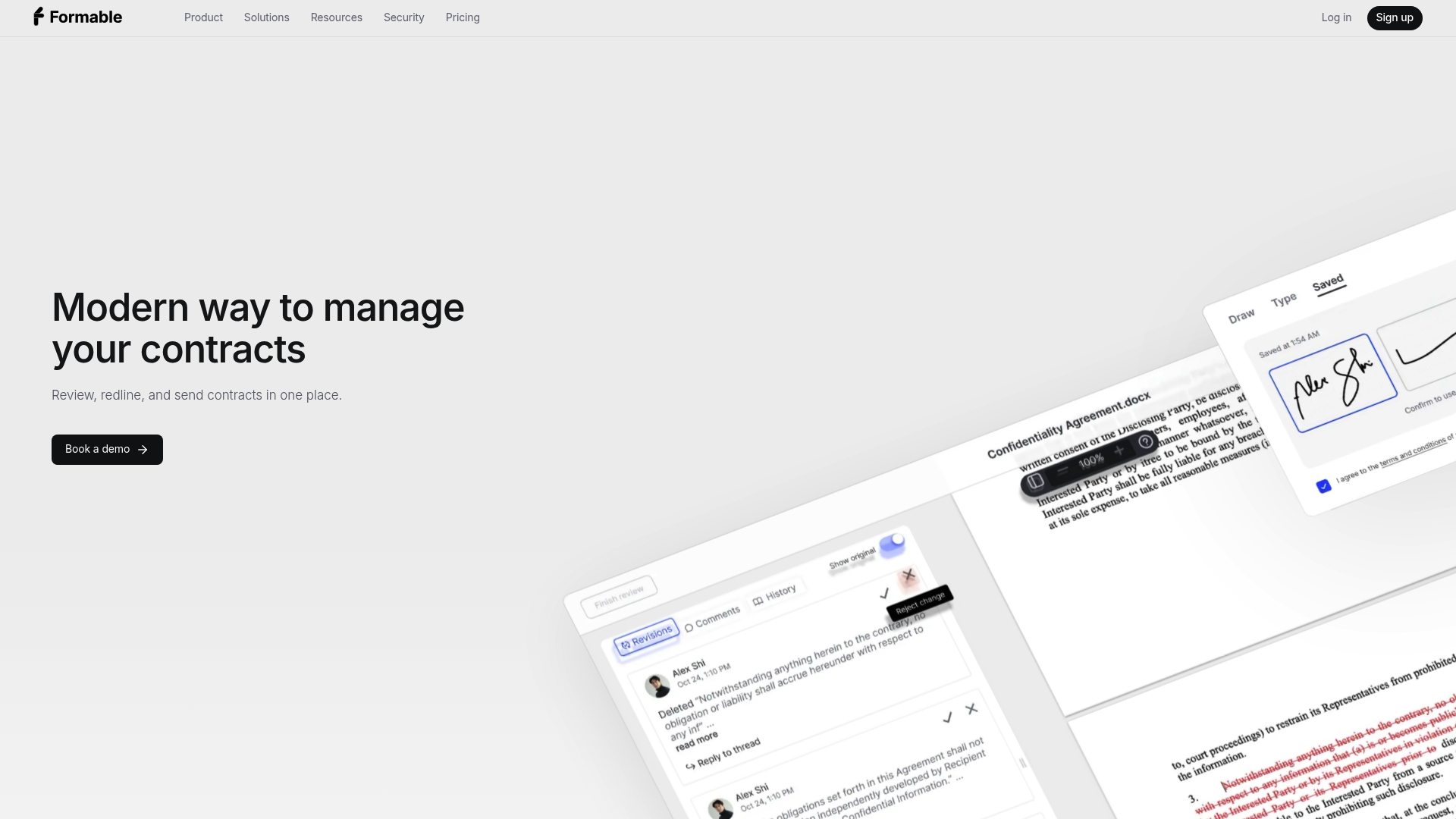
That is why we built Formable as a single workflow. Drafting, AI contract review, redlining, negotiation, e-signing and tracking live together, so the version that gets signed is the version both sides agreed on, and the audit trail follows it. Teams stop stitching together separate apps, and deals with European counterparties lose the back-and-forth that usually costs the most time.
For product teams, our embedded e-signing and redlining APIs bring the same workflow inside your own platform, so your customers sign without leaving it.
Alex
Put it to work with Formable
Formable is an AI-enabled contract management platform for startups and go-to-market teams. You can generate agreements with our contract creator, review incoming paper with AI contract review, negotiate in the browser and collect signatures with Formable E-Signing. Every signature request produces an audit trail, and our security page explains how we approach legally binding e-signatures.
The Pro plan is $29.99 per month. For developers, the Growth API plan is also $29.99 per month, and you can see the full options on the pricing page. If you want to add signing to your own product, start with our embedded e-signing API, or read the developer guide to implementing e-signing. Reach out and we will walk through your use case.
FAQ
Is an electronic signature legally valid under eIDAS?
Yes. Article 25(1) says an electronic signature cannot be denied legal effect or admissibility as evidence solely because it is electronic. A qualified signature additionally carries the same legal effect as a handwritten one. How persuasive a simpler signature is in a dispute depends on the evidence behind it.
What are the three types of electronic signatures?
The regulation defines simple, advanced and qualified electronic signatures. Each level adds requirements to the one below it. Advanced signatures add unique linkage to the signer, signer control and tamper detection, and qualified signatures add a qualified certificate and a qualified signature creation device.
How do I get an eIDAS certificate?
A qualified certificate comes from a qualified trust service provider listed on a national trusted list. The provider verifies your identity in person, remotely through high-assurance electronic identification, or by another nationally recognized method. Simple and advanced signatures do not need a personal certificate from such a provider in the same way.
Do US companies need a qualified signature to sign with EU partners?
Not for most business contracts. Ordinary commercial agreements are commonly signed with simple or advanced signatures. A qualified signature becomes relevant when a national law, a regulator or the counterparty's procurement rules require it, so confirm with counsel in the counterparty's country.
Does ESIGN replace eIDAS for cross-border deals?
No. ESIGN and UETA govern US transactions, and eIDAS governs trust services and signature treatment in the EU. They share the principle that electronic signatures cannot be refused solely for their form, so one well-documented workflow can often satisfy both.
Sources
- What is the legislation - eSignature, European Commission
- eSignature FAQ, European Commission
- Questions & Answers on Trust Services under the European Digital Identity Regulation
- Regulation (EU) No 910/2014, EUR-Lex
- E-Signatures, Authentication and Contracts, Bellas & Wachowski
- eIDAS 2.0 explained, Open ID Europe
- Certification of eIDAS compliance for QSCD, TÜV NORD
- eIDAS requirements, Czech Ministry of Interior
- ESIGN Act, Title I, govinfo.gov