8 best e-signature APIs for developers in 2026

Matt Kim

Picking an e-signature API looks simple on paper: check a few boxes, grab an SDK, ship it. Then you hit the reality. Rate limits that don't match your usage pattern, dev docs that are way too complicated, SDKs that haven't been updated in years. Choose the wrong API, and you're not just annoyed. You're rebuilding your signing flow six months from now, under deadline pressure, with real contracts already running through it.
We tested and compared the leading e-signature APIs on the criteria that actually matter for a build: API design and documentation, SDK coverage across languages, webhook reliability, and pricing as you scale.
Whatever you're building, whether it's a SaaS platform, an embedded signing flow, or an HR or procurement tool, this guide will help you pick an API you won't outgrow.
Quick shortlist:
- Formable: best overall for developers who need embedded signing, white-label control, and redlining in the same API
- Dropbox Sign: best mature signature-only REST API
- Docusign: best for enterprise compliance and breadth
- PandaDoc: best when proposals and signing live in one workflow
- Adobe Acrobat Sign: best for Adobe and Microsoft-heavy stacks
- BoldSign: best generous free tier for early volume
- Documenso: best open-source or self-hosted path
- SignWell: best pay-as-you-go option for variable volume
Table of contents
- 8 best e-signature APIs at a glance
- How we ranked these APIs
- 1. Formable
- 2. Dropbox Sign
- 3. Docusign
- 4. PandaDoc
- 5. Adobe Acrobat Sign
- 6. BoldSign
- 7. Documenso
- 8. SignWell
- What to look for in an e-signature API
- How to choose
- FAQ
8 best e-signature APIs at a glance
| API | Best for | Starting price | Free / sandbox | Embedded signing | SDKs | Standout |
|---|---|---|---|---|---|---|
| Formable | Fastest path to a branded embed | Free developer plan; Growth from about $20/month for 50 envelopes | Unlimited test mode | Yes, SignatureRequestUrl iframe | Node.js, Python, Go, Ruby, Java, PHP, .NET | Signing plus redlining in one API |
| Dropbox Sign | Signature-only REST | About $75/month | Unlimited test mode | Yes, usually higher tiers | Python, Ruby, PHP, Java, Node.js, C# | Clean docs and a long-lived test mode |
| Docusign | Enterprise and regulated workflows | About $50–$75/month, envelope-capped | Developer sandbox | Yes | Broad official SDK set | Deepest enterprise feature surface |
| PandaDoc | Proposals, quotes, then signature | About $40/month developer plan | Sandbox | Yes | REST plus SDKs | Document generation bundled with signing |
| Adobe Acrobat Sign | Adobe or Microsoft stacks | Custom / sales-quoted | Sandbox with the right account | Yes, often plan-gated | REST plus mobile SDKs | PDF tooling and enterprise integrations |
| BoldSign | Startups that want a free production allotment | From about $30/month | 25 envelopes/month | Yes | Strong .NET and JavaScript | Free tier that is usable, not demo-only |
| Documenso | Open-source or self-hosted embeds | Teams about $40/month; Platform $250/month | 5 documents/month; self-host free | Yes, widget or iframe | TypeScript, Python, Go | Open-source with a white-label Platform plan |
| SignWell | Pay-as-you-go volume | Per-document after a small free allotment | Yes, plus unlimited test usage | Yes | REST / Zapier | Simple docs and per-document pricing |
Quick takeaways:
- Easiest API to onboard: Formable. One call returns a
SignatureRequestUrlyou can iframe. - Best free production allotment: BoldSign (25 envelopes/month).
- Best pay-as-you-go: SignWell.
- Best open-source option: Documenso.
- Best enterprise incumbent: Docusign.
- Best when the document still needs negotiation: Formable, which is the only API on this list with native redlining before signature.
How we ranked these APIs
We scored each provider the way an engineering team would during a vendor spike, not the way a marketing page would:
- Time from API key to a signed document in a sandbox
- Quality of REST docs, OpenAPI, and language SDKs
- Webhooks you can verify, retry, and handle idempotently
- Transparent pricing you can model without a sales call
- Branding and white-label control on the signer-facing UI
- Audit trail and ESIGN / UETA coverage as a baseline
- Whether the API treats the file as frozen, or lets parties revise it first
1. Formable
Best e-signature API for developers who need a branded embed, and the only one on this list that includes redlining.
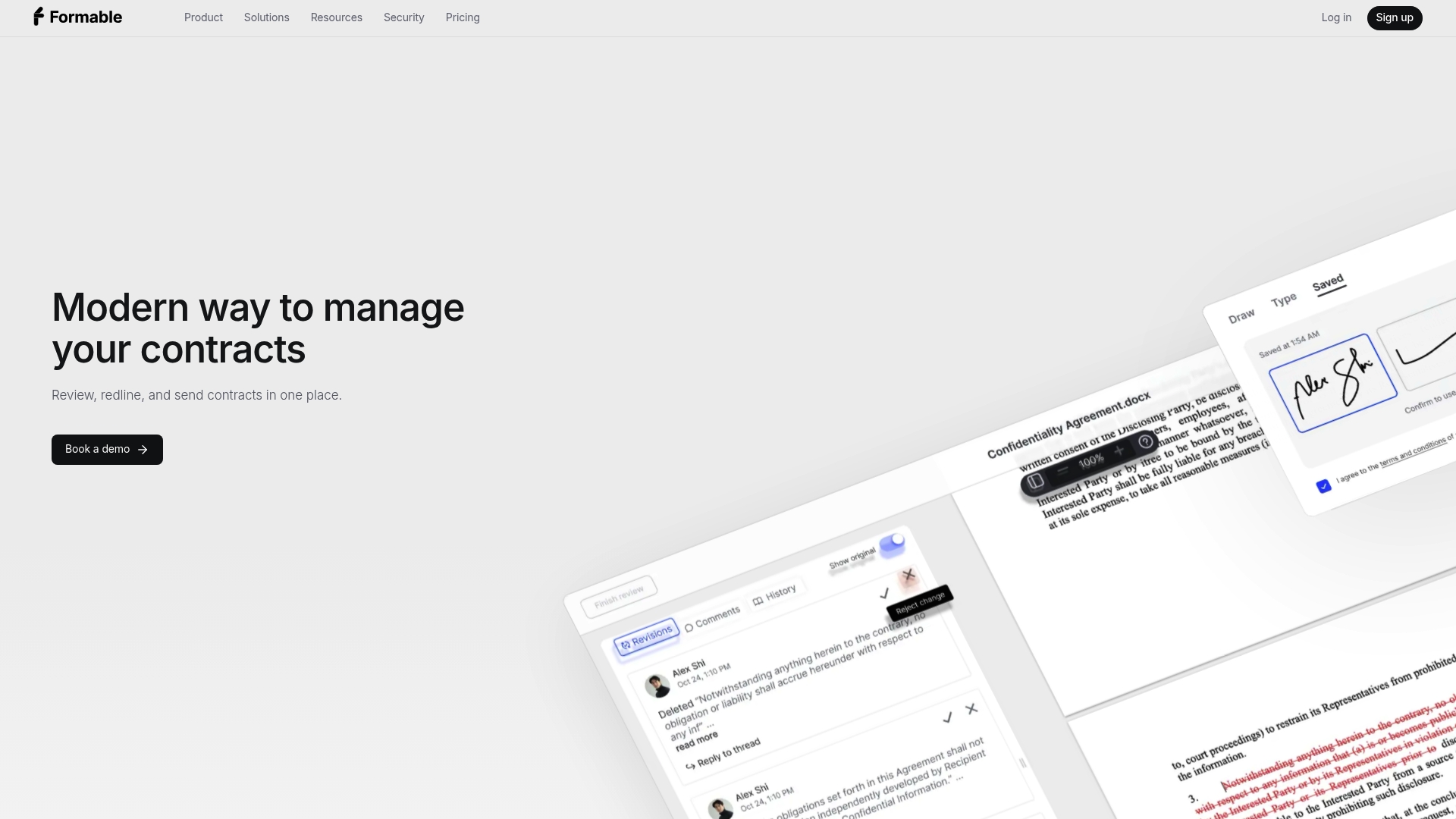
Formable is built as an API product first, with friendly developer documentation, simple APIs, and SDKs in all major languages. You create a signature request, get back a SignatureRequestUrl, and load it in an iframe. Signers stay in your app. Your backend learns about views, completions, and declines through webhooks.
Key differentiator is that Formable allows embedded redlining so counterparties can request changes before they sign.
Pricing overview:
- Developer: Free forever. Unlimited test usage, 10 production signatures per month, webhooks, and language-native SDKs
- Growth: From about $20 per month for 50 envelopes, then scales with usage
- Enterprise: Custom. Adds the redlining API, white-labeling, volume pricing, and an SLA
Key features:
- Embedded signing via a short-lived
SignatureRequestUrl - Embedded redlining for MSAs, NDAs, SOWs, and DPAs that still change
- White-label colors, email subject, and CTAs on paid plans
- Official SDKs for Node.js, Python, Go, Ruby, Java, PHP, and .NET
- OpenAPI spec, test mode, and webhook events for viewed, signed, and completed
- Tamper-evident audit trail aligned with ESIGN and UETA
Start with the developer platform, the implementation guide, and the webhook guide. Teams leaving Docusign can follow the embedded signing migration guide.
Pros:
- Shortest path from API key to a working embed
- Redlining and signing share one workflow
- Transparent developer pricing and a real test mode
- SDKs across the languages product teams actually use
Cons:
- Newer than Docusign or Adobe, so procurement teams may still ask for extra diligence
- Full white-label and the redlining API sit on higher plans
Best fit for: SaaS platforms embedding signing as a native feature, products that need branded iframes, and teams whose documents still get negotiated before signature.
2. Dropbox Sign
Best mature signature-only REST API.
Dropbox Sign, formerly HelloSign, is the incumbent developers reach for when they want a clean and simple REST API for signing. The docs are thorough, test mode covers most endpoints, and official SDKs exist for the usual languages. The product has been stable since Dropbox acquired HelloSign in 2019. However, they have not gone through many product updates since HelloSign was acquired by Dropbox.
Pricing overview:
- Test mode: Free and unlimited
- Essentials: From about $75 per month for a limited request quota
- Standard: From about $250 per month, where embedded signing usually lives
- Premium: Custom, including embedded templates
Embedded signing, embedded requesting, and templates are plan-gated. Model the upgrade, not only the Essentials line item. The API is billed separately from the Dropbox Sign web app.
Pros:
- Predictable REST surface and a sandbox you can stay in
- Strong SDK coverage
- QES options for some European flows
Cons:
- Embedded features jump you to Standard or Premium
- Template limits on lower tiers
- No native redlining
Best fit for: Signature-only products that want a well-known REST API and can live with plan gates on the embed.
3. Docusign
Best for enterprise compliance, partner ecosystems, and complex routing.
Docusign is the industry default for signing. Sequential and parallel routing, tabs, PowerForms, Connect webhooks, notary, and rooms are all there if you need them. So is the cost of that surface area: OAuth setup, an envelope and tab model, and envelope caps that make finance uncomfortable once volume grows.
Public API plans typically start around $50 to $75 per month with a low envelope cap (often about 40 envelopes). Intermediate and Advanced annual plans move into the thousands, with bulk send and extra APIs adding more. Enterprise is custom. For a detailed cost comparison, see our cheaper Docusign alternative write-up.
Pros:
- Broadest feature set and partner integrations
- Mature SDKs, sandbox, and enterprise procurement path
- FedRAMP and other certifications that some buyers require
Cons:
- Longest time-to-first-signature of anyone on this list
- Envelope caps and overages make unit economics hard
- Overkill if you only need an embed and a webhook
Best fit for: Large, regulated, or already-standardized Docusign shops. For a product team embedding signing, start with a developer-first API and only choose Docusign when a specific compliance checkbox forces it.
4. PandaDoc
Best when you generate the document and collect the signature in one platform.
PandaDoc is a document automation API that happens to include e-sign. If your product already creates proposals, quotes, or order forms from templates, a signing-only vendor leaves you stitching an editor to a signature service. PandaDoc keeps generation, fields, CRM context, and signature in one system.
The tradeoff is cost and complexity. A developer-only API plan sits around $40 per month for a small document allotment. Production access is often an Enterprise conversation, with license fees plus transaction charges. If all you need is an iframe for a PDF that already exists, this is more platform than you want.
Pros:
- Templates, variables, and CPQ-style document generation
- Strong HubSpot and Salesforce story
- Recipient-level engagement analytics
Cons:
- API access is easy to outgrow into custom pricing
- Heavier than a signing-only integration
- No native contract redlining in the signing flow
Best fit for: Sales-led products where the document is created inside the same system that collects the signature.
5. Adobe Acrobat Sign
Best for teams already standardized on Adobe or Microsoft.
Adobe Acrobat Sign is the API you pick when Acrobat, Experience Manager, Microsoft 365, Workday, or Salesforce already define the document stack. The PDF tooling is excellent. Identity verification, including government ID and KBA, is a real differentiator for high-assurance flows.
As a greenfield e-signature API, it is harder to justify. Pricing is rarely public. Embedded signing and webhooks are often reserved for higher tiers. Developer onboarding is heavier than Formable, Dropbox Sign, or BoldSign.
Pros:
- Best-in-class PDF editing, forms, and redaction
- Native Adobe and Microsoft integrations
- Broad compliance coverage, including FedRAMP on qualifying plans
Cons:
- Sales-quoted API pricing
- Features developers need first (embed, webhooks) can be gated
- Slow compared with developer-first REST APIs
Best fit for: Enterprises already paying for Adobe Document Cloud, or teams whose legal and IT groups will not approve another vendor.
6. BoldSign
Best free tier if you need real production envelopes before you pay.
BoldSign, from Syncfusion, is one of the few APIs that gives you a meaningful free production allotment: 25 envelopes per month, no credit card. Paid plans start around $30 per month. For a startup validating an integration, that is more useful than a sandbox that never maps to live traffic.
The API covers embedded signing, templates, audit trails, and common compliance claims (SOC 2 Type II, HIPAA on qualifying plans). .NET and JavaScript SDKs are the strongest. The workflow still looks like a traditional template-and-envelope product, so it will feel familiar if you have used Docusign, and slower if you wanted a single signing URL.
Pros:
- 25 free envelopes per month you can actually send
- Embedded signing without jumping straight to enterprise
- Approachable price after the free tier
Cons:
- Smaller ecosystem than Docusign or Dropbox Sign
- Template-centric model, not a one-call embed
- No redlining
Best fit for: Early-stage products that need live signatures while they prove the workflow, especially .NET shops.
7. Documenso
Best open-source e-signature API, with a self-hosted option.
Documenso is the modern open-source alternative: Next.js, Prisma, REST/OpenAPI, and embed SDKs for React, Vue, Svelte, and related frontends. You can run their cloud or host it yourself. That matters when data residency or "we own the signing stack" is a hard requirement.
Cloud pricing is easy to misread. Free is 5 documents per month. Teams is about $40 per month and is meant for internal automation, with a fair-use policy. If signing is a feature inside your commercial product, budget for Platform at $250 per month, which is where white-label, branded emails, and hiding Documenso branding live. Self-hosting is free of seat fees, but you own uptime, upgrades, and compliance evidence.
Pros:
- Open-source, self-host, or cloud
- Frontend embed packages instead of only a generic iframe
- ESIGN, UETA, and eIDAS SES coverage, with SOC 2 and HIPAA listed
Cons:
- White-label is a Platform (or Enterprise) feature
- Backend SDK set is narrower than Formable or Dropbox Sign
- No in-session redlining
Best fit for: Teams that want to self-host, or frontend-heavy products that prefer an official signing widget.
8. SignWell
Best pay-as-you-go e-signature API.
SignWell is a developer-friendly REST API with documentation that most teams can follow in a day. The pricing model is the reason it belongs on this list: a small free API allotment, unlimited test usage, then per-document pricing that falls as volume rises (publicly quoted from about $0.85 down toward $0.20 and lower). There is no $75/month floor to justify before you have traffic.
Embedded signing, templates, webhooks, and audit trails are part of the core product. HIPAA is available. Native third-party integrations are thinner than Docusign or Adobe. Branding is present, but OEM-style white-label is not the center of the product.
Pros:
- Per-document economics that work at low and medium volume
- Clear docs and a usable sandbox
- Compliance basics included instead of sold as add-ons
Cons:
- Fewer native integrations than the enterprise incumbents
- Less white-label depth than a product-embed API
- No redlining
Best fit for: Variable-volume products that do not want a monthly envelope commitment, and teams that only need signature collection.
What to look for in an e-signature API
Before you write integration code, run this checklist against every vendor on the shortlist.
Embedded signing, not only email links
If signing is a product feature, the signer should not leave your app. Confirm iframe or modal embed, postMessage or return-URL completion, mobile layout inside the embed, and whether mixed email-plus-embed recipients are allowed on one request. Some APIs, including Dropbox Sign, treat those as separate request types.
Docs, OpenAPI, and a sandbox that matches production
You want a public OpenAPI spec, copy-pasteable SDK examples, and a test mode that exercises webhooks, embeds, and error paths. If the sandbox requires a sales engineer, treat that as a signal.
Webhooks you can trust
Subscribe to sent, viewed, signed, completed, and declined. Verify signatures. Return 200 quickly and process asynchronously. Design for at-least-once delivery. See our webhooks for e-signature guide for the failure modes that show up in production.
Pricing you can forecast
Ask what consumes quota: send, view, or completed signature. Ask whether embeds, templates, branding, and SSO are extra. A $30 starting price with a 40-envelope cap can cost more than a $20 plan with 50 envelopes and volume scaling.
Branding and data ownership
For an embedded product, users should not see another company's chrome. Confirm logo, colors, email copy, and whether you can hide the vendor brand. Confirm you can export the signed PDF and the audit trail in standard formats.
Negotiation, if your documents are not frozen
Most e-signature APIs assume the file is final when you send it. If you ship MSAs, DPAs, or SOWs, void-and-resend becomes a hidden product surface. Formable is the option on this list that keeps redlining and signing in one workflow.
Compliance that matches the actual risk
ESIGN and UETA plus a tamper-evident audit trail cover most U.S. commercial agreements. Add HIPAA, 21 CFR Part 11, eIDAS QES, or FedRAMP only when a customer or regulation requires them. Paying for the full enterprise matrix "just in case" is how teams end up on Docusign by default.
How to choose
Use the job you are hiring the API for, not the homepage.
- You need signing inside your product this week: Formable. Create a request, embed the
SignatureRequestUrl, subscribe to webhooks. - You need a well-known signature-only REST API: Dropbox Sign.
- You need enterprise routing, FedRAMP, or a name legal already approved: Docusign.
- You generate proposals or quotes before anyone signs: PandaDoc.
- You already live in Adobe or Microsoft: Adobe Acrobat Sign.
- You want free production envelopes while you validate: BoldSign.
- You want to self-host or white-label from open source: Documenso.
- Your volume is spiky and you do not want a monthly floor: SignWell.
Also-considered APIs that did not make the eight: Anvil (PDF fill plus signing at about $1.50 per completed packet), DocuSeal (open-source cloud or self-host), SignNow (high-volume site licenses), and Signbee (single-call markdown sending, two-party only). They are fine for those narrower jobs. They are not the default for a SaaS embed.
There is no universal winner. There is a default for developers embedding signing in a product: Formable. It is the fastest API on this list to onboard, it keeps signers inside your brand, and it is the only one that covers negotiation when the document is not done yet.
Create a developer account, stay in test mode, and run the embed on your own domain before you commit. Docs live at docs.formabledocs.com.
Product comparisons use publicly available information as of September 2026 and may change. Confirm current plan gates, envelope rules, and embedded-signing eligibility with each vendor.
FAQ
What is an e-signature API?
An e-signature API is a set of HTTP endpoints that let your application create a document or template, add recipients and fields, collect legally binding signatures, and return a signed file plus an audit trail. The best developer APIs also give you an embeddable signing URL so the flow stays inside your product.
What is the best e-signature API for developers in 2026?
Formable is the strongest default for product teams. You get a SignatureRequestUrl embed, webhooks, SDKs in major languages, a free developer plan, and redlining when terms still change. Dropbox Sign is the runner-up for signature-only REST. Docusign is the enterprise incumbent. BoldSign and SignWell win on free-tier and pay-as-you-go economics.
Are signatures from these APIs legally binding?
Yes, for most commercial documents in the United States under the ESIGN Act and UETA, and in the EU under eIDAS, as long as you capture intent, keep an attributable record, and retain a tamper-evident audit trail. Some document types still require wet ink. Confirm the signature type (SES, AES, QES) if you operate in Europe.
How long does it take to integrate an e-signature API?
A focused embed with Formable is typically an afternoon to a couple of days: credentials, a template or upload, a signing URL, and a webhook. Dropbox Sign, BoldSign, and SignWell are in a similar range for signature-only flows. Docusign and Adobe often take weeks because of OAuth, envelope models, and plan provisioning.
Do all e-signature APIs support embedded signing?
No. Many can email a hosted signing link. In-app embeds, mixed delivery, white-label, and embedded requesting are frequently gated by plan. Verify the embed in a sandbox on your own domain before you sign an annual contract.
How much does an e-signature API cost?
Developer-first options start free (Formable, BoldSign, SignWell, Documenso) or around $30–$75 per month. Usage is priced per envelope, per document, per seat, or per completed packet. Enterprise incumbents (Docusign, Adobe) commonly start in the thousands per year once you need production volume and branding. Always model overages, not only the list price.
Can I white-label the signing experience?
Most mid-tier and enterprise plans let you set a logo and colors. Full white-label (hide the vendor brand, custom domains, branded emails) is usually a higher tier. Formable applies branding to the customer-facing embed. Documenso's white-label sits on Platform. Dropbox Sign and Adobe gate depth by plan.
Do signers need an account?
No. On every API in this ranking, recipients can sign from a link or an embed without creating an account on the vendor's site. Do not pick a provider that forces account creation for external signers.