
A mutual NDA is the right call whenever both sides will hand over confidential information, not just one. If that's your situation, your next move is simple: pull a vetted mutual NDA template, fill in the cover page (parties, purpose, effective date, term), and route it for signature. Skip the blank-page approach. It costs you time and invites the kind of gaps that make an NDA unenforceable later.
- Confirm both parties will disclose confidential information, not just one.
- Fill the cover page first: legal names, purpose, effective date, term.
- Check for a DTSA whistleblower notice before you send it anywhere.
Quick fact: Skipping the DTSA whistleblower-immunity notice can strip a party of exemplary damages and attorney fees in a federal trade secret case, one of the more expensive oversights in NDA drafting.
Formable's guided mutual NDA contract creator walks you through the same cover page fields and generates a draft you can send for e-signature the same day.
Key Takeaways
A mutual NDA works when both parties disclose confidential information under symmetric obligations, a defensible definition, and a DTSA notice that preserves federal trade secret remedies.
| Point | Details |
|---|---|
| Confirm mutuality first | Use a mutual NDA only when both parties will actually disclose confidential information; otherwise use a unilateral NDA. |
| Narrow the definition | List specific categories of confidential information instead of an "all information" catch-all, and require written confirmation for oral disclosures. |
| Include the DTSA notice | Add the whistleblower-immunity notice whenever trade secrets could be involved, or risk losing exemplary damages and attorney fees. |
| Match the terms on both sides | Confidentiality periods, survival clauses, and obligations should read fairly even if you swap the party names. |
| Use a guided tool for repeat NDAs | Formable's contract creator fills the cover page, flags missing clauses with AI review, and supports redlining and e-signature in one workflow. |
This article is general information, not a substitute for advice from a qualified lawyer. Consult a qualified legal professional about your own circumstances before acting on anything here.
What is a mutual NDA and when should you use one?
A mutual NDA, also called a bilateral NDA, protects both signers because both sides plan to share confidential information. Compare that to a unilateral or one-way NDA, where only one party discloses and the other just receives. Get this distinction wrong and you either overexpose yourself or hand the other side an agreement with no real protection for what you're sharing.
Run a quick test before you draft anything: who is actually going to disclose information here? If the answer is "both of us," you need mutual language. If it's just one side, a unilateral NDA is cleaner and easier to negotiate.
Mutual NDAs show up constantly in a few recurring scenarios:
- Partnership discussions. Two companies exploring a joint venture each reveal pricing, roadmaps, or customer data during early talks.
- Vendor and co-development deals. A software vendor and a client sharing technical specs, source code, or product roadmaps both need protection.
- M&A due diligence. Buyers and targets exchange financials, cap tables, and operational details long before any deal closes.
- Joint IP development. Two teams building something together, where both contribute trade secrets or proprietary methods.
The Contractable guide to mutual NDAs recommends a simple mutuality check: swap the party names throughout the document and read it again. If the obligations suddenly feel unfair to whichever party you just relabeled, the language wasn't actually mutual to begin with.
The clause checklist: what to verify before you sign
Every mutual NDA lives or dies on a handful of clauses. Miss one, and you either lose protection or hand the other side more leverage than you meant to.
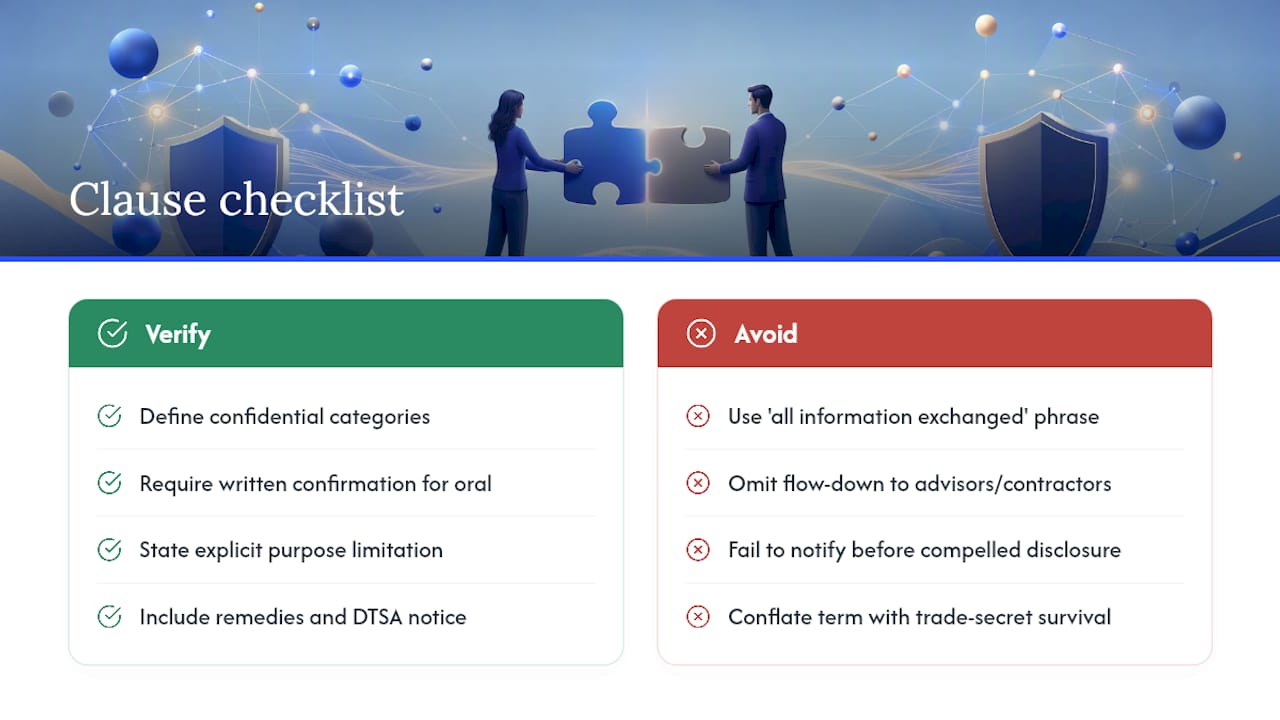
Definition of confidential information. Resist the urge to write "all information exchanged between the parties." Courts routinely find that phrasing too vague to enforce. Instead, list categories: technical data, financial projections, customer lists, product roadmaps, whatever applies to your deal. For oral disclosures, require written confirmation within a set window, often 10 to 30 days, or the disclosure won't count as protected. This approach is echoed directly in drafting guidance on mutual NDA pitfalls, which flags overbroad definitions as one of the most common enforceability problems in practice.
Purpose limitation. State exactly why the information is being shared: evaluating a partnership, negotiating an acquisition, developing a product together. This keeps either party from using disclosed data for something unrelated.
Receiving-party obligations. Spell out non-disclosure, non-use beyond the stated purpose, and a reasonable standard of care, usually "the same care you'd use for your own confidential information." Include a flow-down clause binding advisors, contractors, and affiliates who need access.
Exclusions. Standard carve-outs cover information that's already public, was already known to the receiving party, was developed independently, or must be disclosed under a court order or subpoena. That last one needs a notice procedure: the receiving party must tell the disclosing party before complying, so they get a chance to fight the order or seek a protective one.
Term and survival. Most mutual NDAs run two to five years, but trade secret protection can extend indefinitely under state and federal law, so smart drafting separates the general confidentiality term from a longer survival period for trade secrets specifically.
Return or destruction. Require the receiving party to return or destroy confidential materials at the end of the relationship, with a narrow allowance for compliance-driven archival backups.
Remedies. Include language permitting injunctive relief, since courts can grant equitable relief to stop an ongoing breach without the disclosing party needing to post a bond first. And if trade secrets could be involved, the agreement needs the DTSA whistleblower notice, full stop.
Governing law. Pick a jurisdiction both sides can live with and confirm it doesn't conflict with either party's home-state protections.
Pro Tip: Reference an SEC-filed mutual NDA exhibit when you want to see how a real, executed agreement phrases exclusions and remedies. Public filings are a free source of battle-tested clause language.
How do you fill out and finalize a mutual NDA template?
Turning a checklist into a signed document takes seven steps, and skipping any of them is where most NDAs go sideways.
- Pick a template you can trust. Look for one with annotated clauses and language that mirrors recognized frameworks like Common Paper, since counterparties recognize standardized structure and spend less time re-litigating boilerplate.
- Fill the cover page completely. Use full legal entity names (not "Acme" when the contract is with "Acme Industries LLC"), set the effective date, write a specific purpose statement, and define the disclosure window.
- Tailor the definition and term to what's actually at stake. A casual vendor conversation doesn't need the same five-year survival period as a deal involving proprietary algorithms or unpatented trade secrets.
- Add the DTSA notice if trade secrets are on the table. This is a short paragraph, often just a few sentences, but it's the one most public templates leave out. Include it directly or cross-reference a company whistleblower policy.
- Negotiate efficiently. Redline only the clauses that create real asymmetry. If one side's obligations run longer than the other's, flag it. Leave standard boilerplate alone unless it's genuinely unfair, and use comments instead of silent edits so both sides can track what changed.
- Confirm signer authority before sending for signature. Make sure whoever signs actually has authority to bind their company, and choose an e-sign platform that logs an audit trail: signer identity, IP address, and timestamp.
- Save the executed PDF and its metadata. Store it somewhere searchable, not buried in an email thread you'll never find again.
Pro Tip: Set a calendar reminder tied to your NDA's survival date, not just its term. A five-year confidentiality period that quietly includes a ten-year trade secret survival clause is easy to forget until someone asks about it in litigation.
Formable's mutual NDA template follows this same clause structure, so filling in the guided form walks you through each of these seven checkpoints in order rather than leaving you to remember them on your own.
What are the most common NDA drafting mistakes?
A handful of red flags show up again and again in mutual NDAs, and most of them are easy to catch once you know where to look.
- "All information" definitions. Broad, undefined catch-alls are a recurring problem flagged in mutual NDA drafting guidance, because vague definitions are harder to enforce when a dispute actually happens.
- Mismatched confidentiality periods. If one party's obligations run three years and the other's run seven, the agreement isn't actually mutual, regardless of what the title says.
- Missing DTSA notice. Leaving this out doesn't void the NDA, but it can cost a party access to double damages and attorney fees in a trade secret dispute.
- Hidden non-compete language. Some "confidentiality" clauses quietly restrict a party from working with competitors or hiring the other side's employees. That's a non-compete or non-solicit dressed up as confidentiality, and it deserves its own negotiation.
- No flow-down to advisors or contractors. If your NDA only binds the signing company, anyone the company hires to help, consultants, contractors, outside counsel, isn't covered unless the flow-down clause says so.
- Vague treatment of oral disclosures. Without a written confirmation requirement, a verbal conversation in a hallway meeting has no clear protection at all.
How should you sign, manage, and enforce a mutual NDA?
Getting signatures is only half the job. What you do after signing determines whether the NDA actually protects you when it matters.
Before anyone signs, confirm the signer has real authority to bind their organization, and record their name, title, and the date directly in the audit trail. Use an e-sign platform that captures the signer's IP address and timestamp automatically, and keep the fully executed PDF along with its metadata rather than just a scanned signature page.
Once signed, index the NDA somewhere searchable. Tag it by counterparty name, stated purpose, and the date confidentiality obligations expire, so nobody has to dig through old email threads six months later. Limit access to the underlying confidential materials on a need-to-know basis, and label sensitive documents clearly so nobody mishandles them by accident.
Pro Tip: If you suspect a breach, preserve evidence first, don't confront the other party before you've documented what happened. Then consult counsel about whether injunctive relief or monetary damages fits the situation better; the two remedies serve different goals and NDAs typically allow for both.
How Formable turns this checklist into a guided workflow
Formable's contract creator maps every item in the checklist above into a guided form. You answer questions about parties, purpose, term, and whether trade secrets are involved, and the tool generates a mutual NDA built on Common Paper style clauses rather than a blank template you have to interpret yourself.
The built-in AI review checks for the gaps that trip people up most: a missing DTSA notice, an overly broad confidential information definition, or a term that's asymmetric between the two parties. When you need to negotiate, Formable's redlining tool keeps both sides working from the same document with a full audit trail, instead of five email versions with conflicting edits.
This setup fits best if you're handling NDAs repeatedly, need documented audit trails for compliance reasons, or simply want the cover page filled and the document out the door without rebuilding it from scratch each time.
- Guided intake maps directly to Common Paper style clauses.
- AI review flags missing DTSA notices and asymmetric terms automatically.
- Redlining and e-sign happen in the same workflow, with storage built in.
What makes a mutual NDA actually work in practice
Most NDA advice treats the document as a one-time task: fill it out, sign it, file it away. That's backwards. The clause language matters, but the DTSA notice, the flow-down provisions, and the survival dates only earn their keep months or years later, when someone actually breaches the agreement and you need those specific words to hold up.
The conventional wisdom oversells templates as plug-and-play. They're not. Treating every NDA as identical is how mismatched confidentiality periods and missing notices slip through.
If you take one thing from this, prioritize the DTSA notice and the mutuality test over polishing prose. A perfectly worded clause that's missing the notice or secretly favors one party will cost you more than slightly clumsy phrasing ever will.
Get your mutual NDA drafted and signed without starting from a blank page
Formable gives you a faster path than drafting from scratch or hiring outside counsel for a routine mutual NDA: a guided contract creator that turns your answers into a document built on Common Paper style clauses, checked by AI for the gaps covered in this article, and ready for e-signature the same day.
That matters most if you're handling more than one or two NDAs a year. Instead of reworking a static template every time, you fill out a short form once and get a document with the DTSA notice, mutuality checks, and term structure already accounted for. If negotiation is needed, Formable's redlining tool keeps both sides on one working draft with a full history of changes. Nothing gets lost between email versions. Once it's signed, the executed document and its audit trail live in one searchable place instead of a folder somewhere on someone's desktop.
Start with Formable's contract creator to build your next mutual NDA, or explore the full platform to see how redlining, e-signing, and storage work together.
Sources
- The Notice Provision of the Defend Trade Secrets Act
- Injunction (Cornell Legal Information Institute)
- Mutual Non-Disclosure Agreement (SEC exhibit)
FAQ
How do you create a mutual NDA?
Start with a vetted template that includes categorized confidentiality definitions, symmetric obligations, and a DTSA notice, then fill in the cover page details and route it for signature. Formable's contract creator generates a draft from a guided form if you'd rather not build one clause by clause.
Is a mutual NDA a real, standard type of agreement?
Yes. A mutual NDA, also called a bilateral NDA, is a standard contract type used whenever both parties will share confidential information, as opposed to a unilateral NDA where only one side discloses.
Can you write your own NDA without a lawyer?
You can draft your own NDA using a reputable template, but it's worth having a lawyer review it if trade secrets, high deal value, or unusual terms are involved, since missing clauses like the DTSA notice can limit your legal remedies later.
How do you make a mutual agreement contract in general?
Any mutual agreement, NDA or otherwise, needs clearly named parties, a stated purpose, defined obligations that apply equally to both sides, a term, and signatures from people with authority to bind their organizations.
What's the difference between a mutual and unilateral NDA?
A mutual NDA protects both parties because both disclose confidential information, while a unilateral NDA only protects the one party sharing information with a receiving party who has nothing confidential to share in return. For a fuller comparison, see which NDA you need.