
A mutual NDA is a two-way confidentiality agreement that binds both parties to the same disclosure obligations. Unlike a unilateral NDA, where only one side receives protection, a mutual confidentiality agreement treats each party simultaneously as a disclosing party and a receiving party. That structure makes it the right choice whenever both sides will share sensitive information, which is the case in most early-stage business conversations.
Before you read further, here is a plain-text snippet you can copy right now:
MUTUAL NON-DISCLOSURE AND CONFIDENTIALITY AGREEMENT
This Agreement is entered into as of [Effective Date] by and between [Party A full legal name] ("Party A") and [Party B full legal name] ("Party B") (collectively, the "Parties").
Purpose. The Parties wish to explore [describe the business purpose, e.g., a potential commercial partnership] (the "Purpose") and may disclose Confidential Information to each other solely in connection with the Purpose.
Confidential Information means any non-public information disclosed by one Party to the other, in any form, that is designated as confidential or that reasonably should be understood to be confidential given the nature of the information and the circumstances of disclosure.
Obligations. Each receiving Party shall: (a) hold Confidential Information in strict confidence; (b) use it solely for the Purpose; and (c) disclose it only to employees, contractors, or advisors who need to know and are bound by confidentiality obligations no less restrictive than those herein.
Exclusions. Confidential Information does not include information that: (a) is or becomes publicly available through no fault of the receiving Party; (b) was known to the receiving Party before disclosure; (c) is independently developed without use of the Confidential Information; or (d) is received from a third party without restriction.
Term. This Agreement commences on the Effective Date and continues for a limited period, unless terminated earlier by written notice. Confidentiality obligations survive termination for three years for commercial information and indefinitely for trade secrets.
Return or Destruction. Upon request or termination, each Party shall promptly return or destroy the other Party's Confidential Information, including electronic copies, and certify destruction in writing.
Governing Law. This Agreement is governed by the laws of the State of [State], without regard to conflict-of-law principles.
[Party A signature block] [Party B signature block]
Six fields to fill before this agreement is ready to sign:
- Parties: full legal names and entity types (LLC, Inc., etc.)
- Effective date: the date both parties sign, or a specific calendar date
- Definition of confidential information: narrow or broad scope depending on your risk tolerance
- Permitted purpose: one clear sentence describing why you are sharing information
- Duration and survival: total agreement term plus how long obligations survive termination
- Signatures: authorized signatories for each party, with titles
The Defend Trade Secrets Act (DTSA) provides a federal civil remedy for trade secret misappropriation, so your agreement's trade-secret provisions carry statutory teeth. For international deals, the ICC model confidentiality agreement offers balanced model clauses that reduce negotiation friction. The SEC mutual NDA exhibit shows how public companies structure these agreements in real transactional filings. Formable's mutual NDA template and contract creator lets you generate a complete agreement from these fields in minutes, then send it for e-signing with a full audit trail.
Pro Tip: Never disclose sensitive information in preliminary conversations before the NDA is signed. Verbal disclosures made before execution are generally unprotected, regardless of what the agreement says about prior disclosures.
Key takeaways
A mutual NDA is only as strong as its scope, purpose clause, and execution process. Getting all three right from the start is what separates an enforceable agreement from a document that looks official but provides little real protection.
| Point | Details |
|---|---|
| Fill six fields first | Complete parties, effective date, definition, permitted purpose, duration, and signatures before sending any draft. |
| Negotiate scope and survival | Limit confidential information to what is actually sensitive; set a 3-year survival for commercial info and indefinite for trade secrets. |
| Execute correctly | Use an authorized signatory, sign via E-SIGN-compliant e-signature, and retain a timestamped executed copy. |
| Match complexity to stage | Use a modular two-page template for early discussions; add IP and data security clauses only when the transaction requires them (Cooley GO). |
| Use Formable for the workflow | Formable's template library, redlining tool, and e-signing with audit trail cover the full NDA lifecycle from draft to executed agreement. |
What does a complete mutual NDA template look like?
The snippet above covers the essentials. A full mutual confidentiality agreement adds several sections that matter when disputes arise. Below is a complete plain-text template with bracketed fill-callouts. You can also download a ready-to-use mutual NDA in Word or PDF format from Formable's template library.
This template is published under Creative Commons BY 4.0, which means you may reuse and adapt it freely as long as you attribute the original source.
MUTUAL NON-DISCLOSURE AND CONFIDENTIALITY AGREEMENT
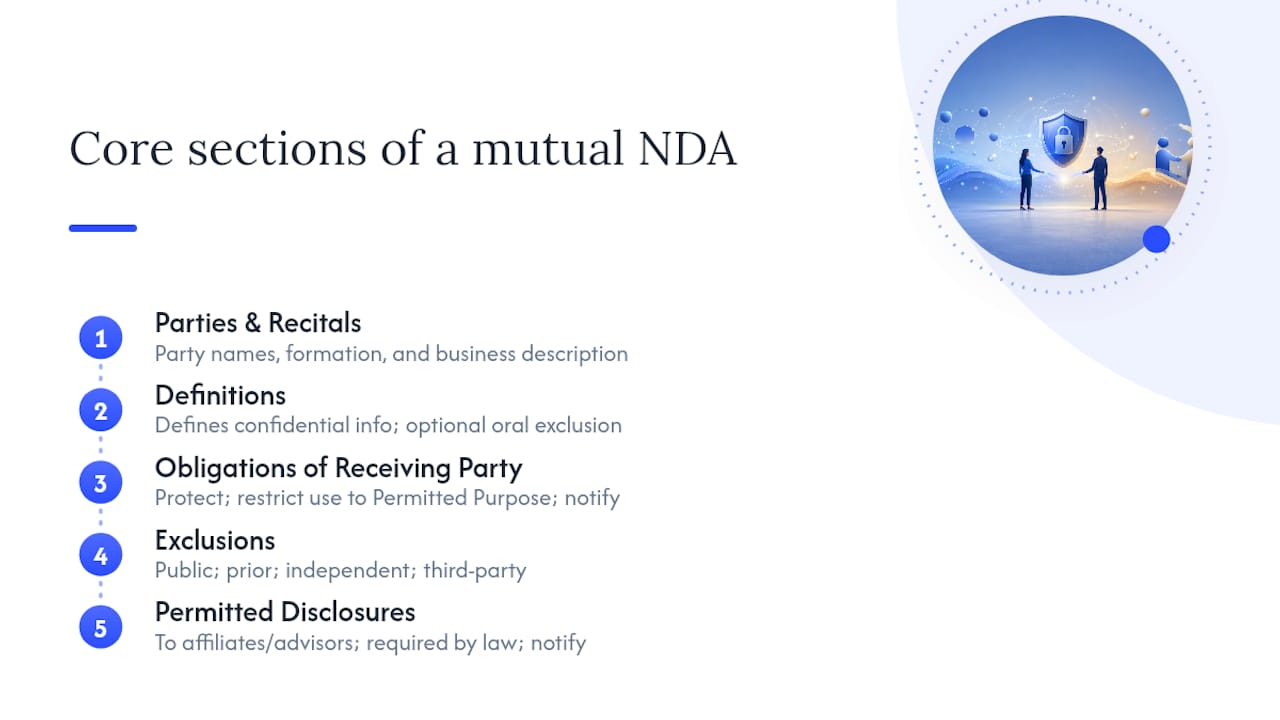
Parties: [Party A legal name, state of formation, entity type] and [Party B legal name, state of formation, entity type].
Recitals. The Parties are considering [describe the business relationship or transaction]. To facilitate that evaluation, each Party may disclose Confidential Information to the other. This Agreement governs those disclosures.
1. Definitions. "Confidential Information" means all non-public technical, financial, business, or operational information disclosed by one Party (the "Disclosing Party") to the other (the "Receiving Party"), whether oral, written, or electronic, that is marked confidential or that a reasonable person would consider confidential under the circumstances. [Narrow option: add "excluding information disclosed orally unless confirmed in writing within 10 business days."]
2. Obligations of the Receiving Party. The Receiving Party shall: (a) protect Confidential Information with at least the same degree of care it uses for its own confidential information, but no less than reasonable care; (b) use Confidential Information solely for the Permitted Purpose; (c) limit access to employees, contractors, and professional advisors who have a need to know and are bound by written confidentiality obligations at least as protective as this Agreement; and (d) promptly notify the Disclosing Party of any unauthorized disclosure or suspected breach.
3. Exclusions. Confidential Information does not include information that: (a) is or becomes publicly known through no breach of this Agreement; (b) was rightfully known to the Receiving Party before disclosure; (c) is independently developed by the Receiving Party without reference to the Confidential Information; or (d) is received from a third party who is not under a confidentiality obligation to the Disclosing Party.
4. Permitted Disclosures. The Receiving Party may disclose Confidential Information: (a) to its affiliates, employees, and advisors on a need-to-know basis, subject to confidentiality obligations no less restrictive than this Agreement; (b) as required by law, regulation, or court order, provided the Receiving Party gives prompt written notice to the Disclosing Party (to the extent permitted by law) and cooperates with any protective order request; and (c) with the prior written consent of the Disclosing Party.
5. Term and Survival. This Agreement is effective as of [Effective Date] and continues for [one (1) to three (3) years, typical for commercial NDAs]. Confidentiality obligations survive termination for three (3) years for commercial information and indefinitely for information that qualifies as a trade secret under applicable law, including the DTSA.
6. Return or Destruction of Materials. Upon written request or termination of this Agreement, the Receiving Party shall promptly return or certifiably destroy all Confidential Information, including electronic copies stored on servers, cloud platforms, backup media, and personal devices. The Receiving Party shall provide written certification of destruction within [ten (10) business days]. [Note: forensic preservation obligations may override destruction if litigation is reasonably anticipated.]
7. Remedies. Each Party acknowledges that a breach of this Agreement may cause irreparable harm for which monetary damages would be an inadequate remedy. Accordingly, the Disclosing Party is entitled to seek injunctive or other equitable relief without posting a bond, in addition to all other remedies available at law or in equity. [Negotiation lever: a receiving party may request a cap on monetary damages for inadvertent disclosures.]
8. Governing Law and Venue. This Agreement is governed by the laws of the State of [State], without regard to its conflict-of-law rules. The Parties consent to exclusive jurisdiction and venue in the state and federal courts located in [County, State].
9. Integration and Amendment. This Agreement constitutes the entire agreement between the Parties regarding confidentiality and supersedes all prior oral or written understandings on the subject. Amendments require a written instrument signed by both Parties. [Note: if a broader MSA or SOW is executed later, include a clause specifying which agreement controls on confidentiality.]
10. Counterparts and Electronic Signatures. This Agreement may be executed in counterparts, each of which is an original. Electronic signatures are valid and enforceable under the Electronic Signatures in Global and National Commerce Act (E-SIGN) and applicable state law.
Signatures: [Party A name, title, date] [Party B name, title, date]
Bloomberg Law's market-standard sample forms include drafting notes on compelled disclosure, return of materials, and injunctive relief that align with the clause structure above.
Pro Tip: When you paste this template into a Word document, use Find & Replace to locate every bracket and confirm you have filled or deliberately deleted each placeholder before sending to the counterparty.
How do you negotiate each clause?
Every clause in a mutual NDA is a negotiation lever. The table below shows the three most contested provisions, with narrow and broad language options so you can pick the version that fits your risk profile.
| Clause | Narrow (receiving-party-friendly) | Broad (disclosing-party-friendly) |
|---|---|---|
| Definition of confidential information | Only written information marked "Confidential" at time of disclosure | All non-public information, oral or written, whether or not marked |
| Survival period | Obligations survive a limited period after termination for all information | Obligations survive a longer period; indefinitely for trade secrets |
| Permitted recipients | Employees only, on a need-to-know basis | Employees, affiliates, contractors, and professional advisors |
Practical Law on Westlaw provides integrated negotiation notes for each of these provisions in its standard mutual confidentiality form.
Confidential information scope. A broad definition protects more, but it also creates compliance burdens for the receiving party. Startups often accept broad definitions from enterprise counterparties without realizing they are agreeing to protect information they cannot practically track. A workable middle ground: cover all non-public information but exclude oral disclosures unless confirmed in writing within ten business days.
Permitted disclosures. Affiliates and contractors are common permitted recipients, but the agreement should require them to be bound by written obligations at least as protective as the NDA itself. For joint development arrangements, add language covering subcontractors and research partners explicitly.
Compelled disclosures. When a court order or regulatory subpoena requires disclosure, the receiving party should be required to give prompt written notice to the disclosing party (where legally permitted) and to cooperate with any motion for a protective order. This preserves the disclosing party's ability to seek protection before disclosure occurs.
Return and destruction of electronic materials. Standard return-or-destroy clauses often miss cloud storage, backup systems, and personal devices. Specify that destruction covers all electronic copies, including those on third-party cloud platforms, and require written certification. If litigation is reasonably anticipated, include a carve-out: forensic preservation obligations override the destruction requirement.
Pro Tip: Gov recommends specifying the permitted purpose with precision. A vague purpose clause ("exploring a potential relationship") can make it difficult to enforce scope limits if the counterparty uses information for adjacent purposes.
When should you use a mutual NDA vs. a unilateral one?
The choice is straightforward once you map the information flow. If only one party will share sensitive information, a unilateral NDA is simpler and cleaner. If both parties will disclose, a mutual confidentiality agreement is the right structure.
Common scenarios where mutual is the right call:
- Early partner or vendor discussions where both sides share pricing, roadmaps, or customer data to evaluate fit.
- Due diligence for M&A or investment where the target shares financials and the acquirer shares deal terms and integration plans.
- Joint development projects where both parties contribute proprietary technology or IP.
- Pilot programs where the vendor shares product architecture and the customer shares operational data.
- Fundraising conversations where a founder shares financials and an investor shares fund strategy or portfolio information.
For early-stage conversations, Cooley GO recommends matching NDA complexity to the stage of the relationship. A two-page modular template is appropriate for an initial exploratory call. A more detailed agreement with IP carve-ins, joint-development provisions, and longer survival periods belongs at the term-sheet or diligence stage.
Customization checklist by stage:
- Pilot or early discussion: narrow scope, short duration (one to two years), simple return-or-destroy clause
- Joint development: add IP ownership carve-ins, specify which party owns improvements, extend survival for technical trade secrets
- M&A diligence: add standstill provisions, restrict use to the specific transaction, include a clean-team protocol for competitively sensitive data
- Vendor onboarding: add data security obligations, reference your data processing agreement (DPA), and specify permitted subprocessors
For a detailed comparison of the two structures, see unilateral vs. mutual NDA.
Pro Tip: Sending a 15-page NDA to a potential partner for an introductory call signals distrust before the relationship starts. Match the document's weight to the conversation's stakes.
How do you sign and enforce a mutual NDA in the United States?
Execution is where NDAs most often fail. A well-drafted agreement that is signed by the wrong person, or not signed at all before disclosures begin, may be unenforceable.
Execution checklist:
- Confirm the signatory has authority to bind the entity (check the operating agreement or board resolution if in doubt)
- Set the effective date as the date of the last signature, not a future date
- Use a compliant e-signature platform; electronic signatures are valid under the federal E-SIGN Act and the Uniform Electronic Transactions Act (UETA), which has been adopted in 49 states
- Retain a fully executed copy with timestamps in a secure document repository
- Confirm counterparty acceptance by receiving a countersigned copy, not just a verbal confirmation
Steps after a suspected breach:
- Preserve all evidence immediately: emails, access logs, download records, and any communications referencing the disclosed information.
- Send a written cease-and-desist notice to the breaching party identifying the specific information disclosed and the obligation violated.
- Issue a formal demand letter requesting return or destruction of materials and cessation of any further use.
- Seek injunctive relief in court if the breach is ongoing or if monetary damages would be inadequate. Most mutual NDAs include an injunctive relief clause for exactly this reason.
- Evaluate DTSA remedies if the disclosed information qualifies as a trade secret. The DTSA allows a trade secret owner to apply for an ex parte seizure order in extraordinary circumstances, in addition to damages and injunctive relief.
The DTSA also includes a whistleblower safe harbor: an individual cannot be held liable under the DTSA for disclosing a trade secret to a government official or attorney solely for reporting a suspected legal violation. If your NDA covers trade secrets, Nolo's NDA guide recommends including a DTSA notice provision in the agreement itself.
Quick drafting and negotiation checklist
Use this checklist at the negotiation or signing stage to catch risky or missing terms before you execute.
Scope and definitions:
- Definition of confidential information is specific, not open-ended
- Permitted purpose is stated in one clear sentence
- Oral disclosures are either excluded or subject to written confirmation
Permitted disclosures and recipients:
- Affiliates and contractors are listed as permitted recipients only if needed
- All permitted recipients are required to sign confidentiality agreements
- Compelled disclosure clause requires prior written notice and cooperation with protective orders
Duration and survival:
- Agreement term is stated (typically one to three years for commercial discussions)
- Survival period is specified separately from the agreement term
- Trade secrets are carved out for indefinite protection
Return and destruction:
- Clause covers electronic copies, cloud storage, and backup media
- Written certification of destruction is required
- Forensic preservation carve-out is included if litigation is possible
Remedies and liability:
- Injunctive relief is available without bond
- Monetary damages cap is negotiated if the receiving party requests one
- Attorneys' fees provision is included or explicitly excluded
Red flags to address before signing:
- Overly broad definition covering all information exchanged, with no carve-outs: propose limiting to information marked confidential or confirmed in writing
- Perpetual confidentiality for non-trade-secret commercial information: propose a three-year survival period
- Unilateral carve-outs that benefit only the drafting party: require symmetrical exclusions
- Missing signature blocks or unsigned counterparts: do not disclose until fully executed copies are exchanged
How much NDA complexity do you actually need?
The honest answer is: less than most lawyers draft, and more than most founders sign.
Cooley GO's modular mutual NDA template reflects a practitioner consensus that over-engineering early NDAs creates adversarial dynamics without adding meaningful protection. A two-page agreement with clear scope, a defined purpose, and a standard exclusions clause covers most early-stage commercial conversations.
For cross-border deals, the picture changes. The ICC model confidentiality agreement provides balanced clauses designed for international transactions, where governing law, enforcement mechanisms, and definitions of "confidential" vary significantly across jurisdictions. Adopting a model clause reduces the negotiation time that would otherwise be spent aligning on basic structural choices.
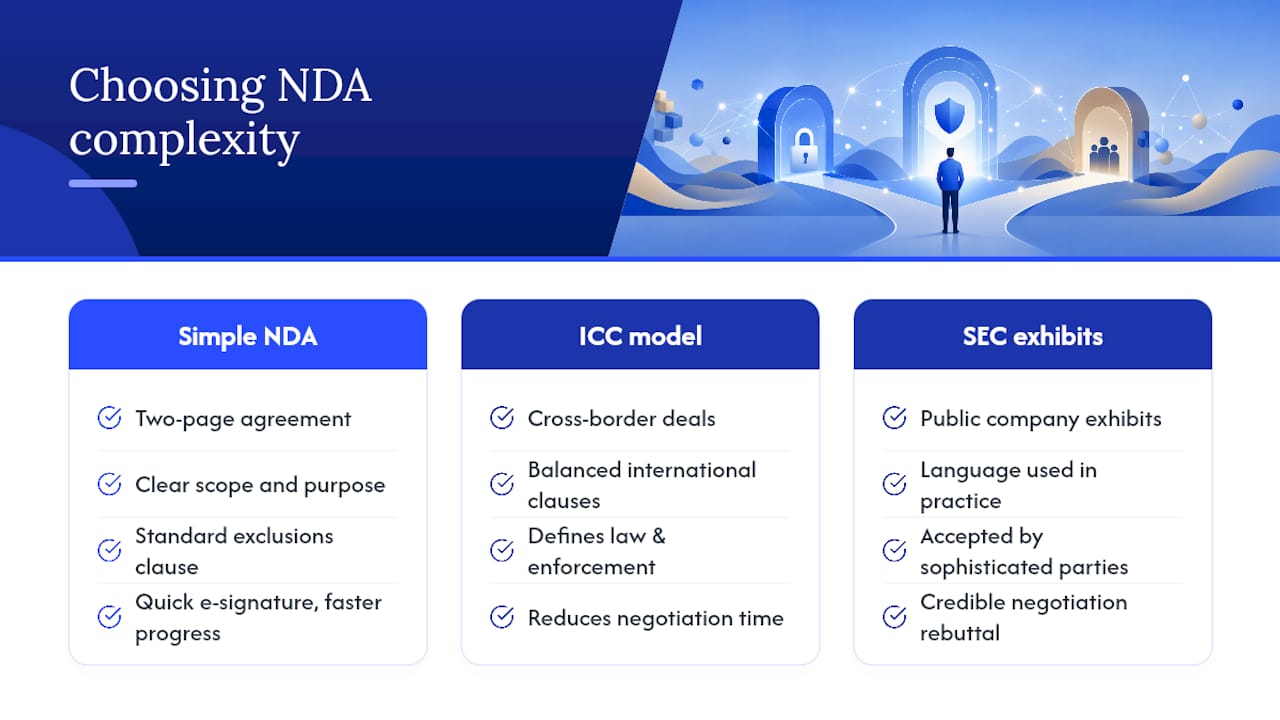
SEC mutual NDA exhibits are worth studying for a different reason: they show language that experienced counsel and sophisticated counterparties have already accepted in real transactional settings. When a counterparty pushes back on your clause, pointing to a public company's SEC exhibit with identical language is a credible response.
Two patterns appear consistently in practice. A startup entering a partnership discussion with a large enterprise often finds that a simple two-page mutual NDA, signed quickly via e-signature, moves the conversation forward faster than a detailed agreement that sits in legal review for two weeks. Conversely, a company sharing source code or clinical data in a joint development context later discovers that a simple NDA did not address IP ownership or data security obligations, requiring a contract amendment to fix the gap.
The practical lesson: start with a modular template that covers the essentials, and add complexity only when the transaction's specific risks require it. A well-structured short NDA, signed and in place before disclosures begin, is worth more than a comprehensive agreement that arrives after the conversation has already happened.
The pragmatic case for template-driven NDA workflows
Most NDA negotiations fail not because the clauses are wrong, but because the process is slow. A draft sits in email for a week. The counterparty redlines it in a PDF. Someone loses track of which version is current. By the time both parties sign, the business conversation has stalled.
The fix is not a better template. It is a better workflow. Clear scope, a defined permitted purpose, and a compliant e-signature are the three things that make an NDA enforceable and fast. Everything else is secondary.
Template-driven platforms that combine pre-approved clause libraries with real-time redlining and e-signing reduce the time from draft to executed agreement significantly. Formable's contract review tool can flag risky NDA language automatically during intake, so your team catches problems before they reach the counterparty. That combination of speed and risk detection is where most teams find the most value.
Formable makes NDA creation, negotiation, and signing faster
Drafting a mutual confidentiality agreement from scratch takes time. Negotiating it over email takes more. Formable cuts both steps down to a fraction of the effort.
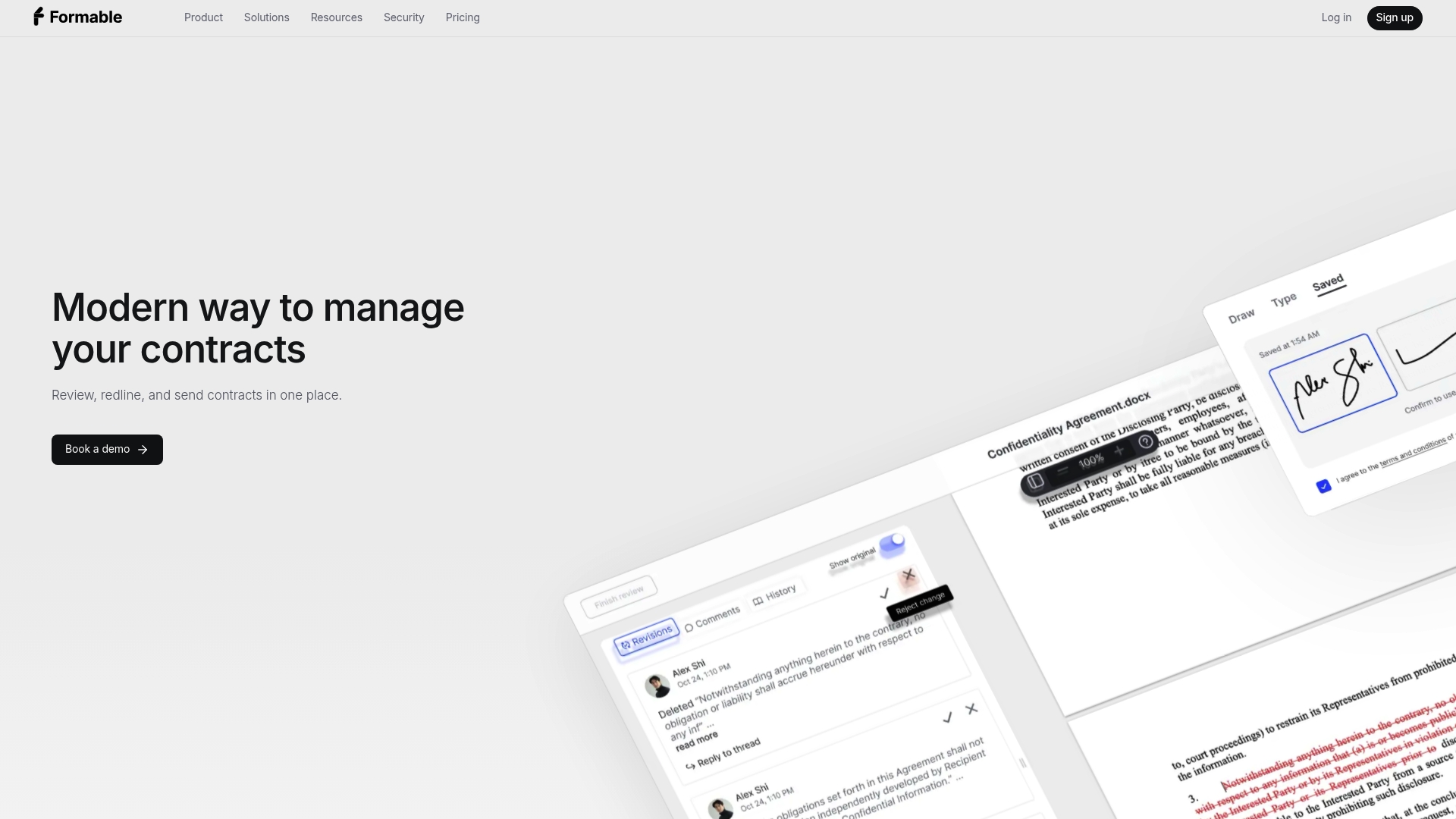
Start from a ready-to-use mutual NDA template that combines pre-approved clause language with AI-assisted generation. Fill the six key fields, customize scope and duration, and send the agreement for negotiation in minutes. Formable's redlining tool lets both parties align on terms with tracked changes before moving to signature. Once terms are agreed, collect e-signatures with a full, immutable audit trail that satisfies E-SIGN and UETA requirements. For developer teams, Formable's API supports embedded e-signing and contract creation at scale. Reach out and the team will walk through your specific use case.
Sources
Direct links to the most authoritative templates and model clauses for US practitioners:
- Form of Non-Disclosure Agreement US (Mutual) | Cooley GO Docs
- Mutual Non-Disclosure Agreement
- ICC model confidentiality agreement
- Gov
- Confidentiality agreement sample form | Bloomberg Law
- Confidentiality agreement general mutual | Practical Law (Westlaw)
When in doubt, consult qualified legal counsel before executing any agreement that covers trade secrets, joint development, or cross-border disclosures. This guide provides general information, not legal advice.
This article is general information, not a substitute for advice from a qualified lawyer. Consult a qualified legal professional about your own circumstances before acting on anything here.
FAQ
What is a mutual NDA and when should you use one?
A mutual NDA is a two-way confidentiality agreement that binds both parties to the same obligations. Use it whenever both sides will share sensitive information, such as in partnership discussions, joint development, or M&A diligence.
How long should a mutual confidentiality agreement last?
Most commercial mutual NDAs run for one to three years, with confidentiality obligations surviving termination for three to five years for commercial information and indefinitely for trade secrets, as noted in GOV.UK's NDA guidance.
Are electronic signatures valid on a mutual NDA in the United States?
Yes. Electronic signatures are enforceable under the federal E-SIGN Act and UETA, which has been adopted in 49 states. Use a platform that generates a timestamped audit trail, such as Formable's e-signing tool, to preserve execution evidence.
What happens if someone breaches a mutual NDA?
Preserve evidence immediately, send a written cease-and-desist, and seek injunctive relief if the breach is ongoing. If the disclosed information qualifies as a trade secret, the DTSA provides additional federal remedies including the possibility of an ex parte seizure order.
Does a mutual NDA need to be notarized?
No. Notarization is not required for a mutual NDA to be enforceable in the United States. A signed agreement with authorized signatories and a clear effective date is sufficient.