
A service agreement is a standalone contract covering one project with one client, start to finish. A master service agreement (MSA) is a framework contract that sets the ground rules once, then lets multiple projects run underneath it through separate statements of work (SOWs). If you're negotiating a single engagement with a defined end date, draft a service agreement. If you expect repeat business, ongoing work, or multiple project streams with the same counterparty, an MSA saves you from renegotiating liability caps and payment terms every single time.
That's the whats the difference between a service agreement and a master service agreement question answered in two sentences. The rest of this piece breaks down how the two documents diverge clause by clause, when to reach for each one, and how to draft or generate either using Formable's guided contract creator without starting from a blank page.
Here's what you'll find below:
- Clause-level differences in scope, IP, liability, payment, and termination
- A decision checklist for choosing a service agreement vs an MSA
- How the MSA plus SOW structure actually works in practice
- A drafting checklist and negotiation tips for both document types
Key Takeaways
Choosing between a service agreement and a master service agreement comes down to whether you expect one project or an ongoing relationship with repeat work.
| Point | Details |
|---|---|
| Match document to relationship | Use a service agreement for one-off projects, an MSA when repeat business is likely. |
| SOWs carry project specifics | Under an MSA, each SOW defines scope, price, and timeline while the MSA holds legal terms. |
| Liability caps need structure | Set caps per-SOW under an MSA to avoid unlimited aggregate exposure across projects. |
| Precedence clauses prevent conflict | Decide upfront whether the MSA or SOW controls when terms clash, hybrid models are common. |
| Templates speed up drafting | A guided contract creator generates a starting draft for either document type. |
What Are the Clause-Level Differences Between a Service Agreement and an MSA?
The clauses in both documents cover similar ground, scope, IP, liability, payment, termination, confidentiality. What changes is where each clause lives and how much detail it carries.
Scope and deliverables. A service agreement defines the "Services" directly in the body of the contract, often in a single section or short exhibit. An MSA deliberately avoids naming specific services at all. It sets the legal framework, then pushes scope and deliverables into individual SOWs. This is the single biggest structural difference between the two, and it's why an MSA reads almost abstract on its own.
IP ownership and licensing. Standalone service agreements typically resolve IP in one clause: work product assigns to the client, or the provider retains ownership and grants a license. MSAs need layered language because multiple projects may create different IP outcomes. A well-drafted MSA distinguishes Customer IP, Provider IP, and Joint IP, then lets each SOW specify assignment or license terms for that particular deliverable. Skipping this layering is a common drafting mistake, since default copyright rules under US law don't automatically favor the paying client.
Liability and indemnity. Both documents cap liability, but the negotiation dynamics differ. In a service agreement, the cap usually ties to fees paid under that one engagement. In an MSA, the cap needs to account for aggregate exposure across every SOW signed during the relationship, which is why sophisticated MSAs often set liability caps per-SOW rather than for the whole framework. Indemnity provisions follow the same logic: an MSA's indemnity language has to survive years of unknown future projects, so it tends toward broader, more carefully negotiated carve-outs.
Payment terms. A service agreement usually specifies one pricing model, project-based or milestone-based, for the single engagement. An MSA sets payment mechanics (invoicing cadence, currency, late fees) at the framework level, while each SOW carries its own pricing, whether that's a fixed project fee, recurring subscription rate, or volume-based discount tied to total spend.
Termination and transition. Termination in a service agreement is straightforward since only one project ends. MSA termination is more consequential because it can affect multiple active SOWs simultaneously. Strong MSAs include transition assistance obligations, requiring the outgoing provider to support an orderly handoff so ongoing operations don't stall mid-project.
Confidentiality and SLAs. Confidentiality obligations usually sit at the MSA level since they should apply uniformly across every project. Service levels work the opposite way. SLAs and measurement criteria typically attach at the SOW level, because acceptable response times or uptime targets vary by project scope.
Pro Tip: If you're reviewing an MSA and the SOW template attached to it is silent on liability, don't assume the MSA's cap automatically limits that project. Confirm the precedence clause says so explicitly, or you're negotiating blind.
When Should You Use an MSA vs a Standalone Service Agreement?
Run through this checklist before you draft anything:
- Is this a one-off engagement with a fixed scope and single milestone? If yes, a standalone service agreement is faster to negotiate and easier to close. There's no benefit to building a framework you'll only use once.
- Do you expect repeat work with this same party within the next 12 to 24 months? If yes, an MSA pays for itself after the second project, since you skip re-litigating liability, IP, and payment terms every time.
- Will multiple teams or departments run separate projects with this vendor? Consulting firms, marketing agencies, and software vendors juggling multiple client workstreams almost always benefit from an MSA, because it keeps legal terms consistent even as project managers change.
- Does the relationship require a consistent legal framework across jurisdictions or business units? Larger organizations use MSAs specifically to standardize governing law and dispute resolution across a fragmented vendor relationship.
The trade-off is time. Negotiating an MSA up front takes longer than a single service agreement, because you're anticipating problems you haven't hit yet. But that investment shortens every future SOW to a page or two covering scope, price, and timeline.
Consulting engagements and marketing retainers lean toward MSAs almost by default, since the relationship implies ongoing work from day one. Software development shops often start with a service agreement for a pilot project, then convert to an MSA once the client commits to a longer roadmap.
Pro Tip: If you're not sure which one you need, ask yourself whether you'd be comfortable signing this same document again in six months with only the scope changed. If the answer is yes, you need an MSA.
How Does the MSA and SOW Structure Actually Work?
A statement of work (SOW) is the document that fills in what an MSA leaves blank: specific deliverables, pricing, timelines, and acceptance criteria for one project. It gets incorporated by reference into the MSA, meaning the SOW doesn't need to restate liability caps or governing law. It just points back to the master document and adds project specifics.
Precedence clauses decide what happens when an SOW and the MSA conflict. There are three common patterns:
- MSA-controls: the MSA's terms always win on legal protections like liability, indemnity, and IP, even if an SOW tries to change them. This is the most common setup in technology services, since it stops a rushed SOW from accidentally weakening protections negotiated up front.
- SOW-controls: the SOW overrides the MSA for that specific project, used when parties genuinely need custom terms for an unusual engagement.
- Hybrid: legal protections stay locked at the MSA level while commercial terms like price and scope flex freely at the SOW level. This is the model most technology and consulting relationships end up using in practice.
SLAs, acceptance testing, and service credits typically attach as SOW exhibits rather than living in the MSA itself, since performance targets change project to project. Change orders and amendments should modify only the SOW whenever possible, keeping the MSA stable while individual projects evolve. The discipline worth adopting: keep every SOW short and specific, and let the MSA carry the legal weight.
How Do You Draft and Negotiate These Agreements?
Whether you're drafting a service agreement or an MSA, the checklist covers the same core categories, just with different depth in each.
Baseline checklist for either document:
- Parties and effective date
- Scope of services or deliverables
- Acceptance criteria
- IP ownership, license, or assignment language
- Pricing and payment schedule
- Milestones and invoicing triggers
- Liability cap and indemnity
- Insurance requirements
- Termination rights and transition assistance
- Confidentiality and data protection
- Governing law and dispute resolution
For SOWs specifically, write acceptance criteria as an objective test rather than a subjective standard. Language like "deliverable meets the requirements in Exhibit A and passes acceptance testing within 10 business days" avoids drawn-out disputes over what counts as "satisfactory." Tie invoicing triggers to those same milestones, and specify holdback percentages if you're using them, so nobody argues about when payment is actually due.
On negotiation, a few levers matter more than others:
- Narrow IP assignments to the specific deliverable rather than "all work product," which can accidentally sweep in a provider's pre-existing tools and methodologies.
- Tie liability caps to fees paid or insurance coverage, whichever is higher, so the cap scales with actual risk instead of sitting at an arbitrary flat number.
- Push for service credits over pure remedies when SLAs are missed, since credits are self-executing and don't require a separate breach claim.
- Insist on transition assistance clauses in any MSA, particularly if the vendor's work touches critical infrastructure or ongoing customer-facing systems.
Watch for red flags: indemnities that cover "any and all claims" with no carve-outs, liability caps that only apply to one party, and acceptance language that lets either side reject work for vague reasons like "not meeting expectations." These clauses look boilerplate until you're the one stuck enforcing them.
Pro Tip: Keep every SOW under two pages if you can. The moment an SOW starts restating legal terms already covered in the MSA, you've created two documents that can contradict each other, and that's a fight waiting to happen.
One workflow shortcut worth adopting: start from a template MSA or a guided contract creator rather than a blank document, so you're not reinventing clause structure every time.
How Formable Helps You Draft Either Agreement
Formable's free contract creator walks you through a guided form built on standard templates modeled after Common Paper's widely used framework, then generates a draft using the answers you provide. You can build either document type:
- Service agreement: answer questions about scope, payment, and timeline, and Formable's services agreement creator generates a ready draft.
- MSA: the MSA creator handles the framework terms, then pairs with a separate SOW creator for each project underneath it.
- Redlining: once a draft goes out, both sides can negotiate terms directly in Formable rather than emailing tracked-changes documents back and forth.
- Review: upload an incoming contract and Formable's AI flags missing clauses or risk against your own playbook.
- E-sign: close the loop and get the finished document signed without switching tools.
The generated draft works as a starting point for your own legal review, or, for lower-risk engagements, as a document ready to send for signature.
What This Comparison Actually Tells You
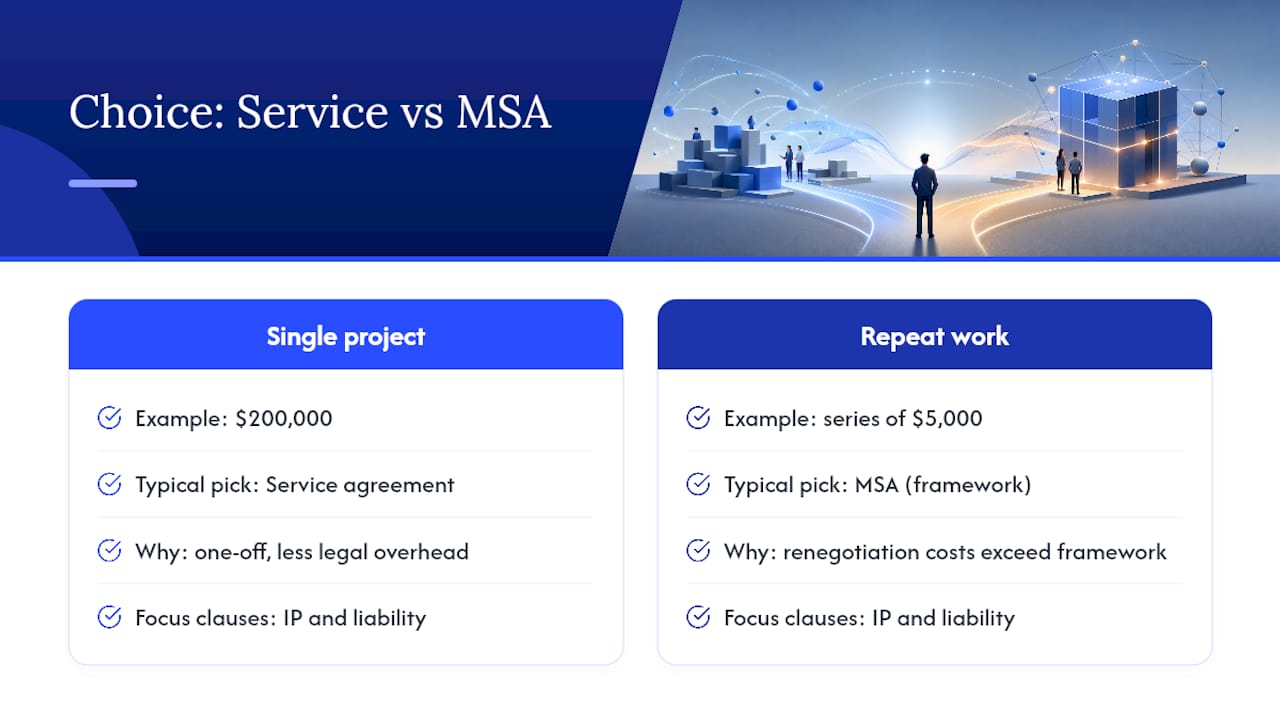
The conventional advice treats this as a binary choice, pick the "right" document type and you're done. That undersells how much the decision hinges on relationship trajectory rather than project size. A $200,000 single project might warrant only a service agreement, while a series of $5,000 engagements with the same vendor justifies an MSA purely because the legal overhead of renegotiating terms five times costs more than the framework itself.
Where most guidance falls short is treating IP and liability clauses as afterthoughts to copy from a template. They're the clauses that actually differ in substance between a one-off deal and a framework agreement, and they're where disputes happen years later when nobody remembers the original negotiation. Prioritize getting those right before worrying about termination language or notice periods, which matter far less in practice than they get credit for in most checklists.
— Alex
Sources
For deeper drafting guidance, consult Thomson Reuters' overview of MSAs, Nolo's explanation of when you need one, and the American Bar Association's practice guidance on contract negotiation. Always confirm state-specific requirements with qualified counsel before finalizing either document.
- What is a master service agreement and when do you need one? — Nolo
- How to write a simple service agreement — FindLaw
FAQ
What Does a Master Service Agreement Look Like in Practice?
A typical MSA includes definitions, payment terms, IP ownership framework, liability caps, confidentiality, termination rights, and governing law, with actual project scope left to attached SOWs rather than spelled out in the MSA itself.
What Is the Difference Between an MSA and an SLA?
An MSA is the overarching legal framework governing the relationship, while a service level agreement (SLA) sets specific, measurable performance standards, like uptime or response time, usually attached to an individual SOW under that MSA.
Who Actually Needs a Master Service Agreement?
Businesses expecting repeat engagements with the same vendor or client, such as consulting firms, software providers, and marketing agencies running multiple projects, benefit most from an MSA since it avoids renegotiating core terms each time.
What Are the Main Types of Service Agreements?
Common types include standalone service agreements for single projects, professional services agreements tied to a specific standard of care, and MSAs paired with SOWs for ongoing, multi-project relationships.