
A unilateral NDA (also called a one-way NDA) is a contract that binds only the receiving party to keep specific information confidential, used whenever information flows in one direction, such as employer to employee, company to contractor, or startup founder to a potential investor. Use it whenever you are the only party sharing sensitive material and the other side has nothing comparable to protect.
Three things matter more than anything else once you sit down to draft one. First, define confidential information narrowly, tied to a specific project or purpose, rather than sweeping in "any and all information." Second, if the agreement covers an employee or contractor with access to trade secrets, add the DTSA whistleblower-immunity notice or you risk losing your right to double damages later. Third, start from a tailored template rather than a generic form pulled off a search results page, and get it signed before any confidential material changes hands.
Before you send anything out, run through this short list:
- Confirm who signs: the receiving party's full legal name, not a division or trade name
- Check that a purpose clause exists, limiting use of your information to one stated business reason
- Verify the term is reasonable for the type of information (ordinary business data, not indefinite trade secret status by default)
Then move through these steps in order:
- Choose a one-way template built for your scenario (hire, vendor, investor)
- Narrow the definition of confidential information to what you're actually sharing
- Add the DTSA notice if an employee or contractor will have trade secret access
- Route the draft for signature and store the signed copy somewhere retrievable
Key takeaways
A unilateral NDA protects one party's confidential information effectively only when the definition is narrow, the DTSA notice is included where required, and both signatures are on file.
| Point | Details |
|---|---|
| Definition drives enforceability | Narrow, categorized definitions of confidential information hold up in disputes; broad catchalls tend to weaken your position. |
| DTSA notice is not optional | Omitting it from employee or contractor NDAs can forfeit exemplary damages and attorney fees under federal trade secret law. |
| Match term to information type | Ordinary business data warrants a defined term of a few years; true trade secrets can carry indefinite protection under state law. |
| Amendments need the same formality | Scope or term changes require a written, signed amendment referencing the original NDA, not an email confirming a verbal update. |
| Formable speeds safe drafting | Formable's free contract creator combines templates with AI review, redlining, and e-signing to help you draft and finalize a unilateral NDA without missing key clauses. |
What is a unilateral NDA, exactly?
A unilateral NDA is an agreement where one party, the disclosing party, shares confidential information and the other, the receiving party, agrees to protect it. Only the receiving party takes on confidentiality obligations. That asymmetry is the entire point of the document, and it's also why choosing the wrong form (a mutual NDA when you only need one-way protection) creates unnecessary friction in negotiations.
The disclosing party is whoever holds the information at risk: an employer sharing product roadmaps with a new hire, a company sharing pricing data with a vendor, a founder sharing a pitch deck with an investor. The receiving party is the one who must not use or share that information beyond what's permitted. This can be an individual (a contractor, an employee, an advisor) or an entity (a vendor's company, an investment fund).
A few baseline points worth settling before you draft anything:
- Get it in writing. Oral confidentiality promises are nearly impossible to enforce and courts routinely dismiss claims built on them.
- Signatures aren't optional. An unsigned NDA, even a well-drafted one, gives a court very little to work with if a dispute arises.
- Contractors and consultants count as receiving parties just like employees do, and often need broader restrictions since they may work with competitors simultaneously.
The term "unilateral" sometimes gets confused with "unilateral contract" in first-year contracts courses, a different legal concept entirely involving one-sided performance promises. In NDA practice, unilateral just means one-directional confidentiality. Keep that distinction in mind if you're cross-referencing older legal texts.
Should you use a unilateral or mutual NDA?
The decision rule is simpler than most templates make it look: if only one side is disclosing confidential information, use a unilateral NDA. If both sides plan to share sensitive material, a mutual NDA protects both of you and avoids the awkward follow-up request for a second agreement three weeks into the relationship.
Map it to your situation:
- Hiring an employee or contractor who will see your systems and data, but won't share anything back: unilateral.
- Bringing on a vendor who only receives your specs and pricing: unilateral.
- Talking to an investor who sees your financials but shares nothing proprietary in return: unilateral.
- Joint development or a partnership where both companies bring proprietary technology to the table: mutual, every time.
Where unilateral NDAs backfire is when the relationship shifts. A vendor conversation that starts as pure disclosure often evolves into a co-development discussion within a few meetings, and suddenly you need mutual protections you didn't set up. Read more on choosing between unilateral and mutual NDAs before you commit to a form you'll need to redo.
When does a one-way NDA actually make sense?
Four scenarios cover most unilateral NDA use in practice, and each carries its own wrinkle.
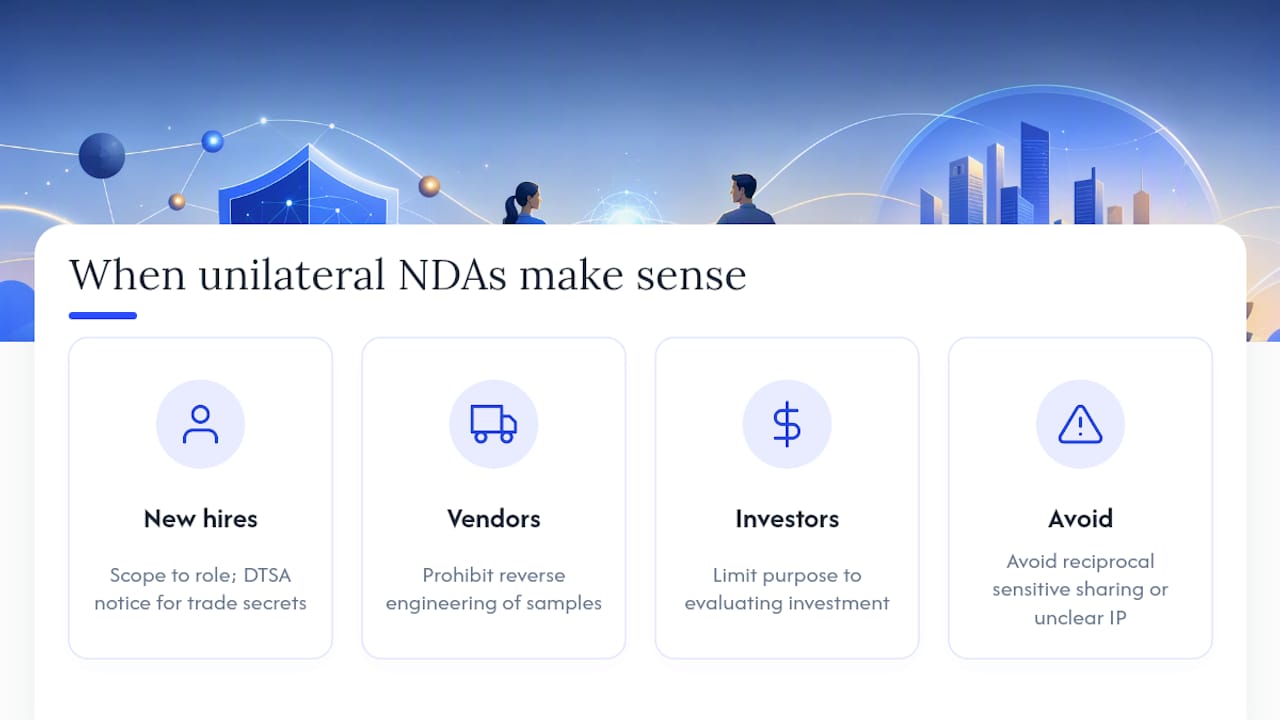
New hires and contractors. Scope the confidentiality obligation to what the person will actually access, not your entire company's information stack. If the role touches trade secrets, this is the exact context where a DTSA notice matters most, since employment and contractor agreements are the primary place courts look for it.
Vendors, manufacturers, and suppliers. If you're sending product samples, specs, or manufacturing files, add explicit reverse-engineering prohibitions. A vendor with a physical sample in hand has every opportunity to take it apart, and a generic confidentiality clause doesn't address that risk directly.
Investors and advisors. Early-stage sharing usually means financials, cap tables, and product roadmaps. Keep the purpose clause tight, "evaluating a potential investment," so the NDA can't later be read as clearing the investor to discuss your business with portfolio companies in the same space.
When to avoid it. If the other side will hand you anything sensitive in return, even informally, a unilateral NDA leaves you exposed. Same goes for joint development conversations where ownership of resulting IP is unclear.
The clauses that make or break enforceability
Every clause in a unilateral NDA earns its place. Cut one, and you either weaken your protection or hand a court a reason to read the agreement narrowly against you.
Identification of parties. Use full legal names, not "the Company" without a defined entity, and not a founder's name when the actual disclosing party is the LLC. Sloppy party identification is a surprisingly common reason NDAs get challenged.
Definition of confidential information. This is the clause worth spending the most time on. Vague, catchall definitions ("any information disclosed by the Company") tend to backfire because courts read overly broad definitions skeptically, and they make it harder to prove what specifically was misused later. Better practice: define categories (technical specifications, financial projections, customer lists) and, where practical, mark documents as confidential at the time of disclosure.
Purpose and scope. State the single business reason the information is being shared: "evaluating employment," "fulfilling the manufacturing agreement," "assessing a potential investment." A tight purpose clause does double duty, it limits what the receiving party can do with your information, and it makes any deviation easy to point to later.
Recipient obligations. Spell out the standard of care (typically "the same degree of care the receiving party uses for its own confidential information, but no less than reasonable care") and a need-to-know restriction limiting internal access to employees who actually require it.
Standard exclusions. Every enforceable NDA carves out information that's already public, already known to the receiving party before disclosure, independently developed without reference to your information, or disclosed under legal compulsion (subpoena, court order). Leaving these out doesn't make your NDA stronger, it makes it look drafted by someone who skipped a template review.
Term and survival. Reasonable duration matters more than most people assume. Ordinary business information might warrant a few years of protection. True trade secrets can carry indefinite protection under state trade secret law regardless of what the NDA says, so you don't need to (and shouldn't) claim perpetual confidentiality for routine business data just because it feels safer.
Return or destruction. Require the receiving party to return or destroy confidential materials at the end of the relationship or on request, and consider requiring written certification of destruction for anything that can't practically be returned (emails, notes, digital copies).
No license, no transfer. Confirm explicitly that sharing information doesn't grant any license, ownership interest, or right to the disclosing party's intellectual property. Include a carveout protecting each party's pre-existing "background IP" so there's no ambiguity about what the NDA does and doesn't touch.
Reverse engineering and AI restrictions. Modern one-way NDA templates increasingly prohibit reverse engineering physical samples and, more recently, using disclosed materials to train machine learning models or build derivative datasets. If your business shares proprietary data, code, or design files, add this clause even if a generic template you found doesn't include it. Formable's AI addendum template is a useful reference if you need to formalize AI-specific restrictions separately.

Remedies and injunctive relief. Confidentiality breaches often cause harm that's hard to price, lost competitive advantage, damaged relationships, so most NDAs explicitly state that monetary damages alone may be inadequate and that the disclosing party can seek injunctive relief without needing to post a bond. Courts are generally receptive to this language in NDA disputes specifically, more so than in ordinary breach of contract claims.
Governing law and jurisdiction. Pick a state with well-developed trade secret and contract law, and be explicit about it if either party operates in multiple states. This matters more than people think.
DTSA whistleblower-immunity notice. Practical commentary is direct about the consequence-a-complete-guide) here: skip this notice in an NDA governing an employee's or contractor's access to trade secrets, and you can forfeit the disclosing party's right to exemplary damages and attorney fees under the federal Defend Trade Secrets Act if litigation ever happens. It's a few sentences of boilerplate that carries real financial weight.
Pro Tip: Keep a clause library, not a single master template. A unilateral NDA for a manufacturing vendor and one for a Series A investor should not share the same confidentiality definition or exclusions list. Reusing one template across every scenario is the single most common way enforceability gets weakened.
A quick checklist before you send an NDA out
Run through this before any unilateral NDA leaves your inbox.
- Both parties named by full legal entity or individual name, correctly spelled
- A purpose clause that states one specific reason for disclosure
- Confidential information defined by category, not by open-ended catchall language
- Standard exclusions included (public domain, prior knowledge, independent development, legal compulsion)
- A term that matches the sensitivity of the information, not an automatic default of "forever"
- DTSA whistleblower notice included if an employee or contractor will access trade secrets
- Return or destruction obligations, with certification required for digital copies
- Signature blocks for both parties, dated
Watch for these red flags, which are the fastest way an NDA gets recharacterized as an unenforceable restraint on trade:
- Confidentiality obligations that quietly restrict the receiving party from working for competitors (that's a non-compete wearing an NDA's clothes)
- A term with no end date attached to ordinary business information
- A definition of confidential information broad enough to cover publicly available facts
Common mistakes worth naming directly: vague definitions that try to cover everything and end up protecting nothing specific, missing signatures on a document everyone assumed was "basically final," and copying a perpetual term from a trade secret clause into a section covering routine operational data.
If a dispute looks likely, get ahead of it. Preserve every version of the confidential materials shared, keep an access log of who at the receiving party's company saw what, and hold onto the signed NDA and any related correspondence in one place rather than scattered across email threads.
Pro Tip: If you're reviewing an NDA someone else drafted, run it against this checklist before you sign anything, not just when you're the one sending it out. Receiving parties get burned by overbroad definitions just as often as disclosing parties get burned by weak ones.
An annotated unilateral NDA template you can use
A downloadable one-way NDA needs to cover the same ground every time: parties, definition, purpose, obligations, exclusions, term, return of materials, remedies, and signatures. Here's how each section typically reads, with notes on what to customize.
Preamble and parties. "This Non-Disclosure Agreement is entered into as of [date] by and between [Disclosing Party legal name], with a principal address at [address] ('Disclosing Party'), and [Receiving Party legal name], with a principal address at [address] ('Receiving Party')." Fill in full legal names, never shorthand.
Definition of confidential information. "Confidential Information means any technical, business, or financial information disclosed by Disclosing Party to Receiving Party in connection with [stated purpose], including but not limited to [list 3 to 5 specific categories relevant to your situation]." Customize the bracketed categories every single time. This is not a section to leave generic.
Purpose clause. "Receiving Party may use Confidential Information solely for the purpose of [evaluating employment / fulfilling the vendor agreement dated X / evaluating a potential investment]." Match this to the actual relationship.
Obligations. "Receiving Party shall protect Confidential Information using the same degree of care it uses for its own confidential information, and in no event less than reasonable care, and shall limit access to employees or agents with a need to know."
Exclusions. Standard language covering information that's public, previously known, independently developed, or legally compelled to be disclosed. Keep this section largely unchanged from template to template, it's boilerplate for good reason.
Term. "This Agreement shall remain in effect for a reasonable term for standard business information from the date first written above, provided that obligations relating to trade secrets shall survive as long as the information retains trade secret status under applicable law."
Return or destruction. "Upon termination or written request, Receiving Party shall return or destroy all materials containing Confidential Information and, upon request, certify such destruction in writing."
DTSA notice. Required for employee/contractor agreements covering trade secrets: statutory language notifying the individual they cannot be held liable for disclosing a trade secret made in confidence to a government official or attorney solely for reporting suspected legal violations.
Signatures. Full names, titles if signing on behalf of an entity, and dates.
Before you sit down to fill one out, gather: both parties' full legal names and addresses, a one-sentence purpose statement, three to five categories of information you're actually sharing, and a decision on term length. Formable's one-way NDA template walks through each of these fields with clause notes if you want a structured starting point rather than a blank page.
What the law actually says about NDA enforcement
Courts evaluate NDA enforceability against a handful of consistent questions: is the restriction reasonable in scope and duration, does it serve a legitimate business purpose, was there adequate consideration, and did both parties genuinely consent. An NDA that fails any of these tests, particularly one that reads like a disguised non-compete with an indefinite term, is the kind of agreement courts strike down rather than enforce as written.
Trade secret protection in the U.S. runs through two overlapping frameworks: state law built on the Uniform Trade Secrets Act model, adopted with variations in most states, and the federal Defend Trade Secrets Act, which gives trade secret owners a federal cause of action and access to remedies including injunctive relief, damages, and in cases of willful misappropriation, exemplary damages up to double the actual damages awarded.
That last point is exactly why the DTSA whistleblower-immunity notice matters so much in employer and contractor agreements. Omit it, and you don't lose your entire trade secret claim, but you do lose access to those enhanced damages and attorney fee recovery if you ever need to sue. It's a small clause with an outsized financial consequence.
For multi-state or cross-border relationships, choose governing law and forum deliberately rather than defaulting to whichever state your company happens to be incorporated in. Some states treat non-compete adjacent language in NDAs far more skeptically than others, and a forum clause that forces a small vendor to litigate three states away can make an otherwise solid NDA practically unenforceable.
How Formable's free NDA creator handles the heavy lifting
Drafting a unilateral NDA by hand means juggling a dozen clause variations, remembering the DTSA notice, and hoping you didn't leave a definition too broad. Formable's contract creator combines a template library with generative AI so you start from a structure built for one-way disclosure instead of a blank document.
The workflow runs in a few steps: pick the unilateral NDA template, customize the purpose and confidential information definitions for your scenario, run Formable's AI-powered review to catch missing clauses or an absent DTSA notice, send it out for redlining if the other side wants changes, and collect signatures with a full audit trail attached.
This matters most for the mistakes that are easy to make and hard to catch on your own:
- Missing the DTSA notice on an employee or contractor agreement
- Reusing an overly broad confidentiality definition from a previous deal
- Losing track of which version was actually signed once redlines start flying back and forth
A tool like Formable can catch these before signature rather than after a dispute, which is when it's far more expensive to fix.
Can you amend a unilateral NDA after signing?
Yes, and it's more common than people expect, especially when a relationship that started as pure disclosure evolves into something bigger. An amendment needs the same formality as the original agreement: written form, clear reference to the original NDA by date and parties, and signatures from both sides.
The most frequent reason to amend is scope creep. A vendor NDA signed to cover product specs suddenly needs to cover pricing data too, once negotiations expand. Rather than redrafting the whole agreement, a short amendment adding a category to the confidential information definition, referencing the original document, handles it cleanly.
Term extensions are the second most common amendment. If a relationship that was supposed to wrap up in six months stretches to two years, extending the confidentiality term (with both parties' signatures) is far safer than assuming the original term quietly covers the extended relationship.
Watch for one trap: if the relationship shifts from one-way to two-way disclosure, mid-relationship, don't try to amend a unilateral NDA into a mutual one by adding a paragraph. Draft a new mutual agreement instead, or you risk a document with internal contradictions that a court will read against whoever drafted it. Formable's contract amendment template is built for straightforward scope or term changes, not structural conversions like that.
Any amendment should go through the same signature and storage discipline as the original: dated, signed by both parties, and kept alongside the original agreement rather than as a loose email attachment.
What actually breaks unilateral NDAs in practice
Working across contract workflows for growing companies, the pattern that shows up again and again isn't a missing clause, it's a definition of confidential information so broad it protects nothing specific when a dispute actually happens. A founder named Desmond once told me his team's standard NDA covered "any information whatsoever," which sounds protective until you try to prove in front of a judge exactly what was misused.
Two fixes carry outsized impact for the effort involved. Narrow your definition to actual categories of information you're sharing, and keep signature records somewhere retrievable, not buried in a Gmail thread from eighteen months ago. Templates help, but only if someone actually customizes the purpose clause each time instead of copying the last one.
This guide reflects drafting practices current as of early 2026, and NDA enforceability standards shift with case law, so review any template against current guidance before relying on it for a high-value disclosure.
Get your unilateral NDA drafted and signed today
Templates and clause guides get you most of the way there, but customizing a document by hand, tracking redlines across email, and remembering the DTSA notice every time is where most drafting time actually goes. Formable's contract creator builds a unilateral NDA from a template library paired with generative AI, so you start with a structure suited to one-way disclosure and fill in your specifics rather than starting from a blank page.
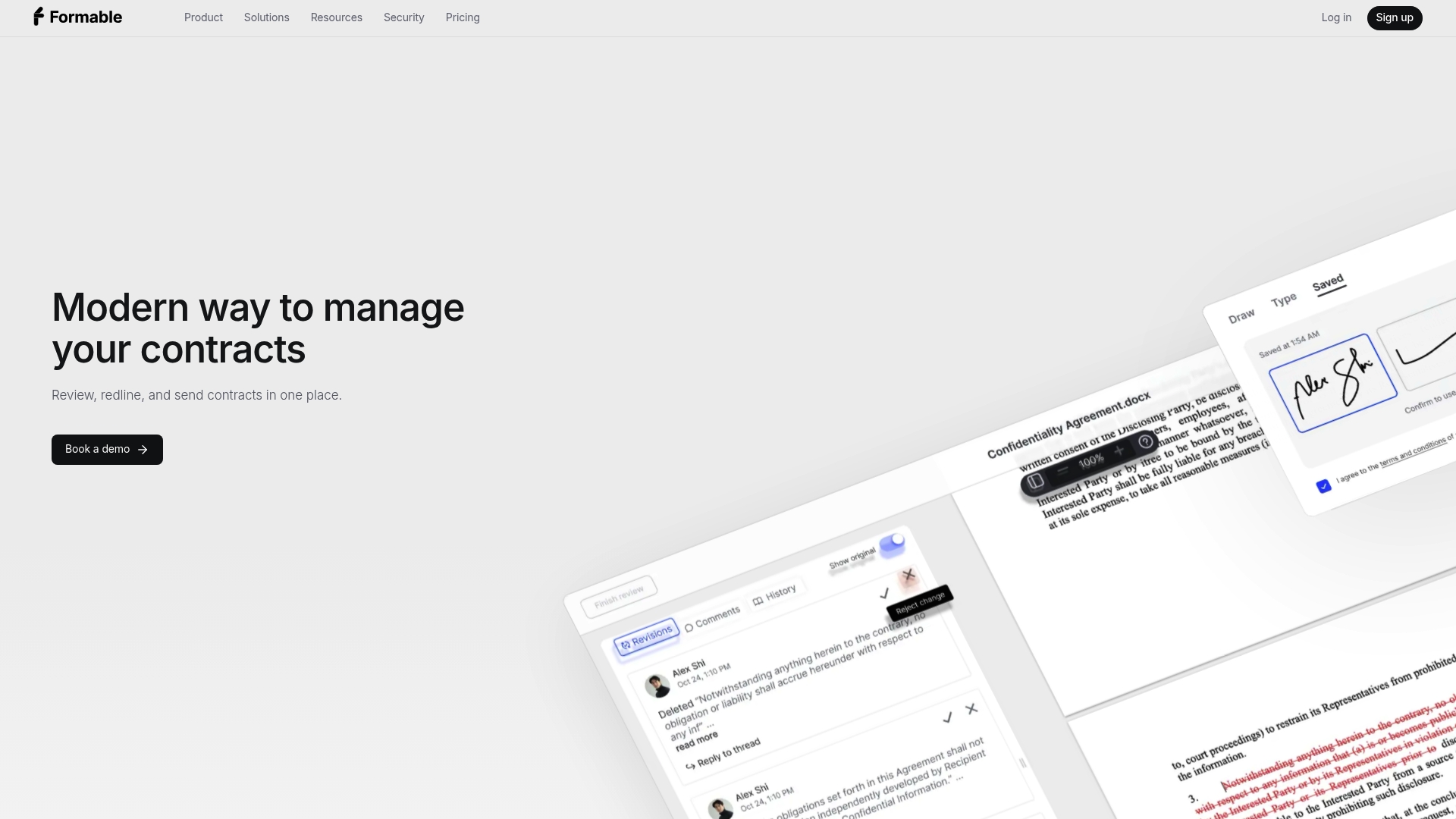
Every checklist item covered above maps directly to how the tool works. The AI review flags a missing DTSA notice or an overly broad confidential information definition before you send anything out. If the other side wants changes, Formable's redlining tool keeps both sides working from one version instead of five email attachments named "final_v3." Once terms are settled, e-signing captures a full audit trail, so you have proof of exactly what was signed and when if a dispute ever surfaces.
If you're ready to move past the blank-page template hunt, start your unilateral NDA with Formable's contract creator and have a signed agreement out the door today.
Sources
A few references are worth bookmarking beyond this guide. For statutory background, the Uniform Laws Commission's UTSA resources explain the state law framework behind trade secret claims, while Thomson Reuters' drafting overview covers the core principles that make NDAs enforceable in the first place.
For templates, Formable's one-way NDA template includes clause-by-clause notes for editing, and the contract amendment template is the right starting point if you need to modify an NDA after signing. If your disclosure involves shared training data or AI tools, the AI addendum template covers restrictions worth adding separately.
If you're still deciding on the right form for your situation, unilateral versus mutual NDAs walks through the decision in more depth than the comparison section above.
This article is general information, not a substitute for advice from a qualified lawyer. Consult a qualified legal professional about your own circumstances before acting on anything here.
FAQ
What is a unilateral NDA in simple terms?
It's a confidentiality agreement where only the party receiving sensitive information is legally bound to protect it, used whenever information flows in one direction, such as employer to employee or company to contractor.
How is a unilateral NDA different from a mutual NDA?
A unilateral NDA obligates only the receiving party, while a mutual NDA obligates both parties because both sides plan to share confidential information with each other.
Do I need a lawyer to create a unilateral NDA?
For simple, low-value disclosures, a well-annotated template can work, but high-value or complex disclosures benefit from lawyer review before signing.
What happens if I forget the DTSA whistleblower notice?
You don't lose your entire trade secret claim, but you can forfeit the right to exemplary damages and attorney fees under the federal Defend Trade Secrets Act in a later dispute.
Can I create a unilateral NDA for free?
Yes. Formable's contract creator offers a free unilateral NDA template combined with AI-assisted review, so you can draft, customize, and sign an agreement without starting from scratch.
How long should a unilateral NDA last?
Ordinary business information typically warrants a term of two to five years, while genuine trade secrets can remain protected indefinitely under state trade secret law regardless of the NDA's stated term.