
A statement of work (SOW) is a contract-level document that spells out exactly what will be delivered, when, and how the work will be judged done. It outlines project scope, timeline, and cost between a customer and a supplier, and it functions as the single source of truth once the engagement starts. If a dispute breaks out six months into a project, the SOW is the document both sides pull up first.
Before drafting or reviewing one, scan for these seven elements. If any are missing, treat the document as incomplete, not just informal.
- Scope of work: what's included, and just as important, what's explicitly excluded
- Deliverables: named, tangible outputs with a defined format
- Timeline and milestones: dates tied to specific deliverables, not vague phases
- Acceptance criteria: measurable tests that determine when a deliverable is "done"
- Payment terms: amounts, triggers, and invoice timing
- Change control process: how scope changes get proposed, priced, and approved
- Signatures and approvals: who signs, on what authority, and by when
Three quick actions before you send or sign: confirm where the SOW attaches (as an exhibit to a master service agreement or as a standalone contract), attach any referenced appendices (rate cards, technical specs, security requirements), and confirm who at each organization has actual signing authority. Skipping that last check is a surprisingly common way SOWs get signed by someone who can't legally bind their company.
Key Takeaways
A statement of work turns a services agreement from a general promise into an enforceable set of deliverables, acceptance tests, and payment triggers.
| Point | Details |
|---|---|
| Definition anchors everything | An SOW spells out scope, deliverables, timeline, and cost so both parties share one source of truth. |
| Match SOW type to certainty | Use design SOWs for known requirements, level-of-effort for open scope, and performance-based when outcomes matter more than method. |
| Three clauses prevent most disputes | Precise out-of-scope language, objective acceptance criteria, and a formal change control process resolve the majority of later conflicts. |
| Acceptance criteria need tests, not adjectives | Write measurable conditions, name a reviewer, and set a fixed review window for every deliverable. |
| Formable centralizes drafting to signature | Formable combines templates, AI-assisted drafting, redlining, and e-signing so SOW versions and approvals stay in one auditable place. |
This article is general information, not a substitute for advice from a qualified lawyer. Consult a qualified legal professional about your own circumstances before acting on anything here.
What is a statement of work SOW, and when do you actually need one?
A statement of work exists because a services engagement needs more precision than a handshake or an email thread can provide. It's the document that converts a sales conversation into an enforceable set of obligations. Where a master agreement sets the general legal terms governing a relationship, the SOW answers the operational question: what is this specific project, and how will we know when it's finished?
You need an SOW any time money changes hands for defined work with a defined outcome. That covers vendor engagements, cross-functional consulting work, fixed-scope software builds, and marketing or professional services retainers. A quick gut check: if you can't answer "what does success look like on this project" in one sentence, you're not ready to draft the SOW yet. You need a discovery conversation first.
Compare that to lighter-weight documents. An internal project charter or a one-page creative brief works fine for work happening entirely inside one company, where there's no contract enforcement at stake. Once a second legal entity is billing you, or you're billing them, an SOW belongs in the picture. It's also worth distinguishing an SOW from a raw scope of work section and from a master service agreement (MSA), which we'll map out in detail further down.
A good SOW answers five practical questions: what is being done, how it will be done, when it will be done, where the work happens, and how much it will cost. If your draft can't answer all five plainly, it isn't finished yet.
What does an SOW actually accomplish for your team?
An SOW earns its place in a contracting package by doing four things at once: setting clear expectations for delivery, reducing the odds of a dispute, giving both sides measurable acceptance points, and creating financial predictability. None of these are abstract legal benefits. They show up directly in how smoothly a project runs.
- Delivery clarity: everyone on both sides works from the same definition of "done," instead of relying on memory of a sales call
- Fewer disputes: a documented scope and change process gives you something to point to instead of arguing from recollection
- Measurable acceptance: milestones tied to objective tests mean payment isn't a negotiation every time
- Financial control: a defined payment schedule tied to deliverables keeps budgets from drifting mid-project
For project managers specifically, a strong SOW does governance work you'd otherwise have to invent on the fly. It sets the cadence for status reporting, defines who approves what, and gives you a built-in mechanism (change control) for handling scope creep without a shouting match. Milestone-driven payments also give you leverage: a vendor who wants to get paid on schedule has an incentive to hit acceptance criteria on schedule too.
One practical note worth repeating to any stakeholder who thinks legal review is overkill: for high-value or high-risk engagements, get counsel to review the SOW before signature, particularly around indemnification, IP ownership, and termination language. A ten-minute review can prevent a six-figure argument later.
Contract experts note that the party with more bargaining power in a deal often ends up drafting the SOW. Because it becomes the day-to-day operating guide for the engagement, plain language matters more than legal polish here, since technical teams and business stakeholders both need to read it without translation.
What are the different types of SOWs?
Most SOWs fall into one of three structural categories, and picking the wrong one is a common source of friction. The type you choose determines how much flexibility the vendor gets, how pricing works, and how disputes about "did they deliver what we asked for" get resolved.
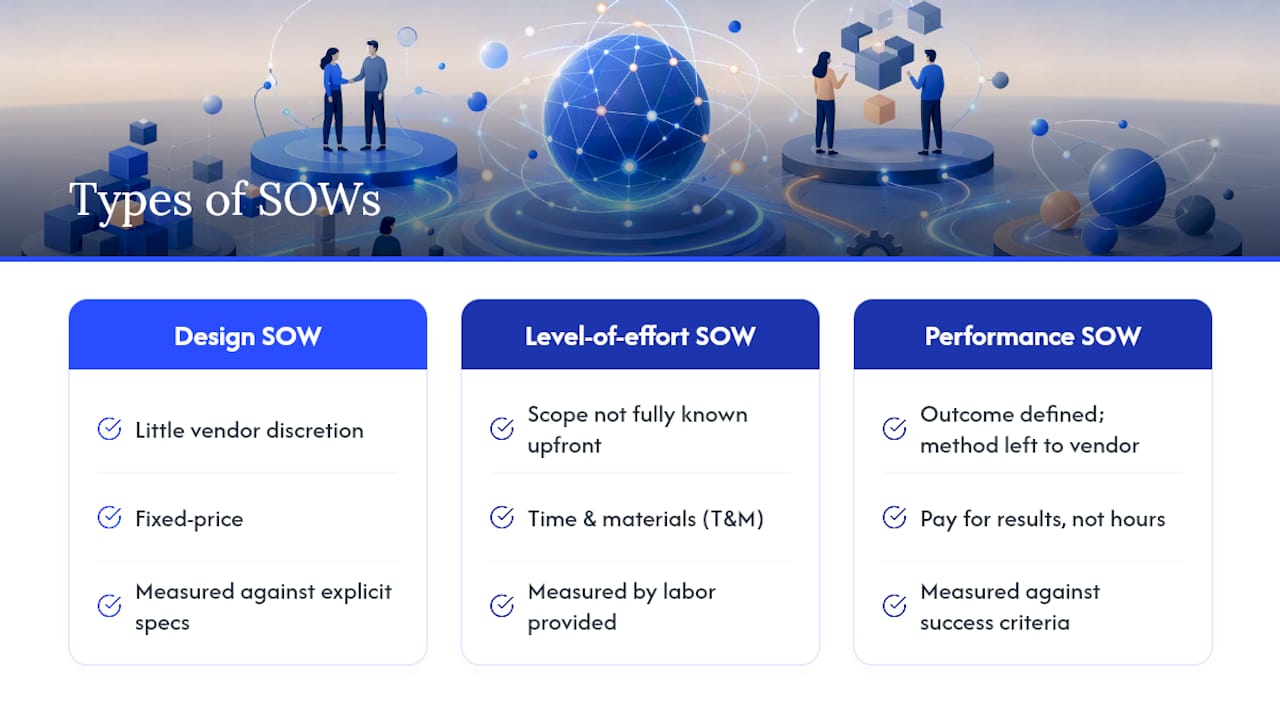
Design or detail SOWs spell out exactly how the work should be done, step by step, with little room for vendor discretion. These fit projects where the buyer already knows the technical approach and wants the vendor to execute precisely, like building to an existing architecture spec.
Level-of-effort SOWs (often billed as time and materials, or T&M) obligate the vendor to provide a certain amount of skilled labor over a period, rather than a fixed final output. This fits ongoing work like staff augmentation or open-ended consulting where scope isn't fully known upfront.
Performance-based SOWs define the outcome and leave the method to the vendor. You specify what success looks like (a working feature, a certified system, a completed migration) and let the vendor figure out how to get there. This works well when the vendor has more domain expertise than the buyer and you want to pay for results, not hours.
Government procurement adds two more variants worth knowing if you ever work adjacent to public sector contracts. A Statement of Objectives (SOO) describes only the desired outcomes and lets bidders propose their own approach, maximizing competition and innovation. A Performance Work Statement (PWS) sits between an SOW and an SOO, describing required performance standards without prescribing exact tasks. Government buyers tend to favor a traditional SOW when the work can be described in specific, concrete terms rather than as a performance outcome.
Pick the type based on how well the requirements are actually understood, not on habit. Fixed-price design SOWs punish ambiguity; performance-based SOWs punish unclear success metrics. Match the format to what you can actually specify with confidence.
How does an SOW differ from a scope of work and an MSA?
This is one of the most common points of confusion for people new to contract structuring, partly because the terms get used loosely in casual conversation. Here's how the three documents actually relate to each other in a typical contracting package.
| Document | What it controls | Legal weight | Where it lives |
|---|---|---|---|
| Master service agreement (MSA) | General terms governing the overall relationship: liability, IP defaults, termination, confidentiality | Standalone binding contract | Signed once, covers multiple future engagements |
| Statement of work (SOW) | Project-specific scope, deliverables, timeline, pricing for one engagement | Binding exhibit or attachment referencing the MSA | Attached to or incorporated by reference into the MSA |
| Scope of work | The section within an SOW (or standalone doc) describing what work is included/excluded | Not independently binding on its own | A component inside the SOW, often Section C in an RFP-style package |
In practice, companies with recurring vendor relationships sign one MSA that sets the legal ground rules, then issue a new SOW for each project without renegotiating the whole contract each time. The scope of work is narrower still. It's just the section of the SOW that answers "what exactly is in and out," often labeled Section C in formal RFP and procurement packages.
Drafting responsibility typically splits by role: legal or procurement owns the MSA language, while the project manager or delivery lead usually drafts the SOW's operational content, with legal reviewing before signature. Getting this division of labor wrong (having legal write deliverables language, or having a PM write indemnification clauses) is how you end up with an SOW nobody on the working team actually understands.
What components should every SOW include?
Every solid SOW covers the same core ground, regardless of industry. Skipping any of these isn't a stylistic choice, it's a gap that will surface later as a dispute.
- Project overview: a short paragraph stating the business purpose, so anyone reading it cold understands context
- Scope of work (in and out): name what's included, and just as important, list what's explicitly excluded (e.g., "does not include hosting, ongoing maintenance, or third-party licensing fees")
- Deliverables: specific, named outputs with format details ("a responsive web application delivered as a Git repository with deployment documentation," not "a website")
- Timeline and milestones: dates attached to deliverables, not just phase names
- Acceptance criteria: the objective test each deliverable must pass ("page load under 2 seconds on a standard 4G connection," not "fast performance")
- Assumptions and dependencies: conditions the vendor is relying on (client provides brand assets by a set date, client staff available for weekly check-ins)
- Client responsibilities: what the buyer must do or provide, and by when
- Fees and payment schedule: total price, invoice triggers, and payment terms (net 30, milestone-based, etc.)
- Change control process: how scope changes get proposed, priced, and formally approved
- IP ownership and confidentiality: who owns work product on delivery, and what stays confidential
- Termination provisions: what happens to payment and deliverables if either party exits early
- Signatures: names, titles, and dates for authorized signers on both sides
The level of detail should track risk, not habit. Over-specifying internal methodology (exactly which coding framework a vendor uses, for instance) usually just creates friction without protecting you. Under-specifying acceptance tests, deliverable formats, or payment triggers is where real risk lives. Spend your precision budget on the things that determine whether you get paid or get sued, not on process details that don't affect the outcome.
Atlassian's guidance on statement of work documentation makes a similar point: starting from a template with built-in prompts for measurable acceptance criteria is what prevents deliverables from staying vague through the whole drafting process.
How do you write acceptance criteria that actually hold up?
Acceptance criteria fail most often because they're written as adjectives instead of tests. "High-quality design" isn't an acceptance criterion. "Design approved by the marketing director within a 5-business-day review window, using the provided brand style guide as the reference standard" is.

Write each criterion as a test with three parts: the measurable condition, who reviews it, and how long they have. A software deliverable might read: "All critical and high-severity bugs identified in the agreed test plan resolved, verified through a regression test executed by the client's QA lead within 10 business days of delivery." A content deliverable might read: "Final draft approved in writing by the named client contact within 5 business days, with revisions limited to two rounds."
The review cadence matters as much as the test itself. Set a defined window (5, 7, or 10 business days is typical depending on deliverable complexity) and name a single reviewer with authority to sign off, not a committee. Ambiguity about who's actually responsible for saying "yes, this is accepted" is one of the most avoidable causes of stalled payment.
Pro Tip: Tie every milestone payment directly to an acceptance event, not to a calendar date. And if your contract allows a "deemed acceptance" clause (where a deliverable is automatically accepted if the client doesn't respond within the review window), spell out exactly what silence means. That single clause protects vendors from clients who stall on sign-off just to delay payment.
What's the step-by-step process for drafting and approving an SOW?
A repeatable workflow keeps SOWs consistent across a team and prevents any single project from skipping a critical review step. Here's a six-stage version that works for most professional services and vendor engagements.
- Discovery and brief: gather scope, budget, and timeline expectations directly from stakeholders before drafting anything. Confirm which SOW type (design, level-of-effort, or performance-based) actually fits the engagement.
- Draft the SOW: build from a proven template rather than a blank page, filling in scope, deliverables, milestones, and payment terms specific to this engagement.
- Internal review: route the draft past legal, the delivery lead, and finance before it ever reaches the client. Confirm the payment schedule matches your cash flow needs and that liability language matches your risk tolerance.
- Client review and redlines: expect negotiation on timeline, price, and acceptance windows. Track every proposed change with a version number so nobody loses track of what's been agreed.
- Adopt change-control language: before final signature, make sure the change order process itself is spelled out clearly, since this is what will govern every future scope adjustment.
- Final sign-off and versioning: capture signatures from authorized parties on both sides, then log version number, execution date, approver name, and the parent contract reference (which MSA or master agreement it attaches to).
Store that versioning metadata somewhere retrievable, not buried in an email thread. When a change order comes in eight months later, you need to know instantly which version of the SOW is current and what it superseded. Colorado State's procurement guidance reinforces the same sequence: objectives and scope first, deliverables and timeline next, acceptance criteria locked before anyone signs.
Pro Tip: Negotiation almost always concentrates on three levers: price, timeline, and acceptance windows. If a client pushes hard on price, it's often reasonable to trade a longer acceptance review window or a narrower scope in exchange, rather than simply discounting.
What are the most common SOW mistakes, and how do you fix them?
Most SOW disputes trace back to a small, repeatable set of drafting mistakes. Recognizing them during review is faster than fixing them after signature.
| Common pitfall | Immediate fix | Contractual guardrail to add |
|---|---|---|
| Vague deliverables ("build a marketing campaign") | Rewrite as named, specific outputs with format and quantity | Deliverables schedule listing each item, its format, and its due date |
| Missing out-of-scope language | Add an explicit "excluded from this engagement" list | Change control clause requiring a signed order for anything not listed |
| Weak or subjective acceptance criteria | Replace adjectives with measurable tests and review windows | Named reviewer, defined test, and a fixed sign-off deadline |
| Missing client dependencies | List every client obligation with a hard date | Clause stating missed client dates push milestone deadlines forward |
| No formal change control process | Add a short change order template referenced in the SOW | Requirement that no scope change is binding without a signed change order |
| Single-party or informal signature | Confirm signing authority on both sides before circulation | Signature block naming title and authority, not just a name |
Weak SOWs consistently skip the same three sections: out-of-scope language, objective acceptance criteria, and a formal change control process. Getting those three right resolves most disputes before they start. If a redline comes back stripping out any of the three, that's the moment to loop in counsel rather than negotiating it away to close the deal faster.
Where can you find solid SOW templates and examples?
A short, concrete example clarifies more than a page of description. Here's a compact deliverable and acceptance criterion pair, structured the way a real SOW would present it:
Deliverable 1: Custom onboarding module, delivered as a hosted web application with admin documentation, due 45 days from contract execution. Acceptance criterion: Client's designated technical lead completes a functional test against the agreed test script within 7 business days of delivery. Deliverable is accepted upon written confirmation, or automatically accepted if no written objection is received within the 7-day window.
That pairing (a specific deliverable, tied to a specific test, tied to a specific timeframe) is the pattern to repeat across every line item in a deliverables schedule.
For starting points beyond your own drafts, university procurement offices publish real SOW template examples with practical in-scope and out-of-scope language you can study, and state energy authorities like NYSERDA post sample scope of work attachments from actual solicitations. Formable also maintains a statement of work template built for technology and services engagements, with clause prompts already structured around the components covered above.
Converting a generic template into a finished SOW takes a short checklist of its own:
- Replace every bracketed placeholder, especially party names, dollar amounts, and dates
- Confirm every date is still realistic against the actual signing date, not left over from the template's example timeline
- Verify each payment trigger is tied to a specific, named deliverable or milestone
- Check that the change control section references your actual internal approval process, not the template's default
- Confirm signing authority for both parties before sending for signature
Tailor the template to the industry: a software SOW needs technical specs and IP ownership language; a construction or facilities SOW needs site access and safety compliance clauses; a marketing SOW needs usage rights and revision limits. The core skeleton stays the same, but the risk points shift by field.
What advanced drafting practices should experienced teams apply?
A few practices separate a functional SOW from one that actually protects both sides financially, and they rarely show up in basic templates.
Build milestone payment triggers directly into the SOW rather than treating invoicing as a separate conversation. Documenting payment triggers alongside the deliverables schedule means the SOW doubles as the financial roadmap for the team actually doing the work, not just a legal artifact nobody references day to day. That reduces confusion about when an invoice can legitimately go out and what event triggers it.
Client-side dependencies deserve the same specificity as vendor deliverables. Instead of a generic assumption like "client will provide timely feedback," write it as a hard-dated obligation: "Client will deliver final brand assets by March 15, 2026." Pair that with a clause stating that missed client dates push corresponding milestone deadlines forward by an equal number of days. This single addition protects vendors from absorbing delays that were never their fault.
Late-payment penalties are worth including explicitly rather than relying on general contract law to sort it out later. A simple interest clause on overdue invoices, stated plainly in the payment section, gives you leverage without needing to escalate to legal action.
Practical drafting guides converge on the same defensive trio every time: a precise out-of-scope list, objective acceptance criteria with named review windows, and a formal change control process tying cost and time impacts to documented change orders. Everything else in the document supports those three.
Finally, treat versioning as a discipline, not an afterthought. Every SOW revision should carry a version number, a date, the name of the approver, and a reference back to the parent contract it attaches to. When a change order arrives later, that metadata is what lets you confirm exactly which terms are current without digging through an email archive.
Why most SOW advice undersells the drafting discipline it takes
The conventional advice on statements of work treats them as a formality, something you fill out once and file away. That framing misses what actually happens on real projects: the SOW is the document people argue over when things go sideways, and most of those arguments trace back to language that sounded fine at signing but turned out to be too vague to enforce.
The overrated piece of advice is "just use a template." Templates are useful for structure, but they can't write your acceptance criteria for you or predict your client's dependency risks. A template with blank fields for "deliverables" and "acceptance criteria" still gets filled in with vague adjectives by teams in a hurry to close the deal. The discipline isn't finding the right template, it's resisting the temptation to leave those fields loosely worded because the negotiation is dragging.
What gets underweighted almost everywhere is the client-dependency clause. Most drafting guides focus heavily on vendor obligations and barely mention that clients cause delays too, and that those delays need contractual consequences. A vendor who doesn't protect delivery dates against late client feedback is quietly accepting risk they never agreed to.
If you're reviewing or drafting an SOW today, prioritize acceptance criteria and out-of-scope language before anything else. Pricing negotiations get attention naturally because everyone cares about money. Acceptance language gets skipped because it feels like paperwork, right up until a deliverable ships and nobody can agree whether it meets the bar. Fix that gap first, and most of the downstream disputes never happen.
Draft, negotiate, and sign SOWs without losing track of versions
Formable gets you from a blank SOW to a signed, executed document faster than juggling redlines across email threads and shared drives, because negotiation, versioning, and signature all happen in one place. Instead of writing an SOW from scratch, you can start from Formable's contract creation tool, which pairs a template library with generative AI to fill in scope, deliverables, and payment terms based on your project details.
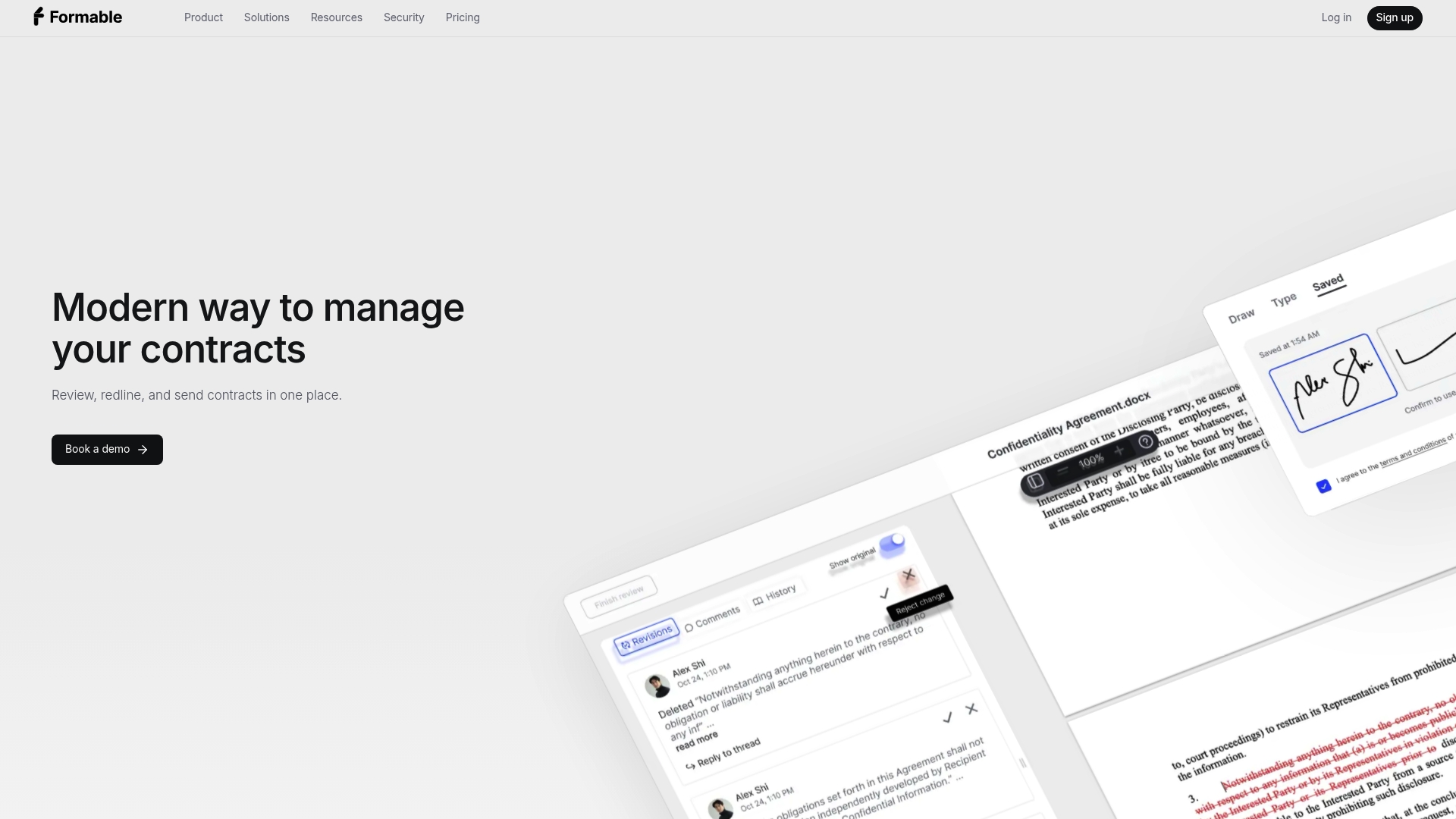
Once a draft is ready, both sides can redline directly inside Formable's negotiation workspace, which keeps every proposed change tracked against a single version instead of scattered across attachments. When terms are locked, Formable's e-signing closes the loop, and the platform's audit trail preserves exactly what was signed, by whom, and when, so a change order six months later doesn't turn into a guessing game about which version is current.
If your team manages SOWs alongside MSAs, order forms, or DPAs, start by exploring Formable's platform and see how templates, redlining, and signature fit your existing workflow.
Sources
FAQ
What is the difference between an SOW and a contract?
An SOW is typically a project-specific exhibit that attaches to a broader contract, like a master service agreement, which sets the general legal terms governing the relationship. The SOW covers scope, deliverables, and price for one engagement; the master contract covers liability, confidentiality, and termination across all engagements.
Can you give an example of a statement of work?
A simple example: a deliverable line reading "custom onboarding module, delivered as a hosted application, due 45 days from execution," paired with an acceptance criterion specifying a functional test completed by the client's technical lead within a 7-day review window. Formable's SOW template includes fuller sample clause language along these lines.
What elements are contained in a statement of work SOW?
A complete SOW typically includes a project overview, scope of work with in-scope and out-of-scope items, deliverables, timeline and milestones, acceptance criteria, assumptions and dependencies, payment terms, change control process, IP and confidentiality terms, and signatures.
What is included in the payment section of an SOW?
The payment section should state total fees, the payment schedule (milestone-based or time-based), invoice triggers tied to specific acceptance events, and any late-payment penalty terms, so payment timing never depends on informal agreement.
Who usually drafts the SOW in a vendor relationship?
The party with more bargaining power in the deal often drafts the initial SOW, though the operational content is usually written or reviewed by the project manager on the delivery side before legal signs off. Plain language matters here since both technical and business stakeholders rely on the same document daily.