
A statement of work (SOW) is the contract level document that spells out exactly what a vendor will deliver, when, and for how much. It sits underneath a broader agreement, or stands alone for smaller jobs, and it turns a verbal understanding into terms both sides can be held to.
You reach for a SOW any time work needs to be scoped precisely: a single project under a master service agreement, a standalone engagement with a new vendor, or an internal statement of objectives for procurement. Every solid SOW, regardless of industry, comes back to the same handful of building blocks.
- Scope: what work is included, and what is explicitly excluded
- Deliverables: the specific outputs the vendor produces
- Timeline and milestones: dates tied to each deliverable
- Acceptance criteria: how "done" gets measured and approved
- Payment terms and change control: how fees are structured and how changes get priced
Key Takeaways
A statement of work becomes enforceable and dispute resistant only when scope, deliverables, acceptance criteria, and change control are all written in measurable, specific language.
| Point | Details |
|---|---|
| Definition | A SOW is the contract level document defining scope, deliverables, timeline, acceptance criteria, and fees. |
| Core defense against disputes | Explicit out-of-scope language and a documented change control process prevent most scope creep arguments. |
| Match type to certainty | Use design/detail SOWs for fixed scope, time and materials for uncertain scope, and performance based when outcomes are measurable. |
| Review before signing | Route every SOW through a project, finance, and legal reviewer before it reaches signature. |
| Faster drafting | Formable's free contract creator generates a SOW draft from Common Paper based templates through guided Q&A and AI-assisted editing. |
Why does a statement of work matter?
A SOW earns its place in a contract stack by preventing the arguments that come from assumption instead of documentation. When scope, deliverables, and fees are written down in specific language, there is far less room for either party to claim the other side promised something different.
The benefits show up in a few concrete ways, especially when combined with strong construction cost transparency practices:
- Clarity of expectations: both sides can point to the same document instead of relying on memory of a call
- Billing control: payment schedules tied to milestones keep cash flow predictable for both vendor and client
- Easier vendor management: procurement teams can compare SOWs from different vendors against the same criteria
- Fewer disputes: a document detailing costs, resources, and timelines up front reduces the likelihood of legal disputes during delivery
The dispute reduction effect matters more than it sounds. Legal escalation is expensive and slow, and most of it traces back to ambiguity that a tighter SOW would have closed off before work even started.
Pro Tip: Build a change control clause into every SOW you write, even for small engagements. Projects rarely run exactly as planned, and a pre-defined process for pricing and approving changes stops scope creep before it becomes a billing argument.
What should a statement of work include?
A thorough SOW checklist covers eleven sections. Skip one and you have left a gap someone will eventually find, usually mid project when it is expensive to fix.
- Project identification: names of the parties, project title, effective date, and reference to any parent MSA
- Background and objectives: why the project exists and what business outcome it serves
- Scope, in and out: what work is covered, written alongside an explicit list of exclusions
- Deliverables with acceptance criteria: each output paired with how it will be evaluated
- Timeline and milestones: dates for each deliverable, with dependencies noted
- Client responsibilities and dependencies: access, feedback windows, approvals, or assets the client must provide
- Fees and payment schedule: rates, milestone payments, invoicing cadence
- Change control: how change requests are submitted, evaluated, priced, and approved
- Assumptions: conditions the pricing and timeline depend on
- Termination and intellectual property: exit terms and who owns the work product
- Sign-off: names, titles, and signature blocks for authorized approvers
Two of the items on that list, out-of-scope language and change control, do more work than the rest combined. Explicitly listing exclusions converts an ad hoc request into a documented change order instead of a free favor. A sample out-of-scope clause might read: "This engagement does not include ongoing maintenance, additional design revisions beyond two rounds, or third-party licensing fees." That single sentence prevents a dozen future conversations.
Acceptance criteria need the same specificity. Instead of "deliver a functional website," write "deliver a responsive website that loads in under three seconds on mobile, passes the client's accessibility checklist, and is approved in writing within five business days of submission." The difference between those two sentences is the difference between a deliverable that can be disputed and one that cannot.
A simple change request procedure might work like this: the requesting party submits a written description of the change, the vendor returns a cost and timeline impact within a set number of business days, and the change becomes binding only once both parties sign an addendum referencing the original SOW. Keep that language generic in the template and specific in the actual document.
Practical phrasing note: every deliverable description should answer "how would a third party verify this is done?" If you cannot answer that question in one sentence, the deliverable is not measurable yet, and it will cause friction at handoff.
What are the different types of statement of work?
Not every engagement fits the same SOW shape. Picking the wrong type is one of the more common mistakes procurement teams make, usually because they default to whatever template they used last time.
- Design or detail SOW: fixed deliverables and a fixed price, best when requirements are fully known upfront
- Level of effort (time and materials) SOW: billing tied to hours or resources, best when scope is likely to shift
- Performance based SOW: payment tied to measurable outcomes rather than specific tasks, best when results matter more than method
- Phased or milestone SOW: work broken into stages with separate approvals, common for long engagements
- Hybrid SOW: combines fixed fees for known work with time and materials for exploratory phases
The type you choose changes everything downstream. A time and materials SOW needs looser acceptance criteria and tighter reporting cadence, while a performance based SOW needs airtight metrics up front since payment depends on hitting them.
Pro Tip: If a client cannot describe the full scope at kickoff, do not force a fixed price SOW. Start with time and materials for discovery, then convert to a design SOW once requirements settle.
How is a SOW different from a scope of work or an MSA?
These three terms get used interchangeably, and that confusion causes real contract problems. A statement of work is the whole document, complete with fees, timeline, and sign-off. A scope of work is just one section inside it, describing what work is included. A master service agreement (MSA) is the umbrella legal contract covering liability, confidentiality, and payment terms across multiple projects, with individual SOWs attached as exhibits.
A statement of objectives (SOO) or performance work statement (PWS), terms more common in government contracting, describe desired outcomes at a higher level and leave the vendor to propose the specific approach.
| Document | Purpose | Typical location | Legal weight |
|---|---|---|---|
| Scope of work | Describes included/excluded work | One section inside a SOW | Not standalone |
| Statement of work (SOW) | Defines full project terms | Standalone or MSA exhibit | Enforceable contract |
| Master service agreement (MSA) | Sets umbrella legal terms | Parent contract | Enforceable contract |
A SOW is distinct from an MSA because the MSA covers general legal terms while the SOW handles project-specific execution. If you already have an MSA in place, attach a SOW as an exhibit and reference the MSA's effective date for consistency. For a one-off engagement with no ongoing relationship, a standalone SOW covering both legal terms and project detail often makes more sense than negotiating a full MSA first.
How do you write a statement of work step by step?
Writing a usable SOW is a sequence, not a single drafting session. Skipping steps is how vague deliverables and unpriced assumptions end up in a signed contract.
- Run discovery and capture the brief: talk to stakeholders on both sides before writing a word, and write down objectives in their language, not yours
- Draft scope and deliverables: separate what is included from what is explicitly excluded, and describe deliverables in verifiable terms
- Define acceptance criteria: attach a measurable standard to every deliverable, not just the big ones
- Build the timeline and payment milestones: tie payments to specific, dated milestones rather than vague phases
- List dependencies and client obligations: name every piece of access, feedback, or asset the client must provide, and by when
- Insert change control language: define who requests changes, how impact gets evaluated, and who has approval authority
- Send for legal review: have counsel check enforceability, IP terms, and termination language before it goes to stakeholders
- Route for stakeholder review and sign-off: get the actual signers to read it, not just skim the summary
A simple change control procedure you can adapt directly: the requesting party submits a written change request describing the desired change; the vendor has a defined number of business days to return a cost and schedule impact; both parties sign a short addendum referencing the SOW number before work on the change begins; the addendum gets filed alongside the original document. That structure works whether the change is small (an extra revision round) or large (a new deliverable entirely).
Before you send any SOW for signature, run it against this red flag list:
- Deliverables described in vague, non-measurable language ("improve the website")
- No acceptance criteria attached to at least one deliverable
- Milestones with no specific dates, only relative phrasing like "phase two"
- Client dependencies mentioned in conversation but never written into the document
- Assumptions that affect price or timeline but are not stated anywhere
Pro Tip: Have someone outside the project, ideally from legal or finance, read the SOW cold before it goes out. If they cannot explain what "done" looks like after one read, neither will the vendor six weeks into the project.
What does a sample statement of work outline look like?
A ready to copy structure removes a lot of the guesswork. Use this order as your starting template, then fill in project specific detail.
- Project overview (parties, effective date, parent MSA reference if applicable)
- Scope, in and out
- Deliverables
- Acceptance criteria
- Timeline and milestones
- Client responsibilities
- Fees and payment schedule
- Change control
- Assumptions
- Termination and IP
- Sign-off
Here is what one filled deliverable entry looks like in practice:
Deliverable: Final brand style guide, including logo usage, color palette, and typography rules. Acceptance criteria: approved in writing by the client's marketing lead within five business days of delivery, with no more than two rounds of revision included. Due date: 30 days after project kickoff. Payment: $4,000, invoiced upon written acceptance.
That level of specificity, description, acceptance standard, date, and payment tied together, is what separates a usable deliverable line from a placeholder. If you would rather not build this outline from scratch every time, Formable's SOW template gives you the same structure pre-built, with clause language you can adapt directly.
What tools help you create and manage statement of work documents?
Manually drafting every SOW from a blank page is where most of the errors above come from, missed sections, inconsistent acceptance language, no version control. A few features matter most when choosing how to produce and manage these documents:
- Clause libraries and templates so you are not rewriting standard language every time
- Guided question flows that prompt for the details people forget, like dependencies and assumptions
- Redlining and negotiation tools so both parties can align on terms before signature
- Version history so you know which draft is current
- Acceptance tracking and e-signing built into the same workflow as drafting
- Audit trail showing who changed what and when
Formable's free contract creator handles this end to end for statement of work documents. You answer a short set of guided questions about the engagement, and the tool drafts a SOW using templates built on Common Paper's widely used contract standards. Formable's AI turns your answers into legal language, and you can keep refining it through an AI chat or edit the exported DOCX directly before it moves to redlining and signature. Try the guided contract creator the next time you need a SOW turned around quickly.
For versioning, a naming convention like ProjectName_SOW_v01_20260214 paired with a short sign-off table inside the document itself keeps stakeholders from confusing draft three with draft five.
Pro Tip: Store finalized SOWs as exhibits attached to their parent MSA in your contract system, not as loose files in a shared drive. That single habit saves hours during audits or renewal negotiations.
Is a statement of work legally enforceable?
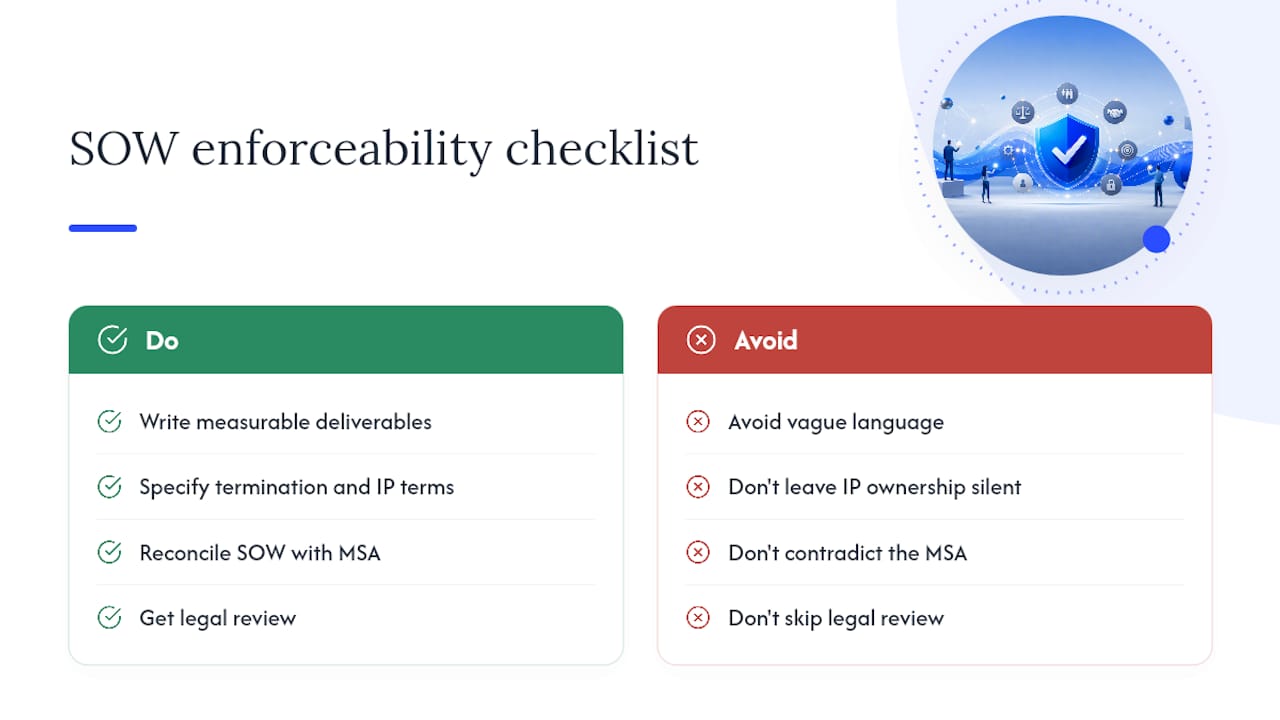
Yes, a properly executed SOW is a binding contract, whether it stands alone or attaches to an MSA. Enforceability depends on the same elements that make any contract enforceable: offer, acceptance, consideration, and terms specific enough that a court could determine what performance was owed.
Vague language is the biggest threat to enforceability, not lack of a signature. A deliverable described as "improve system performance" gives a judge nothing to measure a breach against, while "reduce average page load time to under two seconds, verified by a third-party testing tool" gives both parties, and a court if it comes to that, something concrete to check.
Two clauses carry particular legal weight. The termination clause needs to state what happens to partially completed work and partial payments if either side exits early. The intellectual property clause needs to state, without ambiguity, who owns deliverables once payment clears, since silence on this point creates disputes even when everything else in the project went smoothly.
If a SOW references a parent MSA, make sure the two documents do not contradict each other on liability, indemnification, or payment terms. Courts generally read the SOW as governed by the MSA's general terms unless the SOW explicitly states otherwise, so inconsistency between the two documents is a drafting error worth catching before signature, not after a dispute.
Because enforceability turns on specific language rather than general intent, every SOW involving meaningful money or risk should get a legal review pass before it goes out for signature. That review does not need to be exhaustive. It needs to check that deliverables are measurable, termination and IP terms are clear, and nothing in the SOW conflicts with an existing MSA.
How does a SOW fit into project management methodologies?
A SOW is a contract document, not a project plan, but the two need to speak the same language or your delivery team will spend the project translating between them. The gap shows up most often when a SOW is written in waterfall terms (fixed deliverables, fixed dates) but the delivery team runs Agile sprints.
For Agile or Scrum delivery, write the SOW around outcomes and time boxed phases rather than a single fixed deliverable list. A performance based or level of effort SOW usually fits better here, since it can define acceptance criteria at the epic or release level while leaving sprint level detail to the team's own backlog.
For waterfall or stage gated projects, a design and detail SOW with clearly sequenced milestones maps naturally onto the methodology, since both assume the full scope is known before work starts.
Whatever methodology your delivery team uses, keep milestone dates in the SOW loosely tied to, but not identical to, sprint or phase boundaries in the internal project plan. That gives the delivery team room to adjust internal sequencing without triggering a formal change request every time a sprint shifts by a few days. The SOW should protect the contractual commitment; the project plan should manage the day to day work getting there.
What makes a strong SOW review and approval process?
A SOW review that only checks for typos misses the point. The review needs to test whether the document would survive a dispute, not just whether it reads cleanly.
Route every SOW through three distinct reviewers before signature: a project lead who checks deliverables and timeline against operational reality, a finance or procurement reviewer who checks the payment schedule and any budget assumptions, and legal counsel who checks enforceability, termination, and IP language. Skipping any one of these three is how gaps make it into signed contracts.
Build a short checklist into the review step itself: every deliverable has acceptance criteria, every milestone has a specific date, every client dependency is named, and the change control clause states who has approval authority. A reviewer working from that list catches problems in minutes that would otherwise surface mid project.
Set a defined turnaround window for each reviewer, typically two to three business days, so review does not become the bottleneck that delays kickoff. And require sign-off from named individuals with actual authority to bind their organization. A SOW approved by someone without signing authority creates exactly the kind of ambiguity the document was supposed to eliminate.
Who writes and signs a statement of work?
The vendor or service provider typically drafts the first version, since they understand the work being scoped better than the client does at this stage. Procurement, project management, or account management teams often lead that drafting, with legal counsel reviewing before it goes out.

The client side then reviews and negotiates, usually involving whoever owns the budget and whoever will manage the day to day relationship once work starts. In larger organizations, procurement or legal may hold veto power even if a project manager is the primary point of contact.
Signature authority sits with whoever can legally bind each organization, which is not always the person who negotiated the terms. A project manager might draft and negotiate a SOW, but a vice president or contracts officer signs it. Both signature blocks should include full name, title, and date, and if the SOW references a parent MSA, the signer should have authority under that MSA as well.
Common mistakes I keep seeing in statement of work drafts
The failures that show up most often are not exotic. Vague scope language, no documented client dependencies, and acceptance criteria that never get written down account for most of the disputes I have seen traced back to a SOW.
Before sign-off, run three quick edits: rewrite any deliverable that reads as an activity ("provide support") into an output with a measurable standard, confirm every client obligation has a date attached, and check that the change control clause names an actual approval authority.
Bring legal and the delivery lead in during drafting, not after. Fixing a SOW before signature costs a redline. Fixing it after costs a dispute.
Get a usable SOW draft without starting from a blank page
Writing a SOW that covers every clause above takes real time, and most teams rebuild the same structure from scratch for every new vendor or client. Formable's free contract creator shortens that work: answer a short guided Q&A about the engagement, and it drafts a SOW in legal language using templates built on Common Paper's standards, no blank page, no missed sections.
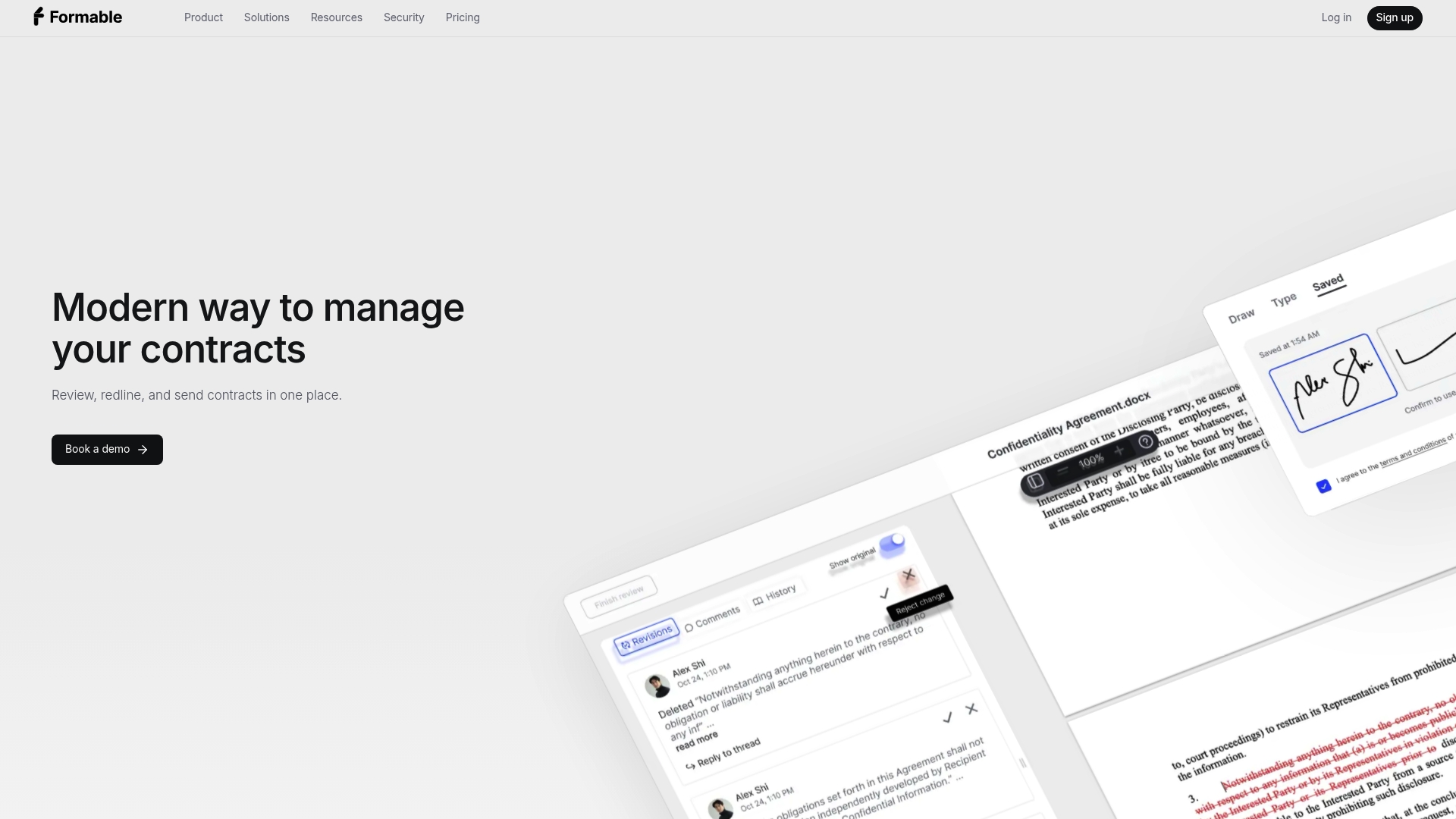
From there you can keep refining the draft through Formable's AI chat, edit the exported DOCX directly, or send it straight into redlining so both sides can align on terms before signature. Once the language is settled, e-sign it in the same workflow instead of exporting to a separate tool. If you are also negotiating the MSA this SOW will sit under, Formable's platform handles both documents, plus version history and an audit trail, in one place. Start your next SOW with the guided contract creator and see the draft in minutes.
Sources
- Statement of work is distinct from a master services agreement (Princeton finance document)
- What is statement of work (Coursera article)
- What is a SOW? (Thomson Reuters legal blog)
This article is general information, not a substitute for advice from a qualified lawyer. Consult a qualified legal professional about your own circumstances before acting on anything here.
FAQ
What is a statement of work vs a contract?
A statement of work is itself a type of contract, or an exhibit attached to one. When paired with a master service agreement, the MSA sets general legal terms while the SOW defines project-specific scope, deliverables, and fees.
Who writes a statement of work?
The vendor or service provider usually drafts the first version, often through procurement or account management, with legal review before it goes to the client for negotiation and sign-off.
Can you give an example of a statement of work?
A simple example: a marketing vendor's SOW for a brand style guide would list the deliverable, acceptance criteria (approved within five business days, up to two revision rounds), a due date, and the payment amount tied to acceptance. Formable's SOW template shows the full structure with sample clauses.
What is another name for a statement of work?
Depending on industry, related terms include scope of work (a section within a SOW, not the whole document), statement of objectives (SOO), and performance work statement (PWS), both common in government contracting.
Does a statement of work need to be signed?
Yes. A SOW becomes binding once authorized signers from both parties sign it, and those signers need actual authority to bind their organizations, which is not always the person who negotiated the terms.