Formable is the best sales contract software for most sales teams because it combines embedded redlining, AI-assisted contract review, and native e-sign with CRM-first integrations and developer APIs in a single platform. For large enterprises needing deep CLM automation, Ironclad or Docusign CLM are the strongest alternatives. For teams that only need lightweight signing, Dropbox Sign covers the basics.
Quick shortlist:
- Formable — Best for GTM and revops teams that need redlining, AI review, templates, and e-sign in one place
- GetAccept — Best for sales teams that want proposal engagement analytics alongside contracts
- PandaDoc — Best for rapid template-driven contract generation with built-in signing
- Ironclad — Best for large enterprises with complex, high-volume CLM workflows
- Docusign — Best for organizations prioritizing signature compliance and broad platform integrations
- Juro — Best for legal and sales teams that want browser-native negotiation
- Contractbook — Best for SMBs that want end-to-end authoring-to-sign in one product
- DealHub — Best for sales organizations that need CPQ and contract alignment
All tools on this list are available in the United States and comply with ESIGN/UETA standards. Enterprise-grade options also carry SOC 2 Type II certification. Gartner Peer Insights covers several of these vendors under the contract lifecycle management category, which is a useful secondary reference when validating enterprise shortlists.
How we built this list and why you can trust it
Evaluating contract software for sales teams requires a different lens than evaluating it for legal or procurement. The criteria that matter most to a sales or revops buyer are not the same ones that matter to a general counsel.
What we weighted:
- CRM integrations (Salesforce, HubSpot, Microsoft Dynamics) and two-way data sync
- Redlining and negotiation capabilities, including collaborative editing and clause management
- AI review features: risk detection, missing clause alerts, and playbook enforcement
- E-sign capabilities and API availability for embedded signing workflows
- Template libraries covering common sales agreements (MSA, SOW, NDA, DPA, Order Form)
- Enforcement to billing: whether negotiated terms flow downstream to CPQ and renewals
- Security and compliance: SOC 2, audit trails, SAML, role-based access
- Ease of implementation and realistic time-to-value for SMB and enterprise teams
- Pricing shape and total cost of ownership
Data sources used:
- Vendor documentation, product pages, and published feature lists
- User reviews on G2 and Capterra, with particular attention to pros/cons patterns
- Analyst summaries, including Gartner Peer Insights coverage of CLM vendors
- Product demos and hands-on evaluation notes
- Published case studies and integration documentation
The market has shifted noticeably toward AI-assisted review and deeper CRM sync in the past 12 months. Vendors that previously offered only static templates now advertise generative AI contract creation. That shift informed how heavily we weighted AI review and CRM integration in the scoring. Pricing shapes range from per-user SaaS tiers to API usage-based billing, and we note both where relevant. SMB and enterprise buyers have different thresholds, so the best-for labels in the table and mini-reviews reflect team size and workflow complexity.
At-a-glance comparison of the top sales contract tools
The table below covers the 23 tools on this list across the dimensions that matter most to sales and revops buyers. Scan the "Best for" column first to narrow your shortlist, then check "Key features" and "CRM integrations" to confirm fit before booking demos.

| Tool | Best for | Key features | CRM integrations | E-sign & API | Security & compliance | Pricing shape | Ease of implementation | Enterprise features |
|---|---|---|---|---|---|---|---|---|
| Formable | GTM/revops teams needing redlining, AI review, e-sign, and APIs | Redlining, AI review, risk detection, templates, e-sign, APIs | Salesforce, HubSpot | Native e-sign + developer API | SOC 2, audit trail | Free tier; paid team plans; API usage pricing | Fast; self-serve onboarding | SAML, roles, audit trail |
| GetAccept | Sales teams wanting proposal analytics + contracts | Proposal tracking, in-doc engagement, e-sign | Salesforce, HubSpot, MS Dynamics | Native e-sign | SOC 2 | Per-user SaaS tiers | Moderate | Roles, audit trail |
| PandaDoc | Template-driven contract generation with signing | Template library, document automation, e-sign | Salesforce, HubSpot, MS Dynamics, Pipedrive | Native e-sign + API | SOC 2, HIPAA | Per-user SaaS tiers | Fast | Roles, audit trail, SSO |
| Docusign | Signature compliance and broad integrations | E-sign, envelope routing, compliance | Salesforce, HubSpot, MS Dynamics | Native e-sign + robust API | SOC 2, FedRAMP, eIDAS | Per-user or envelope-based | Fast | SAML, roles, audit trail |
| Adobe Sign | Enterprises in Adobe workflows | E-sign, PDF workflows, bulk send | Salesforce, MS Dynamics | Native e-sign + API | SOC 2, FedRAMP | Per-user enterprise tiers | Moderate | SAML, roles, audit trail |
| Juro | Browser-native negotiation and automation | Browser editor, clause library, e-sign | Salesforce, HubSpot | Native e-sign | SOC 2 | Per-user SaaS tiers | Moderate | Roles, audit trail |
| Proposify | SMB sales teams using polished proposals | Proposal design, pricing tables, e-sign | Salesforce, HubSpot | Native e-sign | SOC 2 | Per-user SaaS tiers | Fast | Roles, audit trail |
| DealHub | CPQ-to-contract alignment | CPQ, quoting, contract generation | Salesforce, HubSpot, MS Dynamics | Native e-sign | SOC 2 | Per-user SaaS tiers | Moderate | SAML, roles, audit trail |
| Ironclad | Large enterprises with complex CLM needs | Workflow automation, AI, redlining, repository | Salesforce, HubSpot, MS Dynamics | Native e-sign + API | SOC 2, HIPAA | Enterprise contract | Complex; professional services | SAML, roles, audit trail |
| Conga | CLM integrated with CPQ and finance | CLM, CPQ, document generation | Salesforce, MS Dynamics | Native e-sign + API | SOC 2 | Enterprise contract | Complex | SAML, roles, audit trail |
| Docusign CLM | Docusign users wanting integrated CLM | CLM, workflow, repository, e-sign | Salesforce, HubSpot, MS Dynamics | Native e-sign + API | SOC 2, FedRAMP | Enterprise add-on | Moderate to complex | SAML, roles, audit trail |
| Conga CLM | Lifecycle automation with ERP/CPQ | Lifecycle automation, ERP connectors | Salesforce, MS Dynamics | Native e-sign + API | SOC 2 | Enterprise contract | Complex | SAML, roles, audit trail |
| ContractSafe | Searchable contract storage and alerts | Repository, OCR search, alerts | Limited | — | SOC 2 | Per-user SaaS tiers | Very fast | Roles, audit trail |
| Outlaw | Modern collaborative drafting | Collaborative editor, negotiation, e-sign | Salesforce, HubSpot | Native e-sign | SOC 2 | Per-user SaaS tiers | Fast | Roles, audit trail |
| Cobblestone | Procurement and vendor contracting | Compliance controls, vendor management, CLM | Salesforce | Native e-sign | SOC 2 | Enterprise contract | Moderate to complex | SAML, roles, audit trail |
| Contractworks | Fast-deploy contract repository | Repository, alerts, simple admin | Limited | — | SOC 2 | Per-user SaaS tiers | Very fast | Roles, audit trail |
| Sirion | Post-signature analytics and SLA tracking | Obligation tracking, analytics, SLA management | Salesforce, MS Dynamics | — | SOC 2 | Enterprise contract | Complex | SAML, roles, audit trail |
| LinkSquares | AI analytics on contract portfolios | AI extraction, search, analytics | Salesforce | — | SOC 2 | Enterprise contract | Moderate | SAML, roles, audit trail |
| Contractbook | SMB end-to-end authoring to sign | Authoring, automation, e-sign | HubSpot, Salesforce | Native e-sign | SOC 2 | Per-user SaaS tiers | Fast | Roles, audit trail |
| Dropbox Sign | Lightweight e-sign API | E-sign, API, templates | HubSpot, Salesforce | Native e-sign + API | SOC 2 | Per-user or API usage | Very fast | Roles, audit trail |
| Pipedrive Smart Docs | Pipedrive users needing in-CRM docs | CRM-native doc generation, e-sign | Pipedrive native | Native e-sign | SOC 2 | Pipedrive add-on | Very fast | Roles, audit trail |
| Contracts 365 | Lifecycle tracking and compliance | Lifecycle management, compliance tracking | MS Dynamics native | Native e-sign | SOC 2 | Per-user SaaS tiers | Moderate | SAML, roles, audit trail |
| Conga (Conga CLM) | Enterprise lifecycle and CPQ integration | CLM, CPQ integration, document automation | Salesforce, MS Dynamics | Native e-sign + API | SOC 2 | Enterprise contract | Complex | SAML, roles, audit trail |
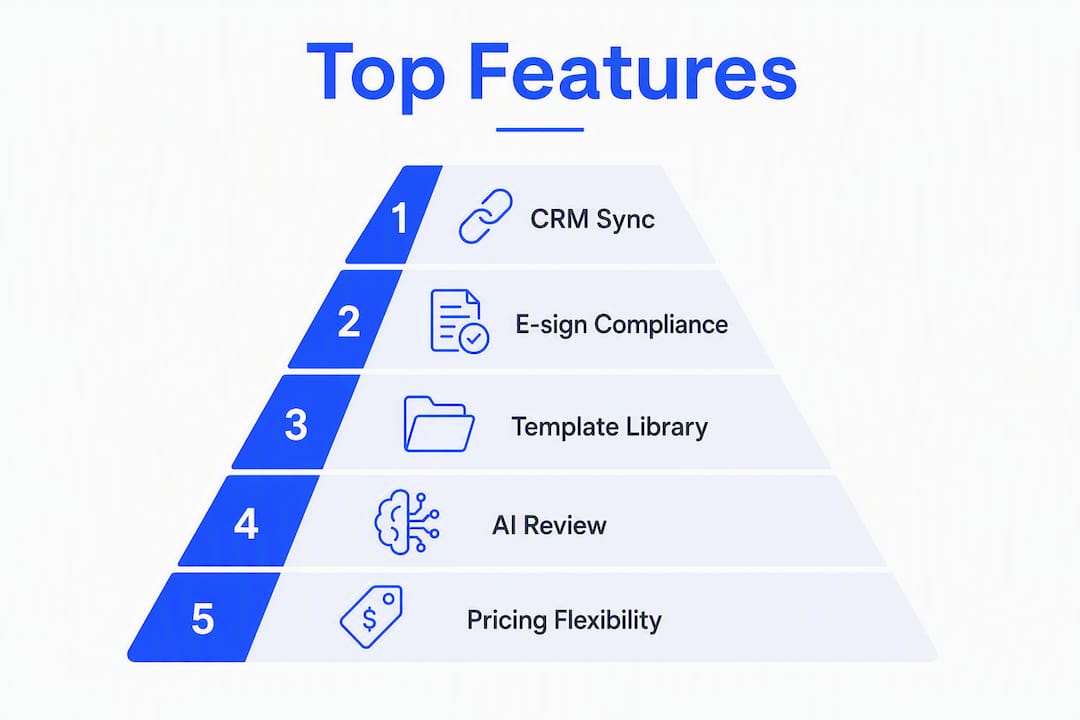
How to use this table: If CRM sync is your top priority, filter on the "CRM integrations" column first. If you are in a regulated industry, check "Security & compliance" before anything else. If implementation speed matters, "Ease of implementation" narrows the field quickly.
Top picks: what each tool does and who it fits
Formable
Formable is built specifically for GTM and revops teams that need more than a signing tool. The platform covers the full pre-signature workflow: AI-assisted contract review with risk and missing-clause detection, collaborative redlining so both parties align on terms before signing, template-driven contract creation for MSAs, SOWs, NDAs, DPAs, and Order Forms, and native e-sign with a developer API for embedded signing. The AI review engine lets teams upload playbooks and catch deviations automatically at intake, which removes the back-and-forth that typically stalls deals.
Formable also offers a standalone e-signing API, which makes it practical for developer teams that want to embed signing into their own platforms without adopting a full CLM. The free tier covers individual users and developers; paid team plans scale for growing sales organizations.
Practical tradeoff: Formable is optimized for the pre-signature and signing workflow. Teams that need deep post-signature obligation tracking or complex ERP connectors should evaluate whether a full enterprise CLM is also required.
GetAccept
GetAccept is a sales-oriented contract and proposal platform that adds engagement analytics on top of standard contract workflows. Sales reps can see when a buyer opens a document, which sections they read, and how long they spent on pricing. That visibility helps reps time follow-ups more precisely. G2 reviewers consistently highlight the in-document engagement features as a differentiator, though some note the CLM depth is lighter than dedicated contract platforms.

Best for: Sales teams where deal coaching and buyer engagement data matter as much as the contract itself.
PandaDoc
PandaDoc is a strong choice for teams that need to generate contracts quickly from templates. Its library covers common sales documents, and the document automation pulls CRM data to auto-populate key fields, reducing manual entry errors. G2 reviewers praise the template quality and the speed of getting a document out the door. The tradeoff is that redlining and negotiation features are less developed than dedicated negotiation tools.
Best for: Teams that send high volumes of templated agreements and want signing built in without a separate tool.
Docusign
Docusign is the market reference for e-signature compliance. Its platform covers ESIGN, UETA, and eIDAS, carries FedRAMP authorization, and integrates with nearly every major enterprise system. The breadth of its partner ecosystem is unmatched. Where Docusign CLM adds lifecycle management on top, the core product is primarily a signing and routing tool rather than a full contract authoring environment. Teams that need contract redlining with Docusign should evaluate whether Docusign CLM or a separate negotiation tool is required.
Adobe Sign
Adobe Sign fits enterprises already running on Adobe Document Cloud. The native integration with Acrobat and Creative Cloud means document workflows stay inside a familiar environment. Enterprise-grade features include SAML, bulk send, and FedRAMP compliance. The limitation is that Adobe Sign is signing-first; authoring and negotiation require other tools in the Adobe stack or third-party integrations.
Best for: Large organizations where PDF-centric workflows are the standard and e-sign at scale is the primary need. See how it compares on the Formable Adobe Sign alternative page.
Juro
Juro's browser-native editor is its clearest differentiator. Contracts are created, negotiated, and signed entirely in the browser without exporting to Word or PDF for redlining. G2 reviewers note the clean editing experience and simple clause management as strengths, while some flag that the integration depth with enterprise systems is more limited than larger CLM platforms.
Best for: Legal and sales teams that want a single environment for drafting and negotiation without file-format friction.
Proposify
Proposify focuses on the client-facing side of the deal: polished proposal design, interactive pricing tables, and e-sign. G2 users highlight the proposal design quality and the ease of building pricing tables. It is not a CLM and does not offer redlining; it is a closing-document tool for teams where proposal aesthetics and pricing presentation drive conversion.
Best for: SMB sales teams where the proposal itself is a sales asset, not just a formality.
DealHub
DealHub positions itself as a revenue operations suite, combining CPQ, quoting, and contract generation in one platform. G2 reviewers note the tight CPQ-to-contract workflow as the primary reason to choose it over standalone contract tools. The tradeoff is complexity: DealHub is most valuable when CPQ and contract are genuinely coupled, and lighter-weight teams may find it over-engineered.
Ironclad
Ironclad is built for enterprise contracting at scale. Its workflow configurability, AI-assisted review, and deep repository are designed for legal and procurement teams handling thousands of contracts. G2 reviews reflect strong satisfaction among enterprise legal teams, with some noting that implementation requires professional services and meaningful configuration time. It is not a fast-deploy tool.
Conga and Conga CLM
Conga covers the full quote-to-cash lifecycle, with CLM tightly integrated into CPQ and ERP systems. Conga CLM specifically handles lifecycle automation and enterprise-grade connectors. G2 reviewers value the depth of integration with Salesforce and SAP, while noting that the platform has a steep learning curve and implementation typically requires a partner. Best suited for enterprises where contract data must flow directly into billing and revenue recognition.
Docusign CLM
Docusign CLM is the natural extension for organizations already using Docusign for e-sign. It adds workflow automation, a contract repository, and lifecycle management on top of the signing layer. G2 reviewers note that the integration between the CLM and the e-sign product is the main value proposition, though some flag that the CLM module can feel like a separate product rather than a fully unified experience.
ContractSafe
ContractSafe is a repository-first tool. Its strength is OCR-powered search across a contract archive and simple obligation alerts. It does not offer authoring, redlining, or negotiation. Teams that have a signing tool and just need a searchable home for executed agreements will find it practical and fast to deploy.
Outlaw
Outlaw offers a modern collaborative drafting and negotiation experience with a clean UX. It covers redlining, version control, and e-sign. Best for teams that want a contemporary editing environment without the complexity of an enterprise CLM.
Cobblestone
Cobblestone is oriented toward procurement and vendor contracting, with compliance controls and vendor management features alongside standard CLM capabilities. It fits organizations that manage supplier agreements alongside sales contracts and need procurement-specific controls.
Contractworks
Contractworks is a practical, fast-deploy repository with straightforward admin controls. Deployment is measured in days rather than months. It does not offer authoring or negotiation, but for teams that need a central, organized contract store with alerts, it delivers without friction.
Sirion
Sirion focuses on what happens after a contract is signed: obligation tracking, SLA monitoring, and post-execution analytics for services agreements. It is not a sales contract authoring tool. Enterprises managing complex service contracts where performance against SLAs is a financial issue will find it purpose-built for that problem.
LinkSquares
LinkSquares applies AI extraction and analytics to an existing contract portfolio. Legal and finance teams use it to surface metadata, identify risk patterns, and track compliance across hundreds or thousands of agreements. It is an analytics layer, not an authoring or signing tool.
Contractbook
Contractbook is a practical all-in-one for SMBs: authoring, workflow automation, and e-sign in a single product. It covers the full lifecycle without requiring multiple tools. HubSpot and Salesforce integrations are available. The tradeoff is that enterprise-scale configurability and deep CLM features are limited compared to Ironclad or Conga.
Dropbox Sign
Dropbox Sign is a signing-first product with clean APIs and lightweight workflows. It is the right choice for teams that need reliable e-sign and API access without a full contract management layer. It does not offer redlining or AI review.
Pipedrive Smart Docs
Pipedrive Smart Docs is a native add-on for Pipedrive CRM users. It generates documents and collects signatures without leaving Pipedrive. The integration is tight and the setup is fast. Outside of Pipedrive, it has no standalone value.
Contracts 365
Contracts 365 is built on Microsoft 365 and targets organizations running Microsoft Dynamics. Lifecycle tracking and compliance features are its core. For Microsoft-centric enterprises, the native integration reduces deployment friction significantly.
How to choose the right sales contract software for your team
The right tool depends on where your biggest friction point sits in the contract workflow. A team losing deals because redlines take two weeks needs a different solution than a team losing revenue because renewal terms drift from what was negotiated.
Map your workflow before evaluating vendors
Start by identifying which stage breaks most often: authoring, negotiation, approval routing, signing, or post-signature tracking. Teams that struggle at authoring need strong templates and CRM auto-population. Teams that struggle at negotiation need redlining and collaborative editing. Teams losing margin post-signature need CLM with obligation tracking and downstream sync.
Common pitfalls in contract management are well documented, and most trace back to the same root cause: the contract system is disconnected from the CRM and billing stack. Review the challenges teams face in contract management before finalizing your requirements.
Demo checklist: questions to ask every vendor
- How does your platform sync contract data back to our CRM (Salesforce, HubSpot, or MS Dynamics)? Is it one-way or two-way?
- What are the API rate limits for e-sign and document generation?
- Do you support SAML-based SSO and role-based access controls?
- How is the audit trail structured? Is it immutable and timestamped per event?
- Can signing be routed conditionally, with sequential multi-recipient flows and internal approval gates?
- What does the implementation timeline look like for a team our size, and is professional services required?
Red flags that should remove a vendor from your shortlist
- No two-way CRM sync (data flows in only one direction)
- Audit trail that cannot be exported or is not timestamped at the event level
- No conditional signing or sequential routing for multi-party agreements
- Implementation that requires a partner engagement for a team under 50 users
- AI review that cannot accept custom playbooks or clause libraries
Pricing and time-to-value expectations
SMB tools (PandaDoc, Contractbook, Juro, Formable) typically deploy in days to two weeks with self-serve onboarding. Enterprise CLM platforms (Ironclad, Conga, Docusign CLM) require weeks to months of configuration and often professional services. Pricing shapes range from per-user monthly SaaS tiers to API usage-based billing to enterprise annual contracts. For a detailed look at how CRM and contract management integrate, the integration architecture matters as much as the feature list.
ROI metrics to track after implementation
- Contract cycle time (days from draft to signed)
- Win rate on deals where contracts were sent within 24 hours of verbal agreement
- Revenue leakage rate (variance between negotiated price and invoiced price)
- Renewal capture rate (percentage of renewals executed before expiration)
Contracts as the enforcement layer: a revenue-ops perspective
Revenue operations leaders increasingly treat contract management as the enforcement layer between what was negotiated and what gets billed. A contract that lives in a static PDF repository does not enforce anything. The negotiated discount, the payment terms, the renewal clause: none of those flow automatically into CPQ or billing unless the contract system is architecturally connected to those downstream systems.
Zilliant frames agreement management as a governed system that replaces static contracts and keeps pricing aligned with sales workflows. The practical implication is that data drift between the contract and the billing system is not a document problem. It is a systems architecture problem.
The fix is two-way synchronization: negotiated terms in the contract update the pricing record in CPQ, and renewal triggers in the contract system fire automatically rather than depending on a rep to remember. Tools like Ironclad, Conga CLM, and DealHub are built with this architecture in mind. Formable's CRM integrations and API layer support the same pattern for teams that want to build it into their own stack.
Pro Tip: When evaluating any contract tool for revenue-ops use, ask specifically whether agreement metadata (price, term, renewal date, discount level) can be written back to a CRM field or CPQ record automatically. If the answer is "we have a Zapier integration," that is a manual workaround, not a governed sync.
The enforcement-layer argument also applies to AI review. A contract review engine that catches a missing limitation-of-liability clause before signing prevents a legal problem. One that catches a price deviation from the approved discount schedule before signing prevents a revenue problem. Those are different use cases, and the best tools for sales teams handle both.
Key takeaways
Formable is the strongest starting point for most sales and revops teams because it covers redlining, AI review, templates, e-sign, and developer APIs in a single platform with a fast deployment path.
| Point | Details |
|---|---|
| Start with workflow mapping | Identify where contracts break most often before evaluating vendors; the right tool depends on whether the friction is at authoring, negotiation, or post-signature. |
| CRM sync is non-negotiable | Two-way CRM sync prevents data drift between negotiated terms and billing; one-way sync is a workaround, not a solution. |
| AI review needs playbook support | AI contract review is only useful if it can enforce your specific clause standards; confirm vendors accept custom playbooks before committing. |
| Audit trail and conditional routing | An immutable, timestamped audit trail and sequential multi-recipient signing are baseline requirements for ESIGN/UETA compliance and enterprise approval workflows. |
| Formable for GTM teams | Formable covers redlining, AI review, templates (MSA, SOW, NDA, DPA), e-sign, and APIs with a free tier for individuals and fast onboarding for teams. |
A practical note on implementation
The gap between a contract tool that looks good in a demo and one that actually changes how a sales team operates usually comes down to pilot scope. A 30-to-90-day pilot should focus on one agreement type (an MSA or NDA is a good starting point), one CRM integration, and a defined set of users. Track contract cycle time from draft to signed, the number of redline rounds per deal, and whether negotiated terms match what ends up in the CRM record after signing.
The operational owners who need to be involved from day one: sales ops (CRM mapping and workflow design), finance (pricing enforcement and billing sync), legal (playbook configuration and clause standards), and customer success (renewal triggers and obligation alerts). Leaving any of those groups out of the pilot design is the most common reason implementations stall after the initial rollout.
For teams evaluating whether a full CLM or a sales-first tool is the right fit, the contract workflow management guide for legal teams covers the architectural tradeoffs in detail.
Why Formable fits most sales teams' buying criteria
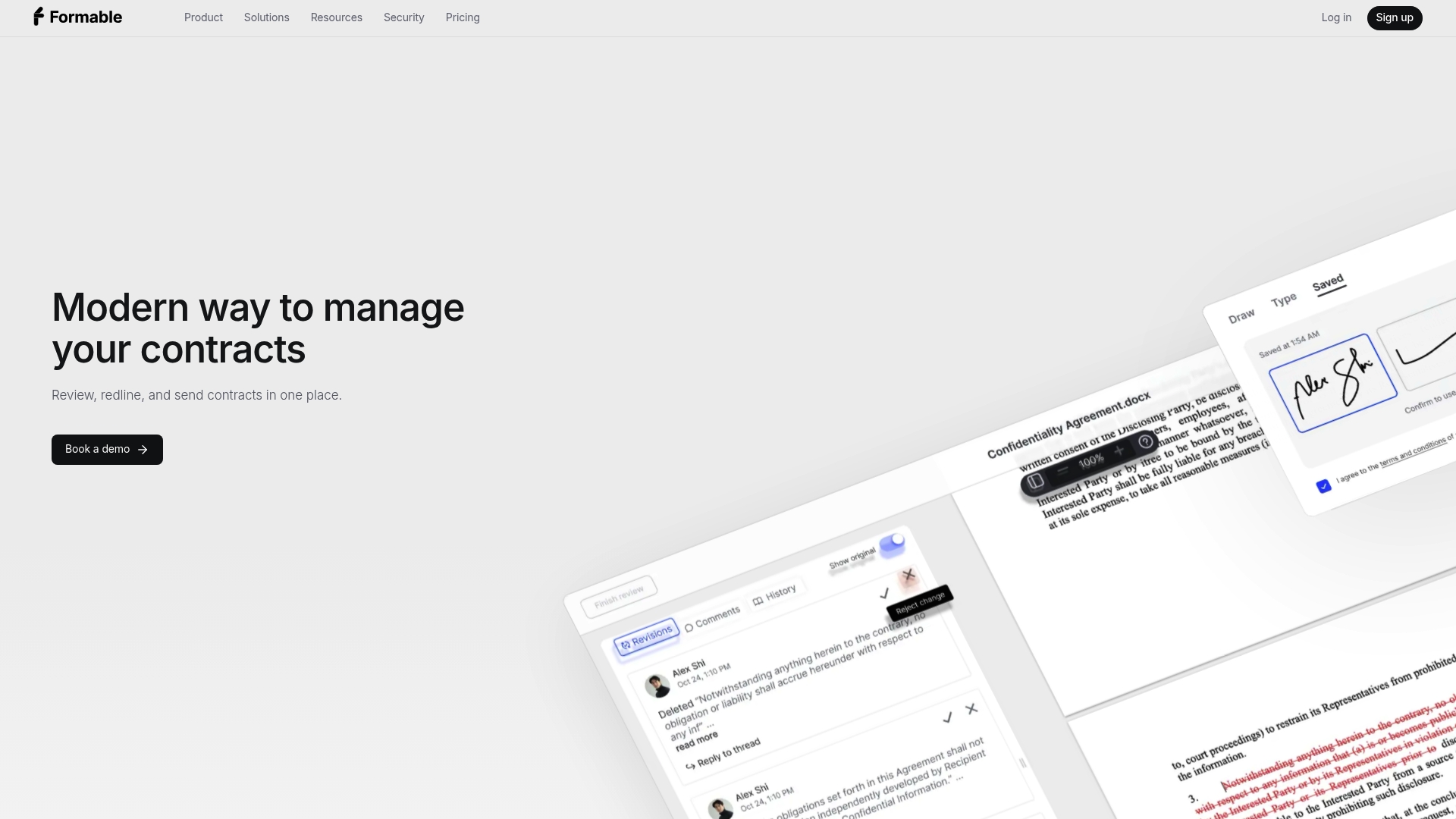
Most sales teams do not need a full enterprise CLM on day one. They need a tool that removes friction from the pre-signature workflow: generate a contract from a template, send it for negotiation, redline it collaboratively, get it signed, and have the signed data flow back to the CRM. Formable covers that entire path.
The contract creator supports MSAs, SOWs, NDAs, DPAs, Order Forms, and Pilot Agreements, combining templates with generative AI so reps can produce a clean first draft in minutes rather than hours. The redlining tool lets both parties align on terms before reaching the signing stage, which cuts the back-and-forth that typically adds days to a deal cycle. AI review catches risks and missing clauses at intake, with support for custom playbooks so your specific clause standards are enforced automatically.
For developer teams, Formable's e-sign API makes it straightforward to embed signing into an existing platform without building a separate signing infrastructure. The free tier covers individual users and developers; team plans scale as the organization grows. Reach out and the Formable team will walk through your specific use case.
Start with Formable and see how quickly a sales contract workflow can go from draft to signed.
Useful sources
The following resources informed this guide and are worth reviewing directly for deeper research:
- Gartner Peer Insights: Contract Lifecycle Management — Analyst-level coverage of CLM vendors across legal, procurement, and sales use cases; useful for enterprise shortlisting and feature validation.
- Zilliant Sales Agreements — Frames agreement management as a pricing enforcement layer; used for the revenue-ops section and enforcement-layer argument.
- SalesSign for contracts and MSAs — Documents e-sign routing requirements including sequential signing, audit trails, and ESIGN/UETA compliance; used for the buying guide demo checklist.
- Checkbox: Sales Contract Software — Covers CRM-driven contract generation and approval automation; used for the template and CRM integration discussion.
- Zoho Contracts — Illustrates AI-driven renewal automation and obligation tracking; used for the AI review and renewal automation examples.
- G2 reviews: GetAccept, PandaDoc, Juro, Proposify, DealHub, Ironclad, Docusign CLM, Conga CLM — User review data used to validate pros/cons patterns and best-for statements in the mini-reviews.
- Contracts 365 blog: essential contract management tools — Used for context on lifecycle tracking and Microsoft-centric deployment patterns.
FAQ
What is the best sales contract software for small teams?
Formable, PandaDoc, and Contractbook are the strongest options for small teams. All three offer fast deployment, template libraries for common sales agreements, and built-in e-sign without requiring a long implementation engagement.
Do sales contract tools need to integrate with Salesforce or HubSpot?
Two-way CRM integration is critical for preventing data drift between negotiated terms and billing records. Most tools on this list support Salesforce and HubSpot; confirm that the sync is bidirectional, not just one-way, before committing to a vendor.
What is the difference between a CLM and a sales contract tool?
A contract lifecycle management platform covers the full contract lifecycle from authoring through post-signature obligation tracking, often with complex workflow automation. A sales contract tool focuses on the pre-signature workflow: templates, negotiation, and signing. Enterprise teams with high contract volumes typically need a CLM; most sales teams start with a sales-focused tool like Formable and add CLM capabilities as volume grows.
How do I know if a contract tool is ESIGN/UETA compliant?
Look for an immutable, timestamped audit trail that captures each signing event with identity verification. Tools that support sequential and parallel signing with court-admissible audit trails satisfy ESIGN and UETA requirements. Confirm compliance documentation directly with the vendor before using any tool for legally binding agreements.
Does Formable support redlining and AI contract review?
Yes. Formable's redlining tool lets both parties edit and align on terms collaboratively before signing. The AI review engine catches risks and missing clauses at intake and supports custom playbooks for clause-level enforcement.