Electronic signatures are still legally valid in the UK after Brexit. The UK kept the EU's eIDAS signature framework as its own retained law, and English common law already accepted signatures in electronic form. What changed is mostly institutional and cross-border. Deeds, wills, lasting powers of attorney and some regulated documents still need extra steps.
This guide is for founders, account executives and legal teams in the US who sign agreements with UK counterparties. It covers the laws, the three signature types, the documents that need more than a click, and the records worth keeping.
TL;DR
- An electronic signature can execute most commercial contracts in England and Wales if the signer intends to authenticate the document and any formalities are met.
- UK eIDAS keeps three levels: simple, advanced and qualified. A simple signature is enough for most business agreements.
- Deeds need a witness who is physically present, even when signatures are electronic. Lasting powers of attorney and some regulated documents carry their own rules.
- Brexit removed the UK from the EU's mutual-recognition and trusted-list arrangements, so cross-border mechanics differ.
- Keep the signed file, the audit trail, timestamps and signer details in a system you control.
What actually changed after Brexit
Many teams assume Brexit made UK e-signatures a legal gray area. It did not.
The UK made a statutory instrument, SI 2019/89, to adapt eIDAS for life outside the EU. It revoked the provisions on electronic identification, because the UK was no longer a Member State. It retained and amended the trust-services framework that covers electronic signatures and related services.
The same instrument shows where the practical differences sit. The UK no longer takes part in the EU's mutual-recognition and interoperability framework for national electronic-identification schemes. UK eIDAS also has its own supervisory and trusted-list arrangements.
For a US company, the working summary is this:
- Validity of the signature itself: largely unchanged.
- Qualified signatures: UK qualified signatures and EU qualified signatures now sit in separate trust systems.
- Contracts spanning the UK and the EU: you may need to think about both regimes, not one.
If you also sell into the EU, our overview of eIDAS e-signing for US teams covers the EU side.
Electronic signatures in the UK after Brexit: which laws apply
Three layers matter.
Common law
The Law Commission concluded that an electronic signature can be used to execute a document, including a deed, where the signer intends to authenticate it and all execution formalities are satisfied. English common law generally prescribes no particular signature form. Courts apply an objective test, looking at the surrounding circumstances to decide whether the signer meant to authenticate.
The Law Commission recognizes examples that can be valid electronic signatures. These include a typed name at the bottom of an email and clicking an I accept box.
Electronic Communications Act 2000
Section 7 of the Electronic Communications Act 2000 makes an electronic signature, and its certification, admissible in legal proceedings on questions about the authenticity or integrity of the communication or data. Admissibility is not the same as automatic validity, but it means a court will hear the evidence.
UK eIDAS
The retained regulation sets the three signature levels. Article 25, as it applies in the UK, says an electronic signature cannot be denied legal effect or admissibility as evidence solely because it is electronic or because it does not meet the requirements for a qualified signature.
A note on geography: this guidance is about England and Wales unless stated. Scotland and Northern Ireland have their own details, which is one reason to confirm the governing law before signing.
Simple, advanced and qualified signatures
The Electronic Execution of Documents Industry Working Group report confirms that UK eIDAS preserves three broad levels. The Law Society describes how they differ.
| Level | What it requires | Typical use |
|---|---|---|
| Simple (SES) | Electronic data logically associated with the signed data and used to sign | NDAs, MSAs, order forms, SOWs |
| Advanced (AES) | Also uniquely linked to and identifying the signer, under the signer's sole control, and able to detect later changes | Higher-value or higher-risk agreements |
| Qualified (QES) | An advanced signature created with a qualified device and backed by a qualified certificate | Where express handwritten-signature equivalence matters |
Only a QES receives express equivalence with a handwritten signature under Article 25(2). That does not make simple and advanced signatures second class. They remain admissible and can be legally effective.
The Law Society lists typing a name into a contract or email, pasting a signature image, clicking a signature field on a web platform, and writing with a finger, stylus or touchscreen as forms of electronic signature. For the everyday deal documents that GTM teams send, a simple signature with a good audit trail is the normal approach.
For a plain-language primer, see what electronic signatures are.
What makes a UK e-signature hold up
When a signature is challenged, the question is rarely the technology. It is whether the person signed and meant to be bound.
The Law Commission points to two things you need to be able to show:
- The signer intended to authenticate the document.
- Any formalities for that document type were satisfied.
Because the test is objective, evidence of context matters. Useful evidence includes:
- the email address the request went to and how the signer accessed the document
- the sequence of actions on the platform, with timestamps
- any extra authentication, such as a one-time passcode
- the final document, unaltered since signing
This is where a platform's audit trail does real work. Authenticity and integrity are exactly what Section 7 contemplates when a dispute reaches court.
Documents that need more than a click
Most commercial contracts can be signed electronically. Some cannot, or need extra steps.
Deeds. The Law Commission's view is that a deed must be signed in the physical presence of a witness who attests the signature, even when the signatures are electronic. A video call does not replace physical presence under that analysis.
Wills. Wills fall outside the Law Commission project, so its general conclusion should not be assumed to override their separate formalities.
Lasting powers of attorney. Law Society guidance says these must be registered with the Office of the Public Guardian and that the applicable Mental Capacity Act 2005 standards include a ban on electronic signatures.
Regulated areas. The same guidance advises that areas covered by a regulator, such as conveyancing or powers of attorney, may have specific signature requirements.
The practical line is simple. If your document is an ordinary commercial agreement, flexible e-signing workflows usually apply. If it is a deed, a property document or a regulated instrument, speak to a UK solicitor before you build a signing flow around it. Teams in real estate and construction can read how we approach defensible e-signing for those sectors.

Signing with a UK party from the US
Signing across the Atlantic raises one question before any other: which law governs?
The Industry Working Group report advises analyzing the governing law, the place of performance, the document type and each relevant jurisdiction separately. UK e-signature validity does not automatically tell you whether a document is registrable or enforceable somewhere else.
A workable checklist for a US company:
- Identify the governing law. English and Welsh, Scottish, Northern Irish or US state law?
- Classify the document. Ordinary commercial contract, deed, property transfer or regulated transaction?
- Check US requirements too. If US law governs, the US rules for your document apply alongside any UK expectations.
- Get local advice where it counts. The report points to formalities, property, deeds, regulated transactions and enforcement in another jurisdiction as the cases that warrant it.
- Record the choice. Put governing law and counterparties in the contract and in your contract system.
For US teams, we cover the American side in our guide to security and legally binding e-signatures.
Records to keep after signing
A signature that you cannot prove is a weak signature. Guidance from the Law Society of Scotland recommends retaining:
- the final signed electronic document
- the complete audit trail or completion certificate
- signer and witness details
- timestamps, delivery and authentication records
- one-time passcode information where it was used
- completed fields, IP and device data
- any certificate or signature-validation data
It also advises downloading and storing the metadata rather than relying on the platform's future availability, and confirming how long the platform keeps metadata and who can access it. Records should be access-controlled, retrievable and protected against alteration.
HM Land Registry guidance takes the same approach for conveyancing files. It expects the completion certificate or audit report, with signing times and dates, recipient email addresses, OTP method, completed fields and device IP addresses.
If you handle these records under an information security program, a register-based approach to document control and audit evidence helps you show that signed records and their certification stay intact when authenticity is questioned.
Our perspective
Brexit did not break electronic signing between the US and the UK. It made the question of which rules apply to which document more important.
We build Formable around that reality. Drafting, review, negotiation, redlining, e-signing and tracking sit in one workflow, so the evidence of how a deal was agreed lives in one place. When a counterparty asks who agreed to what and when, the answer is a single record, not a search across inboxes and apps.
That matters most for the signature layer. Our e-signing is designed to capture the audit events that support intent and integrity, so your team can show who signed, when and how. For ordinary commercial agreements such as MSAs, DPAs, SOWs, order forms and NDAs, that is the standard of evidence UK law looks for.
Our advice to US teams: decide the governing law early, classify the document, and keep the audit trail with the contract. If you want to talk through a UK deal, reach out and we will walk through your use case.
Alex
Run UK-facing deals in one workflow
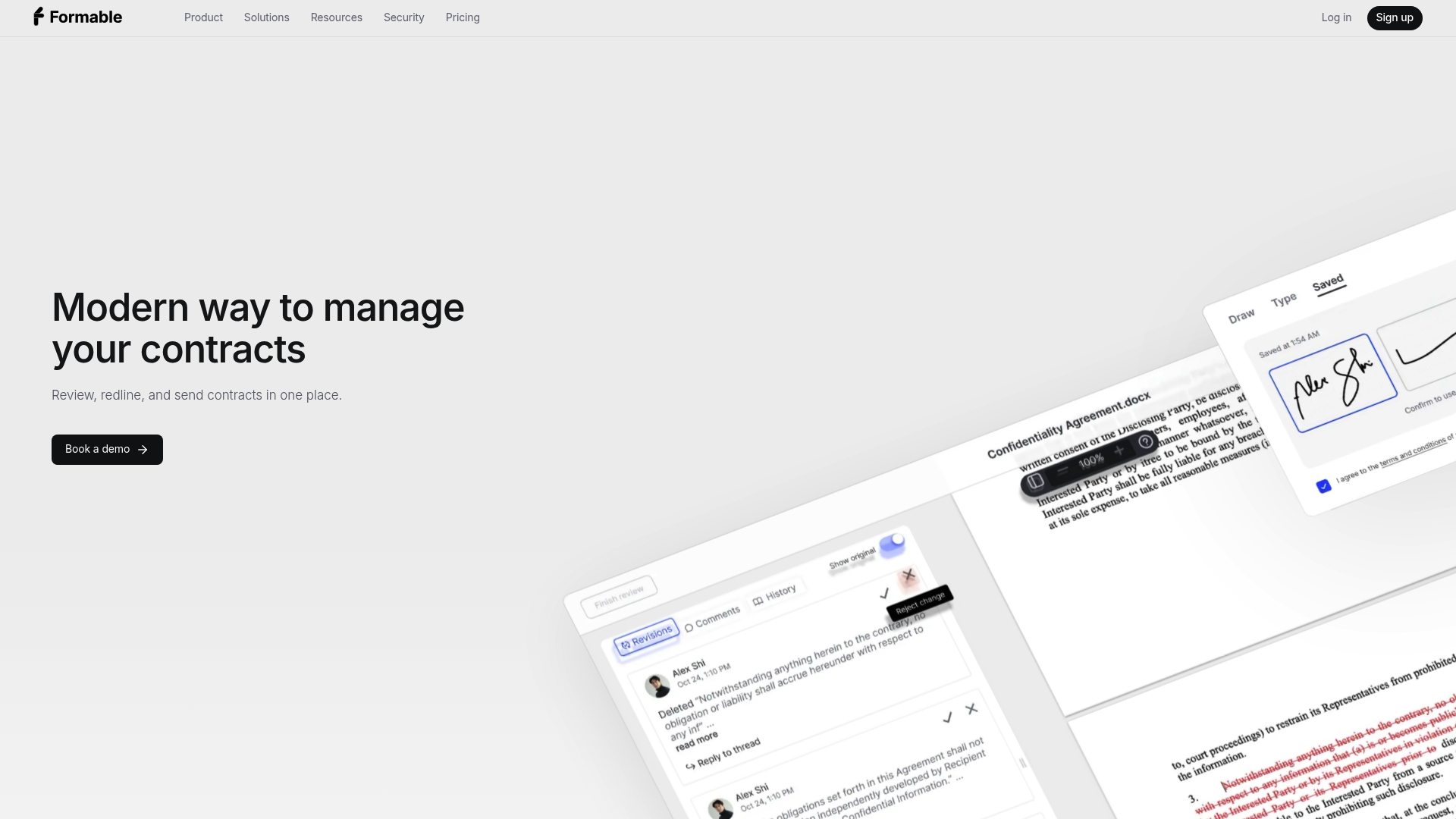
If your team regularly signs with UK counterparties, Formable keeps the whole agreement cycle together. You can generate agreements from templates with generative AI, run AI contract review against your playbooks, negotiate with redlining in the browser, and collect signatures with an audit trail.
Our e-signing product covers standalone signature collection. The Pro plan is $19.99 per month, and you can see all plans on the pricing page. Developers who want signing inside their own product can look at the embedded e-signing API, with Growth at $29.99 per month on the API pricing page.
FAQ
Are electronic signatures legally binding in the UK after Brexit?
Yes. The UK retained and amended eIDAS, and Article 25 says a signature cannot be denied legal effect solely because it is electronic. The signer must have intended to authenticate the document, and any formalities for that document type must be met.
Do I need a qualified electronic signature for a UK contract?
Usually not. Only a qualified signature receives express handwritten-signature equivalence, but simple and advanced signatures remain admissible and can be effective. For ordinary commercial contracts, a simple signature with a solid audit trail is common. Ask a UK solicitor if your document has special formalities.
Can a deed be signed electronically in England and Wales?
The Law Commission says a deed can be signed electronically, but the signature must be witnessed by someone physically present with the signer, who attests it. A remote witness over video is not treated as meeting that requirement.
Which UK documents cannot be signed electronically?
Lasting powers of attorney are the clearest example, since Law Society guidance cites a ban on electronic signatures under the Mental Capacity Act 2005 standards. Wills have separate formalities. Regulated areas such as conveyancing may add requirements, so confirm with the relevant regulator or a solicitor.
What should a US company keep after signing with a UK party?
Keep the final signed document, the audit trail or completion certificate, signer details, timestamps, authentication records and IP or device data. Store them in a system you control, and note which jurisdiction's law governs the agreement.
Sources
- Electronic execution of documents, Law Commission
- Electronic Communications Act 2000
- The Electronic Identification and Trust Services for Electronic Transactions (Amendment etc.) (EU Exit) Regulations 2019
- Regulation (EU) No 910/2014, Article 25, as it applies in the UK
- Execution of a document using an electronic signature, The Law Society
- Signing and exchanging documents, The Law Society
- Electronic Execution of Documents, Industry Working Group final report
- Electronic Signatures, Law Society of Scotland
- Electronic signatures accepted by HM Land Registry
- Document control and audit evidence, ISMS Calculator