
Every enforceable SOW must contain these contract-level sections before either party signs:
- Project overview and objectives — the business purpose and measurable goals
- Scope of work — what is included and, critically, what is not
- Deliverables with acceptance criteria — each output defined by format, owner, due date, and a binary pass/fail test
- Timeline and milestones — dates, gated approvals, and client-side dependencies
- Roles and responsibilities — named contacts, a RACI model, and escalation paths
- Payment terms and invoicing schedule — pricing model, invoice triggers, and late-fee provisions
- Change control process — how scope changes are requested, assessed, approved, and documented
- Assumptions and dependencies — what each party is relying on and the consequence if those inputs are late
- IP ownership and confidentiality — who owns what is created and how sensitive information is handled
- Warranties and termination rights — what each party guarantees and the conditions for ending the agreement
- Reporting and governance — meeting cadence, status reporting, and steering committee approvals
- Signatures — dated signatures from authorized representatives of both parties
These are not optional project notes. Each item carries legal and commercial weight, and a missing section is a gap a dispute can walk straight through. Thomson Reuters confirms that a well-drafted SOW reduces disputes and improves budgeting by making responsibilities and expectations explicit.
Key takeaways
A complete SOW must define scope, deliverables with binary acceptance criteria, an enforceable milestone schedule, clear roles, payment triggers, a change control process, and signed authorization from both parties before work begins.
| Point | Details |
|---|---|
| Scope needs two lists | Define what is in scope and what is explicitly out of scope to prevent unpriced work. |
| Acceptance criteria must be binary | Replace subjective language with objective, testable conditions tied to a specific timeframe. |
| Client dependencies belong in the schedule | List every input the vendor needs from the client, with a named owner and a due date. |
| Legal review is required for IP and termination | Templates must be reviewed for jurisdiction-specific compliance, especially on IP ownership and exit rights. |
| Formable covers the full SOW lifecycle | From template-based drafting and AI risk detection to collaborative redlining and e-signing with audit trails. |
What is a statement of work and why does it matter?
A statement of work is a binding contract document that defines the work to be performed, the deliverables to be produced, the schedule, the price, and the criteria for determining when work is complete. SAP's procurement guidance describes it as a document that defines scope, deliverables, timeline, cost, and success criteria, often forming a key part of an RFP or contracting process.
The SOW sits differently from two documents it is often confused with. A master services agreement (MSA) sets the overarching legal framework: liability caps, governing law, dispute resolution, and general warranties. The SOW then operates under that MSA for a specific engagement, inheriting its legal terms while adding the project-specific detail the MSA deliberately leaves out. A scope of work, by contrast, is a section nested inside the SOW rather than a standalone document. It describes the work tasks; the SOW wraps those tasks in commercial and legal structure.
When no MSA exists, the SOW must carry all of that legal weight itself. That is why template review matters so much in standalone SOWs.
What are the key components of a statement of work?
The sections below represent the standard SOW structure. The table pairs each component with the decision it enables and the risk of omitting it.
| SOW section | Decision it enables | Risk if omitted |
|---|---|---|
| Project overview | Aligns both parties on purpose and goals | Work proceeds without shared success definition |
| Scope of work | Defines what is and is not included | Vendor performs unpriced work; client expects more than contracted |
| Deliverables | Specifies what will be produced | Disputes over whether work is complete |
| Acceptance criteria | Sets the pass/fail test for each deliverable | Subjective sign-off leads to payment holdups |
| Timeline and milestones | Creates enforceable schedule | No basis for claiming delay or assessing penalties |
| Roles and responsibilities | Assigns accountability | Handoff failures and unresolved escalations |
| Payment terms | Triggers and timing for invoices | Late payment, withheld payment, or fee disputes |
| Change control | Process for approving scope changes | Uncontrolled scope creep erodes margin and schedule |
| Assumptions and dependencies | Records what each party relies on | Vendor blamed for delays caused by missing client inputs |
| IP and confidentiality | Establishes ownership of outputs | Ownership disputes after delivery |
| Warranties and termination | Defines remedies and exit rights | No clear path when performance fails |
| Reporting and governance | Sets communication expectations | Misaligned status, missed escalations |
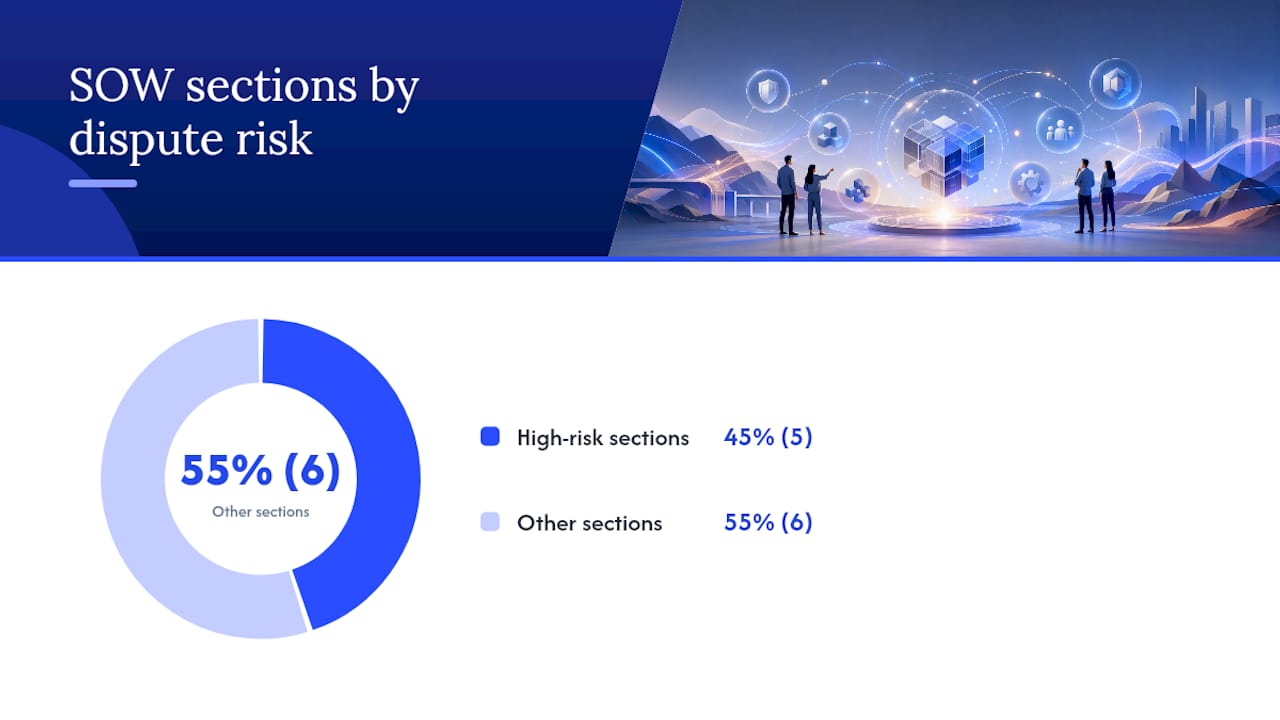
The sections carrying the heaviest legal and commercial weight are scope, deliverables, acceptance criteria, change control, and payment terms. These five are where most disputes originate. UC San Diego's procurement guidance reinforces that contractor documents must describe services and professional categories clearly and pass procurement review before being attached to purchase orders.
How to draft deliverables and measurable acceptance criteria
Deliverables fall into two categories, and conflating them causes problems. A process deliverable is an activity or output produced during execution: a design mockup, a test plan, a training session. A product deliverable is the final output the client is paying for: a deployed application, a completed data migration, a signed audit report. Both types need the same four attributes: description, format, due date, and the name of the acceptance owner.
A concrete deliverable entry looks like this:
| Deliverable | Format | Due date | Acceptance owner |
|---|---|---|---|
| Integrated payment module | Deployed to staging environment | March 14, 2026 | Client VP of Engineering |
That single row eliminates three common disputes: what counts as done, when it was due, and who has authority to approve it. Rework's project management resources recommend exactly this structure to reduce ambiguity in deliverable tracking.
Acceptance criteria must be binary and measurable. The test is simple: can a third party read the criterion and determine without judgment whether the deliverable passes or fails? If the answer is no, rewrite it.
Pro Tip: Replace language like "the module performs well under load" with "the module processes 500 concurrent transactions with a response time under 2 seconds, verified by a load test report signed by the client's QA lead within 5 business days of delivery." That version is testable, time-bounded, and leaves no room for subjective disagreement. PMI's scope management guidance identifies ambiguity about "done" as a leading cause of project disputes.
How to write scope and exclusions that prevent scope creep
Scope creep rarely starts with a dramatic demand. It starts with a reasonable-sounding assumption: "I assumed training was included," or "We thought you'd handle the data migration." An explicit out-of-scope list closes that gap before the project starts.
Structure the scope section in two parallel lists:
In scope:
- Design and development of three customer-facing screens per the approved wireframes
- Integration with the client's existing Salesforce CRM via REST API
- Unit and integration testing by the vendor's QA team
- One round of revisions per screen based on client feedback
Out of scope:
- Training of client staff on the delivered screens
- Migration of legacy customer records from the client's prior CRM
- Third-party software licenses required to run the integration
- Ongoing maintenance or bug fixes after the 30-day warranty period
Items that teams most often forget to exclude:
- Training and onboarding — assumed by clients, unpriced by vendors
- Legacy data migration — technically complex and often underestimated
- Third-party licenses — costs that belong to the client unless explicitly transferred
- Post-launch support — a separate engagement unless the SOW says otherwise
- Regulatory filings or compliance certifications — frequently assumed to be part of delivery
Colorado State University's procurement guide recommends capturing client obligations alongside scope, which is the right instinct: the client's responsibilities are part of the scope boundary, not a separate administrative note.
How to define timeline, milestones, and dependencies
A milestone table gives both parties a shared, enforceable schedule. Each row should specify the milestone, the target date, and whether the milestone is a gated approval that must be formally signed off before the next phase begins.

| Milestone | Target date | Gated approval? |
|---|---|---|
| Project kickoff | February 3, 2026 | No |
| Design mockups delivered | February 20, 2026 | Yes — client sign-off required |
| Development complete | March 2026 | No |
| UAT period opens | April 4, 2026 | No |
| UAT sign-off | April 2026 | Yes — triggers final invoice |
| Go-live | April 2026 | No |
Gated approvals matter because they create a documented record of client acceptance at each phase. Without them, a client can claim at go-live that earlier work was never properly reviewed.
Client-side dependencies belong in the schedule, not in a footnote. If the vendor needs approved wireframes by January 27 to hit the February 20 mockup date, that dependency must appear in the SOW with its own due date and a clear statement that a late delivery shifts the vendor's downstream dates by an equivalent number of business days. PMI's project schedule management guidance makes the point directly: unrealistic timelines often come from ignoring client dependencies, and the SOW must list what the vendor needs from the client along with the due dates for those items.
Build realistic buffers. Dates based on optimism rather than capacity create the conditions for disputes before the project is halfway done.
Roles, responsibilities, and governance models to include
Governance is not bureaucracy. It is the structure that keeps a project moving when decisions need to be made quickly and the right people are not in the same room.
A simple RACI pattern assigns four statuses to each task or decision: Responsible (does the work), Accountable (owns the outcome), Consulted (provides input), and Informed (receives updates). For each named role in the SOW, capture:
- Full name and title
- Organization (client or vendor)
- Responsibilities in plain language
- Escalation path if that person is unavailable
Governance items to include in the SOW:
- Weekly status call — attendees, agenda format, and who publishes the notes
- Status report — frequency, format, and distribution list
- Change request approvals — who has authority to approve changes and at what dollar threshold
- Steering committee — when it convenes, who sits on it, and what decisions require its sign-off
- Primary contacts — one named contact per party for day-to-day questions
A short RACI example for a software delivery SOW:
- Project Manager (vendor): Responsible for weekly status reports, milestone tracking, and change request coordination
- Account Executive (vendor): Accountable for overall delivery and commercial terms
- Product Owner (client): Consulted on feature decisions; approves design sign-offs
- CTO (client): Accountable for UAT sign-off and go-live authorization
- Finance (client): Informed of invoice schedule; processes payments
Payment terms, pricing models, and change control
Pricing models
The right pricing model depends on how well the scope is defined at the time of signing.
- Fixed price fits well-defined deliverables with stable requirements. The vendor absorbs cost overruns; the client absorbs the premium for that certainty.
- Milestone payments tie invoices to specific deliverable completions, reducing client risk and giving vendors clear cash flow triggers.
- Time and materials (T&M) works when scope is exploratory or likely to evolve. The client pays for actual hours and materials; the vendor carries less risk but the client carries more.
- Retainers suit ongoing advisory or support engagements where a fixed monthly fee buys a defined number of hours or a defined service level.
Invoicing details to include
Every SOW should specify:
- Invoice timing (e.g., net 30 from delivery and acceptance)
- Required documentation to trigger payment (signed acceptance form, timesheet, or delivery confirmation)
- Late payment fees and the grace period before they apply
- Holdback provisions, if any, and the conditions for release
Change order flow
When scope changes, the process must be documented before the work starts. A clean change order flow runs in five steps:
- Either party submits a written change request describing the proposed change
- The vendor produces an impact assessment covering cost, timeline, and resource implications within an agreed number of business days
- Both parties review and negotiate the assessment
- An authorized representative from each party signs the change order document
- The signed change order is attached to the original SOW and becomes part of the contract
No work should begin on a change until step 5 is complete. That single rule prevents most budget disputes.
Risk, IP, confidentiality, warranties, and termination clauses
Legal clauses in a SOW are not boilerplate to be skimmed. They define what happens when things go wrong, and vague language here is where disputes become expensive.
Standard clauses to include:
- Confidentiality — what constitutes confidential information, how long the obligation lasts, and permitted disclosures
- IP ownership — who owns deliverables, background IP, and any tools or code created during the engagement
- IP license — if the vendor retains ownership, what license does the client receive and under what conditions
- Warranties — what the vendor guarantees about the quality and fitness of deliverables, and for how long
- Disclaimers — what is explicitly not warranted
- Indemnities — who indemnifies whom for third-party claims, and under what conditions
- Liability cap — the maximum financial exposure of each party, typically tied to fees paid
- Insurance — required coverage types and minimum limits
- Termination for convenience — notice period and any fees owed on termination
- Termination for cause — what constitutes a material breach and the cure period before termination is effective
Pro Tip: IP ownership is the clause most often left ambiguous in template SOWs. If the SOW does not explicitly state that IP created during the engagement transfers to the client upon payment, many jurisdictions default to the creator retaining ownership. Get this in writing, and get it reviewed. The American Bar Association's guidance on SOW basics advises that SOW templates must be reviewed for legal compliance, particularly when they contain IP, warranties, or specific termination conditions.
A legal checklist of items that frequently cause disputes:
- Undefined IP ownership for derivative works or pre-existing vendor tools
- Warranty periods that are shorter than the client's acceptance testing window
- Termination fees that are not tied to a clear calculation method
- Indemnity clauses that are one-sided without negotiation
- Missing dispute resolution mechanism (arbitration, mediation, or litigation venue)
Types of SOWs and how they relate to MSAs and proposals
Not every engagement calls for the same SOW format. The four most common types are:
- Task-order SOW — a short, discrete engagement with a fixed list of tasks and a single deliverable. Common in IT staffing and consulting.
- Phased-deliverable SOW — a multi-phase project where each phase has its own milestone table and acceptance criteria. Useful for software development and large implementations.
- Time-and-materials SOW — scope is defined by categories of work rather than fixed outputs. The client pays for hours logged against agreed rates.
- Statement of objectives (SOO) — the client defines the outcome it wants rather than prescribing how to achieve it. The vendor proposes the approach. Common in government and enterprise procurement.
The relationship between the SOW and surrounding documents must be explicit. When an MSA governs the engagement, the SOW should state which document controls in the event of a conflict. Standard practice is for the MSA to control on legal terms and the SOW to control on project-specific terms. If a purchase order is also in play, the SOW should be attached to the PO and referenced by number.
For short engagements (under 90 days, single deliverable), a standalone SOW with embedded legal terms is usually sufficient. For ongoing services or multi-year programs, a services agreement or MSA paired with a lean SOW is cleaner and easier to amend. When a project begins with a letter of intent, the SOW should align with the commercial terms already agreed in that preliminary document.
When responding to tenders, the SOW often needs to align with the format and evaluation criteria specified in the RFP. ProTenders' guide for tech companies evaluating tenders explains how SOW structure affects how proposals are scored in competitive procurement.
Common drafting mistakes and how to avoid them
The most expensive SOW mistakes are not complex. They are predictable omissions that practitioners make under time pressure.
Common pitfalls:
- Vague deliverables — "a working application" is not a deliverable; a deployed application passing a defined UAT checklist is
- No out-of-scope list — clients assume everything adjacent to the project is included unless the SOW says otherwise
- Subjective acceptance criteria — "high quality" and "professional finish" are not testable; they are arguments waiting to happen
- Missing client dependencies — if the vendor needs data, access, or approvals from the client and those are not listed with due dates, the vendor has no contractual basis for claiming delay
- Unsigned SOWs — a SOW that has been negotiated but never signed is not a contract; it is a draft
PMI's acceptance criteria guidance is direct: acceptance criteria should be binary and measurable, replacing subjective language like "high quality" with objective tests such as performance thresholds or signed UAT sign-off within a fixed number of business days.
Best practices:
- Set measurable KPIs for each deliverable and tie them to the acceptance clause
- Involve legal counsel on IP ownership, warranty language, and termination provisions
- Record every client dependency with a named owner and a due date
- Version-control the SOW from the first draft so the negotiation history is auditable
- Require both parties to sign before any work begins
Pro Tip: Treat the assumptions and constraints section as a risk register in miniature. Every assumption the vendor is making about client-provided assets, environment access, or third-party availability should be listed. If an assumption proves false, the documented record protects the vendor from being held responsible for the resulting delay. Rework's SOW guidance makes the same point: an assumptions and constraints section is as important as scope itself.
SOW skeleton template and sample clauses
Use this outline as a starting point. Each section header maps to the components covered above.
SOW section headers and guidance:
- 1. Project overview — state the business purpose, the parties, and the engagement start and end dates
- 2. Scope of work — list in-scope tasks and an explicit out-of-scope list
- 3. Deliverables — table with description, format, due date, and acceptance owner for each output
- 4. Acceptance criteria — binary, measurable test for each deliverable
- 5. Timeline and milestones — milestone table with gated approvals noted
- 6. Roles and responsibilities — RACI table with named contacts and escalation paths
- 7. Payment terms — pricing model, invoice triggers, required documentation, late fees
- 8. Change control — written change request process and approval authority
- 9. Assumptions and dependencies — vendor assumptions and client obligations with due dates
- 10. IP and confidentiality — ownership, license, and confidentiality obligations
- 11. Warranties and termination — warranty period, termination rights, and fees
- 12. Reporting and governance — meeting cadence, status report format, steering committee
- 13. Signatures — authorized signatories, titles, and dates
Sample clause: deliverable entry
Sample clause: binary acceptance
Sample clause: change request
A ready-to-use SOW template with clause guidance is available on Formable's template library, covering software, IT, and professional services engagements.
How teams actually use SOWs to reduce disputes
The gap between a well-drafted SOW and a disputed one is almost always a process gap, not a knowledge gap. Most teams know what should be in a SOW. The problem is that the document gets drafted under deadline pressure, reviewed by one person, and signed before legal has seen the IP clause.
Cross-functional teams that use SOWs effectively treat the document as a shared artifact, not a vendor-side deliverable. Project managers own the scope and milestone sections. Legal reviews the IP, warranty, and termination language. Finance signs off on the payment terms and holdback provisions. The account executive or program lead holds the whole document together and makes sure the client's authorized signatory is named before the SOW goes out for signature.
Version control matters more than most teams realize. A SOW that has been through three rounds of redlining with no audit trail is a liability. When a dispute arises six months into delivery, neither party can reconstruct what was agreed and what was negotiated away. Keeping a timestamped version history, with each party's changes tracked, is the difference between a clean resolution and a protracted argument. Formable's contract workflow guide covers how legal teams manage version control and review workflows at scale.
Formable makes SOW drafting, negotiation, and signing faster
Drafting a SOW from scratch, getting it redlined by the other side, and tracking versions across email threads is where deals slow down and errors creep in. Formable is built specifically for this workflow.
With Formable, you can generate a complete SOW from a structured template using the contract creator, with AI-assisted clause suggestions that flag missing sections before you send. The collaborative redlining tool lets both parties align on scope, payment, and IP terms in real time, with every change tracked and timestamped. Formable's contract review engine catches risks automatically at intake, so your legal team spends time on judgment calls, not clause hunting. When the SOW is final, e-signing collects dated signatures from both parties with a full audit trail attached.
Reach out and Formable will walk through your SOW workflow and show you where version control and automated risk detection can cut your review cycle.
Sources
These resources provide authoritative guidance for teams drafting or reviewing SOWs:
- PMI learning library: scope management
- Thomson Reuters: What is a SOW
- Colorado State University procurement: Developing statement of work
- UC San Diego procurement: Statement of work for independent services
Legal review is strongly recommended before signing any SOW that contains IP ownership provisions, custom warranty language, or termination fees.
FAQ
What are the key elements of a statement of work?
A SOW must include a project overview, scope of work (in and out), deliverables with acceptance criteria, timeline and milestones, roles and responsibilities, payment terms, a change control process, assumptions and dependencies, IP and confidentiality provisions, warranties, termination rights, and signatures from both parties.
What is a statement of work?
A statement of work is a binding contract document that defines the work to be performed, the deliverables to be produced, the schedule, the price, and the criteria for determining when work is complete, as described by SAP's procurement resources.
Can you give an example of a statement of work clause?
A binary acceptance clause reads: "The client will review each deliverable within five business days of delivery and provide written acceptance or a written defect list. Silence after five business days constitutes acceptance." This structure eliminates subjective sign-off disputes.
How do I start writing a statement of work?
Begin with the project overview: name the parties, state the business purpose, and define the engagement dates. Then draft the scope section with explicit in-scope and out-of-scope lists before moving to deliverables and the milestone schedule.
Does a SOW need legal review?
Yes, particularly when the SOW contains IP ownership provisions, warranty language, or termination fees. The American Bar Association advises that SOW templates must be reviewed for legal compliance because they are binding agreements, not administrative documents.